

Blue heron symbolism commonly centers on patience, independence, balance, quiet confidence, and acting at the right moment. These ideas come largely from the bird’s behavior: it can remain still beside the water before making one fast, accurate strike.
However, its meaning is not fixed or universally spiritual. The great blue heron is a real North American wading bird, while many older stories involve different heron species. A thoughtful interpretation should therefore separate wildlife facts, specific cultural traditions, and the personal significance someone gives an encounter.
Quick Answer
Blue heron symbolism represents patience, self-reliance, balance, wisdom, and purposeful action. Its calm hunting posture suggests waiting without losing focus, while its sudden strike represents recognizing the right moment to act. Seeing one can inspire reflection, but it does not objectively predict good luck, death, romance, or another future event.
Key Takeaways
- A blue heron commonly symbolizes patience, balance, wisdom, and independence.
- Its hunting behavior inspires the connection with timing and focus.
- Solitary feeding does not mean herons always live alone.
- Cultural meanings differ among communities and historical periods.
- A sighting can feel meaningful without being a supernatural prediction.
- Personal context matters in dreams, tattoos, grief, and relationships.
Blue Heron Meanings at a Glance
| Meaning | Behavioral or Cultural Connection | Personal Reflection |
|---|---|---|
| Patience | Waits quietly while hunting | Avoid rushing an important choice |
| Focus | Watches the water closely | Remove distractions from one clear goal |
| Decisive action | Strikes quickly when prey appears | Act when preparation meets opportunity |
| Independence | Often feeds alone | Trust your judgment without rejecting support |
| Balance | Moves through water, land, and air | Adjust calmly between different responsibilities |
| Adaptability | Lives around varied wetland habitats | Change your method while keeping your purpose |
| Wisdom | Appears observant and deliberate | Pause before responding |
| Renewal | Water and ancient heron imagery suggest beginnings | Leave room for a healthier next stage |
What Does Blue Heron Symbolism Mean?
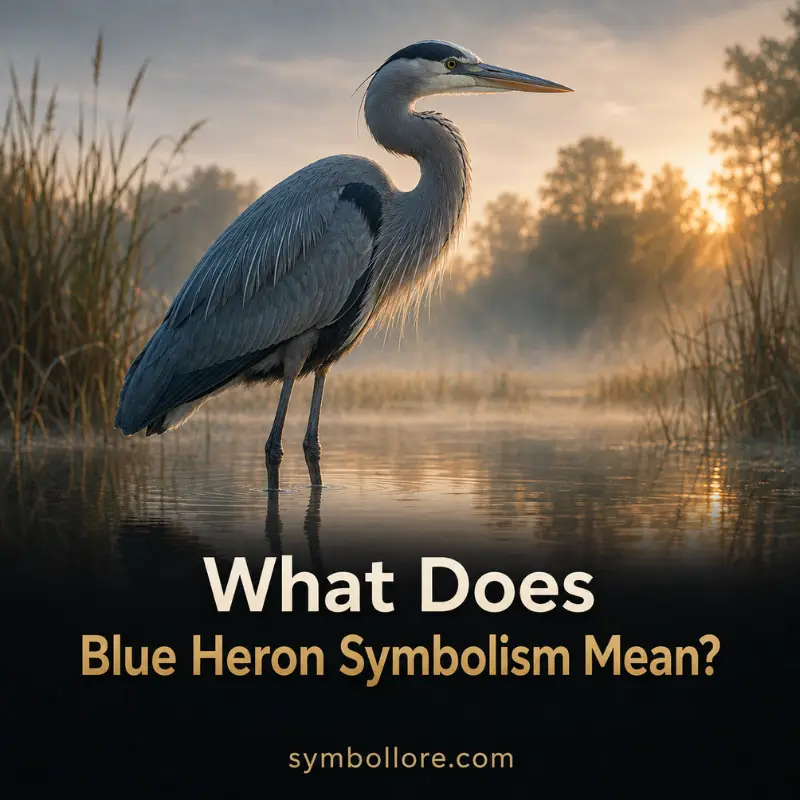
The blue heron represents calm strength: the ability to observe patiently, maintain balance, and move decisively when the time is right. It does not display constant speed or force. Instead, it succeeds through attention, positioning, and accuracy.
That pattern explains why modern readers associate the bird with inner wisdom and self-determination. Someone facing a difficult choice might treat a sighting as a reminder to gather information before acting. Another person may see its steady posture as an image of emotional control during an uncertain period.
These are interpretations, not messages with one official translation. The bird’s significance depends on the observer’s circumstances, beliefs, and cultural background. Therefore, the most useful question is not “What will happen?” but “What quality does this encounter bring to mind?”
Why Patience and Stillness Come First
Patience is the strongest meaning because a hunting heron often stands motionless or walks slowly through shallow water. Once prey moves within range, the bird thrusts its head and bill forward with remarkable speed.
The Cornell Lab of Ornithology’s great blue heron guide
describes how these birds forage alone, wade slowly, and remain statue-like before striking. They eat fish, amphibians, reptiles, insects, small mammals, and even other birds.
Therefore, stillness does not represent passivity. The heron is watching, measuring, and preparing. In daily life, that symbolism may fit a job decision, difficult conversation, creative project, or relationship boundary. Waiting can be productive when it includes attention and a clear purpose.
Independence, Balance, and Self-Reliance
A heron’s solitary appearance makes it a natural symbol of independence. People often see one bird standing apart from a flock, seemingly comfortable in its own space. This image can represent trusting personal judgment or following a path that others do not immediately understand.
Still, self-reliance should not be confused with total isolation. Great blue herons commonly feed alone, yet breeding birds often gather in colonies called heronries. Cornell notes that these colonies may contain hundreds of nests.
This contrast gives the symbol more depth. Healthy independence means maintaining your identity while recognizing when cooperation matters. Likewise, balance does not require perfect stillness. It involves making small adjustments as conditions change, much as a wading bird shifts its weight in moving water.
Cultural and Historical Meanings of Herons
Heron meanings vary widely, so no single interpretation represents every culture. Some Native American stories connect herons with patience, successful fishing, good judgment, or restless solitude. However, beliefs differ among nations. Writers should identify a particular community or documented story instead of attributing one “Native American meaning” to hundreds of distinct peoples.
Ancient Egyptian imagery offers a separate historical connection. The Bennu deity became associated with the sun, creation, and renewal and was depicted as a grey heron in later Egyptian art. That tradition concerns an Old World bird and should not be presented as ancient blue heron symbolism from North America.
Irish folklore adds another layer. Recorded beliefs linked the direction of a grey heron’s flight with changing weather. These traditions show how communities interpreted local herons, but they do not establish one universal spiritual code.
Spiritual Meaning of Seeing a Blue Heron
Seeing a blue heron can symbolize a need to slow down, observe carefully, and trust a considered decision. If the encounter feels significant, its value may come from the attention it creates rather than from a supernatural prediction.
A simple reflection process can keep the interpretation grounded:
- Notice what the bird was doing.
- Identify the strongest feeling the encounter created.
- Connect that feeling with a current situation.
- Choose one practical action based on the reflection.
For example, a still heron may remind someone to stop forcing an immediate answer. A bird taking flight might suggest gaining distance from a problem. These readings are personal metaphors. They should support sound judgment, not replace medical, financial, legal, or relationship advice.
Blue Heron Meaning in Dreams
A blue heron in a dream may represent patience, solitude, emotional balance, or the wish to act with greater confidence. However, the dream’s setting and emotional tone matter more than a fixed symbol list.
A heron waiting beside clear water may reflect careful observation or emotional clarity. Muddy water could suggest confusion, while a flying heron may represent freedom, perspective, or movement beyond a restrictive situation. An injured bird might express vulnerability or frustrated independence.
Dreams do not provide reliable forecasts. Instead, they often combine memory, emotion, daily concerns, and imagination. Recording the setting, actions, and feelings immediately after waking usually gives a more useful interpretation than applying a universal meaning from a dream dictionary.
Love, Grief, and Major Life Changes
In love, a blue heron may represent emotional maturity, personal space, loyalty to one’s values, or patience with a developing relationship. Its symbolism can encourage closeness without losing independence. However, it should not be treated as proof that a specific person will return or that a relationship is destined to succeed.
During grief, a heron encounter may become a comforting remembrance symbol. Its quiet presence can give someone a moment to pause, feel connected, or honor a person who died. That meaning is emotionally real even though it cannot confirm communication from the dead.
During a major transition, the bird may symbolize moving carefully between two stages. Water, shore, and sky make it a compelling image of adaptability and changing perspective.
Blue Heron Tattoo Meaning
A blue heron tattoo commonly expresses patience, independence, grace, resilience, or confidence in one’s path. The design’s posture and surroundings can refine that message.
A standing heron may represent stillness, awareness, or control. A bird striking at the water emphasizes timing and decisive action. Meanwhile, a flying heron can suggest freedom, transition, or rising above difficulty. Reeds, ripples, sunrise, or moonlight may add meanings related to flexibility, renewal, reflection, or intuition.
Before using imagery linked to a specific Indigenous community, research its origin and seek guidance where appropriate. A nature-based heron design can communicate personal meaning without copying sacred patterns, ceremonial objects, or community-owned symbols.
What the Bird’s Real Behavior Teaches
The great blue heron is the largest heron native to North America. It occupies freshwater and coastal habitats, including rivers, ponds, marshes, mangrove swamps, shorelines, and tidal flats. Its adaptability supports modern associations with resilience and resourcefulness.
The National Audubon Society field guide
explains that the bird usually hunts by standing still or walking slowly before making a rapid thrust with its bill. It may hunt during the day or at night and can eat many kinds of prey.
This combination of flexibility and precision offers a practical lesson. Adaptability does not mean changing direction at every disturbance. Instead, it means using different methods while remaining focused on a genuine need.
Common Misconceptions About Blue Heron Symbolism
Blue heron symbolism is interpretive, not a scientific system for predicting events. Seeing the bird does not guarantee prosperity, pregnancy, reconciliation, death, or a message from another person. Such claims may reflect private faith, but they should not be presented as established facts.
Other common misunderstandings include:
- A great blue heron is not a crane, although people often confuse them.
- “Blue heron” can mean the great blue heron or little blue heron.
- Great blue herons appear solitary while feeding but often nest in colonies.
- Egyptian Bennu traditions concern ancient heron imagery, not the North American species.
- Indigenous nations do not share one universal heron belief.
- Spiritual meaning and documented cultural history are not the same thing.
These distinctions do not remove the bird’s emotional power. Instead, they make its meaning more honest and respectful.
FAQs
Some traditions and modern interpretations connect herons with good fortune, especially successful fishing. However, seeing one does not guarantee a favorable event. It can still serve as a positive reminder to stay patient, notice available opportunities, and act carefully when the right opening appears.
Spiritually, a blue heron often represents stillness, intuition, self-reliance, balance, and purposeful action. These meanings are personal or tradition-specific rather than universal. A sighting may encourage reflection, but its message depends on the observer’s beliefs and present circumstances.
A blue heron crossing your path can be interpreted as a reminder to pause and assess your direction. Consider whether you are rushing, ignoring useful information, or waiting without a purpose. The encounter does not predict an outcome, but it may help focus your attention.
A blue heron does not universally symbolize death. During bereavement, someone may associate the bird with remembrance, peace, transition, or a deceased loved one. That private connection can provide comfort, but no wildlife encounter proves that death is approaching or that supernatural contact occurred.
Both birds may suggest grace, patience, and balance, but their cultural histories and behavior differ. Herons commonly hunt alone with their necks curved, while cranes often forage and migrate in social groups with their necks extended. Their symbolic meanings should not be treated as interchangeable.
A pair may symbolize partnership, balance between independence and connection, or shared patience. Yet two herons together can also have an ordinary biological explanation, especially around nesting or productive feeding areas. Personal meaning should remain separate from claims about animal behavior.
Conclusion
Blue heron symbolism draws its strongest meanings from the bird’s patient hunting style, adaptability, balance, and sudden decisive movement. It can remind you to observe before acting, trust thoughtful judgment, and remain flexible without losing direction.
However, no encounter has one guaranteed message. Cultural history, wildlife behavior, and personal spirituality are separate layers. When those layers remain clear, the heron becomes a grounded symbol of quiet attention rather than a promise about what will happen next.