
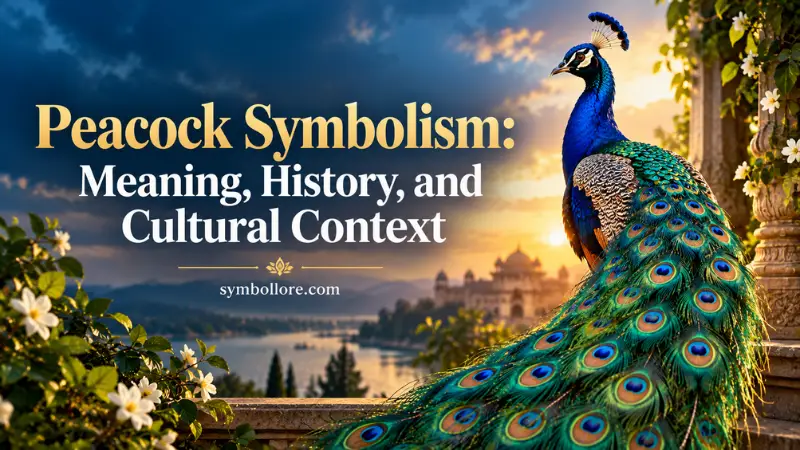
Peacock symbolism commonly represents beauty, splendor, pride, renewal, watchfulness, and immortality. These meanings developed across several cultures rather than from one universal symbolic system. The bird’s spectacular tail, changing feathers, and distinctive eye-like markings made it especially powerful in mythology, religious art, royal imagery, and decoration.
In ancient Greece and Rome, the peacock became associated with Hera and Juno. Later, early Christian artists adapted the bird as an image of immortality and resurrection. In South Asian traditions, peacock imagery developed its own religious and cultural meanings, including associations with deities and royal identity. Modern Americans often encounter the bird as a symbol of beauty, confidence, individuality, luxury, or decorative elegance.
The meaning therefore depends on culture, period, artwork, and setting. A peacock in a Byzantine mosaic does not necessarily communicate the same idea as a peacock in modern fashion or a personal tattoo.
Quick Answer
Peacock symbolism commonly represents beauty, pride, renewal, watchfulness, dignity, and immortality. Its ancient association with Hera helped connect the bird with divine status and its eye-marked tail with vigilance, while early Christian art adopted the peacock as a symbol of eternal life. Modern interpretations often emphasize beauty and self-expression, but the meaning changes across cultures and contexts.
TL;DR
- Peacocks commonly symbolize beauty, splendor, dignity, and visible self-expression.
- Ancient Greek and Roman traditions associated the bird with Hera and Juno.
- The eye-like tail feathers encouraged meanings connected with watchfulness and divine vision.
- Early Christian art used the peacock to represent immortality, resurrection, and eternal life.
- In South Asian traditions, the peacock has distinct religious and cultural associations that should not be merged with Greek or Christian symbolism.
- Modern American uses often emphasize confidence, individuality, luxury, and beauty, while pride can also become vanity.
Peacock Meanings at a Glance
| Context | Possible Meaning | Why the Association Exists | Important Limit |
|---|---|---|---|
| Ancient Greek and Roman | Divine status and watchfulness | Association with Hera and Juno | Mythological context matters |
| Christian art | Immortality and resurrection | Early Christian adaptation of older symbolism | Not every Christian image uses the bird this way |
| Tail feathers | Watchfulness and beauty | Eye-like markings and elaborate display | Interpretation varies by tradition |
| Royal imagery | Dignity and splendor | Rare, costly, visually impressive bird | Royal meaning is not universal |
| Modern American design | Beauty and individuality | Dramatic colors and distinctive form | Often secular rather than religious |
| Pride imagery | Confidence or vanity | Peacock’s conspicuous display | Context determines whether pride is positive or negative |
| South Asian traditions | Sacred or auspicious meanings | Long religious and artistic traditions | Meanings differ by religion and region |
What Does Peacock Symbolism Mean?
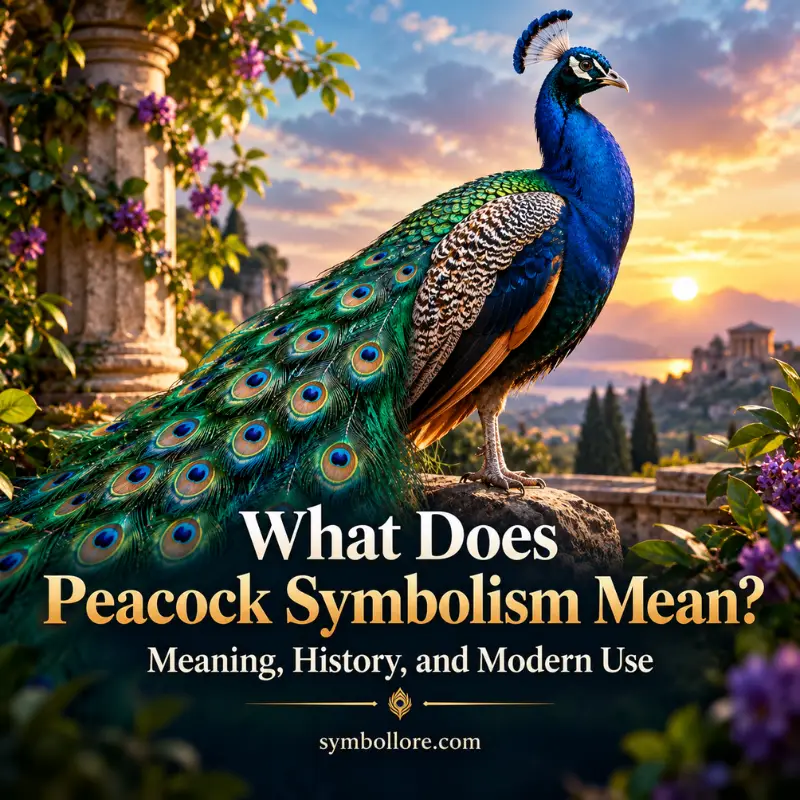
Peacock symbolism often begins with the bird’s extraordinary appearance. Its fan-shaped tail, iridescent colors, and eye-like markings make it visually different from ordinary birds. Those features encouraged symbolic associations with beauty, splendor, display, and watchfulness.
The bird’s behavior also matters. A male peacock’s elaborate courtship display can suggest confidence and self-expression. In another context, the same display can suggest vanity or excessive pride.
Historical traditions add another layer. The peacock became an attribute of Hera in Greek and Roman culture, while Christian artists later used the bird to communicate ideas about immortality and eternal life. A scholarly study of the peacock’s movement from the Achaemenid world into Greece and Rome also shows that its symbolism developed through cultural contact and changing religious ideas.
So, there is no single definition. The most useful interpretation asks where the peacock appears, who uses it, and what surrounds it.
Why Does the Peacock Symbolize Beauty?
Beauty is the most immediate meaning because the peacock’s appearance is difficult to separate from its symbolism.
Its tail combines repeated eye-like shapes with shimmering colors. When fully displayed, the tail becomes a large visual pattern rather than simply a group of feathers. Artists can therefore use the bird to represent magnificence, ornament, elegance, or visual abundance.
This association appears strongly in decorative art. A peacock can fill a composition with color while also suggesting status and refinement.
Beauty, however, is not necessarily the same as vanity. A peacock used in a wedding design may communicate elegance and celebration. A peacock shown admiring its reflection may instead emphasize self-absorption.
That distinction matters because the bird’s beauty can support both positive self-expression and negative pride.
Peacock Symbolism and Pride
Pride is one of the most complicated peacock meanings.
The phrase “proud as a peacock” reflects the bird’s conspicuous display. A peacock spreads its tail, raises its body, and makes itself visually noticeable. Human observers can easily translate that behavior into ideas about confidence, status, or self-importance.
In symbolic art, the interpretation depends on context.
A peacock standing among flowers may represent beauty. A richly dressed peacock beside a wealthy figure may suggest luxury or status. A peacock paired with a mirror may emphasize vanity.
Christian moral traditions also used the bird as a warning about excessive pride. The Kimbell Art Museum notes that the peacock’s display could symbolize worldly pride and vanity while its older Christian symbolism represented immortality.
This creates an important symbolic tension:
Confidence says, “I value what I am.”
Vanity says, “My appearance makes me superior.”
The peacock can represent either idea depending on the surrounding story.
Hera, Juno, and the Peacock
The most famous classical association connects the peacock with Hera, the Greek goddess who became Juno in Roman tradition.
The peacock was associated with Hera by the classical period, and its connection with her became especially prominent in later Greek and Roman art. The story of Argus Panoptes provided a mythological explanation for the bird’s eye-marked feathers.
According to the later literary tradition, Argus was a many-eyed guardian who watched over Io. Hermes eventually killed Argus, and Hera preserved his eyes by placing them on the peacock’s tail. The Getty explains this myth as part of the symbolism of the peacock in Roman imagery.
The story explains why the tail looks like a collection of watching eyes. It therefore strengthens meanings of vigilance, observation, protection, and divine awareness.
However, the myth should not be treated as the original explanation for every ancient peacock image. A modern scholarly study notes that the peacock’s relationship with Hera developed through several stages and that the Argus explanation belongs to a later literary tradition.
What Do the Peacock’s “Eyes” Symbolize?
The eye-like markings on peacock feathers have inspired meanings of watchfulness, awareness, protection, and divine vision.
In the Argus story, the connection is especially direct. The eyes of a faithful watchman become part of the peacock’s tail. The bird consequently becomes a visual reminder of someone who watches.
Christian artists later developed related interpretations. The Getty’s educational material explains that the peacock’s tail eyes could contribute to its symbolic association with an apparently ever-watchful presence, while the bird’s annual loss and regrowth of its tail supported ideas of renewal.
The eye pattern can therefore work on several levels:
- Watchfulness: seeing what others overlook.
- Protection: remaining alert to danger.
- Awareness: observing the surrounding world.
- Divine vision: an artistic metaphor for a higher power.
- Mystery: many eyes create an uncanny or supernatural effect.
These meanings are symbolic interpretations. The feather pattern itself does not provide evidence of supernatural protection.
Peacock Symbolism and Immortality
Immortality is one of the oldest important meanings attached to the peacock in Mediterranean and Christian art.
The Vatican Museums identify their ancient bronze peacocks with symbolism connected to immortality. The museum notes that the birds were associated with the decoration of Hadrian’s Mausoleum and that their symbolic meaning supports that interpretation.
Early Christian artists adopted the peacock into their visual vocabulary. The Kimbell Art Museum explains that Christian peacock symbolism drew partly from an ancient belief that the bird’s flesh did not decay after death. The bird’s renewal of its plumage also supported ideas of continued life.
A famous Christian composition places two peacocks near a vessel, fountain, or Tree of Life. The image can represent believers receiving the waters of eternal life.
This meaning should be kept within its historical context. A peacock feather today does not automatically communicate Christian resurrection. The surrounding image determines whether that tradition is actually being invoked.
Peacock Symbolism in Early Christian Art
Christian artists did not create the peacock’s symbolism from nothing. Instead, they adapted an established Mediterranean image to new religious ideas.
The transition is an example of symbolic reuse. A bird already associated with immortality, divine imagery, and renewal could be incorporated into Christian art without preserving every earlier meaning.
Byzantine mosaics provide striking examples. The American University of Beirut Museum describes a Byzantine mosaic featuring a peacock and notes associations with paradise, renewal, immortality, and victory over death.
The peacock could therefore appear in churches, tombs, mosaics, and other religious settings.
Its symbolism worked especially well in funerary art. A bird associated with continued life could express hope for existence beyond physical death.
The image was not simply decorative. Its beauty itself could support the message. A radiant bird suggested a world beyond ordinary decay.
Peacock Symbolism in South Asian Traditions
South Asian peacock symbolism developed independently and should not simply be treated as an extension of Greek or Christian ideas.
The Indian peafowl has a long cultural history in South Asia. Peacock imagery appears in religious art, literature, royal settings, textiles, architecture, and modern national imagery.
In Hindu traditions, the bird has important connections with deities and sacred stories. Krishna is frequently depicted with a peacock feather, while the peacock is also associated with Kartikeya or Murugan in traditions where the bird serves as his mount.
These associations can connect the peacock with beauty, divine presence, courage, protection, and sacred identity, but the exact meaning depends on the deity and tradition.
That distinction is important. A peacock feather associated with Krishna should not automatically be interpreted through the Greek story of Hera and Argus.
Likewise, a South Asian religious image should be studied within its own textual and artistic tradition rather than placed into a generic Western symbolism chart.
Peacock Symbolism in Chinese Culture
Chinese art also gives the peacock distinctive meanings.
A peacock can communicate beauty, dignity, splendor, and official status. In historical Chinese visual culture, peacock imagery could appear in clothing, courtly settings, decorative arts, and paintings.
Modern Chinese bird symbolism also places the peacock among birds associated with beauty and official success. Symbollore’s broader discussion of Chinese bird symbolism notes that the peacock can suggest beauty, dignity, splendor, and official achievement, while stressing that the composition and historical setting determine the precise interpretation.
This is another example of why cultural context matters. A Chinese court image, a Greek mythological vase, and a Christian mosaic may all depict the same bird while communicating different ideas.
The shared visual feature does not require a shared symbolic origin.
Peacock Symbolism and Royalty
The peacock’s connection with royalty comes partly from its rarity, beauty, and expensive visual presence.
In ancient and medieval courts, unusual animals and elaborate decorative motifs could communicate wealth and access. A bird with spectacular plumage naturally fit that visual language.
The association became especially powerful in South and Central Asian royal culture. The famous Peacock Throne, for example, made peacock imagery part of a language of imperial magnificence.
The bird can therefore represent:
- status;
- luxury;
- dignity;
- abundance;
- authority;
- ceremonial display.
However, royalty is not an inherent meaning of the animal. It develops when a society places the bird within courtly or elite contexts.
The same peacock in a garden may simply represent beauty. In a palace setting, it can become part of a larger visual statement about wealth and power.
Peacock Symbolism in Modern American Culture
Modern Americans often encounter peacock imagery in home décor, fashion, jewelry, tattoos, gardens, art, and graphic design.
The meaning is usually secular rather than explicitly religious. A peacock-patterned fabric may communicate elegance and color. A peacock tattoo may represent individuality or confidence. A decorative feather may simply be chosen because of its visual beauty.
Modern use often combines several older meanings.
A person may choose a peacock because it suggests:
- confidence;
- self-expression;
- beauty;
- individuality;
- transformation;
- luxury;
- creativity;
- visibility.
These are contemporary interpretations rather than universal historical definitions.
The distinction is useful because modern American symbolism often borrows older imagery without preserving the original religious context.
Peacock Symbolism in Tattoos
A peacock tattoo can represent beauty, confidence, individuality, renewal, pride, or personal transformation.
The design’s details can change the message.
A fully spread tail may emphasize confidence and visibility. A close-up feather can focus attention on beauty, color, and the eye pattern. A flying peacock may suggest freedom or change. A darker composition may emphasize mystery or mortality.
Other elements matter too.
For example:
- Peacock and flowers: beauty, growth, elegance, or celebration.
- Peacock feather: individuality, beauty, or watchfulness.
- Peacock and crown: royalty, dignity, or status.
- Peacock and moon: mystery, transformation, or nighttime beauty.
- Peacock with religious imagery: potentially specific Hindu, Christian, or other traditions.
The wearer’s explanation remains the strongest evidence for a personal tattoo. Symbolism dictionaries cannot determine someone’s private meaning.
Peacock Feathers and Their Symbolism
A peacock feather can function differently from the complete bird.
The feather emphasizes the eye pattern, color, and display. It can therefore symbolize beauty, awareness, individuality, or protection depending on the context.
In religious contexts, a feather can carry a much more specific meaning. Krishna’s traditional association with the peacock feather is one example.
In Christian art, feather imagery may appear within larger compositions involving resurrection or eternal life. Yet a loose feather in modern jewelry does not automatically carry that theological meaning.
Modern spiritual communities sometimes assign additional meanings to peacock feathers, including awakening or energetic protection. Such claims should be identified as modern spiritual interpretations rather than presented as historical facts.
Does Peacock Symbolism Mean Pride or Vanity?
It can mean either positive confidence or negative vanity.
The difference comes from the context.
A peacock displaying its feathers can symbolize healthy self-expression, beauty, and confidence. But if the artwork emphasizes excessive self-display, mirrors, luxury, or contempt for others, the same bird can symbolize vanity.
This dual meaning has a long history. The Kimbell Art Museum explicitly identifies both immortality and worldly pride or vanity in Christian interpretations of the peacock.
Therefore, the peacock is particularly useful as a symbol of the boundary between confidence and self-importance.
It can ask whether beauty is being appreciated or used to establish superiority.
Common Misconceptions About Peacock Symbolism
“Peacocks always symbolize immortality.”
No. Immortality is especially important in ancient Mediterranean and Christian art, but modern and South Asian interpretations can emphasize very different meanings.
“The peacock always represents pride.”
No. Pride is one established interpretation, but beauty, dignity, renewal, watchfulness, and religious meanings can be equally important.
“The eye feathers prove that peacocks have supernatural powers.”
No. Eye-like markings have inspired symbolic interpretations, but they are natural feather patterns.
“All peacock symbolism comes from Greek mythology.”
No. The bird has independent cultural histories in South Asia, China, the Middle East, and other regions.
“A peacock feather has one spiritual meaning.”
No. Its meaning depends on the religious, cultural, artistic, or personal context.
“The Argus story was always the reason Greeks associated peacocks with Hera.”
This is too simple. Scholarly research indicates that the peacock’s association with Hera developed over time, while the specific Argus-eye explanation is documented later.
How to Interpret Peacock Symbolism Correctly
Start with the setting.
A museum artifact requires a historical reading. A religious painting requires attention to doctrine and iconography. A tattoo requires attention to personal meaning. A decorative object may be primarily aesthetic.
Next, examine the peacock’s role.
Is it standing beside a deity? Drinking from a vessel? Appearing beside a Tree of Life? Displaying its tail? Sitting near a throne? Each detail can change the interpretation.
Then identify the culture and period.
A Roman mosaic should not automatically be explained through modern Indian symbolism. Likewise, a Krishna image should not be reduced to the Greek Hera story.
Finally, separate evidence from interpretation.
If a museum identifies a peacock as an emblem of immortality, that is documented iconographic evidence. If a modern viewer sees the bird as a symbol of personal confidence, that is a contemporary interpretation.
Both can be meaningful. They simply belong to different levels of symbolic understanding.
FAQs
A peacock may symbolize beauty, renewal, watchfulness, immortality, divine presence, or self-expression in different spiritual traditions. These meanings are not universal. A Christian mosaic, Hindu religious image, and modern spiritual tattoo may use the bird in very different ways.
In Christian art, the peacock can symbolize immortality, resurrection, renewal, and eternal life. The association developed partly from ancient beliefs about the bird’s flesh and from its renewal of plumage. Museums document peacocks in early Christian and Byzantine artistic contexts.
The peacock became associated with Hera in Greek tradition and later with her Roman counterpart Juno. The famous Argus myth explains the bird’s eye-marked feathers by saying that Hera preserved the eyes of her slain watchman in its tail. However, the historical development of the association was more complex than this single story suggests.
A peacock feather can symbolize beauty, watchfulness, individuality, or spiritual significance depending on its setting. In Hindu traditions, the feather has specific associations with Krishna. In modern design, it is often used simply for its striking color and eye pattern.
A peacock may be treated as an auspicious image in particular cultural traditions, but there is no universal rule that makes every peacock a good-luck symbol. Positive meanings such as beauty, dignity, renewal, and prosperity depend on the culture and context.
A peacock tattoo may represent confidence, beauty, individuality, transformation, pride, creativity, or renewal. A spread tail emphasizes visibility and self-expression, while a single feather may focus on beauty or watchfulness. The wearer’s personal intention remains the most important factor.
Yes, vanity is one established peacock interpretation, especially when the bird’s dramatic display is used as a metaphor for excessive self-admiration. However, the same display can symbolize confidence or beauty. Context determines whether the symbolism is celebratory or cautionary.
Conclusion
Peacock symbolism developed through several distinct cultural histories. In Greek and Roman traditions, the bird became associated with Hera and Juno and with the watchful eyes of its tail. Early Christian artists adapted it as a symbol of immortality and resurrection. South Asian and Chinese traditions developed their own meanings, while modern American culture often emphasizes beauty, individuality, confidence, and luxury.
The peacock therefore has no single universal definition. Its meaning becomes clearer when the viewer identifies the culture, period, setting, surrounding symbols, and purpose of the image. The same brilliant bird can celebrate beauty, express dignity, suggest vanity, or represent renewal without contradiction.
Five Related Articles from symbollore.com
- Hera Symbolism: Marriage, Power, and Ancient Meaning — https://symbollore.com/hera-symbolism/
- Chinese Bird Symbolism: Meanings, History, and Cultural Context — https://symbollore.com/chinese-bird-symbolism/
- King Symbolism: Meaning, History, and the Responsibilities of Power — https://symbollore.com/king-symbolism/
- Guardian Angel Symbolism: Protection, Faith, and Art — https://symbollore.com/guardian-angel-symbolism/
- Lapis Lazuli Symbolism: Meaning, History, and Beauty — https://symbollore.com/lapis-lazuli-symbolism/