Owl symbolism most often represents wisdom, knowledge, observation, mystery, and the night. These meanings did not come from one universal tradition. They developed through the owl’s unusual behavior, its ability to see and hunt at night, and its long role in mythology and art.
Ancient Greek culture gave the owl one of its strongest symbolic identities through Athena, the goddess associated with wisdom, strategy, and reason. The owl later appeared in Roman imagery, medieval art, folklore, literature, coins, and modern design.
Yet the owl has never meant only wisdom. In some European traditions, it could suggest death, bad fortune, or the unknown. Modern interpretations often combine these older ideas with themes of independence, intuition, intelligence, and quiet observation.
Quick Answer
Owl symbolism commonly represents wisdom, knowledge, intelligence, mystery, night, observation, and independence. The connection with wisdom is especially strong because the owl became an attribute of Athena in ancient Greek art and remained prominent in European iconography. However, owl meanings vary by culture and setting, and some traditions associate the bird with darkness, death, or ill omen instead.
TL;DR
- Owls commonly symbolize wisdom because of their long association with Athena and Minerva.
- Their nocturnal behavior supports meanings of mystery, secrecy, observation, and the unknown.
- Ancient Athenian coins made the owl a powerful public and political image.
- Some European folklore treated owls as ominous birds rather than symbols of wisdom.
- Indigenous communities have their own distinct relationships with owls, so broad claims about “Native American owl symbolism” can be misleading.
- Modern owl imagery often combines intelligence, independence, mystery, learning, and personal insight.
Owl Meanings at a Glance
| Context | Possible Meaning | Why the Association Exists | Important Limit |
|---|---|---|---|
| Ancient Greece | Wisdom and reason | Owl associated with Athena | Specific to Greek religious and civic imagery |
| Athenian coins | Civic identity and Athena | Owl appeared prominently on coinage | More than a generic wisdom symbol |
| Night imagery | Mystery and observation | Owls are active at night | Symbolic interpretation, not supernatural evidence |
| European folklore | Death or ill omen | Nocturnal calls and darkness inspired fear | Meanings varied by region and period |
| Modern education | Knowledge and learning | Wisdom tradition remains popular | A modern cultural adaptation |
| Modern tattoos | Wisdom, independence, mystery | Personal use builds on older symbolism | Exact meaning belongs to the wearer |
What Does Owl Symbolism Mean?
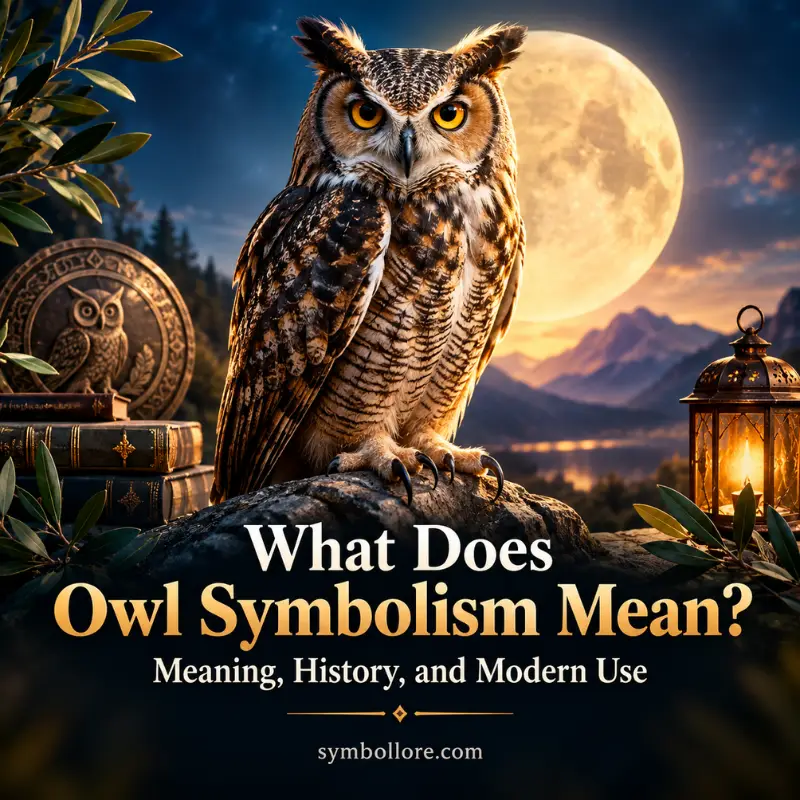
Owl symbolism most commonly centers on wisdom and knowledge. The association became especially powerful through ancient Greek representations of Athena, whose owl became one of her best-known attributes. The British Museum describes the owl as one of Athena’s symbols, alongside the olive tree.
The owl also represents observation. Its large eyes, still posture, and ability to hunt in darkness create a natural visual metaphor for seeing what others may miss. In symbolic writing, this can suggest careful thought, awareness, patience, or hidden knowledge.
At the same time, the owl’s nighttime activity gives it a second symbolic direction. It can represent mystery, secrecy, darkness, and the unknown. These meanings can appear together with wisdom because knowledge itself can be portrayed as the ability to see through darkness.
Therefore, an owl does not have one fixed definition. A university mascot, an ancient coin, a Gothic painting, and a personal tattoo can all use the bird differently.
Why Do Owls Symbolize Wisdom?
The strongest historical reason is the owl’s connection with Athena, the ancient Greek goddess of wisdom, strategy, reason, and war.
The association is especially well documented in ancient art. A bronze statuette at The Metropolitan Museum of Art, dated to about 460 BCE, depicts Athena with her owl. The museum notes that owls of a type found around the Acropolis were associated with Athena.
The owl also appeared extensively on Athenian coinage. The Met notes that Athena appeared on one side of important Athenian coins while an owl appeared on the other. The British Museum likewise describes the famous Athenian “owl” coins and their long production history.
This repeated connection helped turn the owl into a visual shorthand for intelligence and wisdom.
The symbolism therefore developed through religious association, civic imagery, and repeated artistic use. It was not simply the result of modern people deciding that owls “look intelligent.”
Athena and the Ancient Greek Owl
Athena provides the clearest historical foundation for owl symbolism.
In Greek mythology and religion, Athena was associated with wisdom, reason, strategy, handicraft, and civic order. Her owl became a recognizable attribute. The British Museum identifies the owl as one of Athena’s principal symbols and documents ancient coins showing Athena alongside an owl.
The relationship became especially visible in Athens. An ancient Greek vessel in the British Museum shows Athena together with an owl identified as her sacred bird. Another Attic vessel from around 490–460 BCE depicts Athena with an owl behind her.
These objects matter because they provide physical evidence for the association. They are stronger evidence than modern lists claiming that “owls have always symbolized wisdom.”
The historical chain is clearer:
Athena → wisdom and reason → sacred owl → repeated art and coinage → long-lasting wisdom symbolism
That tradition later influenced Roman and European representations of Minerva, Athena’s Roman counterpart.
The Owl on Athenian Coins
The Athenian owl became more than a religious emblem. It also became a symbol of the city itself.
Ancient Athenian silver coins commonly showed the head of Athena on one side and an owl on the other. The British Museum notes that these coins became known as “owls” and that the type remained broadly consistent for centuries.
The owl’s repeated appearance on money gave it an unusually public role. It was seen not only in temples and artworks but also in everyday economic life.
That helps explain why the owl became such a durable symbol. Symbols become powerful when people encounter them repeatedly. In this case, the owl was connected with Athena, Athens, civic identity, and a widely circulated form of currency.
A modern reader might therefore see the owl simply as “wisdom.” Historically, however, the Athenian owl also communicated identity, authority, religion, and civic culture.
Owl Symbolism and the Night
The owl’s relationship with nighttime created another major symbolic layer.
Owls are naturally associated with darkness because many species are most active at night. Their ability to function when humans have limited visibility makes them useful symbols of seeing through darkness.
Artists and writers can therefore use an owl to suggest:
- hidden knowledge;
- secrecy;
- careful observation;
- mystery;
- solitude;
- the unknown;
- awareness of things others cannot see.
This does not mean ancient people all interpreted owl behavior in exactly the same way. Instead, the physical characteristics of the bird gave artists a strong visual language.
The Met has documented later European imagery in which owls could represent night, death, and knowledge at the same time.
That combination is important. Darkness does not always mean evil in symbolism. It can mean something unseen, unexplored, private, or difficult to understand.
Owl Symbolism in European Folklore
European folklore shows why it is dangerous to say that an owl always represents wisdom.
In some traditions, owls were treated as ominous birds. Their nighttime habits and distinctive calls could make them seem connected with death, fear, or supernatural forces.
A Metropolitan Museum publication discussing a medieval Christian prayer book notes that owls were considered birds of ill omen in French folklore, even though the Little Owl also retained its classical association with wisdom and Athena.
This creates an important contrast:
Classical tradition: owl → Athena → wisdom
Some European folklore: owl → night → fear or ill omen
Neither interpretation should be treated as the universal meaning of the bird.
The same animal can acquire different symbolic meanings because people encounter it within different religious systems, landscapes, stories, and cultural memories.
Wisdom and Death Can Exist Together
Owl symbolism sometimes combines apparently opposite ideas.
An owl can represent wisdom because it sees in darkness. Yet the same darkness can represent death, mystery, or the boundary between the known and unknown.
The Met documents Renaissance imagery in which owls were used as symbols of night, death, and knowledge.
This does not mean the owl “means death” in every culture. Instead, it shows how artists can build several meanings around one visual characteristic.
For example, an owl appearing beside a skull in an artwork may emphasize mortality. An owl beside books may emphasize learning. An owl flying through a moonlit forest may suggest mystery or solitude.
The surrounding imagery often matters as much as the animal itself.
Owl Symbolism Across Indigenous Cultures
Claims about “Native American owl symbolism” need especially careful treatment.
There is no single Indigenous American belief system that assigns one universal meaning to owls. Indigenous nations have distinct languages, histories, ceremonies, artistic traditions, and relationships with animals.
The Smithsonian’s National Museum of the American Indian provides evidence of owl imagery within several distinct Indigenous artistic traditions. Its collections include owl figures associated with A:shiwi (Zuni), Eastern Cherokee, Inuit, Cochiti Pueblo, and other communities.
These museum records demonstrate that owl imagery exists across diverse Indigenous artistic contexts. They do not establish one shared Indigenous definition of the owl.
This distinction is essential. A claim such as “Native Americans believe owls always represent death” or “Native Americans see owls as universal spirit guides” is too broad without identifying a specific nation and source.
When discussing Indigenous symbolism, the community should be named whenever reliable evidence allows.
Owl Symbolism in Art and Iconography
The owl is particularly effective in visual art because its body communicates several ideas at once.
Large eyes can suggest knowledge and perception. A forward-facing head can suggest attention. Silent flight can suggest secrecy. Nighttime activity can suggest mystery.
Historical art adds another layer. The owl became an established attribute of Athena and continued to appear in European representations of wisdom, knowledge, and classical learning. The Met’s collection includes both ancient Greek and later European examples showing how long this visual tradition remained active.
The British Museum also documents Roman-period engraved gems depicting Athena with an owl-like body, showing that the association continued beyond classical Greece.
This is a good example of iconographic continuity. A symbol can survive because later artists inherit an established visual language and adapt it to new settings.
Owl Symbolism in Literature
Literature often uses the owl to create an atmosphere rather than communicate one fixed definition.
An owl appearing at night may establish mystery or isolation. An owl near a scholar may reinforce intelligence. An owl calling before an important event may create suspense or an ominous mood.
Writers can also deliberately challenge traditional symbolism. A supposedly wise owl may behave foolishly. A frightening owl may become a protective figure. Such reversals remind readers that literary symbols depend on narrative context.
This makes owl symbolism especially useful in stories about knowledge and uncertainty. The owl can represent someone who knows more than others, but it can also represent knowledge that remains hidden.
The symbol’s strength comes from this tension. Wisdom does not eliminate mystery. Sometimes wisdom means recognizing how much remains unknown.
Owl Symbolism in Modern American Culture
In modern American culture, the owl is commonly associated with education, intelligence, wisdom, learning, and observation.
Schools, libraries, educational programs, book illustrations, stationery, and decorative art often use owls because the classical wisdom tradition remains familiar.
Modern design also uses the owl for darker or more mysterious themes. A moonlit owl can suggest independence and solitude. A stylized owl with geometric eyes can communicate intelligence and focus. A fantasy owl may represent magic, hidden knowledge, or supernatural awareness.
These are modern adaptations rather than evidence of one ancient universal code.
The same owl image can therefore work in very different settings. Its meaning depends on the audience, surrounding imagery, and purpose.
Owl Symbolism in Tattoos and Jewelry
An owl tattoo often represents wisdom, intelligence, independence, mystery, or personal growth.
Someone may choose an owl because it represents learning or a desire to see situations more clearly. Another person may use it to symbolize independence, especially when the owl is shown alone.
A moon, stars, books, keys, or glasses can further shape the meaning. For example:
- Owl with books: learning and knowledge
- Owl with moon: mystery and night
- Owl with stars: imagination or the unknown
- Flying owl: freedom or transition
- Owl with an open book: education and study
- Dark owl imagery: mystery, mortality, or hidden knowledge
However, tattoo symbolism is personal. There is no universal rule that determines what every owl tattoo means.
If an owl design intentionally copies a culturally specific sacred or historical image, its origin deserves separate research.
Do Owl Colors Change the Meaning?
Color can influence an owl’s symbolic interpretation, but there is no universal color code.
A white owl may suggest purity, clarity, rarity, or spiritual imagery. A black or dark owl can emphasize mystery, night, secrecy, or mortality.
A brown owl may create a more natural association with forests, earth, observation, and wildlife. A golden owl may suggest prestige, knowledge, or illumination.
These interpretations are mainly contextual and artistic. They should not be presented as fixed historical rules.
The same principle applies to the owl’s pose. A perched owl may suggest stillness and observation, while a flying owl may communicate freedom, movement, or change.
Common Misconceptions About Owl Symbolism
Several popular claims become unreliable when they are presented as universal facts.
“Owls always symbolize wisdom.”
No. Wisdom is one of the strongest modern associations, especially because of Athena, but other traditions connect owls with darkness, death, fear, or ill fortune.
“The owl has always represented intelligence.”
The association has a long history, but it developed through particular cultural traditions. Ancient Greek connections with Athena are especially important.
“All Native American cultures see the owl in the same way.”
This is an overgeneralization. Indigenous nations have distinct traditions and should be discussed separately.
“Seeing an owl is a guaranteed spiritual message.”
That is a personal or spiritual interpretation, not a scientifically established fact.
“An owl is always a symbol of death.”
This is also too broad. Death-related meanings occur in some traditions and artworks, but they exist alongside wisdom, knowledge, mystery, and other interpretations.
“The owl’s wisdom comes from its supernatural powers.”
The historical wisdom association is better explained through cultural tradition, especially Athena’s iconography, rather than a proven supernatural ability.
How to Interpret Owl Symbolism Correctly
The most reliable approach is to begin with context rather than a symbolism list.
Ask five questions:
- Where does the owl appear? A coin, painting, story, tattoo, school logo, or religious object can create different meanings.
- Which culture is involved? Ancient Athens, medieval Europe, and modern America should not be blended together.
- What is the owl doing? A perched owl may suggest observation, while a flying owl may suggest freedom or transition.
- What surrounds it? Books, weapons, graves, moons, trees, or other animals can change the interpretation.
- What historical period is involved? A Greek vase and a modern fantasy illustration do not use the same symbolic language.
This method also helps separate documented symbolism from personal interpretation.
If an owl appears beside Athena on an ancient object, there is strong historical evidence for the Athena association. If an individual chooses an owl tattoo to represent personal resilience, that meaning belongs to the individual.
Symbolism becomes clearer when those two forms of meaning are not confused.
FAQs
An owl may be interpreted spiritually as a symbol of wisdom, intuition, observation, mystery, or seeing beyond the obvious. These meanings depend on the spiritual tradition or personal belief involved. An owl encounter should not be treated as proof of a supernatural message or prediction.
The strongest historical explanation is its association with Athena, the ancient Greek goddess connected with wisdom and reason. Owls appeared with Athena in art and became prominent on Athenian coins. This repeated association helped establish the owl as a lasting symbol of wisdom.
An owl can symbolize death in some cultural and artistic contexts, especially where nighttime birds are associated with darkness, mortality, or ill omens. However, death is not the owl’s universal meaning. Wisdom, knowledge, mystery, and observation are also major associations.
A white owl may symbolize purity, clarity, mystery, wisdom, or spiritual imagery depending on its setting. Color alone does not establish one fixed meaning. The surrounding artwork, cultural tradition, and purpose of the image should guide interpretation.
An owl tattoo commonly represents wisdom, intelligence, independence, mystery, observation, or personal growth. Additional elements can narrow the meaning. For example, an owl with books may emphasize learning, while an owl with a moon may emphasize mystery or nighttime symbolism.
An owl can represent positive qualities such as wisdom and protection in some modern interpretations, but it is not universally considered a good-luck symbol. Some historical traditions instead treated owls as ominous or unlucky. The cultural setting determines the interpretation.
In Greek tradition, the owl is strongly associated with Athena, a goddess of wisdom, reason, strategy, and war. The bird became one of her recognizable attributes and appeared widely in Athenian art and coinage.
Conclusion
Owl symbolism brings together wisdom, knowledge, observation, mystery, and the night. Its strongest historical foundation comes from ancient Greece, where the owl became closely associated with Athena and appeared prominently in Athenian art and coinage.
Yet the owl has never carried one universal meaning. European folklore could connect it with ill fortune or death, while modern American culture often emphasizes intelligence and learning. Indigenous traditions also require specific cultural attribution rather than broad generalizations.
The most grounded interpretation is therefore contextual. An owl can symbolize the ability to observe carefully, seek knowledge, and face uncertainty without assuming that every owl carries the same message.
Five Related Articles from symbollore.com
- Heron Symbolism: Meaning, History, and Cultural Roots — https://symbollore.com/heron-symbolism/
- Moon Symbolism: Meaning, History, and Culture — https://symbollore.com/moon-symbolism/
- Fire Symbolism: Meaning, History, and Cultural Context — https://symbollore.com/fire-symbolism/
- Fish Hook Symbolism: Meaning, Culture, Luck, and Strength — https://symbollore.com/fish-hook-symbolism/
- House Symbolism: Meaning, History, Culture, and Modern Use — https://symbollore.com/house-symbolism/


