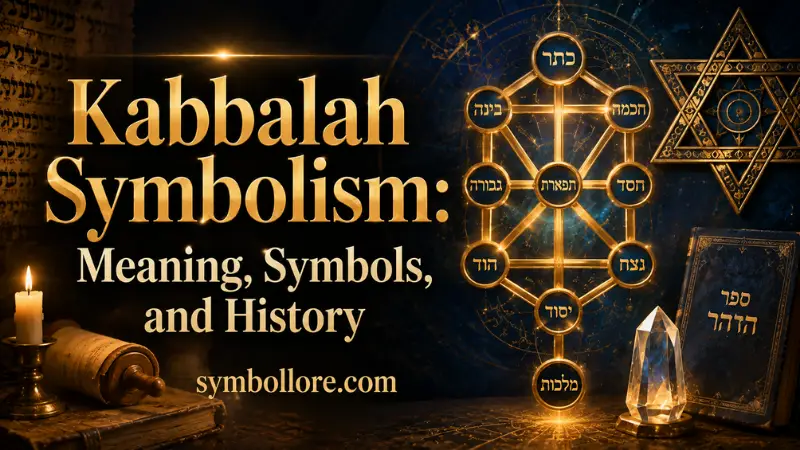
Kabbalah symbolism centers on divine presence, creation, spiritual connection, wisdom, balance, and the relationship between the infinite and the created world. At the heart of Kabbalistic imagery is the Tree of Life, a visual arrangement of the ten sefirot, which developed as a way of thinking about how the infinite God can be understood as present and active in creation.
Kabbalah is not one simple system with a universal dictionary of symbols. Jewish mystical traditions developed over many centuries, and different Kabbalists interpreted divine attributes, Hebrew letters, numbers, names, and cosmological diagrams in different ways. Kabbalah flourished particularly in medieval Europe, including Provence and Spain, and later developed in new forms, especially through the teachings associated with Isaac Luria in 16th-century Safed.
That history matters today because popular culture often presents Kabbalah as a collection of mystical shortcuts, lucky objects, or universal spiritual formulas. A more careful approach distinguishes documented Jewish mystical traditions from later popular and New Age interpretations.
Quick Answer
Kabbalah symbolism represents ideas about God, creation, divine attributes, spiritual connection, wisdom, and the movement between the infinite and the finite. The Tree of Life and its ten sefirot form the best-known symbolic system. Other important imagery includes Hebrew letters, divine names, geometric diagrams, sacred trees, and amulets. Meanings vary among Kabbalistic schools and historical periods, so modern claims should not automatically be treated as traditional Jewish teaching.
TL;DR
- The Tree of Life is the best-known visual expression of Kabbalistic symbolism.
- Its ten sefirot describe divine attributes or emanations and their relationship to creation.
- Ein Sof, meaning “Without End” or “Infinite,” represents the unknowable divine infinity beyond ordinary description.
- Hebrew letters and numbers became important through traditions of mystical interpretation, including gematria.
- Lurianic Kabbalah introduced influential ideas such as the breaking of the vessels and the repair of creation.
- Modern red-string bracelets and celebrity “Kabbalah” culture do not represent the whole historical tradition.
Kabbalah Symbols at a Glance
| Symbol or Concept | Main Symbolic Meaning | Why the Association Exists | Important Limit |
|---|---|---|---|
| Tree of Life | Divine structure, creation, spiritual connection | Organizes the sefirot into a visual cosmological pattern | Different diagrams and traditions vary |
| Ten Sefirot | Divine attributes or emanations | They explain how the infinite relates to creation | Their precise interpretation differs among Kabbalists |
| Ein Sof | Divine infinity | Refers to God beyond finite description | Not simply another “symbol” or deity |
| Hebrew letters | Creation, divine language, hidden meaning | Mystical texts explored letters as formative powers | Letter symbolism varies by system |
| Gematria | Numerical relationships and interpretation | Hebrew letters possess numerical values | Not every numerical coincidence has mystical significance |
| Kabbalistic amulet | Protection and sacred intention | Some traditions used divine names, verses, and letter patterns | Amulets belong to particular historical practices |
| Breaking of the Vessels | Cosmic rupture and the need for repair | Central to Lurianic creation mythology | Mainly associated with later Lurianic Kabbalah |
What Does Kabbalah Symbolism Mean?
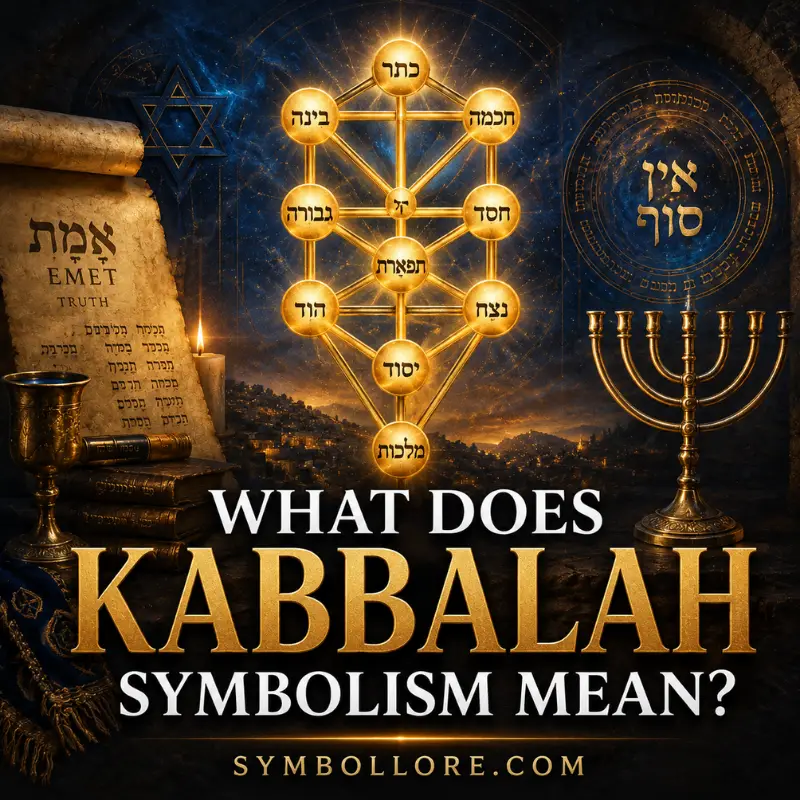
Kabbalah symbolism is a visual and conceptual language used within Jewish mystical traditions to explore questions about God, creation, divine attributes, human spiritual life, and the structure of reality.
The word Kabbalah is commonly understood as “that which is received.” In Jewish tradition, Kabbalistic thinkers worked with existing Jewish texts and practices while seeking deeper layers of meaning. Reform Judaism describes Kabbalah as a form of Jewish mysticism concerned with the essence of God and the relationship between Creator and creation.
The symbolism can therefore be difficult to separate from theology. A diagram is not merely decorative. It may represent a theory about divine activity, creation, spiritual transformation, or the relationship between different aspects of reality.
This is why the Tree of Life should not be treated as simply a mystical tree promising good fortune. In Kabbalistic thought, it is a structured way of representing relationships among the sefirot.
The Tree of Life and Kabbalah Symbolism
The Tree of Life is the most recognizable image associated with Kabbalah.
In Kabbalistic diagrams, the tree organizes the ten sefirot into a structured pattern. These are commonly presented as Keter (Crown), Chokhmah (Wisdom), Binah (Understanding), Chesed (Loving-kindness or Mercy), Gevurah (Strength or Judgment), Tiferet (Beauty), Netzach (Victory or Endurance), Hod (Splendor or Glory), Yesod (Foundation), and Malkhut (Kingdom).
The exact translations can differ because Hebrew terms carry layers of meaning.
The ten sefirot became the central doctrine of Kabbalah in medieval development. The Jewish Encyclopedia describes them as divine potencies or agencies through which God manifests in the production of the universe.
A surviving 17th-century Kabbalistic diagram in the Center for Jewish Art shows how elaborate these visual systems could become. The diagram places the sefirot at the center while incorporating biblical and Jewish ritual imagery, including the Menorah, tablets, cherubim, altars, and other symbols.
The Tree of Life is therefore best understood as a map of relationships, not a literal tree.
What the Ten Sefirot Symbolize
The sefirot are often described as ten divine emanations or attributes. My Jewish Learning calls them one of the most central concepts in Kabbalah, explaining that they address the problem of how an infinite and hidden God can also be understood as manifest in the world.
Each sefirah contributes a different dimension to the symbolic structure.
Keter — Crown represents the highest level of divine will or purpose in many Kabbalistic systems.
Chokhmah — Wisdom is associated with the flash or source of wisdom.
Binah — Understanding represents developed understanding and discernment.
Chesed — Loving-kindness expresses generosity, expansion, and mercy.
Gevurah — Strength or Judgment introduces restraint, boundaries, discipline, and judgment.
Tiferet — Beauty traditionally mediates between opposing qualities and is associated with harmony and compassion.
Netzach — Endurance or Victory suggests persistence and continuing force.
Hod — Splendor or Glory is associated with acknowledgment, expression, and form.
Yesod — Foundation serves as a connecting principle through which divine influences are transmitted.
Malkhut — Kingdom represents manifestation, sovereignty, and the receiving dimension of the system.
These translations are useful for beginners, but they should not be treated as ten independent personality traits. The sefirot function as an interconnected system.
Kabbalah Symbolism and Balance
One of the most important features of the Tree of Life is the relationship between contrasting qualities.
Chesed and Gevurah, for example, are commonly presented as complementary forces. Generosity without limits can become uncontrolled expansion, while judgment without compassion can become excessive severity.
Tiferet occupies a mediating position in many diagrams and interpretations. Its name is often translated as “Beauty,” but the concept can also involve harmony and balance.
This makes the Tree of Life useful as a symbolic model of relationship rather than isolation.
The sefirot do not simply say that mercy is good and judgment is bad. Both qualities can have a place within a larger divine structure. This is one reason modern writers sometimes connect Kabbalistic imagery with balance and integration, although those modern applications should not be mistaken for a simple self-help formula.
For a broader look at how balance works symbolically across cultures, see
Ein Sof: The Infinite Beyond the Diagram
The concept of Ein Sof is essential for understanding why the Tree of Life is not simply a picture of God.
Ein Sof is commonly translated as “Without End” or “Infinite.” In Kabbalistic theology, it refers to the divine infinity that exceeds ordinary human description.
The sefirot provide a way of discussing divine manifestation, but they should not simply be equated with the totality of the Infinite.
The Jewish Encyclopedia records differing historical views about the relationship between the sefirot and Ein Sof. Some Kabbalists treated the sefirot as distinct from the divine essence, while others understood them as aspects or manifestations through which the Infinite becomes knowable.
That disagreement is important. It shows that Kabbalah never operated as one completely uniform doctrine.
The simplest explanation for a general reader is that Ein Sof points toward divine infinity, while the sefirot provide a symbolic language for discussing divine manifestation and relationship.
Hebrew Letters and Kabbalah Symbolism
Hebrew letters carry special importance in some Kabbalistic traditions because mystical thinkers treated language as more than a tool for ordinary communication.
The Sefer Yetzirah, an early Jewish mystical text, is especially important in this history. It connects the ten sefirot with the 22 letters of the Hebrew alphabet, describing the letters as formative elements in creation.
This created a symbolic relationship among letters, numbers, language, and creation.
Kabbalistic interpretations could therefore examine the form, sound, numerical value, and combinations of Hebrew letters. This does not mean that every Hebrew word contains a hidden supernatural code. Rather, specific mystical systems developed methods for interpreting sacred language in deeper ways.
The Jewish Museum London’s collection includes a 19th-century Kabbalistic amulet containing Hebrew writing, letter squares, divine names, and numerical symbolism. Its description specifically identifies the use of gematria, the practice of assigning numerical values to Hebrew letters.
Gematria and the Symbolism of Numbers
Gematria is one of the best-known techniques associated with Jewish mystical interpretation.
In Hebrew, letters also have numerical values. Gematria examines relationships among words or phrases based on those values.
The method has roots in Jewish interpretive traditions, and mystical writers developed it in increasingly elaborate ways. The Jewish Encyclopedia’s discussion of Kabbalah describes the symbolic importance of Hebrew letters, numbers, and their relationships in the Sefer Yetzirah tradition.
Gematria is therefore part of the historical background behind modern claims that Kabbalah can reveal hidden numerical messages.
However, caution is necessary. A numerical similarity between two words does not automatically establish that they have the same meaning. Traditional Kabbalistic interpretation operates within particular texts and methods.
Modern internet numerology often removes those limits and treats any matching number as proof of a hidden message. That is not a reliable way to represent historical Kabbalah.
Kabbalah and the Four Worlds
Later Kabbalistic traditions also developed the idea of four worlds, commonly named Atzilut, Beriah, Yetzirah, and Asiyah.
These names are often translated through concepts such as emanation, creation, formation, and making or action.
The Jewish Encyclopedia describes the fourfold system as a later development that became especially important through Kabbalists such as Moses Cordovero and Isaac Luria in the 16th century.
The four worlds add another dimension to Kabbalistic symbolism. Reality can be understood through multiple levels rather than a simple division between “spiritual” and “physical.”
This layered structure helps explain why Kabbalistic diagrams can look complex. They are often attempting to represent relationships among divine qualities, spiritual worlds, human experience, and creation.
Lurianic Kabbalah and the Breaking of the Vessels
One of the most famous later Kabbalistic ideas is Shevirat ha-Kelim, usually translated as the Breaking of the Vessels.
This concept is particularly associated with Isaac Luria, the 16th-century Jewish mystic associated with Safed.
In Lurianic thought, divine light enters vessels that cannot adequately contain it. The resulting rupture becomes part of a cosmic story involving fragments, divine sparks, evil, and the eventual repair or restoration of creation.
The Jewish Museum Berlin explains this teaching through Anselm Kiefer’s Breaking of the Vessels, describing Luria’s creation account in which the Infinite contracts to make space for creation and the vessels break.
Symbolically, the broken vessel can suggest rupture, fragmentation, hidden holiness, and the possibility of repair.
This idea also helps explain the Kabbalistic concept commonly called tikkun, or repair. In later interpretations, human actions can participate in restoring or repairing a fractured creation.
These concepts belong specifically to later Kabbalistic development and should not be projected backward onto every earlier Jewish mystical tradition.
Kabbalah Symbolism in Amulets
Kabbalah also has a history of practical and protective symbolism.
Some Jewish communities used amulets containing biblical verses, divine names, Hebrew letters, numerical arrangements, and other mystical elements.
The Jewish Museum London preserves an 1832 Kabbalistic amulet created for protection of a home. Its design includes Torah verses, Psalm 91, the Priestly Blessing, a prayer associated with protection from the evil eye, letter squares, and gematria.
The Jewish Museum’s broader collection also documents amulets using Kabbalistic expressions and protective inscriptions.
This history provides a useful correction to a common misconception: Kabbalah was not only a philosophical system. Different Kabbalistic and Jewish mystical traditions also intersected with prayer, contemplation, protective practices, sacred names, and folk customs.
At the same time, not every protective charm sold today should be labeled historically Kabbalistic.
The Red String and Modern Kabbalah Symbolism
The red string is perhaps the most recognizable modern object marketed as a Kabbalah symbol.
Red strings have existed in Jewish folk practices, and some modern people wear them as protection against the evil eye, or ayin hara. But the history is more complicated than the popular claim that a red bracelet is an ancient universal Kabbalistic rule.
Reform Judaism notes that wearing a red string is a Jewish folk custom associated with protection from the evil eye, while also explaining that the original meaning of the practice is uncertain and that the custom was probably not unique to Judaism.
Chabad similarly cautions that it is difficult to find a reputable Jewish or Kabbalistic source establishing the modern red bracelet as a standard protection against the evil eye.
Academic research gives the red string a broader cultural history. Elly Teman’s study traces its symbolism through Jewish folklore, biblical imagery, ideas of protection, boundaries, danger, and redemption.
Therefore, red-string symbolism is real as a folk and modern cultural practice, but its popular commercial presentation should not be confused with the whole of Kabbalah.
Kabbalah Symbolism in Jewish Art
Kabbalistic ideas have influenced Jewish manuscripts, diagrams, amulets, ritual objects, and modern art.
The Center for Jewish Art documents ilanot, or Kabbalistic tree diagrams, as visual representations of Kabbalistic cosmologies. The institution notes that these diagrams developed from simpler forms into increasingly complex systems, especially from the 13th century through later Lurianic traditions.
A 1629 Kabbalistic tree in the Gross Family Collection provides an especially rich example. Its central sefirotic diagram is surrounded by trees, fruit, zodiac symbols, divine-name letter combinations, and Jewish sanctuary imagery. The composition presents a visual model of the relationship between the divine presence and the world.
This artistic evidence matters because it demonstrates that the Tree of Life was not merely a modern graphic design. Kabbalistic diagrams have a documented history in Jewish manuscripts and visual culture.
Kabbalah in Modern American Culture
In the United States, Kabbalah has moved far beyond traditional Jewish study circles.
Books, films, celebrities, jewelry, red strings, workshops, wellness programs, and New Age spirituality have all contributed to a popular image of Kabbalah as a source of personal transformation.
Academic historian Hava Tirosh-Samuelson notes that Kabbalah became increasingly visible in popular culture and that modern versions have sometimes transformed it into a form of New Age spirituality accessible far beyond its original Jewish setting.
That does not mean every modern interpretation is meaningless. It means the historical label should be used carefully.
A person might use a Tree of Life tattoo to represent personal growth. Another might study the sefirot as part of Jewish mystical theology. A designer might use a Kabbalistic diagram simply because it looks beautiful.
Those uses have different relationships to the historical tradition.
For related examples of how spiritual imagery changes between religious tradition and modern culture, see
Common Misconceptions About Kabbalah Symbolism
Kabbalah is simply Jewish magic.
This is too narrow. Kabbalah includes theology, cosmology, scriptural interpretation, contemplation, mystical experience, symbolism, and, in some traditions, practical or protective practices.
The Tree of Life is an ancient universal symbol found unchanged in every culture.
The biblical Tree of Life is much older than medieval Kabbalah, but the specific Kabbalistic sefirotic Tree of Life developed within Jewish mystical traditions. The two should not simply be treated as identical.
The ten sefirot are ten separate gods.
No. Kabbalistic traditions remain within Jewish monotheism, although Kabbalists developed complex ways of describing divine attributes and manifestations.
Every Hebrew number has a secret Kabbalistic message.
Gematria is a historical interpretive method, but random numerical matches do not automatically constitute traditional Kabbalistic teaching.
A red bracelet is the central symbol of Kabbalah.
No. The red string is one modern and folk-associated practice. The sefirot, mystical texts, divine names, Hebrew letters, and cosmological diagrams have much deeper importance to Kabbalistic history.
Kabbalah guarantees protection, wealth, or spiritual power.
Such claims belong to particular beliefs, commercial marketing, or modern spiritual interpretation. They should not be presented as universally established facts.
How to Interpret Kabbalah Symbolism Responsibly
The best approach is to identify which Kabbalistic tradition and which historical period produced the symbol.
Start with the image itself. A Tree of Life diagram may contain the sefirot, Hebrew letters, divine names, planets, zodiac signs, or biblical imagery. Those additions can change the interpretation.
Next, identify the historical setting. Medieval Spanish Kabbalah, early modern Lurianic Kabbalah, Jewish folk practice, and contemporary New Age spirituality are not interchangeable.
Then ask what the object was designed to do. A manuscript diagram may teach or visualize cosmology. An amulet may serve a protective purpose. A modern tattoo may communicate personal identity.
Finally, distinguish historical symbolism from personal meaning.
A useful framework is:
- What does the original tradition say?
- What does the specific object or artwork depict?
- Which historical period produced it?
- How has the symbol changed in modern culture?
- Which interpretation belongs only to the individual user?
This prevents both extremes: reducing Kabbalah to superstition and stripping its symbols of their religious and cultural context.
FAQs
The Tree of Life is the best-known symbol of Kabbalah. It organizes the ten sefirot into a visual structure used to represent relationships among divine attributes, creation, and spiritual reality. However, Kabbalah also uses Hebrew letters, divine names, numbers, sacred diagrams, and amulets.
The ten sefirot represent divine attributes or emanations through which Kabbalistic thinkers explored the relationship between the infinite God and the created world. Their names include Crown, Wisdom, Understanding, Loving-kindness, Strength, Beauty, Endurance, Splendor, Foundation, and Kingdom. Interpretations vary among Kabbalistic traditions.
No. The biblical Tree of Life appears in Genesis and represents a tree associated with life in Eden. The Kabbalistic Tree of Life is a later mystical diagram organizing the sefirot. The two became related in later Jewish interpretation, but they should not be treated as the same historical symbol.
Ein Sof generally means “Without End” or “Infinite.” It refers to the divine infinity that exceeds finite description. Kabbalistic thinkers developed different explanations of how Ein Sof relates to the sefirot, so it is better understood as a central theological concept than as a simple symbol with one fixed definition.
Kabbalistic traditions include gematria, which examines numerical values assigned to Hebrew letters and their relationships. This is a historical Jewish interpretive method. It should not be confused with every form of modern numerology or with the idea that any matching numbers automatically reveal a hidden divine message.
The red string has connections with Jewish folk practices and modern Kabbalah culture, especially ideas about protection from the evil eye. However, its historical meaning and origins are debated, and some Jewish authorities question the idea that wearing a red bracelet is a standard Kabbalistic practice.
No. Modern New Age movements have adopted and transformed some Kabbalistic ideas, but historical Kabbalah developed within Jewish religious and intellectual traditions. Scholars distinguish medieval Jewish Kabbalah from later popular and New Age versions.
Conclusion
Kabbalah symbolism is best understood as a rich Jewish mystical language for thinking about God, creation, divine attributes, and spiritual connection. The Tree of Life and ten sefirot provide its most recognizable visual framework, while Ein Sof, Hebrew letters, gematria, divine names, amulets, and later Lurianic imagery add further layers.
Its history also explains why modern interpretations can be misleading. Red strings, celebrity spirituality, numerology, and commercial products represent selected modern uses rather than the whole tradition. Understanding kabbalah symbolism therefore requires attention to Jewish history, specific Kabbalistic schools, the purpose of each symbol, and the difference between documented tradition and personal belief.