
Green symbolism in literature rarely has one fixed definition. Writers use the color to suggest living nature, growth, hope, youth, envy, money, illness, or danger. However, the correct reading depends on the object, character, setting, and events connected with it.
Unlike a simple color symbolism chart, a literary work builds meaning through repetition and change. A green leaf, light, face, ribbon, or landscape can communicate entirely different ideas. Therefore, readers must study what the color does within the story instead of assigning it an automatic meaning.
Quick Answer
Green symbolism in literature most often represents nature, growth, renewal, hope, youth, or prosperity. However, writers also connect green with jealousy, greed, sickness, danger, and inexperience. Its true significance comes from context: what appears green, who notices it, when it returns, and how its meaning changes alongside the characters or plot.
TL;DR
- Green joins life and renewal with envy, danger, or decay.
- Repetition and consequences make a green detail symbolically important.
- Gatsby’s green light combines desire, status, and an unreachable future.
- Shakespeare uses green for jealousy; Frost links it with fleeting youth.
- Strong interpretation begins with the text, not a universal meaning list.
Green Meanings in Literature at a Glance
| Green object or condition | Possible meaning | Evidence to check |
|---|---|---|
| New leaves or spring growth | Birth, recovery, hope | Seasonal change and character development |
| A distant green light | Desire, permission, unreachable goals | Distance, movement, and repeated appearances |
| Green eyes or complexion | Envy, suspicion, illness | Speaker, tone, and physical description |
| Money or luxurious clothing | Wealth, ambition, status | Class conflict and financial imagery |
| Dark or decaying vegetation | Corruption, danger, stagnation | Mood and changes in the landscape |
| A supernatural green figure | Wilderness, testing, otherness | Genre, folklore, and moral conflict |
| A green ribbon or garment | Identity, protection, shame, belonging | Ownership and changing use |
What Does Green Symbolism in Literature Mean?
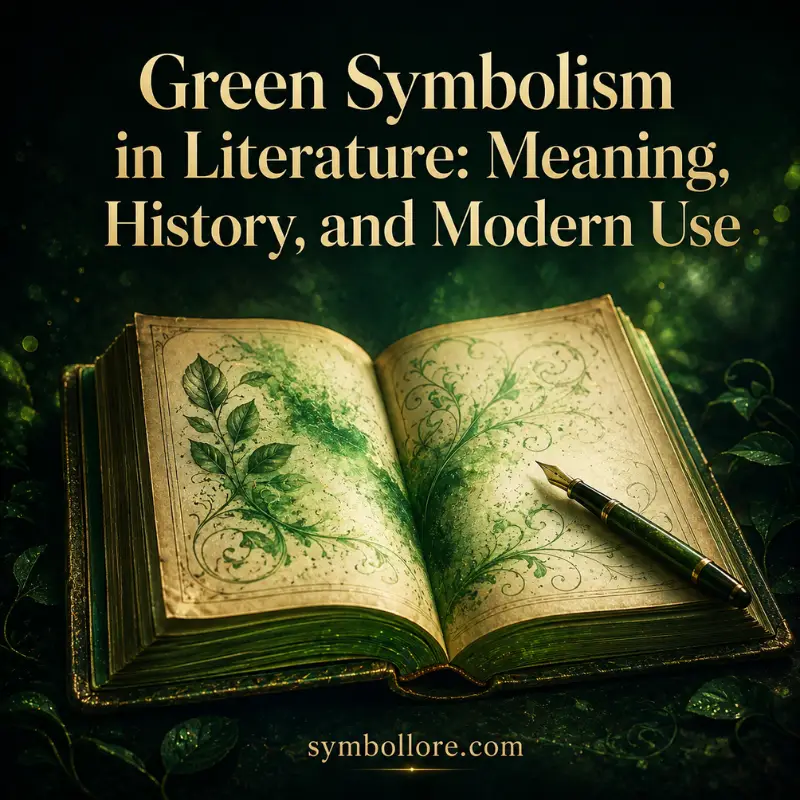
Green symbolism in literature represents ideas that writers connect with the color through narrative patterns. Its strongest positive associations include life, natural abundance, recovery, youth, and future possibility. Meanwhile, its negative side includes jealousy, greed, decay, poison, illness, and dangerous inexperience.
These meanings are starting points, not final answers. The same shade can signal hope in one scene and expose false hope in another. Likewise, a peaceful garden can become threatening after the plot changes.
A broader color meaning overview
helps identify common associations. Still, literary interpretation requires evidence from the work itself. Readers should examine repetition, contrast, dialogue, narration, and consequences before choosing a meaning.
Nature and Renewal: Why Green Suggests Growth and Rebirth
Nature and renewal form green’s most familiar literary connection because living leaves, grass, and crops visibly return after winter. Consequently, authors use growing vegetation to mark recovery, fertility, new beginnings, or a character’s return to emotional life.
Yet growth and rebirth do not always promise permanent happiness. New leaves remain vulnerable, spring passes, and fertile landscapes can become overgrown. Green may therefore represent a beginning whose outcome remains uncertain.
Setting also shapes this interpretation. A garden restored after war can suggest healing, while vines covering an abandoned house may show neglect. Both scenes contain living plants, but their narrative effects differ. One restores order; the other reveals how nature has overtaken human control.
Hope and Desire in The Great Gatsby
In The Great Gatsby, the distant green light represents Gatsby’s hope of reaching Daisy and recovering an idealized past. The light first appears across the water at the end of Daisy’s dock. Its physical distance turns emotional longing into something visible but unreachable.
The Project Gutenberg edition of The Great Gatsby
lets readers trace the light from Gatsby’s private gesture toward Daisy to the novel’s final meditation on the future. As a result, the symbol expands beyond romance. It comes to represent human ambition and the belief that fulfillment waits just ahead.
Hope and desire also intersect with money and social class. Gatsby can accumulate wealth, yet he cannot purchase the exact past he wants.
Fitzgerald’s use of blue imagery in the novel
adds fantasy and emotional distance, while green keeps Gatsby facing a desired future.
Jealousy and Envy: Shakespeare’s Green-Eyed Monster
Shakespeare gives green one of its best-known negative meanings in Othello. Iago warns Othello about jealousy by calling it the “green-eyed monster.”
The Folger Shakespeare text of Act 3, Scene 3
preserves the phrase in its dramatic setting.
The metaphor does more than attach a color to an emotion. It turns jealousy into a creature that consumes and mocks its victim. More importantly, Iago delivers the warning while deliberately creating Othello’s suspicion. Therefore, the image carries manipulation as well as envy.
The speaker matters here. Iago appears to protect Othello, but he plants the fear that destroys him. Green becomes threatening because the metaphor joins emotion, deception, and tragic consequences.
Youth and Inexperience in Robert Frost’s Green
Green can mean youth and inexperience because unripe fruit and new plants have not reached maturity. Writers may apply that association to a hopeful but untested character, an early stage of life, or an idea that has not fully developed.
Robert Frost complicates this meaning in “Nothing Gold Can Stay.” The poem begins with “Nature’s first green is gold,” linking the earliest growth with value, beauty, and rarity. However, the newness cannot last. Readers can examine the complete poem through the
Frost’s green does not simply mean life. Instead, it represents the brief perfection of beginnings. Youth appears precious partly because it changes so quickly.
Green Imagery in Sir Gawain and the Green Knight
In Sir Gawain and the Green Knight, green joins nature with the supernatural and morally uncertain. The Green Knight enters Camelot from a world beyond its orderly court. His color connects him with wilderness, seasonal return, danger, and life that survives apparent death.
A Cambridge Companion chapter describes
green otherworlds in early medieval literature
as spaces where ordinary law and reason lose their control. That background helps explain why the Green Knight can challenge both Gawain’s courage and Camelot’s confidence.
The green girdle changes meaning as the story develops. It begins as promised protection, becomes a sign of Gawain’s fear and shame, and finally gains a communal connection when other knights adopt similar bands. Thus, green shifts from magical hope to moral failure, self-knowledge, and solidarity.
Money and Ambition: Green as an American Status Color
In American writing, green can suggest money because U.S. paper currency has a strong cultural connection with the color. Authors may use green clothing, rooms, cars, lights, or landscapes to connect desire with wealth, competition, and social mobility.
Money and ambition often overlap, but they are not identical. A character may seek financial security, public status, freedom, or acceptance by a higher social class. Therefore, readers should identify what wealth promises inside the story.
This distinction matters in The Great Gatsby. Gatsby’s goal involves Daisy, but Daisy also belongs to a protected world of inherited wealth. Green can consequently support a class reading without reducing the dock light to “money” alone.
How Shade, Setting, and Cultural Context Change Meaning
Shade affects tone, although it cannot determine meaning by itself. Fresh green may suggest newness; emerald can imply richness or enchantment; olive may evoke peace or military life; and yellow-green can create an unhealthy or decaying mood. The surrounding objects decide which association becomes relevant.
Setting creates another layer. In L. Frank Baum’s The Wonderful Wizard of Oz, residents and visitors wear green spectacles inside the Emerald City.
shows that the city’s ruler requires those glasses. Green therefore becomes connected with controlled perception, spectacle, and authority—not merely nature.
Cultural context also matters. American readers may connect green with currency or permission to proceed. A medieval romance, however, may link it with wilderness or an otherworld. Strong analysis identifies the work’s period before applying a modern association.
When Green Is Description, Not a Literary Motif
A green object is not automatically symbolic. Authors often describe grass, clothing, paint, or eyes simply to create a visible scene. A literary motif usually gains significance through repetition, unusual emphasis, contrast, or a clear relationship with character and plot.
For example, the word “green” in a place name does not prove that the entire story concerns growth or envy. Likewise, one green chair may have no deeper function unless characters repeatedly notice it or important events occur around it.
Use restraint when evidence remains thin. The same principle applies to
a detail becomes persuasive as a symbol when several textual clues support the interpretation.
A Five-Step Close Reading Method
Close reading helps readers move from a familiar association to a defensible interpretation. Purdue OWL’s guidance on
recommends building an argument from specific elements and evidence within the work.
Use these five steps:
- Record each appearance. Note the green objects, characters, settings, and descriptions.
- Identify the observer. A frightened narrator may interpret the color differently from a hopeful character.
- Trace contrasts. Compare green with nearby colors, darkness, seasons, or changing locations.
- Connect it with events. Ask what happens before and after the color appears.
- Test the interpretation. Choose the meaning that explains the most details with the fewest unsupported assumptions.
Finally, express the result as an argument rather than a definition. A strong thesis names the symbol, its changing function, and the theme it supports. Textual evidence should then show how the writer creates that meaning.
FAQs
Green can be either positive or negative. It often represents nature, renewal, hope, health, or prosperity. However, it can also suggest envy, greed, illness, poison, decay, or dangerous inexperience. The relevant meaning depends on the green object, narrative tone, and events surrounding it.
The green light primarily represents Gatsby’s longing for Daisy and his hope of recovering an idealized past. As the novel develops, it also represents ambition and a desired future that continually moves away. Its distance across the water makes that separation physically visible.
Green became strongly associated with jealousy through language and literature, especially Shakespeare’s “green-eyed monster” in Othello. In that play, jealousy behaves like a consuming creature. However, readers should not assign envy to every green object unless the surrounding emotions and plot support it.
They can, but shade alone does not create a fixed definition. Light green may support youth, freshness, or fragility, while dark green may suggest dense nature, wealth, secrecy, or danger. Writers establish the final meaning through mood, objects, repetition, and narrative consequences.
Identify a repeated green detail, explain how its meaning changes, and connect that change with a major theme. For example, a thesis might argue that a distant green light turns personal romantic hope into a broader symbol of ambition that remains unreachable.
Yes. Green may serve as ordinary description when it simply identifies grass, clothing, paint, or another object. Symbolic significance becomes more convincing when the author repeats the color, emphasizes it unusually, contrasts it with other images, or connects it with important changes in character and plot.
Conclusion
Green symbolism in literature can express life, renewal, youth, hope, jealousy, wealth, danger, or decay. Still, none of these meanings applies automatically. A green light works differently from a green landscape, face, garment, or supernatural figure.
The strongest interpretation follows the work’s evidence. Examine the object, speaker, setting, historical period, repetition, and consequences. When those clues form a pattern, green becomes more than visual description: it becomes a flexible tool for revealing desire, conflict, identity, and change.