
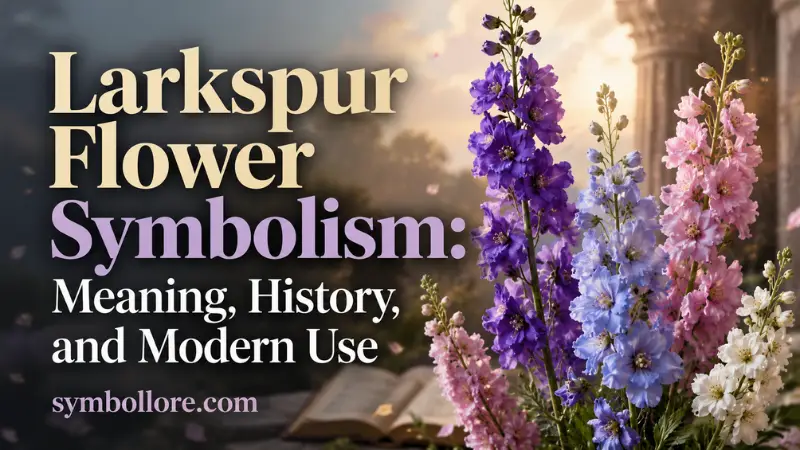
Larkspur flower symbolism centers on lightness, an open heart, and affectionate goodwill. Its blue, purple, pink, and white blossoms also carry different messages. However, those messages change between old flower dictionaries and modern gift traditions. A purple stem can suggest first love today, even though one well-known Victorian handbook assigned it a much less flattering meaning.
The flower itself helps explain its appeal. Spurred blossoms rise along slender stems, creating an airy shape that suits ideas of playfulness and grace. Its place in July birth-flower traditions adds another layer of personal meaning.
Understanding these layers makes larkspur easier to interpret. A birthday bouquet, a religious garden, and a family tattoo may feature similar flowers while expressing very different feelings.
Quick Answer
Larkspur flower symbolism most often expresses lightness, levity, and an open heart, with affection prominent in modern flower lore. Historical flower dictionaries support the lightness association, while the plant’s airy appearance offers a fitting visual explanation. Color, period, and setting matter: Victorian meanings could be critical, and religious traditions sometimes connect larkspur with sorrow.
TL;DR
- Lightness and levity have clear support in nineteenth-century flower language.
- An open heart and affectionate goodwill suit modern gifts and personal designs.
- Purple larkspur’s modern first-love meaning differs from Greenaway’s Victorian entry.
- Larkspur represents July in popular birth-flower traditions.
- Catholic Mary Gardens give its tear-shaped buds a distinct devotional meaning.
- The giver’s intention and the occasion help determine the final message.
Larkspur Meanings at a Glance
| Context | Meaning | Basis for the Association | Interpretation Limit |
|---|---|---|---|
| General flower language | Lightness and levity | Recorded in Victorian flower dictionaries | Levity can suggest playfulness or insufficient seriousness |
| Modern gifts | An open heart and affection | Contemporary flower-lore conventions | Does not always imply romantic love |
| Pink in Greenaway’s handbook | Fickleness | A specific historical entry | A modern pink bouquet need not carry criticism |
| Purple across periods | Haughtiness or first love | Different historical and modern lists | The two meanings belong to different readings |
| July birthdays | Personal identity and celebration | Birth-month flower tradition | Birth flowers do not determine personality |
| Catholic Mary Gardens | Mary’s sorrow and tears | Buds resemble teardrops | A devotional association, not a universal Christian rule |
| Personal memorials | Affection and remembrance | Connection with a person, birthday, or garden | Larkspur does not inherently mean death |
What Does Larkspur Flower Symbolism Mean?
The clearest starting point is emotional lightness. In a friendly setting, larkspur can suggest humor, ease, and the pleasure of someone’s company. It suits a message such as, “You make ordinary days brighter.” That interpretation gives the flower a specific emotional purpose without turning it into a promise of happiness.
An open heart adds a related idea: willingness to welcome and care for others. University of California Cooperative Extension includes openness, lightness, and levity among larkspur’s meanings in its account of
flower symbolism at the Tallac Estates.
Affection can therefore be romantic, friendly, or familial. For example, a partner might connect larkspur with shared laughter. A sibling might choose it to recall childhood summers. Both readings fit the flower without requiring the same relationship or message.
Still, “levity” deserves attention. The word can describe cheerful lightness, but it can also criticize someone for taking matters too lightly. Surrounding words and gestures help settle that difference.
How the Flower’s Shape Influences Its Meaning
Larkspur’s upright stems and many small blossoms create a different impression from a single large, heavy flower. The spaces between blooms can make a stem look light and mobile. As a result, viewers may connect its form with ease, playfulness, or a lifted mood.
That visual reading is an interpretation, not proof of the original historical cause. An old handbook may record a meaning without explaining who first chose it. We can recognize a convincing connection between appearance and symbolism while leaving the exact origin uncertain.
The names also encourage visual associations. “Larkspur” refers to a flower spur resembling a lark’s claw. Meanwhile, Delphinium comes from a Greek word for dolphin, linked to the flower’s shape. Neither name establishes a universal bird or ocean meaning.
Plant identity matters, too. Gardeners often distinguish annual larkspurs from tall perennial delphiniums. However, “larkspur” also appears in the common names of perennial Delphinium species. Therefore, a meaning attached to one named plant should not automatically transfer to every related flower.
What Victorian Flower Dictionaries Actually Recorded
Victorian flower language, also called floriography, assigned sentiments to plants. These printed lists gave readers a way to connect flowers with feelings, character traits, and social messages. However, they did not create one code that everyone interpreted identically.
Kate Greenaway’s Language of Flowers provides a useful historical example. She assigns larkspur “Lightness. Levity.” She gives pink larkspur “Fickleness” and purple larkspur “Haughtiness.” Those entries appear together in the
These distinctions reveal a more complicated flower language than a list of positive qualities suggests. A bloom could flatter, tease, or criticize. Consequently, a historically faithful scene should identify the handbook or convention its characters understand.
Similar differences appear in
Campanula’s flower-language history.
Comparing the two flowers shows why an old floral message needs a source and period, not merely a color.
How Larkspur Color Meanings Have Changed
Modern color guides often connect blue larkspur with grace, white with happiness, purple with first love, and pink with fickleness. Melissa Mayntz presents these associations alongside the flower’s July birthday role in her
contemporary larkspur lore guide.
These current conventions should not all be attributed to Greenaway’s Victorian entries.
Blue: Grace and a Calm Emotional Tone
Blue larkspur can convey admiration, composure, or gentle affection in a modern arrangement. Its cool color also makes it a useful choice when the intended mood is quiet rather than exuberant. However, color alone cannot establish a message of loyalty, healing, or spiritual protection.
For a personal gift, explain what the blue means to you. A sentence about the recipient’s kindness or steady presence makes the symbolism clear.
Purple: First Love or Haughtiness
Purple produces the sharpest historical contrast. Current lists often favor first love, while Greenaway’s entry points toward pride or superiority. Neither interpretation gives every purple stem one permanent message.
A modern anniversary bouquet can use purple to recall a relationship’s beginning. In historical fiction, however, a character following Greenaway’s list might read the same flower as a pointed comment. The date and shared convention change the meaning.
Pink: Fickleness, with Room for Personal Affection
Pink has a documented connection with changeable feelings in Greenaway’s handbook. Yet a person may choose pink flowers simply because the recipient loves that color. Receiving them does not provide evidence that someone doubts your loyalty or intends an insult.
For romance, a brief card can clarify the intended affection. There is no need to let an old dictionary overrule a thoughtful modern gesture.
White: Happiness or Personal Remembrance
White larkspur carries a happiness association in modern flower lore. Nevertheless, its setting can shift the emotional tone. At a celebration, it may feel bright and welcoming; beside a memorial photograph, it can support quiet remembrance.
That second reading comes from the arrangement and occasion. It does not make white larkspur an exclusively funeral flower.
Why Larkspur Represents July Birthdays
Larkspur is one of July’s recognized flowers in popular Western birth-flower lists. Water lily commonly shares the month. For American readers, that connection offers a straightforward way to personalize a birthday bouquet, illustration, or keepsake.
The distinction between a birth flower and a personality claim matters. Choosing larkspur for a July birthday honors a calendar association. It does not establish that every July-born person has an outgoing nature, an open heart, or particular romantic habits.
Likewise, the tradition does not require every larkspur to bloom in July everywhere. Species, climate, and growing conditions affect flowering time. The calendar connection functions as a cultural convention rather than a universal botanical schedule.
A birthday gift becomes more meaningful when it includes an individual reason. For example, larkspur might represent both someone’s birth month and the humor they bring to family gatherings. That combination joins a shared tradition with something true about the person.
Larkspur in Catholic Mary Gardens
Larkspur has a specific devotional role in Catholic Mary Garden traditions. In this setting, its buds can symbolize Mary’s tears and sorrow at Christ’s Crucifixion. The shape of the unopened flowers provides the visual connection.
The University of Dayton’s Marian Library preserves John S. Stokes Jr.’s account of
flowers associated with Mary’s sorrows.
It lists larkspur among plants whose teardrop-like features recall legends about Mary’s tears.
This example shows how a plant can gain a meaning through attention to one small feature. A secular bouquet may emphasize the whole stem’s light appearance. A devotional garden instead draws attention to the buds and connects them with compassionate sorrow.
The tradition also needs a clear boundary. It is a form of religious flower symbolism shaped by devotional interpretation and legend. It does not establish that a biblical passage names larkspur or assigns the flower this meaning directly.
For someone connected with that tradition, the plant may support reflection on grief, maternal love, or care for another person’s suffering.
The Ajax Legend and Its Botanical Uncertainty
Popular larkspur stories often connect the flower with Ajax, the Greek hero. A classical flower story does exist, but identifying its bloom as modern larkspur requires caution.
In Book 13 of Ovid’s Metamorphoses, a purple flower grows from the ground after Ajax’s death. Ovid links it with the flower associated with Hyacinthus and describes petal markings carrying the hero’s name and a cry of grief. The passage survives in the
classical text of Ajax’s transformation.
However, the poem does not give a modern botanical identification. It therefore cannot, by itself, prove that the flower belongs to a particular Delphinium species. Calling the story a verified account of larkspur’s origin goes beyond what the passage establishes.
The literary meaning remains useful even with that uncertainty. The flower preserves a name and gives grief a visible form. A modern artist could draw on that theme when depicting larkspur, provided the artwork presents the connection as an interpretation.
Choosing Larkspur for Gifts and Weddings
Larkspur works best as a symbolic gift when the message is specific. Start with the relationship and occasion, then choose a color that supports the mood. A bouquet does not need to carry every historical meaning associated with the plant.
For friendship, emphasize warmth or shared laughter. A message such as “For all the times you’ve made me smile” fits the lightness theme. If you want another flower with an affectionate friendship association, compare
freesia’s meanings of trust and thoughtfulness.
For a wedding, larkspur can express the couple’s hope for a life with room for joy and openness. A July birth-month connection may add another personal reason. These are thoughtful design choices rather than requirements of a fixed wedding tradition.
Pairings can introduce another idea. For example,
green roses and their associations with renewal
offer a way to connect affection with a growing shared life. Explain the pairing in a note if the meaning matters.
Real larkspur is poisonous, so keep it out of food, drinks, and edible decorations. Botanical artwork or an embroidered flower can communicate the same sentiment when a fresh arrangement is unsuitable.
Larkspur Tattoos, Keepsakes, and Memorial Meaning
A larkspur tattoo can represent a July birthday, a loved one, affectionate openness, or a personal commitment to finding joy. These are possible design intentions, not a code that every viewer will recognize. The wearer’s explanation remains the strongest guide.
The details can make that meaning more precise:
- A birth date connects the flower with a particular person or milestone.
- Several distinct stems can represent family members or relationships.
- A remembered garden variety can honor a place and the person who tended it.
- A handwritten name makes the personal connection explicit.
A memorial design does not require larkspur to be a traditional death symbol. Someone might choose it because a loved one was born in July, grew it, or enjoyed its color. In that case, the flower stands for a remembered life and relationship.
For comparison,
flowers associated with mourning across cultures
have different histories and ceremonial roles. Personal remembrance can overlap with those traditions without following all of them.
For an illustration or keepsake, preserve recognizable botanical features. A slender stem, distinct flower spurs, and the arrangement of blossoms help communicate larkspur more clearly than color alone.
An American Family’s Living Symbol of Remembrance
A family tribute preserved by UNC Charlotte Botanical Gardens shows how larkspur can acquire meaning through lived experience. Writing about her parents, Herb and Marilyn Adrian, Debbie Adrian Isaacs recalls how returning larkspur flowers comforted her mother after her father’s death. Their reseeding and spreading reminded the family of its own growth.
Later, when the family property faced redevelopment, the children collected larkspur seeds and other plants for their gardens.
The Adrian family’s garden remembrance
records that connection in the daughter’s own account.
Here, the flowers carried memory because someone had grown, tended, and loved them. Their return offered continuity, while saving seeds allowed family members to carry part of that place elsewhere. This is a documented personal meaning, not evidence that all American families interpret larkspur the same way.
How to Interpret Larkspur Without Overreading It
Begin with the setting before choosing a meaning. A birthday card, church garden, historical novel, and wedding arrangement supply different clues. Then look for a date, written message, named tradition, or personal explanation that narrows the possibilities.
In an artwork, ask what the flower does within the scene. Does someone offer it warmly, discard it, or place it beside a portrait? Those actions may carry more interpretive weight than the flower’s color. For historical work, the creator’s period and available flower books also matter.
Claims about protection, luck, or supernatural messages need a different standard. A named community’s documented belief can explain a tradition. A vague statement that “ancient people believed” something cannot establish where or when it applied.
Larkspur flower symbolism can still support personal reflection. You might use it as a reminder to welcome affection or make space for laughter. Presenting that as your chosen meaning keeps the interpretation honest and useful.
FAQs
It can express romantic affection, but the flower alone does not settle the question. A friend or relative may choose it for your birthday, favorite color, or cheerful character. The accompanying message and your relationship provide better evidence of romantic intent.
No. A historical association with fickleness does not describe the character of a person wearing the flower. The wearer may connect pink larkspur with a family member, a favorite garden, or a color preference. Ask about the design instead of assuming a negative message.
The names overlap, but garden usage is not perfectly consistent. “Larkspur” can describe annual garden flowers and several perennial Delphinium species. Meanwhile, gardeners often use “delphinium” for tall perennial varieties. Identifying the actual plant helps when interpreting a historical name or choosing a design.
Yes, different settings can support both meanings. Catholic Mary Gardens connect its buds with sorrow, while personal memorials may recall someone’s birthday or garden. Those uses do not cancel its cheerful associations. They show how relationships and traditions give a flower emotional depth.
No particular color is required to express the July association. Blue, purple, pink, or white can serve that purpose in a personal gift or illustration. Choose the shade that suits the recipient, then explain any additional meaning you want it to carry.
No single spiritual meaning applies across religions and communities. A Catholic devotional interpretation differs from someone’s personal use of the flower to represent openness or joy. Keep the tradition or individual intention visible rather than treating either reading as a message everyone must accept.
Conclusion
Larkspur flower symbolism brings together emotional lightness, affectionate openness, and meanings shaped by particular traditions. Its airy stems offer a fitting image for joy, while historical books preserve sharper messages that modern gift guides sometimes soften or replace. Religious gardens and personal memorials add further layers through specific stories and relationships.
The most useful interpretation therefore begins with context. Notice the color, occasion, period, and person who chose the flower. A July bouquet may celebrate someone’s life; a devotional planting may invite reflection on sorrow. Let those details guide the meaning, and use a clear personal message whenever the sentiment matters.
Five Related Articles from symbollore.com
- Campanula Symbolism: Meaning, History, and Cultural Uses — https://symbollore.com/campanula-symbolism/
- Freesia Symbolism: What This Fragrant Flower Really Means — https://symbollore.com/freesia-symbolism/
- Green Rose Symbolism: Meanings of Growth, Love, and Renewal — https://symbollore.com/green-rose-symbolism/
- Flowers That Symbolize Death: Meanings Across Cultures — https://symbollore.com/flowers-that-symbolize-death/
- Bee Balm Symbolism: Meaning, History, and Flower Lore — https://symbollore.com/bee-balm-symbolism/


