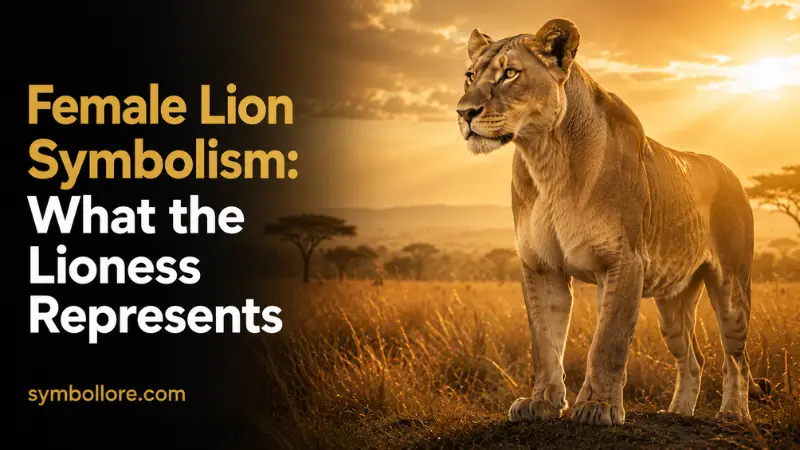
Female lion symbolism centers on courageous protection, cooperative leadership, family loyalty, patience, and feminine strength. Unlike the solitary ruler suggested by the familiar “king of beasts” image, a lioness gains much of her symbolic power from coordinated action within her pride.
These meanings partly reflect real behavior. Female lions form lasting social bonds, hunt cooperatively, and raise cubs within a group. However, historical traditions, religious texts, dreams, and modern designs interpret those traits in different ways. Therefore, the lioness has no single universal meaning.
Quick Answer
A female lion symbolizes protective courage, maternal devotion, strategic leadership, cooperation, and resilience. Female lion symbolism often represents strength used to preserve a family or community rather than power displayed for status. Its exact meaning changes by context: a lioness can suggest nurturing love, controlled ferocity, spiritual authority, or a warning about destructive power.
Key Takeaways
- Lionesses represent courage guided by purpose rather than display.
- Cooperative hunting inspires meanings of teamwork and shared leadership.
- Cubs strengthen associations with motherhood, family, and protection.
- Ancient traditions do not give the lioness one universal meaning.
- Dreams and tattoos depend heavily on personal context.
- Spiritual interpretations express beliefs, not proven supernatural messages.
Female Lion Meanings at a Glance
| Context | Common Meaning | Important Distinction |
|---|---|---|
| Lioness alone | Independence, patience, quiet confidence | Solitude may also suggest vigilance or isolation |
| Lioness with cubs | Motherhood, protection, family devotion | The image can honor any caring guardian |
| Group of lionesses | Cooperation, sisterhood, shared leadership | Real prides consist mainly of related females |
| Hunting lioness | Strategy, focus, decisive action | It represents coordinated effort, not aggression alone |
| Roaring lioness | Boundaries, warning, personal authority | Tone determines whether it feels protective or threatening |
| Ancient Egyptian image | Destructive and healing divine power | Meaning depends on the specific deity and period |
| Biblical lioness | Power, royalty, danger, judgment, or motherhood | The surrounding passage controls the meaning |
| Dream or tattoo | Personal courage, family, survival, identity | No interpretation fits every person |
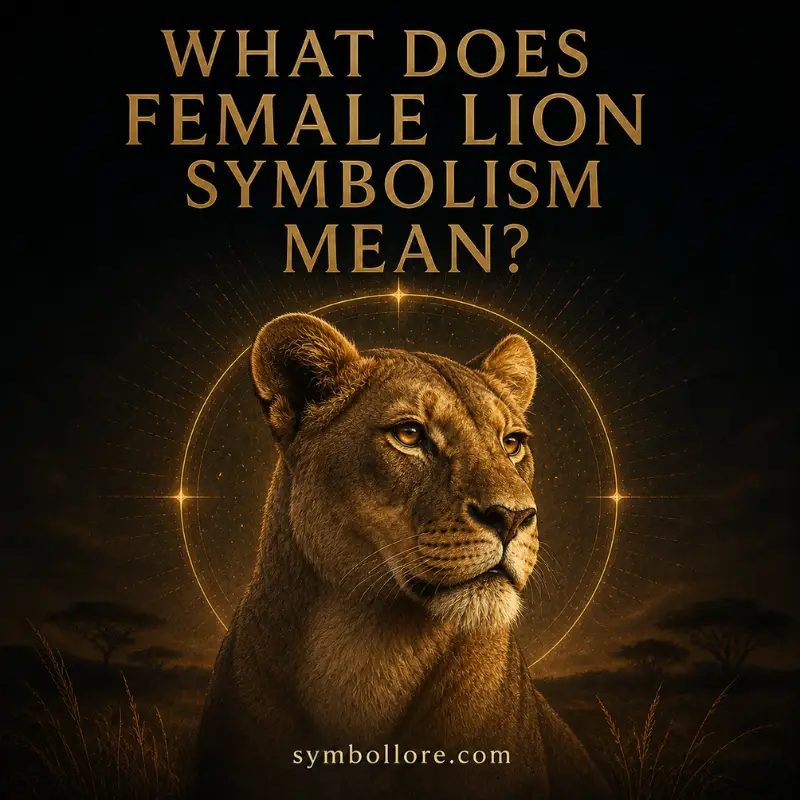
What Does Female Lion Symbolism Mean?
The lioness primarily represents power directed toward protection, survival, and collective well-being. She can act decisively, yet her strength does not depend on constant display. This combination supports modern associations with self-possession, courage, patience, and quiet authority.
Teamwork is equally important. Popular lion imagery often celebrates one commanding figure. In contrast, the female lion commonly symbolizes what a group can accomplish through trust and coordinated effort. That makes her a fitting emblem for families, women’s organizations, athletic teams, caregivers, and leaders who share responsibility.
The same image also contains tension. A lioness is nurturing toward her cubs but dangerous to a threat. Therefore, she can represent tenderness and ferocity at the same time. Neither side cancels the other.
Why Lioness Behavior Shaped the Symbol
Lioness meanings partly developed from visible features of lion society. The Smithsonian’s National Zoo describes lions as highly social cats that
hunt cooperatively and raise cubs in prides.
Related females commonly form the stable center of those groups.
These facts help explain symbolic connections with teamwork, kinship, and continuity. However, they do not prove that nature assigns a spiritual message to the animal. Humans observe behavior and then turn it into metaphor.
That distinction prevents two common errors. First, a pride is not a perfect model for human family or workplace life. Second, calling every pride a simple matriarchy overlooks the complex roles of both sexes, shifting group membership, competition, and environmental pressure. Symbolism works best when it draws insight from nature without turning nature into a human rulebook.
Female Lion Symbolism and Feminine Power
The lioness often represents feminine power that combines agency with connection. In modern American art and language, “lioness” can describe a woman who defends others, survives hardship, leads steadily, or refuses to become powerless.
This meaning can be affirming, but it should remain flexible. Women do not need to be mothers, physically imposing, self-sacrificing, or endlessly resilient to identify with a lioness. Likewise, people of any gender may use the symbol to express loyalty, strategic thinking, courage, or protective love.
The strongest interpretation avoids placing femininity and masculinity in opposing boxes. A lioness can be tender and forceful, independent and communal, calm and commanding. Her symbolic value lies in that range rather than in a fixed definition of how women should behave.
Motherhood, Family, and Protection
A lioness with cubs commonly represents maternal devotion and fierce protection. The image appears in tattoos, memorial pieces, family jewelry, and gifts honoring mothers. It may also represent a grandmother, adoptive parent, older sibling, mentor, or another person who provides safety.
Real behavior contributes to this association. Female lions may isolate themselves while giving birth and later introduce their cubs to the pride. Group life then allows related females to participate in guarding and raising young.
Still, the symbol is broader than biological motherhood. A cub may stand for a child, vulnerable community, creative project, or part of oneself that needs care. In this context, protection does not mean controlling everything. It means setting boundaries, recognizing danger, and giving another life enough security to grow.
Lioness Symbolism in Ancient Egypt
Ancient Egyptian imagery gave the lioness both dangerous and protective power. Sekhmet, whose name is commonly translated as “the powerful one,” appeared as a woman with a lioness head. She was associated with war, violent forces, illness, healing, and protection.
A New Kingdom statue of Sekhmet at The Metropolitan Museum of Art
dates to the reign of Amenhotep III. The museum explains that her destructive force could protect and heal once appeased. This evidence shows why “strength” alone cannot capture her meaning.
Sekhmet embodies controlled opposites: rage and restoration, danger and defense, disease and healing. However, she should not be treated as a generic “divine feminine” symbol detached from Egyptian religion. Her meaning belongs first to a particular historical belief system, even though modern viewers may draw personal lessons from it.
What a Lioness Symbolizes in the Bible
Biblical lioness imagery can communicate royal power, maternal influence, security, danger, or judgment. It is not consistently comforting. Readers must examine who the lioness represents and what happens around the image.
In Genesis 49:9, lion imagery helps describe Judah’s formidable position. Nahum 2 recalls lions and lionesses living without fear before announcing Nineveh’s destruction. Meanwhile, Ezekiel 19 presents a mother as a lioness who raises powerful young lions. The chapter is a lament concerning Israel’s princes, so the metaphor involves leadership and downfall rather than a simple celebration of motherhood.
These passages can be compared in
Bible Gateway’s collection of lioness references.
Their differences matter: biblical symbols gain meaning from their literary setting, not from a fixed spiritual dictionary.
Spiritual Meaning and “Spirit Animal” Language
In contemporary spirituality, a lioness may represent inner courage, protective boundaries, community support, or the need to act with patience. A person drawn to the animal might use it as a reflective symbol while facing leadership, caregiving, or recovery from adversity.
Such interpretations are personal beliefs rather than verifiable predictions. Repeatedly seeing lioness images does not prove that the universe, a deity, or an animal is delivering one specific message. Personal associations, recent experiences, media, and attention can all influence what someone notices.
The phrase “spirit animal” also deserves care because animal-guide and clan traditions have specific meanings within some Indigenous cultures. People outside those traditions can usually say “personal symbol,” “animal archetype,” or “source of inspiration” when they are describing individual reflection rather than a recognized cultural practice.
Dreams About a Female Lion
A female lion in a dream often reflects the dreamer’s feelings about power, protection, anger, responsibility, or family. The lioness’s behavior and the dreamer’s emotional response provide more insight than a fixed dream dictionary.
A calm lioness may suggest confidence or trusted protection. One guarding cubs may reflect caregiving and boundaries. An attacking lioness could represent a feared authority, suppressed anger, an escalating conflict, or the feeling that something important is threatened. Running from her may point toward avoidance, while walking beside her may express growing comfort with personal strength.
Dreams do not reliably predict outside events. A practical reading asks three questions: What was the lioness doing? How did you feel? What current situation carries a similar emotional pattern?
Lioness Tattoos, Jewelry, and Art
A lioness tattoo usually represents feminine strength, family devotion, survival, leadership, or protection. Design details make the message more specific.
- Lioness with cubs: parenting, guardianship, or family loyalty
- Roaring lioness: firm boundaries, resistance, or reclaimed authority
- Lioness portrait: dignity, confidence, patience, or identity
- Multiple lionesses: sisterhood, teamwork, or communal survival
- Lioness with flowers: strength joined with growth, beauty, remembrance, or healing
- Lion and lioness together: partnership, balance, or shared responsibility
Flowers, crowns, celestial objects, scars, and dates can change the reading further. For example, a crown adds sovereignty, while a memorial date turns a general symbol into personal remembrance. The wearer’s intended meaning remains more important than an online list.
Female Lion vs. Male Lion Symbolism
Female and male lion symbolism overlap, but visual emphasis often creates different associations. Both can represent courage, dignity, protection, authority, and power. Yet the male’s mane has made him a frequent symbol of royalty, public status, solar force, and visible command.
The lioness more often represents cooperative action, motherhood, strategic patience, family continuity, and strength without display. This distinction reflects human art and storytelling as much as animal behavior.
It should not become a rigid gender rule. Male lions also protect cubs and territory, while lionesses can compete, dominate, and act alone. Symbolic comparison identifies common cultural patterns; it does not assign permanent human traits to men and women.
How to Interpret a Personal Lioness Symbol
Interpret a lioness by beginning with context rather than using the first meaning found online. A five-question method keeps the reading grounded:
- What is the lioness doing? Resting, hunting, roaring, guarding, or walking each creates a different tone.
- Is she alone or with others? Solitude emphasizes independence; a pride emphasizes relationships.
- What emotion does she create? Safety, admiration, grief, fear, and pressure point toward different concerns.
- Where did the image appear? A religious artwork, dream, tattoo, logo, and wildlife encounter use separate symbolic systems.
- What is happening in your life? Leadership, family conflict, caregiving, recovery, or boundary-setting may shape the connection.
The best interpretation should clarify experience, not dictate a supernatural conclusion.
FAQs
Yes. A female lion commonly symbolizes physical courage, emotional endurance, strategic action, and confidence. Her strength is often portrayed as purposeful because it supports hunting, cub protection, and group survival. In modern symbolism, this can describe someone who acts firmly without constantly seeking attention.
A lioness frequently symbolizes motherhood, nurturing, guardianship, and devotion to family. However, the meaning is not limited to biological mothers. It can honor adoptive parents, mentors, older siblings, community protectors, or anyone responsible for helping another person feel secure.
It can function as a personal spiritual symbol, but there is no universal evidence that seeing one predicts an event or carries a fixed supernatural message. Consider the setting, your beliefs, and your current concerns. Treat the experience as an invitation to reflect rather than as an unquestionable instruction.
A roaring lioness commonly represents warning, authority, defended boundaries, or a refusal to remain silent. In a threatening composition, she may instead represent uncontrolled anger or danger. Her posture, surroundings, and the viewer’s emotional response determine which interpretation fits best.
A lioness with cubs represents protective love, caregiving, family continuity, and responsibility for vulnerable lives. In memorial or family art, individual cubs may represent particular children. The design can also honor a guardian’s courage without suggesting that care requires constant aggression.
In relationships, a lioness can represent loyalty, mutual defense, shared work, and strong boundaries. Multiple lionesses may emphasize supportive friendship or sisterhood. However, a territorial or attacking lioness can symbolize jealousy, conflict, or protection that has become controlling.
No. Although many modern designs celebrate courage and motherhood, a lioness can also represent danger, vengeance, destructive power, pride, or fear. Ancient religious texts and artworks often preserve this dual meaning. Context decides whether her power protects, threatens, or does both.
Conclusion
Female lion symbolism expresses courage joined with protection, patience, cooperation, and decisive action. The lioness can honor motherhood and feminine power, but her meaning also extends to community, leadership, survival, and strong personal boundaries.
No interpretation is universal. Ancient Egyptian art, biblical literature, wildlife behavior, dreams, and tattoos each use the animal differently. A careful reading identifies the context, separates documented tradition from personal belief, and avoids turning animal behavior into a restrictive rule for human identity.


