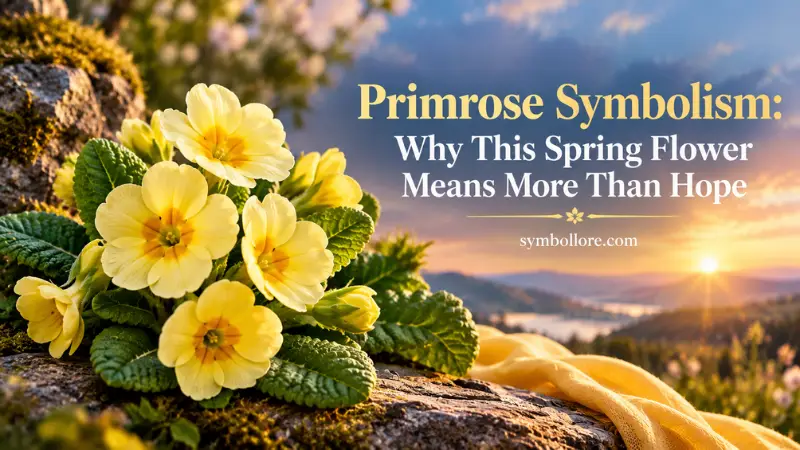
Primrose symbolism often starts with spring. Its early flowers can suggest a fresh start, youth, and hope after winter. In historical flower language, the common primrose also stood for early youth. Yet its story has a sadder side: Shakespeare used pale primroses to evoke young lives cut short and a primrose-lined path to picture tempting pleasure.
Those meanings do not cancel one another out. They come from different settings: a living flower, a nineteenth-century dictionary, a play, or a local tradition. This article focuses on the common primrose, Primula vulgaris, and explains when each reading fits. It also clears up a frequent mix-up with evening primrose, which is a different plant.
Quick Answer
Primrose symbolism most often suggests spring, youth, renewal, and affection because the common primrose flowers early in the year. Kate Greenaway’s nineteenth-century flower dictionary gives it the meaning “early youth.” Shakespeare also gave primroses darker literary roles, including a tempting path and a flower linked to early death. The setting determines which meaning applies.
Primrose Meanings at a Glance
| Context | Possible meaning | Why that reading fits | Important limit |
|---|---|---|---|
| Early spring bloom | Renewal and hope | Flowers appear when winter is ending | A seasonal interpretation, not a prediction |
| Kate Greenaway’s flower dictionary | Early youth | The printed entry assigns that meaning | Other flower books may differ |
| Shakespeare’s “primrose path” | Attractive but risky pleasure | A character contrasts it with a difficult moral path | The phrase does not describe every primrose image |
| Pale primroses in Shakespeare | Youth and early death | The flowers appear in scenes of loss | A literary use, not the flower’s universal meaning |
| Irish doorway folklore | Protection from fairies | The tradition assigns flowers a protective role | A folk belief, not a proven effect |
| Primrose Day | Memory of Benjamin Disraeli | The flower became an emblem after his death | A specific British political history |
| A gift or personal design today | Affection or a fresh chapter | The giver chooses an association | The recipient may not know the intended message |
Why Primroses Suggest Spring and New Beginnings
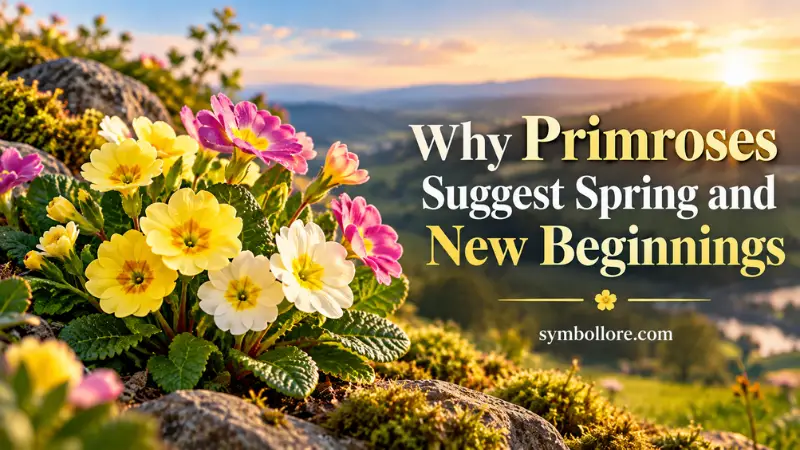
The common primrose has a strong link with seasonal change because it flowers early.
The Royal Horticultural Society’s guide to primroses
notes that Primula vulgaris may open in December or January during a mild British winter, with flowering often peaking in March and April. Its arrival while many other plants remain quiet makes renewal an understandable interpretation.
The flower is small and usually pale yellow in its wild form. It grows close to the ground, where a few open flowers can stand out against old leaves. That visible shift from winter to growth helps explain why a primrose in a poem or garden may suggest hope. It does not follow that the flower has a fixed spiritual message. A person or artist gives the seasonal change its human meaning.
Cultivated primroses add another distinction. Plant breeders have produced a wide range of bright colors, as the RHS explains. A vivid red garden plant and a pale wild primrose may give viewers different impressions. Those impressions should not automatically become claims about centuries-old traditions.
For another flower whose season shapes its meaning, see
What Victorian Flower Language Said About the Primrose
Nineteenth-century flower books gave plants short messages or qualities. People often call this practice the language of flowers, or floriography. It can help explain a historical picture or gift, but it was not one official dictionary that every person followed.
English Heritage’s account of flower language
notes that writers assigned differing meanings and that evidence for bouquets routinely carrying precise secret messages is limited.
A useful primary example is Kate Greenaway’s Language of Flowers, published in 1884.
Its primrose entry in the digitized book
reads “early youth.” It lists evening primrose separately as “inconstancy.” Greenaway also gives red primrose a separate entry, “unpatronized merit.” These are meanings in her book, not universal rules for all primroses or all Victorians.
Many modern guides attach the romantic message “I can’t live without you” to primrose. That phrase may appear in later flower-meaning traditions, but it is not Greenaway’s entry for the common primrose. If you want to describe a historical message accurately, name the book you mean. If you are giving the flower today, your own words will communicate affection more clearly than an assumed code.
Shakespeare’s Primroses: Beauty, Temptation, and Loss
Shakespeare shows why a flower can have opposite emotional meanings. In Hamlet, Ophelia warns Laertes against recommending strict behavior while taking the “primrose path of dalliance” himself. The attractive path stands against a steep, difficult route. In this scene, primroses make an easy course look inviting; they do not make that course wise.
The Folger Shakespeare Library’s text of Act 1, Scene 3
gives the phrase in its dialogue.
Elsewhere, Shakespeare uses pale primroses in a more mournful way.
The Shakespeare Birthplace Trust’s study of the flower
explains its link with youth and early death in his works. A spring flower can therefore draw attention to a life that ends before it has fully grown.
The surrounding passage decides what the reader should take from it. A primrose on a hopeful spring morning and a pale primrose beside a grieving character perform different jobs. Neither passage proves that the flower itself always means temptation or death.
Irish Folklore and the Flower at the Doorway
In one Irish folk belief, placing primroses at a doorway protected a home from fairies.
The Woodland Trust’s primrose profile
records that association. It is a folklore meaning: it tells us something about a traditional story and the role of a household threshold, not about an effect that flowers can be shown to have.
The doorway detail matters. A threshold marks the boundary between home and the outside world. In a story where fairies can cross that boundary, putting flowers there gives an ordinary plant a protective role. The meaning comes from the custom and belief together. It would be too broad to claim that all Irish people shared the practice or that every primrose in European folklore means protection.
If the folklore figure interests you,
looks at why fairies can suggest both wonder and caution.
How the Primrose Became a Symbol of Remembrance
Primrose history extends beyond gardens and poetry. After British prime minister Benjamin Disraeli died in 1881, the flower became connected with his memory and Conservative political culture. The UK government’s
history of Disraeli and the primrose
traces the growth of Primrose Day and the Primrose League after his death.
Here, the flower’s meaning did not arise simply because it blooms in spring. People chose and repeated it as a public emblem associated with one person. This is a useful contrast with the flower’s seasonal meaning. A primrose left in a garden may suggest renewal; a primrose used in a Disraeli commemoration points to a specific political and memorial history. You need to know the occasion to read it well.
Do Primrose Colors Have Fixed Meanings?
No reliable, universal color chart applies to every primrose. A color may shape how a gift feels, and a particular flower dictionary may assign it a meaning. Those are different kinds of evidence.
The wild common primrose is generally pale yellow, as the
Woodland Trust’s identification guide
describes. That appearance can make a spring image feel gentle or bright. A gardener may choose a pink cultivated primrose to express affection, or a red one to create a bold design. Those choices are reasonable personal interpretations; they do not establish an old meaning shared across cultures.
Historical color claims need their own source. Greenaway, for example, printed a separate meaning for red primrose. That does not support every modern claim that red always means romantic passion, white always means mourning, or purple always means spiritual healing. For a comparison with a spring flower whose color and first-love associations appear in period sources, read
Common Primrose and Evening Primrose Are Different Plants
The shared name can lead to a mistaken interpretation. Common primrose is Primula vulgaris. Common evening primrose is Oenothera biennis.
The RHS identifies common primrose as a Primula,
while a USDA plant guide identifies common evening primrose as Oenothera biennis.
The difference also matters in flower language. Greenaway listed “primrose” and “primrose, evening” as separate entries with separate meanings. If an article applies evening primrose’s “inconstancy” to a picture of Primula vulgaris, it has crossed both a botanical and a historical line.
Check the plant name when you can. If a painting or gift shows a flower without enough detail to identify it, keep the interpretation modest. A label, artist’s note, or plant tag can do more for accuracy than a long list of supposed meanings.
What Can a Primrose Mean in an American Gift or Design Today?
In a modern U.S. gift, garden, card, or tattoo, a primrose can express a new chapter, affection, or appreciation for spring. Those are possible messages, not claims that every recipient will recognize the same code. The flower works especially well when its early bloom matters to the giver: perhaps it recalls the first warm days after a hard season or a person who loved a spring garden.
A short note makes that meaning clear. “These reminded me of the first signs of spring” tells the recipient more than an unexplained color rule. In artwork, the surrounding details can do the same job. Bright new growth may support a hopeful reading; a faded flower beside a memorial may point toward loss.
For tattoos, ask what the design depicts and why its wearer chose it. A date, name, or second flower can change the message. The older literary and folk meanings remain available to an artist, but a personal design does not need to claim a Victorian origin.
FAQs
A common primrose most often suggests spring, youth, and a fresh start because it flowers early. Affection is another possible meaning, especially when someone chooses it as a gift. A historical artwork or text may use it differently, so check the setting before settling on one answer.
Some modern flower guides give primrose that romantic message, but it is not a fixed Victorian translation. Kate Greenaway’s 1884 Language of Flowers lists the common primrose as “early youth.” If you want a gift to carry a strong romantic message, say it directly in a note rather than relying on a disputed flower code.
The “primrose path” is an attractive, easy course associated with pleasure and possible trouble. In Hamlet, Ophelia uses the image while challenging Laertes to follow the moral advice he gives her. The phrase describes the choice in that scene; it does not mean that all primroses symbolize wrongdoing.
Yes, in some Irish folklore. One recorded belief placed primroses at the doorway to protect a household from fairies. It is best understood as a traditional belief tied to that setting, rather than a general spiritual rule about every primrose.
No. Common primrose is Primula vulgaris, while common evening primrose is Oenothera biennis. Their shared everyday name does not make them the same plant. Historical flower dictionaries may also list them separately, so check which flower a source actually discusses.
Sources and Further Reading
- Royal Horticultural Society: Everything You Need to Know About Primroses
- Kate Greenaway: Language of Flowers
- Folger Shakespeare Library: Hamlet, Act 1, Scene 3
- Shakespeare Birthplace Trust: Shakespeare’s Favourite Flowers—The Primrose
- Woodland Trust: Primrose
Conclusion
Primrose symbolism begins with a visible event: a small flower opening early in the year. That timing makes spring, youth, and renewal natural readings. Yet printed flower language, Shakespeare’s plays, Irish folklore, and British political history give the primrose other roles. The same flower can mark an appealing but risky path or become an emblem of remembrance.
For the clearest interpretation, identify the plant and then look at its setting. Ask whether a meaning comes from an observed season, a named text, a local belief, or a person’s own choice. That approach preserves the flower’s richness without giving it a message everyone must share.