Grace symbolism turns an abstract quality into visible forms such as a swan, lotus, dove, flowing water, or open hands. Yet grace has more than one meaning. It can describe elegant movement, calm and generous behavior, or divine help freely given.
Therefore, the right symbol depends on the intended message and tradition. A swan usually emphasizes poise, while a lotus suggests purity that rises through difficulty. In Christian settings, the cross, water, bread, and wine may express divine grace. Understanding these layers prevents a beautiful image from receiving a false universal meaning.
Quick Answer
Grace symbolism most often represents elegance, compassion, dignity under pressure, spiritual renewal, or divine favor. Swans and egrets convey physical poise, while pink roses and lotuses express gentle beauty or purity. Christian images such as the cross and water point to God’s freely given help. However, culture, setting, and intention determine the best interpretation.
TL;DR
- Grace can mean poise, kindness, or freely given divine help.
- Swans and egrets are clear movement-based symbols.
- Lotuses and pink roses express different forms of graceful beauty.
- Christian traditions use several grace symbols, not one universal emblem.
- Context matters more than a fixed online symbol list.
Grace Symbols at a Glance
| Symbol | Common Meaning | Strongest Context | Important Limit |
|---|---|---|---|
| Swan | Elegance, beauty, fluid movement | Art, dance, personal designs | It can carry other mythological meanings |
| Egret | Patience, precision, calm competence | Nature symbolism and reflective art | Many interpretations are modern |
| Dove | Peace, Holy Spirit, divine presence | Christian art and worship | Grace is usually an indirect association |
| Lotus | Purity, transcendence, renewal | Buddhist art and modern spirituality | Meanings differ across cultures |
| Pink rose | Gentleness, admiration, gratitude | Western flower language and gifts | Color meanings are not universal |
| Cross | Redemption and divine favor | Christian faith and religious art | It does not represent secular grace |
| Water | Renewal, life, cleansing, baptism | Religious and personal symbolism | Water has many unrelated meanings |
| Three Graces | Beauty, joy, abundance, reciprocity | Greco-Roman mythology and art | They differ from Christian grace |
What Does Grace Symbolism Mean?
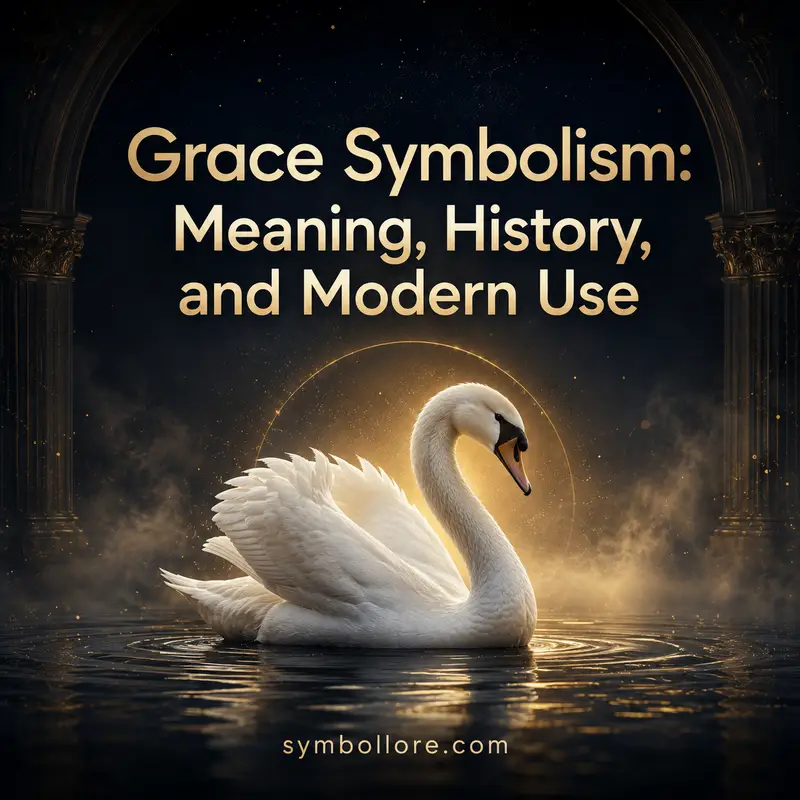
Grace symbolism represents qualities associated with smooth movement, dignified conduct, kindness, favor, beauty, or spiritual help. These meanings reflect the word’s range.
Merriam-Webster’s definition of grace
includes fluid movement, controlled behavior, goodwill, Christian help from God, and the mythological Graces.
A symbol can express those ideas through several channels. Its shape may appear elegant, its behavior may suggest composure, or a religious tradition may give it a specific role. For example, a swan communicates grace through movement. In contrast, water can represent spiritual renewal because religious rituals and texts give it that symbolic meaning.
Consequently, no image has one fixed definition. The strongest reading considers appearance, action, historical use, cultural setting, and the viewer’s intention.
Three Layers: Poise, Compassion, and Divine Grace
Grace usually operates on three connected but distinct levels:
- Physical grace means fluid movement, balance, elegance, and control. Swans, egrets, dancers, curved lines, and flowing fabric often communicate this layer.
- Behavioral grace means patience, compassion, forgiveness, or dignity under pressure. Open hands, gentle animals, and calm water can support this idea.
- Divine grace means help or favor given by God. In Christian theology, people commonly describe it as unearned favor rather than a reward produced by human merit.
These meanings can overlap. A calm bird may represent both physical poise and emotional control. However, the spiritual meaning of grace should not automatically be assigned to every elegant object.
This framework keeps grace symbolism precise. It also prevents a secular image of beauty from being presented as an established religious emblem.
Animals That Represent Grace: Swan Symbolism and the Egret
Among animals, swan symbolism most directly communicates elegant movement, beauty, and poise. A swan’s curved neck and smooth motion across water create an immediate visual link. Historical art also supports the connection. The Metropolitan Museum of Art’s
fourth-century Greek image of Aphrodite riding a swan
identifies the bird with music, divination, health, and grace.
Egrets express a quieter form of the same quality. Their measured steps, still hunting posture, and sudden accurate strike combine composure with practical skill. Therefore, an egret can represent remaining calm without becoming passive. Symbollore’s guide to the bird’s
patient hunting and controlled movement
explains this behavior-based reading further.
Deer and gazelles may also suggest gentle alertness, sensitivity, or graceful speed. Still, their cultural meanings vary. They should not replace the swan as a universal answer or receive invented ancient origins.
Flowers and Nature: The Lotus Flower and Pink Rose
The pink rose commonly represents gentle admiration, gratitude, and graceful beauty in modern American flower language. Clemson Cooperative Extension’s
specifically associates pink roses with affection, gratitude, and grace. As a result, they suit thank-you gifts, tributes, and designs honoring a quietly generous person.
The lotus flower communicates a more spiritual form of grace. It rises from muddy water while producing a clean bloom. Buddhist art therefore uses it for purity, integrity, and transcendence. The Smithsonian’s National Museum of Asian Art explains this meaning in its
However, Egyptian blue-water-lily traditions and Asian lotus traditions have different foundations. Readers can examine the
ancient and modern meanings of the blue lotus
before combining those traditions in artwork.
Christian Symbolism: Cross, Water, and Dove Symbolism
Christian symbolism does not reduce grace to one required emblem. Instead, different images explain how believers understand God’s presence, salvation, renewal, and freely given gifts.
The cross is the clearest Christian image of redemption and divine favor. Meanwhile, baptismal water represents cleansing, new life, and spiritual renewal. Bread and wine carry sacramental meanings, while fire and clouds can signify divine presence or transformation. The St. Paul Center’s
study of five biblical grace images
explains wood, water, fire, clouds, and bread with wine through Catholic theology and Scripture.
Dove symbolism usually points more directly to peace and the Holy Spirit. However, a dove can support a grace-centered design when the religious setting makes that connection clear. Different Christian traditions explain grace and sacraments differently, so writers should avoid claiming that one image carries an identical meaning for every denomination.
The Three Graces in Greek Mythology and Art
The Three Graces are Greco-Roman figures associated with beauty, joy, abundance, social harmony, and reciprocal giving. They belong to a different tradition from Christian grace.
The Metropolitan Museum of Art identifies the familiar trio as Aglaia, Euphrosyne, and Thalia.
Its Roman statue group of the Three Graces
links them with beauty in the arts, growth, festivity, and beneficial exchange. Artists often show the three figures standing or dancing together in a connected composition.
In Greek mythology, their group expresses the pleasures and gifts that enrich social life. Therefore, an artwork featuring three classical figures may represent harmony, charm, or generosity. It should not automatically be interpreted as a picture of salvation, forgiveness, or Christian theology merely because English uses the word grace for both ideas.
Colors, Objects, and Elements That Suggest Grace
Colors and objects can strengthen a grace-centered design, although they rarely operate as universal symbols by themselves.
- White often suggests simplicity, purity, peace, or spiritual clarity in Western settings.
- Soft pink commonly conveys gentleness, appreciation, and quiet affection.
- Pale blue can create a calm, reflective, or devotional tone.
- Pearls suggest polished beauty, balance, restraint, and quiet elegance.
- Open hands express generosity, welcome, surrender, or readiness to receive.
- Flowing water can represent renewal, movement, life, or freely given support.
- Circles may communicate continuity, wholeness, or an unbroken relationship.
However, grace symbolism changes when these elements enter another culture or occasion. White, for instance, does not communicate celebration everywhere. Likewise, a pearl may suggest wealth in one design and purity in another. The complete composition carries more meaning than an isolated color.
Grace Symbolism in Art, Jewelry, and Tattoo Design
A strong grace design begins with the intended message, not a random symbol list. Use this simple process:
- Choose the kind of grace. Decide between elegance, compassion, resilience, renewal, or religious favor.
- Select the main image. Use a swan for poise, an egret for calm precision, or a lotus for spiritual growth.
- Add one supporting element. Water, light, open hands, or a soft color can clarify the message.
- Check the tradition. Confirm whether religious or cultural imagery belongs in the design.
- Test the reading. Ask whether the intended viewer can understand the message without a long explanation.
For example, a swan with flowing lines emphasizes elegant movement. An egret among bending reeds suggests grace under pressure. Meanwhile, a cross above water communicates a clearly Christian message. Open hands with soft light offer a more inclusive image of compassion and generous support.
How to Interpret a Grace Symbol in Context
A grounded personal interpretation should begin with four questions:
- What exact animal, plant, object, or figure appears?
- What is the symbol doing?
- Which religion, culture, artwork, or occasion surrounds it?
- What personal event or feeling makes the image important?
Action often changes the reading. A swan moving across calm water conveys something different from an injured or trapped bird. Likewise, a closed lotus bud may suggest potential, while an open bloom can express maturity or clearer awareness.
This method also applies to dreams and memorable wildlife encounters. Grace symbolism can help someone reflect on patience, self-respect, forgiveness, or composure. However, a dream or sighting does not objectively predict romance, wealth, reconciliation, or divine intervention.
Common Mistakes and Cultural Respect
The most common mistake is treating every online association as an ancient or universal belief. Writers should separate documented history from later devotional practice, modern design convention, and private interpretation.
Other mistakes include:
- confusing the classical Graces with Christian theology;
- calling every white bird a symbol of divine favor;
- presenting grace as an exclusively feminine quality;
- combining sacred patterns from unrelated cultures;
- assigning a fixed meaning without considering the symbol’s action;
- treating dreams or sightings as guaranteed supernatural messages;
- claiming that the number five universally means biblical grace.
The form also matters. Antlers can emphasize power and renewal, while a whole doe may suggest gentleness. Symbollore’s explanation of
how antlers differ from whole-deer imagery
demonstrates why closely related images should not be treated as interchangeable.
FAQs
No single symbol works in every context. The swan is one of the clearest general symbols of elegance and fluid movement. However, Christians may prefer the cross or water for God’s grace, while a lotus better expresses purity, renewal, or spiritual development.
Swans and egrets commonly symbolize grace because their movement appears controlled, balanced, and elegant. Deer or gazelles may also represent gentle alertness and graceful speed. Still, the animal’s behavior, posture, cultural setting, and surrounding design determine the fuller message.
A pink rose commonly represents gentle admiration, gratitude, and grace in Western flower language. Meanwhile, the lotus conveys purity, spiritual development, and transcendence in several Asian religious settings. There is no single flower with the same meaning in every culture.
The cross is a central Christian image of redemption and freely given salvation. Water can represent baptism, new life, and spiritual cleansing. Bread and wine, fire, clouds, light, and the dove can also communicate aspects of divine presence or grace, depending on the denomination and setting.
White, soft pink, and pale blue often support grace-centered designs. White can suggest purity, pink can express gentleness, and blue can create a calm spiritual tone. However, color meanings differ by culture, religion, occasion, and combination, so none functions as a universal grace color.
Some modern Christian numerology sources connect five with grace. However, the Bible does not establish a universal rule that the number five always carries that meaning. It is safer to describe the association as a later devotional interpretation rather than a fixed biblical definition.
Conclusion
Grace symbolism becomes clearest when the intended kind of grace comes first. A swan or egret expresses poised movement, while a pink rose suggests gentle admiration. A lotus evokes purity or renewal, and Christian images such as the cross and water communicate divine favor. The Three Graces belong to a separate Greco-Roman tradition centered on beauty, joy, abundance, and reciprocal giving.
Because symbols change across cultures and settings, use historical context alongside personal meaning. The strongest choice is the image that communicates its purpose without relying on a false universal claim.


