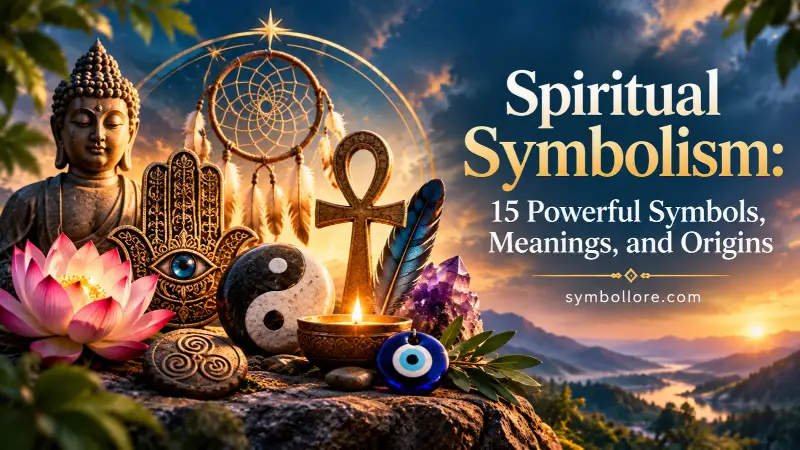
Spiritual symbolism helps people express ideas about faith, hope, protection, and the mysteries of life. A simple image, such as a lotus flower or a circle, can carry meaning far beyond its appearance.
People encounter spiritual symbols in churches, temples, artwork, jewelry, meditation spaces, and even tattoos. Yet these symbols do not always mean the same thing to everyone.
Some have deep religious histories. Others represent personal beliefs or modern interpretations. Understanding their origins can reveal why they matter and how their meanings change across cultures.
This guide explores spiritual symbolism, explains 15 familiar symbols, and shows how to interpret them with care.
Quick Answer: What Is Spiritual Symbolism?
Spiritual symbolism is the use of images, shapes, objects, sounds, or gestures to express spiritual and religious ideas. Symbols may represent faith, protection, wisdom, renewal, balance, or a connection with the sacred. For example, the Christian cross represents central beliefs about Jesus Christ, while the lotus symbolizes purity and spiritual growth in several Asian religious traditions. Meanings depend on cultural and historical context.
Key Takeaways
- Spiritual symbols can communicate complex religious and philosophical ideas through simple forms.
- Sacred symbols often have specific meanings rooted in established traditions.
- Nature, animals, and geometric patterns can also carry spiritual associations.
- A symbol may hold different meanings across cultures and historical periods.
- Personal interpretations can be meaningful, but they should not replace documented traditional meanings.
What Is Spiritual Symbolism?
Spiritual symbolism refers to the use of visible or recognizable forms to represent ideas beyond their ordinary appearance.
These forms may include flowers, animals, colors, geometric patterns, written characters, or religious objects.
For example, a tree is a living plant. However, a tree used in spiritual art may represent life, family connections, renewal, or the relationship between earthly and sacred worlds.
The difference lies in the meaning people give the image.
A symbol becomes important through its connection to stories, beliefs, rituals, or shared experiences.
Religious Symbols vs. Personal Spiritual Symbols
Religious symbols belong to established traditions and often reflect particular teachings.
The Christian cross, for example, represents beliefs about the crucifixion and resurrection of Jesus Christ. Its meaning comes from Christian history and theology.
Personal spiritual symbols work differently. Someone might choose a mountain as a reminder of perseverance or a butterfly to represent a fresh start.
Such interpretations can support personal reflection. However, they do not automatically become religious teachings.
The Meaning and Importance of Spiritual Symbolism
Spiritual symbols matter because they make abstract ideas easier to express.
Concepts such as eternity, faith, inner peace, and spiritual growth can be difficult to describe. Symbols help people understand and remember these ideas.
1. Faith and Sacred Identity
Many religious communities use symbols to express shared beliefs.
These images appear in places of worship, ceremonies, books, and devotional objects.
Their presence can communicate a person’s religious identity and connection to a community.
2. Protection and Reassurance
Certain symbols are traditionally associated with protection.
For example, the hamsa hand appears in several Middle Eastern and North African cultural traditions. People have used it as an amulet associated with protection against misfortune or the evil eye.
The protective meaning reflects cultural beliefs rather than scientifically demonstrated supernatural effects.
3. Personal Growth and Transformation
Some images represent the process of change.
A butterfly may symbolize transformation, while a lotus can suggest spiritual development.
These associations can encourage reflection during difficult or uncertain periods.
4. Balance and Inner Peace
Symbols also express relationships between opposing or complementary forces.
The yin-yang diagram, for example, represents the dynamic relationship between yin and yang in Chinese thought.
This meaning involves more than the simple idea of finding a comfortable balance between two choices.
Types of Spiritual Symbols
Spiritual symbolism includes several overlapping categories.
Religious and Sacred Symbols
These symbols belong to particular faith traditions and express religious teachings, identity, or devotion.
Examples include the cross, Om, the dharma wheel, and the Star of David.
Nature-Based Symbols
Natural objects can represent growth, renewal, continuity, or change.
Trees, flowers, mountains, rivers, and the sun appear in many symbolic traditions.
Their meanings vary with the cultural setting.
Animal Symbols
Animals frequently appear in sacred stories and religious artwork.
A dove may represent the Holy Spirit in Christian art, while the falcon was associated with the Egyptian god Horus.
These meanings come from specific traditions rather than one universal animal-symbol system.
Geometric Symbols
Circles, spirals, and symmetrical patterns can express order, connection, continuity, or sacred ideas.
However, not every geometric design has a spiritual meaning.
Its interpretation depends on how and where it is used.
15 Spiritual Symbols and Their Meanings
The following table introduces well-known religious symbols and broader spiritual motifs.
| Symbol | Common meaning | Main cultural or historical context |
|---|---|---|
| Lotus flower | Purity, awakening, spiritual growth | Hinduism and Buddhism |
| Om (Aum) | Sacred sound, ultimate reality | Hindu traditions; also used in other Indian religions |
| Yin and yang | Complementary forces, interdependence | Chinese philosophy |
| Ankh | Life and continued existence | Ancient Egypt |
| Christian cross | Crucifixion, redemption, resurrection | Christianity |
| Hamsa hand | Protection from misfortune | Middle Eastern and North African traditions |
| Dharma wheel | Buddhist teachings and the path | Buddhism |
| Star of David | Jewish identity and community | Judaism |
| Tree of life | Life, connection, continuity | Various traditions |
| Dove | Peace; the Holy Spirit in Christian contexts | Christianity and wider Western symbolism |
| Mandala | Sacred order, spiritual focus | Hindu and Buddhist traditions |
| Crescent moon | Renewal and changing cycles in modern symbolism | Multiple traditions |
| Butterfly | Transformation and new beginnings | Widespread modern symbolism |
| Spiral | Growth, movement, cycles | Various historical and modern contexts |
| Sun | Light, life, vitality | Many cultural traditions |
The descriptions are summaries, not universal definitions. Individual communities may attach deeper or different meanings to each symbol.
15 Powerful Spiritual Symbolism Examples Explained
1. Lotus Flower Symbolism — Purity and Spiritual Growth
The lotus is an important flower in Hindu and Buddhist art.
Because it grows in muddy water and blooms above the surface, it offers a striking image of purity and development.
In Buddhist symbolism, the lotus is frequently associated with spiritual awakening. Hindu traditions also connect the flower with several deities and sacred ideas.
Modern interpretations often use the lotus to represent resilience.
For example, someone may choose a lotus tattoo to remember overcoming a difficult period. That personal meaning is different from its established religious significance.
2. Om Symbolism — Sacred Sound and Ultimate Reality
Om, also written Aum, is a sacred syllable with a central role in Hindu religious and philosophical traditions.
It appears in sacred texts, chanting, prayer, and meditation.
Within Hindu thought, Om is associated with ultimate reality and the sacred nature of existence.
The written Om symbol often appears in yoga spaces and spiritual artwork.
However, it is more than a decorative meditation sign. Its religious background deserves recognition.
3. Yin-Yang Symbolism — Harmony and Interdependence
The familiar yin-yang diagram shows two interconnected areas, often black and white.
Each area contains a smaller part of the opposite color.
In Chinese philosophy, yin and yang describe complementary and changing aspects of reality.
For example, darkness and light can be understood through their relationship rather than as completely separate forces.
Modern interpretations frequently connect the symbol with balance.
However, the deeper concept concerns dynamic relationships and change, not simply equal amounts of opposing qualities.
4. Ankh Symbolism — Life and Eternity
The ankh is an ancient Egyptian symbol shaped like a cross with a loop at the top.
It represents life and appears frequently in Egyptian religious imagery.
Ancient artworks often show deities holding the ankh or presenting it to rulers.
Its associations include earthly life and continued existence beyond death.
Today, the ankh also appears in jewelry, fashion, and tattoos.
Although modern wearers may connect it with personal renewal, its historical meaning remains closely tied to ancient Egyptian religious beliefs.
5. Christian Cross Symbolism — Faith and Redemption
The cross is Christianity’s most widely recognized symbol.
It refers to the crucifixion of Jesus Christ and the Christian understanding of salvation.
Many Christians also connect it with resurrection, hope, divine love, and sacrifice.
Crosses appear in churches, artwork, jewelry, and religious ceremonies.
Different Christian traditions use distinct forms, including the Latin cross and Eastern Christian cross designs.
Its religious meaning should not be reduced to a general sign of positive energy.
6. Hamsa Hand Symbolism — Protection and Good Fortune
The hamsa is a hand-shaped symbol found in Middle Eastern and North African traditions.
It is commonly associated with protection against the evil eye.
The symbol appears in jewelry, decorative objects, and amulets.
It has connections with Jewish, Muslim, and other regional cultural practices, although interpretations differ.
Some people display the hamsa as a reminder of safety or good wishes.
Its protective significance is a matter of tradition and belief rather than a proven physical property.
7. Dharma Wheel Symbolism — Buddhist Teachings
The dharma wheel, also called the Dharmachakra, is an important Buddhist symbol.
It represents the Buddha’s teachings and the path of spiritual practice.
An eight-spoked wheel commonly refers to the Noble Eightfold Path.
This path includes principles related to understanding, conduct, and mental development.
The wheel also appears in Buddhist art and religious settings.
Its meaning is rooted in Buddhist teaching, not merely the broad idea of movement or change.
8. Star of David Symbolism — Jewish Identity
The Star of David is a six-pointed star formed by two overlapping triangles.
It is widely recognized as a symbol of Judaism and Jewish identity.
The symbol appears on synagogues, ritual objects, jewelry, and the flag of Israel.
Although the geometric design has older uses, its strong association with Jewish communal identity developed over time.
Modern explanations sometimes assign special meanings to the overlapping triangles. These interpretations should not be presented as universal Jewish teachings.
9. Tree of Life Symbolism — Connection and Continuity
The tree of life appears in different religious, mythological, and philosophical traditions.
Its branches, trunk, and roots offer a natural image of connection.
Some traditions associate sacred trees with cosmic order, while others use tree imagery to express wisdom, ancestry, or life.
The Jewish mystical Tree of Life, for example, has meanings that differ from a general family-tree design.
Modern jewelry and artwork often use tree imagery to represent personal growth and strong relationships.
Understanding which tradition a particular design comes from helps clarify its meaning.
10. Dove Symbolism — Peace and the Holy Spirit
The dove has strong associations with peace in modern Western culture.
In Christian symbolism, the dove also represents the Holy Spirit, especially in imagery connected with Jesus’ baptism.
The story of Noah includes a dove that returns with an olive leaf, an image associated with the end of the flood.
These religious and cultural associations helped shape the dove’s broader symbolism.
Today, it frequently appears in artwork promoting peace and reconciliation.
11. Mandala Symbolism — Sacred Order and Focus
Mandalas are organized designs used in several Hindu and Buddhist religious traditions.
They often contain circles, geometric patterns, and carefully arranged images.
Some mandalas represent sacred realms, deities, or aspects of spiritual practice.
They may support meditation, ritual, or religious instruction.
Modern coloring books also use mandala-inspired patterns for relaxation.
However, recreational coloring and traditional ritual mandalas do not necessarily have the same purpose or significance.
12. Crescent Moon Symbolism — Change and Renewal
The crescent moon commonly inspires ideas about cycles, change, and new beginnings.
Its changing appearance provides a natural image of transition.
In modern spiritual artwork, people may use the crescent to represent reflection, intuition, or renewal.
The crescent also appears in historical and religious contexts, including emblems connected with Muslim communities.
However, the crescent and star are not universal theological symbols of Islam.
Their cultural and historical meanings should be distinguished from personal interpretations about lunar energy.
13. Butterfly Symbolism — Transformation
Butterflies are widely associated with transformation because they undergo metamorphosis.
Their development offers a memorable example of major physical change.
This process inspires modern symbolic ideas about growth, renewal, and fresh beginnings.
A butterfly necklace or tattoo may represent an important life transition.
Yet butterfly meanings vary across cultures, and not every encounter with one carries a spiritual message.
14. Spiral Symbolism — Movement and Cycles
The spiral is a recurring shape in nature, mathematics, art, and historical designs.
Its changing curve makes it a useful metaphor for movement and development.
Some modern spiritual interpretations connect spirals with personal growth, life’s cycles, or evolving awareness.
However, spiral designs from different places and periods do not necessarily share one meaning.
A spiral carved on an ancient monument should be interpreted using evidence from its particular cultural setting.
15. Sun Symbolism — Light and Vitality
The sun has inspired symbolic meanings in many cultures.
It provides light and warmth, making it a natural image of vitality and renewal.
Different religious traditions have connected the sun with deities, sacred order, or cosmic power.
Modern personal symbolism often associates sunshine with hope and positivity.
Still, the sun’s meaning depends on the artwork, story, or tradition in which it appears.
How to Interpret Spiritual Symbols Correctly
Understanding spiritual symbolism requires more than memorizing a list of meanings.
A careful interpretation considers the symbol’s origin, setting, and purpose.
Step 1: Identify the symbol. Notice its shape, colors, details, and surrounding images. Similar-looking symbols may have different meanings.
Step 2: Research its cultural background. Find out where it was used and which religious or cultural community is connected with it.
Step 3: Consider its original purpose. Was the symbol used in worship, protection, art, storytelling, or personal decoration?
Step 4: Separate tradition from personal interpretation. A symbol may have a documented religious meaning and a separate meaning for an individual.
Step 5: Avoid unsupported conclusions. A symbol can feel important without proving that a supernatural event or future outcome will occur.
For example, someone may interpret a lotus as a reminder of resilience. That personal meaning can coexist with its religious significance without replacing it.
Spiritual Symbolism in Everyday Life
Spiritual symbols continue to appear in daily activities and personal expression.
Jewelry and Accessories
People wear crosses, ankhs, hamsas, and other symbols to express faith, identity, or personal values.
Some pieces have devotional purposes, while others are primarily decorative.
Tattoos and Personal Artwork
A tattoo may represent a person’s beliefs, memories, or life experiences.
For example, a butterfly tattoo might mark a fresh beginning.
Before choosing a sacred design, understanding its background helps prevent unintended disrespect or misunderstanding.
Prayer and Religious Practice
Religious symbols can help communicate teachings and create a recognizable setting for worship.
Their role depends on the particular tradition.
Meditation and Reflection
Some people use meaningful images as reminders during meditation or quiet reflection.
A symbol may help them focus on patience, gratitude, or compassion.
That use does not establish that the symbol itself possesses measurable supernatural powers.
Spiritual Symbolism vs. Religious Symbolism
These two concepts overlap, but they are not identical.
| Feature | Spiritual symbolism | Religious symbolism |
|---|---|---|
| Main focus | Spiritual ideas, values, or experiences | Teachings and identity within religious traditions |
| Source of meaning | Personal beliefs, culture, or spiritual practices | Religious teachings, history, and communities |
| Examples | Butterfly, personal tree symbol, spiral | Cross, Om, dharma wheel |
| Common use | Reflection, art, personal expression | Worship, devotion, religious identity |
| Interpretation | Can be highly personal | Often shaped by established traditions |
A religious symbol can also be spiritual.
For example, a Christian may regard the cross as both a religious emblem and a deeply personal expression of faith.
However, not every personal spiritual image belongs to an established religion.
Common Misconceptions About Spiritual Symbolism
Every Symbol Has One Universal Meaning
This is incorrect.
The same image can represent different ideas in different cultures. Historical evidence and context matter.
Symbols Automatically Have Supernatural Powers
Some communities believe sacred objects offer protection or blessings.
However, such beliefs should be presented as spiritual or religious claims, not scientifically established effects.
Ancient Symbols Always Have the Same Meaning Today
Meanings often change.
A symbol may move from a religious setting into fashion, art, or personal expression. Its modern use may differ from its original purpose.
Similar Shapes Must Have the Same Origin
Two communities may use similar circles, stars, or spirals without sharing a common tradition.
Visual resemblance alone does not prove a historical connection.
Any Sacred Symbol Can Be Used Without Understanding It
Some symbols carry important ceremonial or community-specific meanings.
Learning about those meanings helps people make informed and respectful decisions.
Important Facts About the History of Spiritual Symbols
Spiritual symbolism is not one unified system created by a single ancient civilization.
Different communities developed symbolic practices through religious teachings, shared stories, art, and ceremonial life.
Historical objects can help scholars identify how particular symbols were used.
For example, ancient Egyptian art provides strong evidence that the ankh represented life. Religious texts and artwork also help explain the significance of Om and the Buddhist dharma wheel.
However, some modern interpretations cannot be traced to a clear historical source.
This distinction matters. A historically documented meaning is not the same as a recent interpretation shared through social media.
A useful way to evaluate a symbol is to ask three questions: What did it mean in its original setting? How do people use it today? What personal meaning might someone attach to it?
These answers may overlap, but they should not be treated as identical.
People Also Ask About Spiritual Symbolism
What are the most common spiritual symbols?
Common examples include the lotus flower, Om, yin-yang, ankh, Christian cross, hamsa hand, dharma wheel, and tree of life. Each has a particular history or cultural context. Their meanings range from religious identity and sacred teachings to growth, protection, and balance.
What spiritual symbol represents protection?
The hamsa hand is widely associated with protection in several Middle Eastern and North African traditions. Other protective symbols exist across cultures. Their meanings depend on specific beliefs, and their spiritual effects are not scientifically established.
What does spiritual awakening symbolize?
Spiritual awakening often refers to a change in awareness, values, or understanding. In modern symbolism, the lotus and butterfly are frequently used to represent such development. Religious traditions may define awakening in more specific ways.
Which symbols represent peace and harmony?
The dove is commonly associated with peace, especially in modern Western imagery. Yin-yang is often used to discuss harmony, although its philosophical meaning centers on complementary and changing forces rather than simple peacefulness.
FAQs
Spiritual symbolism helps people communicate ideas about faith, existence, identity, and personal development. Its deeper meaning depends on the history and purpose of each symbol. A religious emblem may express specific teachings, while a personal image may serve as a reminder of hope or resilience.
A spiritual symbol can represent a broad personal or philosophical idea. A sacred symbol has special religious or ceremonial significance within a particular tradition. The categories overlap, but personal meaning does not automatically make an image sacred to a community.
Lions, mountains, and certain trees are often used as metaphors for strength. A lion may suggest courage, while a mountain can represent stability. These are broad symbolic associations rather than universal religious definitions. Specific traditions may interpret the same images differently.
Some traditions associate particular symbols or sacred objects with protection and healing. In modern personal symbolism, the lotus, butterfly, and tree may represent recovery or renewal. Such meanings can provide emotional encouragement, but symbols themselves should not be presented as proven medical treatments.
Yes. A symbol may have an established cultural meaning and a separate personal meaning. For example, someone may view the butterfly as a reminder of a life change. That interpretation can be meaningful without becoming a universal definition or an authentic teaching of every spiritual tradition.
Many are directly connected to religion. Examples include the Christian cross, Hindu Om, and Buddhist dharma wheel. Others, such as a personally meaningful mountain or tree, may be used outside organized religion. Their religious significance depends on the particular history and context.
Some religious and spiritual traditions attribute protective or sacred powers to particular symbols and objects. These beliefs are important parts of cultural life. However, the existence of supernatural powers has not been scientifically established. Symbols can still hold religious, emotional, and social significance.
Start by identifying the idea you want to express, such as hope, courage, peace, or growth. Then learn about symbols associated with that idea. Check their origins and religious significance before adopting one. Choose a design that reflects your values while respecting its cultural background.
Conclusion
Spiritual symbolism gives visible form to ideas about faith, hope, protection, growth, and connection.
Symbols such as the lotus, ankh, Om, cross, and tree of life carry meanings shaped by history, religion, and cultural experience. Other images become meaningful through personal reflection.
The best way to understand a spiritual symbol is to explore its origin, recognize its traditional significance, and separate established meanings from modern interpretations.
With that approach, spiritual symbolism becomes a way to appreciate human beliefs, art, and cultural traditions more deeply.