
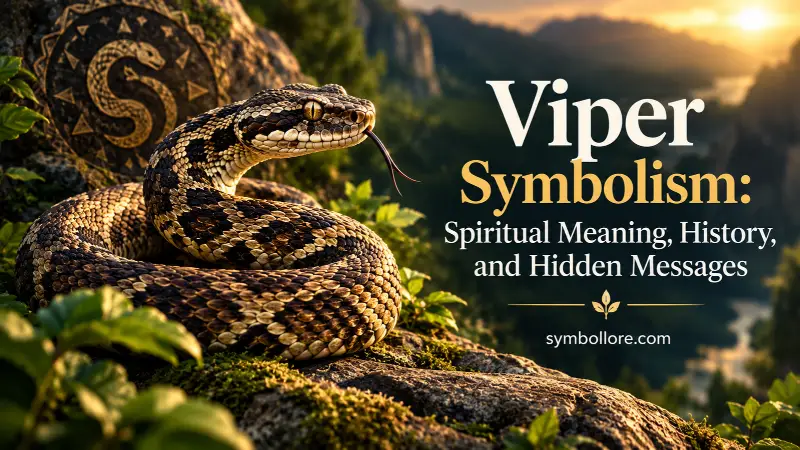
Viper symbolism has fascinated people for centuries because this venomous snake carries a powerful mix of meanings. In religious writings, it often represents danger, deception, or moral corruption. In modern interpretations, the same animal can stand for protection, awareness, and survival.
Why does one snake symbolize both betrayal and personal strength?
Much of the answer comes from its venom, defensive behavior, and reputation in ancient stories. However, real vipers are not naturally evil or dishonest.
Understanding their symbolism requires separating historical beliefs from modern interpretations. This guide explores what vipers represent spiritually, in the Bible, in literature, and in everyday symbolic imagery.
Quick Answer: What Does a Viper Symbolize?
A viper commonly symbolizes danger, betrayal, deception, and hidden threats, especially in biblical and European literary traditions. It can also represent alertness, self-defense, resilience, and transformation in modern symbolism. These meanings come from the snake’s venom, behavior, and cultural history. A viper’s symbolic meaning depends on the setting, tradition, and personal interpretation.
Key Takeaways
- Danger and betrayal: Biblical and literary traditions often use vipers to represent harmful people or hidden threats.
- Self-defense: Modern interpretations can view a coiled viper as a symbol of protective boundaries.
- Transformation: Like other snakes, vipers shed their skin, inspiring associations with renewal.
- Awareness: Their camouflage and ability to detect prey can suggest patience and careful observation.
- Cultural context: Historical myths, religious teachings, and modern personal meanings should not be treated as identical.
What Is Viper Symbolism?
Viper symbolism refers to the meanings people attach to vipers in religion, stories, art, and personal beliefs.
Vipers belong to the snake family Viperidae. This family includes true vipers, rattlesnakes, copperheads, and other pit vipers.
They are venomous reptiles with specialized fangs. Many species rely on camouflage and stillness when hunting or avoiding danger.
These features help explain their symbolic reputation.
A hidden viper can suggest an unseen threat. Its defensive strike may represent the consequences of crossing a boundary. Its ability to shed old skin can suggest change and renewal.
However, symbolic meanings describe human interpretations, not the animal’s intentions.
A viper does not act from human feelings such as revenge, jealousy, or betrayal. People assign those ideas to the animal through storytelling and cultural beliefs.
Viper Spiritual Meaning and Importance
Spiritual interpretations of vipers often explore the relationship between danger, fear, protection, and personal growth.
Unlike historical religious passages, these meanings are not universal teachings. They often reflect individual beliefs.
Danger and Hidden Threats
One of the strongest viper meanings is danger.
Because vipers may remain concealed in their surroundings, they can become symbols of risks that are difficult to notice.
In a personal reflection, a viper might represent an uncomfortable situation or a need to examine something more carefully.
That does not mean seeing a viper predicts betrayal or an upcoming disaster.
Instead, the animal can serve as a metaphor for caution and awareness.
Betrayal and Deception
Vipers have long represented betrayal in Western literature.
A snake hidden close to someone can suggest an enemy who appears friendly while secretly causing harm.
The image is powerful because readers already understand that a venomous bite can have serious consequences.
Writers transfer that physical danger into the emotional world.
In this context, the viper represents broken trust, hidden hostility, or harmful intentions.
Protection and Personal Boundaries
A viper can also symbolize self-defense.
Many vipers attempt to avoid unnecessary encounters. Their venom and defensive behavior help them survive in the wild.
Modern symbolic interpretations may connect these traits with personal boundaries.
Someone might choose a viper image to express the belief that kindness does not require accepting mistreatment.
This meaning emphasizes controlled strength rather than aggression.
Transformation and Renewal
Vipers shed their skin as they grow.
This natural process connects them with the wider symbolism of snakes, which often includes transformation and renewal.
A shedding viper may represent leaving behind an old identity or adjusting to a new stage of life.
For someone recovering from a difficult experience, it can become a personal image of growth.
However, renewal is a broader serpent association rather than a meaning unique to vipers.
Patience and Strategic Awareness
Many vipers hunt by remaining still until an opportunity appears.
This behavior can inspire symbolic ideas about patience, observation, and using energy wisely.
A resting viper in artwork might suggest someone who thinks before acting.
It can also represent quiet strength or the ability to remain calm under pressure.
These are modern metaphors drawn from animal behavior, not established spiritual laws.
Viper Symbolism in the Bible
The Bible provides some of the clearest historical examples of viper symbolism.
In several passages, the viper represents dangerous behavior, moral corruption, or judgment.
The Brood of Vipers Meaning
In Matthew 3:7, John the Baptist refers to certain Pharisees and Sadducees as a brood of vipers.
The expression appears again in passages such as Matthew 12:34, Matthew 23:33, and Luke 3:7.
Here, the image is a sharp criticism of the behavior and spiritual condition of the people being addressed.
The comparison draws on the dangerous reputation of venomous snakes.
Rather than identifying an entire community as evil, the passages use strong figurative language in specific religious confrontations.
Vipers as Symbols of Harmful Speech
Psalm 140:3 compares harmful speech with the venom of snakes.
The image suggests that words can injure people even without physical violence.
This metaphor remains understandable today.
A cruel accusation, deliberate lie, or act of verbal manipulation can damage trust and relationships.
The viper’s venom becomes a symbol of the harm that malicious speech can cause.
Vipers and Divine Judgment
In Isaiah 59:5, venomous snakes appear in imagery associated with wrongdoing and its consequences.
The passage uses vivid language to describe the destructive results of unjust behavior.
Here, the viper represents danger connected with evil actions.
Its symbolic importance lies in the moral message, not in any claim that the animal itself is sinful.
Paul and the Viper in Acts 28
Acts 28:3–6 describes a snake fastening onto Paul’s hand after he gathers firewood on Malta.
The people watching expect him to suffer serious harm. However, Paul remains unharmed.
Within the biblical story, this event challenges the observers’ assumptions and highlights divine protection.
The passage involves an actual snake encounter rather than a direct accusation comparing a person to a viper.
It is important to distinguish this narrative from the metaphorical uses elsewhere in Scripture.
Viper Symbolism in Ancient History and Folklore
The viper’s meaning extends beyond biblical writing.
Ancient authors and medieval storytellers often treated the animal as a creature of danger and unnatural behavior.
Vipers in Ancient Greek Writing
Ancient Greek writers included vipers in accounts of unusual animal behavior.
Herodotus described a belief that female vipers killed their mates and that their offspring destroyed the mother before birth.
These stories made the viper a striking image of violence within family relationships.
However, the accounts reflect ancient natural-history beliefs rather than accurate descriptions of normal viper reproduction.
They still matter because people used such stories to explain the animal’s symbolic character.
Vipers in Medieval European Bestiaries
Medieval bestiaries combined descriptions of animals with religious and moral lessons.
In these works, the viper often represented wickedness, hypocrisy, or dangerous people.
Some illustrations and accounts repeated older myths about destructive reproduction.
Authors used those stories to teach lessons about human behavior.
The animal became a moral example rather than simply a subject of natural history.
Today, readers should understand these descriptions as historical symbolism, not scientific observation.
Viper Symbolism in European Literature
European writers often used vipers to represent betrayal.
A familiar literary image involves someone protecting a snake, only to suffer from its bite.
The message concerns misplaced trust.
In Shakespeare’s Richard II, snake imagery expresses the pain of being betrayed by people who once received kindness or protection.
Such examples helped establish the viper as a metaphor for hidden hostility.
The symbol became especially powerful when betrayal came from someone close.
Different Types of Viper Symbolism
Not every viper image communicates the same message.
The animal’s posture, behavior, and setting can influence interpretation.
A Coiled Viper
A coiled viper often suggests readiness, caution, and self-defense.
In artwork, this posture may symbolize someone who remains calm but refuses to ignore threats.
It can represent protective strength without implying unnecessary aggression.
A Striking Viper
A striking viper creates a stronger image of immediate danger.
Writers may use it to suggest sudden conflict, retaliation, or a serious consequence.
In personal artwork, it might also represent refusing to remain powerless.
A Hidden Viper
A viper concealed among rocks or leaves can symbolize an unnoticed threat.
In literature, this may represent secrecy or betrayal.
In modern personal symbolism, it can suggest the importance of looking beyond appearances.
A Shedding Viper
A shedding viper can symbolize renewal and transition.
Its old skin provides a clear visual metaphor for leaving behind a past identity.
Unlike betrayal imagery, this interpretation emphasizes growth and survival.
Examples of Viper Symbolism in Everyday Life
The meaning of a viper becomes clearer when viewed through real-life situations and original examples.
Example 1: A Viper in a Suspense Story
A character notices a viper beneath a pile of leaves just before discovering a hidden enemy.
The writer uses the snake to build tension.
Its concealed position mirrors the danger that the character has not yet fully recognized.
This is a literary use of viper symbolism.
Example 2: A Viper Tattoo After Personal Growth
Someone chooses a coiled viper tattoo after learning to establish healthier boundaries.
The image represents self-respect, caution, and controlled strength.
Here, the meaning is personal rather than tied to one ancient tradition.
Example 3: A Viper Shedding Its Skin
An artist depicts a viper leaving its old skin behind.
The image becomes a metaphor for changing habits, growing older, or beginning a new chapter.
This example draws on the natural process of shedding and the wider symbolism of serpents.
Example 4: A Viper in Religious Writing
A religious teacher discusses the biblical expression about a brood of vipers.
The snake represents hypocrisy or harmful conduct in the passage being examined.
The interpretation depends on the text and its historical setting.
Viper Tattoo Symbolism and Modern Uses
Viper tattoos have become a personal way to express strength, danger, and transformation.
A coiled viper may symbolize defensive power. An open-mouthed viper can create a stronger warning message, while a snake shedding its skin can represent renewal.
Some people choose the design because they admire the animal’s appearance rather than its historical symbolism.
Others may connect it with resilience after a difficult period.
The meaning can also change through the design.
A viper surrounded by flowers may combine danger with beauty. A snake wrapped around a dagger can suggest conflict, survival, or determination.
No single interpretation applies to every tattoo.
In modern American symbolism, rattlesnakes also have a separate history connected with independence and the warning expressed by the famous “Don’t Tread on Me” motto.
That American political meaning should not automatically be assigned to every viper illustration.
Viper vs. Snake Symbolism: Key Differences
Although vipers are snakes, the symbolic meanings of the two terms are not identical.
| Symbolic Theme | Viper Symbolism | Broader Snake Symbolism |
|---|---|---|
| Danger | Strong association with venom and immediate threats | Depends on species and cultural setting |
| Betrayal | Especially prominent in biblical and Western literary imagery | Appears in some traditions but is not universal |
| Protection | Modern image of defensive strength | Can represent guardianship in several traditions |
| Transformation | Connected with skin shedding | A widespread serpent association |
| Wisdom | May suggest caution and patience in modern readings | Appears in several religious and cultural traditions |
| Healing | Mostly a broader serpent association | Appears in historical medical and religious imagery |
| Independence | Strongest when the image is specifically a rattlesnake in American contexts | Not a universal snake meaning |
The viper tends to carry a sharper sense of danger than a generic snake image.
However, context matters more than the species name alone.
A peaceful viper illustration may communicate patience, while a threatening serpent in a story may represent fear.
Common Misconceptions About Viper Symbolism
All Vipers Represent Evil
This is incorrect.
Some religious and literary traditions use vipers as negative symbols. However, modern interpretations can emphasize caution, survival, and protection.
The animal itself has no human moral character.
Vipers Attack People Out of Revenge
Vipers do not plan revenge in the human sense.
They use venom for hunting and may bite defensively when threatened.
Their behavior should not be confused with literary ideas of malice.
Every Viper Is a Spiritual Warning
Seeing a viper does not prove that betrayal or misfortune is approaching.
A person may interpret the encounter symbolically, but there is no scientific evidence that vipers predict future personal events.
In real life, the appropriate response is to respect the animal and keep a safe distance.
Vipers Kill Their Mothers During Birth
This belief appears in ancient and medieval writing.
However, it is not an accurate description of normal viper reproduction.
The story survived because it provided a dramatic moral image.
Viper and Cobra Symbolism Are Identical
Vipers and cobras belong to different snake families.
Their historical associations may overlap, but they are not interchangeable animals.
An expanded hood, for example, is characteristic of cobras rather than vipers.
Important Facts That Explain Viper Symbolism
Venom Helped Shape the Viper’s Reputation
Vipers possess specialized venom-delivery systems.
Their fangs and defensive abilities made them memorable symbols in cultures familiar with dangerous snakes.
Writers then connected physical venom with harmful speech, betrayal, and moral corruption.
This link between animal biology and figurative language explains much of the viper’s historical symbolism.
Not All Vipers Have Heat-Sensing Pits
Pit vipers possess heat-sensitive organs that help them detect warm-blooded prey.
However, true vipers do not possess the same specialized facial pits.
This difference matters when interpreting images of different species.
An artistic design based on a rattlesnake may emphasize features that do not belong to a European adder.
Shedding Skin Is a Natural Process
Snakes shed their skin as part of normal growth and maintenance.
The process also helps explain why serpents became symbols of change.
In symbolism, this biological event becomes a metaphor for renewal.
It does not mean that vipers experience spiritual rebirth.
Their Ecological Role Is Different From Their Reputation
Vipers are predators that help maintain ecological relationships.
Many consume rodents and other small animals.
Their presence in nature does not make them morally dangerous or malicious.
The negative meanings attached to them reveal more about human fears and storytelling than about the animal’s character.
People Also Ask About Viper Symbolism
What does a viper mean spiritually?
A viper can spiritually represent danger, caution, self-protection, and personal transformation. Some modern interpretations view it as a reminder to recognize unhealthy situations and protect personal boundaries. These meanings are subjective rather than universal spiritual rules.
What does the viper symbolize in Christianity?
In several biblical passages, the viper represents hypocrisy, harmful intentions, and moral corruption. The phrase about a brood of vipers appears in the teachings of John the Baptist and Jesus. Other biblical passages use venomous snake imagery to describe danger or destructive speech.
Does a viper symbolize betrayal?
Yes. Betrayal is one of the viper’s established meanings in Western literary traditions. Writers have used the animal to describe a person who receives kindness but responds with hostility. This imagery reflects human fears of broken trust rather than actual motives in snakes.
Is a viper a symbol of protection?
A viper can symbolize protection in modern personal imagery. Its defensive abilities may represent strength, vigilance, and the willingness to maintain boundaries. However, protection is not its primary meaning in many historical Christian texts, where danger and moral criticism are more prominent.
Frequently Asked Questions
Seeing a viper has no scientifically established meaning as an omen. Some people interpret the encounter as a warning, while others view it as a symbol of awareness or strength. The interpretation depends on personal beliefs. In real life, the important response is to avoid disturbing the animal.
A black viper may symbolize mystery, concealed danger, strength, or fear in modern artwork. Black is often associated with secrecy and the unknown, which can reinforce the viper’s threatening image. However, there is no universal ancient tradition assigning one fixed spiritual meaning to every black viper.
A viper in a dream may reflect feelings about fear, trust, personal boundaries, or an unresolved conflict. The dreamer’s emotions and experiences are more useful than a fixed dream dictionary meaning. Dreaming about a viper does not establish that someone is planning betrayal or that danger will occur.
A serpent is a broader symbol that can represent wisdom, temptation, healing, renewal, or danger depending on the tradition. Viper symbolism often emphasizes venom, harmful speech, betrayal, and hidden threats in Western sources. However, modern artists may use vipers to symbolize survival, self-defense, and transformation.
A viper can symbolize caution, patience, and awareness in modern interpretations. These meanings may come from its hunting behavior and the broader association between serpents and wisdom. However, wisdom is not the dominant meaning of vipers in many historical European and biblical passages.
A viper tattoo has no fixed meaning based on gender. It may represent personal strength, survival, independence, caution, or the ability to defend oneself. The design’s posture, surrounding objects, and individual story shape its message. A person might also choose the tattoo simply because they admire the animal.
A viper can symbolize rebirth because it sheds its skin, a process widely associated with renewal in serpent imagery. Healing is a broader snake symbol found in several cultural traditions. These connections are metaphorical and should not be mistaken for evidence that vipers possess supernatural healing powers.
Conclusion: What Does a Viper Symbolize?
Viper symbolism combines fear, danger, betrayal, protection, and transformation.
In biblical writing and European literature, vipers often represent harmful behavior, hypocrisy, and hidden threats. In modern personal symbolism, they can express alertness, resilience, independence, and defensive strength.
The key is understanding the context. A striking viper may suggest danger, while a coiled or shedding viper can represent protection or renewal.
Ultimately, the viper is neither good nor evil. Its symbolic meaning reflects the stories, beliefs, and experiences people connect with this remarkable animal.