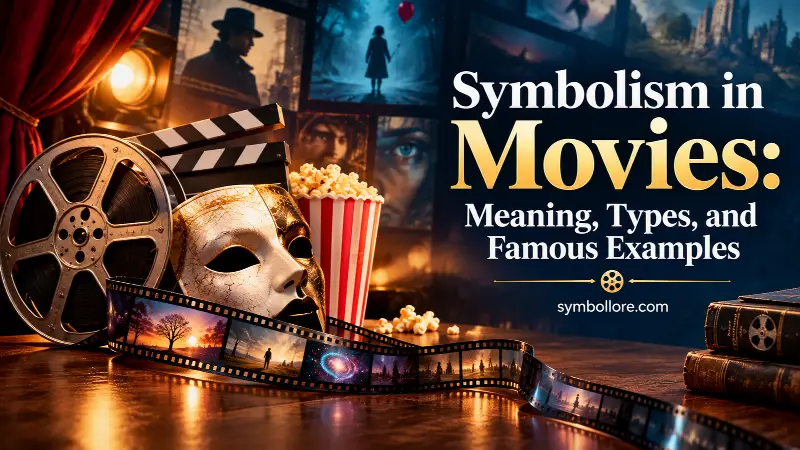
A red coat in a black-and-white scene. A staircase separating wealthy and poor families. A childhood toy that reveals a powerful man’s greatest loss. These details may look simple, yet they can carry the emotional meaning of an entire film.
That is the power of symbolism in movies.
Filmmakers use objects, colors, sounds, settings, and repeated images to tell stories beyond spoken dialogue. Some symbols reveal hidden emotions, while others explore identity, love, freedom, fear, or social inequality.
Understanding movie symbolism helps viewers recognize these deeper meanings. It also makes famous scenes more interesting to discuss and analyze.
Quick Answer: What Is Symbolism in Movies?
Symbolism in movies is a storytelling technique that uses objects, colors, characters, sounds, or visual details to represent ideas beyond their literal meaning. For example, a locked door might suggest emotional isolation, while an open window may represent freedom. The meaning depends on the movie’s story, characters, and context rather than a fixed symbolic rule.
Key Takeaways
- Movie symbolism helps communicate themes and emotions without direct explanations.
- Objects, colors, costumes, lighting, and settings can all carry symbolic meaning.
- Repeated details often gain importance as the story develops.
- Famous movies use symbols to explore memory, identity, inequality, and personal choices.
- Strong interpretations rely on evidence from the film, not assumptions about hidden meanings.
What Is Symbolism in Movies?
Symbolism in movies occurs when something visible or audible represents a larger concept.
A symbol has two levels of meaning. The first is its literal role in the story. The second is the deeper idea viewers may connect with it.
Imagine a character holding an old photograph.
At first, the photograph is simply a personal object. However, its meaning changes when the character carries it through difficult moments or refuses to throw it away.
The photograph may then represent memory, grief, love, or an attachment to the past.
The same principle applies to many cinematic elements.
A filmmaker might use:
- A broken mirror to suggest a damaged sense of identity.
- A bird leaving its cage to represent freedom.
- A dark hallway to create uncertainty or fear.
- A repeating melody to bring back a lost relationship.
- An empty chair to emphasize someone’s absence.
These are possible interpretations, not universal definitions. The surrounding story determines whether a detail functions as a symbol.
Where Does Movie Symbolism Come From?
Cinema developed its symbolic techniques through several older forms of storytelling.
Literature often uses objects and natural elements to represent larger ideas. Theater communicates meaning through costumes, props, gestures, and stage design.
Painting and photography also influenced filmmakers. Both art forms use light, composition, color, and visual contrast to guide attention.
As cinema developed, filmmakers gained additional tools. Movement, editing, sound, and changing camera angles allowed symbols to develop across multiple scenes.
Silent movies relied heavily on visual expression because spoken dialogue was not recorded as synchronized speech in the way it is today. Yet symbolism remained important after sound became common.
Modern films continue using both visual and audio symbols to communicate meaning.
Why Is Symbolism Important in Movies?
Symbolism allows filmmakers to show feelings that characters struggle to explain.
Instead of announcing that someone feels trapped, a director might place that character behind a window covered with metal bars.
The physical setting creates a visual connection to confinement.
This approach adds depth without requiring lengthy dialogue.
It Communicates Complex Emotions
Human emotions rarely fit into simple statements.
A person may experience happiness and regret at the same time. Through symbolic images, a filmmaker can show these conflicting emotions together.
For example, a character might smile while holding a damaged wedding photograph.
The smile suggests affection, while the damaged photograph may point toward loss or a troubled relationship.
Together, these details create a more complicated emotional picture.
It Strengthens the Movie’s Themes
A theme is a central idea explored throughout a story.
Common movie themes include freedom, belonging, ambition, identity, love, and justice.
Symbols help connect these broad ideas to memorable details.
In a film about personal freedom, a locked gate might appear whenever the main character faces restrictions.
If the gate opens near the ending, the change may support the film’s larger theme.
It Makes Scenes More Memorable
Viewers often remember a striking image long after forgetting individual lines of dialogue.
A meaningful prop, unusual color, or repeated visual pattern can become closely associated with a movie.
When audiences recognize these details, they may better understand the story’s emotional structure.
Types of Symbolism in Movies
Filmmakers use several forms of symbolism. Some appear through visual design, while others depend on sound, action, or narrative patterns.
1. Color Symbolism
Colors can help establish emotional associations.
Red might suggest danger, desire, anger, or love. Blue may suggest calmness, loneliness, or emotional distance.
However, these meanings are not automatic. A film must establish how its colors relate to its characters and story.
| Color | Possible Symbolic Meanings |
|---|---|
| Red | Love, danger, desire, anger |
| Blue | Sadness, peace, loneliness, calm |
| Green | Growth, jealousy, money, renewal |
| Yellow | Hope, caution, energy, unease |
| White | Innocence, emptiness, peace, control |
| Black | Mystery, grief, power, fear |
| Purple | Luxury, ambition, imagination |
| Gold | Wealth, success, prestige |
These associations often appear in Western visual traditions. Yet cultures, genres, and individual films can give the same colors different meanings.
2. Object Symbolism
Ordinary objects can become powerful symbols when the story gives them emotional importance.
Consider a house key.
For one character, it might represent independence. For another, the same key could suggest responsibility or an unwanted connection to the past.
Common symbolic objects include clocks, mirrors, photographs, rings, masks, doors, and toys.
Their meanings often become clearer through repeated appearances or important plot events.
3. Nature and Weather Symbolism
Weather and natural settings can reinforce a movie’s emotional atmosphere.
Rain may accompany sadness, renewal, or emotional release.
A storm might reflect conflict, while a sunrise can suggest a new beginning.
Nature does not always symbolize human emotion, though. Sometimes rain simply creates a practical obstacle or establishes the setting.
The stronger interpretation depends on how the weather connects to the plot.
4. Animal Symbolism
Animals can carry cultural or story-specific meanings.
A dove may suggest peace. A raven might create an atmosphere of mystery or death.
Meanwhile, butterflies can suggest change or transformation.
These associations often come from literature, folklore, religion, and visual traditions.
Still, viewers should consider how a particular movie presents the animal rather than relying only on familiar associations.
5. Setting and Architecture Symbolism
Buildings, rooms, streets, and landscapes can represent social or emotional conditions.
A large empty house may suggest loneliness. A crowded apartment could reflect pressure, poverty, or a lack of privacy.
Staircases can create visible differences between characters who occupy higher and lower spaces.
Walls, fences, windows, and doorways may also suggest separation or opportunity.
Architecture becomes especially meaningful when the filmmaker repeatedly connects locations to major themes.
6. Sound and Music Symbolism
Movie symbolism is not limited to images.
A repeated sound can remind viewers of a character, event, or emotional experience.
For example, a particular melody might play whenever a character remembers someone they lost.
When the melody returns without that person on screen, it can suggest their continuing emotional presence.
In film music, a recurring musical idea associated with a person or situation is often called a leitmotif.
Such recurring elements can support symbolic meaning, although not every musical theme is a symbol.
7. Character and Costume Symbolism
Clothing and appearance can express identity, authority, belonging, or transformation.
A uniform may represent institutional power. A mask could suggest concealment or a divided identity.
Costume changes can also reflect personal growth.
For instance, a character who begins a film wearing formal clothing might later choose simpler clothes.
Depending on the story, that change could suggest independence or rejection of social expectations.
How Does Symbolism Work in Movies?
Movie symbols gain meaning through context, contrast, repetition, and changes in the story.
A filmmaker does not always explain a symbol directly. Instead, the audience notices connections between images and events.
Consider this fictional example.
At the beginning of a movie, a young musician receives a silver watch from her father.
She wears it during important performances.
Years later, after their relationship becomes strained, she puts the watch inside a drawer.
Near the ending, she repairs the broken watch and begins wearing it again.
The watch gradually develops symbolic meaning.
It may represent family connection, unresolved conflict, and eventual reconciliation.
Its importance comes from the changing relationship between the object and the character.
How to Identify Symbolism in a Movie
Step 1: Notice unusual details.
Look for objects, colors, sounds, or settings that receive special attention.
Step 2: Track repetition.
Notice whether the detail returns during emotional or important scenes.
Step 3: Connect it to the story.
Ask which character, conflict, or theme the detail might represent.
Step 4: Examine how it changes.
Compare the detail’s meaning at the beginning, middle, and ending.
Step 5: Support your interpretation.
Use specific scenes and story details to explain why your reading makes sense.
A useful question is: Would this interpretation still make sense if another viewer examined the same scenes?
If the answer is yes, the interpretation has a stronger foundation.
Famous Examples of Symbolism in Movies
Some of cinema’s most memorable scenes use symbols to express ideas about identity, memory, power, and human relationships.
The following examples contain plot details and some ending spoilers.
1. The Shawshank Redemption (1994) — Rain and Freedom
The movie follows Andy Dufresne, a man imprisoned for crimes he says he did not commit.
Near the end, Andy escapes and stands outside in heavy rain.
Symbolic meaning: Freedom, renewal, and emotional release.
The rain washes over Andy after years of imprisonment. Viewers can interpret the scene as a form of cleansing and rebirth.
His open posture contrasts with the enclosed spaces that shaped his prison life.
The scene gains meaning from that contrast rather than from rain alone.
2. Schindler’s List (1993) — The Girl in the Red Coat
Most of the film appears in black and white.
During the destruction of the Kraków ghetto, a little girl’s red coat stands out from the surrounding images.
Later, the coat helps viewers recognize her body.
Symbolic meaning: Innocence, human suffering, and the moral responsibility to recognize atrocities.
The selective use of color draws attention to one child amid widespread violence.
The image gives an individual human presence to an enormous historical tragedy.
Steven Spielberg has also connected the moment to the failure of powerful governments to respond adequately to knowledge of the Holocaust.
3. Citizen Kane (1941) — The Rosebud Sled
The central mystery of Citizen Kane concerns the final word spoken by wealthy newspaper owner Charles Foster Kane.
The ending reveals that Rosebud was the name of his childhood sled.
Symbolic meaning: Lost childhood, separation, and emotional longing.
Kane gains enormous wealth and influence during his lifetime.
Yet the sled connects him to a period before he was separated from his childhood home.
It suggests that material success cannot fully replace emotional security or recover what has been lost.
The sled helps explain one part of Kane’s life without reducing his entire personality to a single object.
4. The Matrix (1999) — The Red and Blue Pills
Neo faces a choice between two pills.
The blue pill allows him to continue living within the familiar illusion. The red pill leads him toward a disturbing reality.
Symbolic meaning: Choice, knowledge, illusion, and uncertainty.
The pills transform an abstract philosophical problem into a physical decision.
Neo must decide whether he prefers familiar comfort or difficult truth.
The scene also raises questions about perception, control, and the reliability of everyday experience.
5. Parasite (2019) — Stairs and Social Class
Parasite repeatedly shows characters moving between homes at different elevations.
The wealthy Park family lives in a large modern house. The poorer Kim family lives in a semi-basement apartment.
Symbolic meaning: Economic inequality, class hierarchy, and restricted social mobility.
The visual contrast between higher and lower spaces reinforces the film’s social themes.
Climbing stairs can suggest upward movement, while descending emphasizes the family’s position within the economic hierarchy.
Director Bong Joon-ho explicitly discussed stairs as a central metaphor for class and social structure.
6. Inception (2010) — The Spinning Top
The spinning top appears as an object connected to the question of whether Cobb is dreaming.
Its behavior becomes especially important near the ending.
Symbolic meaning: Uncertainty, perception, and the desire for certainty.
The top gives viewers a physical object through which to consider the boundary between dreams and reality.
Its final appearance encourages debate about what matters most to Cobb.
One interpretation is that his emotional priorities have changed, even though the final scene leaves important questions open.
7. The Great Gatsby (2013) — The Green Light
Jay Gatsby repeatedly looks toward a green light across the water.
The light stands at the end of Daisy Buchanan’s dock.
Symbolic meaning: Longing, ambition, hope, and unreachable dreams.
For Gatsby, the light becomes closely linked with his desire to reunite with Daisy.
Its distance reflects the emotional and social barriers between his dreams and reality.
The film adapts this important symbol from F. Scott Fitzgerald’s novel.
8. Everything Everywhere All at Once (2022) — The Everything Bagel and Googly Eyes
The film presents an unusual black bagel surrounded by layers of everything.
It also repeatedly uses ordinary googly eyes as a visual element.
Symbolic meaning: Despair, meaninglessness, connection, and kindness.
The everything bagel expresses an overwhelming sense that nothing matters.
Googly eyes provide a contrasting image associated with humor, compassion, and an alternative way of seeing life.
The contrast supports the movie’s larger conflict between despair and human connection.
Movie Symbolism Examples at a Glance
| Movie | Main Symbol | Central Interpretation |
|---|---|---|
| The Shawshank Redemption | Rain | Freedom and renewal |
| Schindler’s List | Red coat | Innocence and moral responsibility |
| Citizen Kane | Rosebud sled | Lost childhood |
| The Matrix | Two pills | Truth versus comforting illusion |
| Parasite | Stairs | Class inequality |
| Inception | Spinning top | Reality and uncertainty |
| The Great Gatsby | Green light | Hope and longing |
| Everything Everywhere All at Once | Bagel and googly eyes | Despair versus connection |
These examples show how a small visual element can communicate an idea that shapes an entire story.
How Symbolism Changes Across Movie Genres
Movie genres often influence how audiences interpret symbols.
A mirror in a romantic drama may suggest self-reflection. The same mirror in a horror movie could create fear or uncertainty.
Genre conventions provide clues, but the individual film still determines meaning.
Symbolism in Horror Movies
Horror films frequently use darkness, confined spaces, masks, and unsettling objects.
A locked room might suggest secrecy or helplessness. An abandoned house may reflect traumatic memories or an uncomfortable past.
Horror symbolism often becomes effective through the combination of familiar objects and threatening circumstances.
Symbolism in Romantic Movies
Romantic films may use flowers, photographs, weather, gifts, and meaningful locations.
A place where two characters first meet could later represent memories of their relationship.
If they return after separating, the same location may carry a different emotional meaning.
This change helps viewers understand how the relationship has developed.
Symbolism in Science Fiction Movies
Science fiction often explores technology, identity, control, and human existence.
Machines may represent progress or dependence. Artificial environments can raise questions about what counts as reality.
These interpretations become stronger when the technology directly affects the characters’ choices.
Symbolism in Animated Movies
Animation gives filmmakers unusual freedom to exaggerate objects, colors, and environments.
A character’s changing appearance might visually express an emotional transformation.
Meanwhile, imaginary worlds can represent fears, wishes, or personal challenges.
Still, animated symbols require the same careful interpretation as live-action examples.
Symbolism vs. Metaphor vs. Motif in Movies
These three storytelling concepts are closely related, but they serve different purposes.
| Concept | Meaning | Example |
|---|---|---|
| Symbolism | A detail represents a larger idea | A broken chain represents freedom |
| Metaphor | One thing expresses an idea through comparison | A character’s difficult journey reflects a struggle with grief |
| Motif | A repeated element develops significance | A clock appears during several major turning points |
| Theme | A central idea explored by the story | The importance of personal freedom |
| Foreshadowing | A detail suggests a future development | An early warning hints at a later betrayal |
A single element can serve more than one function.
For instance, a recurring clock could become a motif that symbolizes mortality. It might also foreshadow a character’s approaching deadline.
The best label depends on how the film uses the detail.
Common Mistakes When Interpreting Movie Symbolism
Assuming Every Object Has a Hidden Meaning
Not every costume, piece of furniture, or background color is symbolic.
Films contain ordinary details that establish a believable setting.
A useful interpretation needs support from the story, visual emphasis, or meaningful repetition.
Giving Every Color a Fixed Meaning
Red does not always represent danger. White does not always mean innocence.
Color associations change across cultures and cinematic contexts.
Viewers should examine how a film introduces and develops its colors before deciding what they represent.
Ignoring the Character’s Experience
A symbol may mean different things to different characters.
For example, an old family home might represent comfort to one person and painful memories to another.
Both readings can exist within the same story.
Confusing Interpretation With Fact
An interpretation is not automatically a confirmed statement of the director’s intention.
A filmmaker may explain a symbol in an interview. In other situations, viewers must build arguments from the film itself.
Both approaches can provide insight, but they are different forms of evidence.
Important Insights About Cinematic Symbolism
One of the most important facts about movie symbolism is that meaning develops through relationships between images, characters, and events.
A single object rarely carries the full meaning on its own.
Consider three levels of evidence:
Visual evidence: The camera draws attention to a detail through framing, focus, lighting, or contrast.
Narrative evidence: The detail connects to an important event, relationship, or conflict.
Thematic evidence: Its possible meaning supports an idea explored throughout the movie.
When all three forms of evidence support an interpretation, the argument becomes more convincing.
Documented filmmaker intentions can provide additional support. For example, Bong Joon-ho’s explanation of the staircases in Parasite strengthens an interpretation based on economic hierarchy.
Yet a director’s statement does not necessarily exhaust every possible meaning. Movies can support different interpretations when viewers provide careful evidence.
People Also Ask About Symbolism in Movies
What is a simple example of symbolism in a movie?
A locked door may symbolize restriction if the film repeatedly connects it with a character’s lack of freedom. When the character finally opens the door, the action might represent independence or change.
Why do directors use color symbolism?
Directors may use color to establish emotional associations, distinguish characters, or reinforce themes. The same color can communicate different ideas depending on the movie’s context.
Can a character be a symbol in a movie?
Yes. A character may represent a broader social group, value, institution, or idea. However, symbolic meaning does not prevent that character from having an individual personality and role in the plot.
What makes a movie symbol effective?
An effective symbol connects naturally to the story. It often becomes more meaningful through repetition, visual emphasis, or changes in a character’s experience.
Frequently Asked Questions
The purpose of symbolism is to communicate additional meaning through cinematic details. Symbols can reinforce themes, express complicated emotions, and connect different parts of a story. They may also invite viewers to consider ideas that the characters never explain directly.
Beginners can start by noticing unusual or repeated details. Then, they should consider when those details appear and how they relate to important events. Looking for connections with character development and major themes helps create stronger interpretations.
Not necessarily. Filmmakers often make deliberate symbolic choices, but viewers can also recognize meaningful patterns that were not consciously planned. An interpretation should remain grounded in the film, especially when no reliable statement of artistic intention exists.
Yes. A single object can represent different ideas at once. A wedding ring might suggest commitment, social expectations, family tradition, or emotional restriction. The strongest interpretation depends on the character’s situation and the surrounding scenes.
Visual symbolism uses images, colors, physical objects, and cinematic presentation to convey meaning. Literary symbolism primarily works through written language and descriptions. Both techniques connect concrete details with larger ideas, although films also use editing, music, movement, and sound.
Symbolism can appear in nearly any genre, including comedy, drama, horror, science fiction, romance, and animation. However, different genres use symbols for different purposes. Horror may emphasize fear, while romantic stories often connect meaningful objects to relationships and memory.
Start by identifying a specific symbol and describing the scene where it appears. Explain its possible meaning and connect that meaning to a central theme. Include additional scenes that support your interpretation. Avoid claiming that a director intended a particular message without reliable evidence.
Conclusion
Symbolism in movies turns ordinary images, objects, sounds, and settings into meaningful parts of a story.
A childhood sled can represent lost innocence. A staircase can reveal social inequality. A spinning top can raise questions about reality.
The most important lesson is that symbols gain meaning from context, not fixed definitions.
By noticing repetition, examining character experiences, and connecting details to larger themes, viewers can develop a deeper understanding of cinematic storytelling.