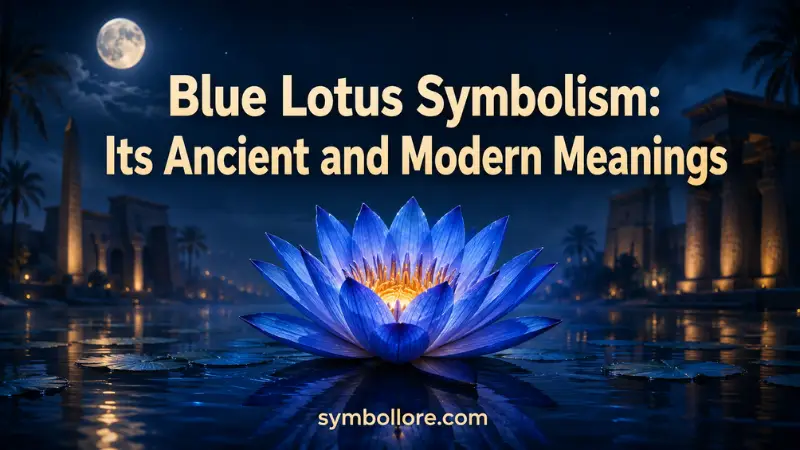
Blue lotus symbolism centers on rebirth, creation, wisdom, spiritual awareness, and inner calm. These meanings developed most strongly in ancient Egypt, where the flower’s habit of opening in daylight connected it with the sun and renewed life.
However, not every meaning comes from the same culture. Egyptian beliefs, Asian lotus traditions, and modern spiritual interpretations overlap in popular culture, but they have different historical foundations.
Quick Answer
Blue lotus symbolism most commonly represents rebirth, spiritual awakening, wisdom, and the return of light after darkness. In ancient Egypt, its daily opening linked it with the sun, creation, and renewed life. Modern people also use the flower to express peace, emotional growth, self-mastery, and transformation, although these newer meanings are personal rather than universal.
Key Takeaways
- The blue lotus primarily symbolizes rebirth, creation, wisdom, and spiritual growth.
- Ancient Egyptians connected its daily bloom with the returning sun.
- The plant is technically a blue water lily, not a true lotus.
- Buddhist-style interpretations emphasize wisdom, discipline, and control over desire.
- Modern tattoos often represent recovery, renewal, or emotional maturity.
- Symbolic meaning does not prove advertised health or psychoactive benefits.
Blue Lotus Meanings at a Glance
| Context | Main Meaning | Why It Developed |
|---|---|---|
| Ancient Egypt | Creation and rebirth | The flower opened with daylight and closed later |
| Solar imagery | Light and renewal | Its golden center resembled the emerging sun |
| Funerary art | Regeneration and eternal life | Renewal supported hopes for life after death |
| Nefertem imagery | Beauty, fragrance, and healing | The deity was closely associated with the flower |
| Buddhist color symbolism | Wisdom and self-mastery | Blue commonly represents knowledge and discipline |
| Modern spirituality | Awakening and inner calm | The bloom suggests a mind opening gradually |
| Tattoos | Transformation and resilience | The flower rises from water and unfolds toward light |
| Memorials | Continuing love and peaceful renewal | Its recurring bloom suggests life continuing through change |
What Is the Blue Lotus?
The Egyptian blue lotus is actually a water lily. Botanists commonly identify it as Nymphaea nouchali var. caerulea, though the older name Nymphaea caerulea remains widespread. It belongs to the water-lily family, Nymphaeaceae, rather than the true-lotus genus Nelumbo.
According to the
its native range extends from Egypt into southern Africa and parts of the Arabian Peninsula. The aquatic plant produces blue or blue-violet petals around a bright yellow center. Its appearance and daily rhythm helped turn an ordinary wetland flower into a lasting cultural emblem.
Calling it a lotus is historically familiar, so the common name is not necessarily wrong in cultural writing. Still, recognizing it as the Egyptian blue water lily prevents confusion with Asian sacred lotuses.
Core Blue Lotus Symbolism
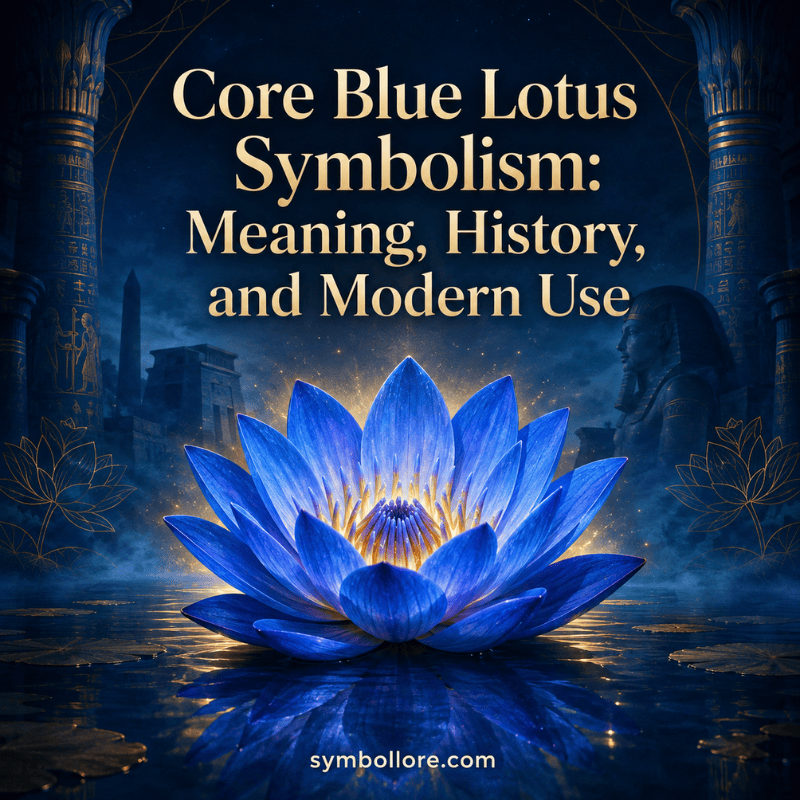
At its heart, blue lotus symbolism expresses renewal through awareness. The flower emerges above dark water, opens toward daylight, and reveals a bright center. People therefore read it as an image of consciousness overcoming confusion, hardship, or spiritual darkness.
Its main meanings include:
- Rebirth: beginning again after loss, failure, or personal change
- Creation: new ideas, new life, and the arrival of possibility
- Wisdom: knowledge guided by patience and self-control
- Awakening: becoming more aware of oneself or a deeper purpose
- Calm: emotional steadiness rather than avoidance of difficulty
- Resilience: maintaining beauty and direction in an imperfect environment
These ideas share one pattern: something valuable becomes visible after a period of darkness, uncertainty, or concealment.
Blue Lotus Symbolism in Ancient Egypt
In ancient Egypt, the blue water lily symbolized regeneration, the sun, creation, and renewed life. Its presence in paintings, carved objects, ornaments, and funerary scenes shows that it carried more than decorative value.
The flower’s daily behavior offered Egyptians a visible model of cosmic order. It appeared to open with the morning light and close as the day ended. As a result, it could represent the sun’s return and the dependable renewal of life.
Egyptian artwork also shows people holding or smelling blue water lilies at banquets and ceremonial gatherings. In such scenes, the bloom may suggest fragrance, beauty, vitality, celebration, sacred presence, or social status. One image can carry several related meanings, so the flower should not automatically be interpreted as evidence of a drug ritual.
Its historical importance rests on what Egyptians repeatedly depicted: life, fragrance, divine order, renewal, and closeness to the sacred.
Creation, the Sun, and Nefertem
The blue water lily became a creation symbol because its golden center opened above the water like a small sun. Egyptian creation traditions described the first light emerging from primordial waters. The flower offered a natural image for that moment: brightness unfolding from a dark, watery beginning.
It was especially associated with Nefertem, a youthful deity connected with the first sunrise, beauty, fragrance, and healing. Nefertem could be portrayed with a lotus bloom on his head or as a divine child arising from the flower. The image linked the plant with newness, radiance, and the restoration of order.
Some modern summaries connect the flower directly with the sun god Ra. That interpretation reflects its broader solar meaning, but Egyptian creation traditions varied by place and period. It is safer to say the flower participated in solar creation imagery rather than assigning every version to one fixed story.
Death, Rebirth, and the Afterlife
The blue lotus represented rebirth because it seemed to repeat a cycle of disappearance and return. To ancient viewers, its closing and reopening could mirror sunset and sunrise, death and renewed life, or passage from one state into another.
This connection made the flower appropriate for tombs and funerary objects. It did not simply stand for death. Instead, it expressed the hope that death formed part of a larger cycle in which life, identity, and divine order could be restored.
The Global Egyptian Museum’s explanation of the lotus
identifies regeneration and the solar cycle as central associations. This evidence helps explain why the flower appears near deceased people, gods, offerings, and scenes of abundance. Within those settings, it promises renewal rather than permanent darkness.
For modern readers, that history gives the flower a fitting memorial meaning: grief can remain real while love, memory, and life continue.
Wisdom, Purity, and Enlightenment
Wisdom and enlightenment are now familiar blue lotus meanings, but they require cultural care. These interpretations draw heavily from broader Buddhist and Hindu lotus symbolism, color associations, and modern spiritual writing. They should not all be presented as original ancient Egyptian beliefs.
In Buddhist imagery, a blue lotus may represent knowledge, discipline, insight, or the mind’s victory over uncontrolled desire. A partly opened bloom can suggest wisdom that continues to unfold. The lotus more broadly represents purity because it rises from muddy water without being defined by that environment.
However, the sacred Asian lotus is generally associated with the genus Nelumbo, while Egypt’s famous blue flower belongs to Nymphaea. Artists and spiritual writers often combine their visual and symbolic traditions. That combination can be meaningful, provided it is described as a later cross-cultural interpretation rather than a single unbroken tradition.
Emotional and Spiritual Meaning Today
Today, the blue lotus often represents emotional renewal, quiet confidence, self-knowledge, and spiritual awakening. Someone may choose it after recovering from grief, leaving a harmful situation, changing careers, or developing a clearer sense of identity.
The flower’s symbolism works well for gradual growth. A dramatic symbol such as a phoenix emphasizes destruction followed by rebirth. In contrast, the lotus suggests a quieter process: remaining rooted, moving through difficulty, and opening when conditions allow.
Modern spiritual communities also connect it with meditation, intuition, dreams, or altered awareness. These are contemporary associations and personal practices, not meanings that history or science can prove for every person. The most grounded interpretation treats the flower as a visual reminder to cultivate clarity. It does not promise supernatural experiences or guaranteed emotional healing.
Blue Lotus Tattoo Meaning
A blue lotus tattoo usually represents personal transformation, wisdom, calm, or a new beginning. Its exact message depends on the flower’s shape, placement, and surrounding symbols.
A closed bud can represent potential or a journey that has just begun. A partly open bloom suggests developing insight, while a fully opened flower may express acceptance, achievement, or awakened awareness. Blue petals strengthen associations with peace, intelligence, and emotional control.
Additional design elements can adjust the message:
- Sun: hope, creation, and returning light
- Water: emotional depth, change, and adaptability
- Ankh: an explicit connection with Egyptian life symbolism
- Moon: intuition, cycles, and private growth
- Eye: awareness, protection, or spiritual perception
- Butterfly: visible personal transformation
- Dates or names: remembrance and continuing love
Before combining sacred symbols, research each one separately. A visually attractive design may unintentionally mix traditions that do not share the same origin.
Meaning in Art, Gifts, and Memorials
In artwork, the blue lotus can express stillness, mystery, renewal, or the meeting of darkness and light. Egyptian-inspired art emphasizes creation and eternal life, while meditation-themed designs often focus on inner awareness.
As a gift, the flower suits someone beginning a new chapter. It can celebrate graduation, recovery, parenthood, a career change, or renewed confidence. The message is generally supportive: growth can emerge even after a difficult period.
For memorials, the bloom may represent peaceful continuation and the endurance of love. Its historic association with regeneration gives it more depth than a generic symbol of beauty. However, explain the intended meaning when the context matters. Not every recipient will recognize its Egyptian background or spiritual associations.
The blue lotus can also appear in jewelry, home décor, logos, and personal altars. In each case, surrounding imagery determines whether it reads as Egyptian, Buddhist-inspired, botanical, or simply decorative.
Common Misconceptions and Cultural Respect
The first misconception is that every blue lotus image refers to the same plant or tradition. Egyptian blue water-lily symbolism differs from the broader religious history of Asian lotuses. Modern designs often combine them, but writers should acknowledge that blending.
A second mistake is treating symbolic associations as fixed definitions. Flowers do not have one universal language. Rebirth may dominate in an Egyptian context, while wisdom may matter more in Buddhist-inspired artwork. Personal stories can add still another meaning.
Finally, ancient Egyptian banquet scenes do not automatically prove that everyone consumed the plant for intoxication. Researchers continue to examine the plant’s chemistry and historical use.
A 2025 University of California, Berkeley research report
describes this as an active area of investigation and notes the difficulty of obtaining authenticated Egyptian plants.
Respectful interpretation begins by naming the culture, separating evidence from speculation, and avoiding claims that one symbol means the same thing everywhere.
Safety and Modern Wellness Claims
Symbolic appreciation is different from consuming blue lotus products. Online sellers market teas, extracts, vaping liquids, and supplements for sleep, anxiety, sexual performance, euphoria, and spiritual experiences. Reliable human evidence has not established these products as safe or effective treatments.
The U.S. Department of Defense’s
Operation Supplement Safety program
reports serious reactions linked with some products, including anxiety, hallucinations, rapid heartbeat, chest pain, decreased responsiveness, and seizures. It also warns that products may contain undeclared synthetic cannabinoids. Blue lotus appears on the Department of Defense’s prohibited dietary-supplement ingredient list, so U.S. service members must not use it.
Do not assume that “natural,” “ancient,” or “spiritual” means safe. Anyone considering consumption should discuss it with a qualified healthcare professional, especially when pregnant, breastfeeding, taking medication, or managing a medical condition.
FAQs
Spiritually, a blue lotus commonly symbolizes awakening, wisdom, inner peace, and mastery over harmful desires. Modern users may also connect it with meditation or intuition. These meanings combine broader lotus traditions with contemporary spirituality, so they should not all be described as beliefs held by ancient Egyptians.
Ancient Egyptians connected the flower with the sun, creation, regeneration, fragrance, and divine presence. Its opening during daylight resembled the sun’s return from darkness. This visible cycle made the bloom a natural symbol of renewed life and cosmic order.
Yes. Rebirth is one of its strongest and best-supported historical meanings. The flower’s recurring opening and closing suggested a cycle of disappearance and return, which connected it with sunrise, regeneration, funerary hope, and continued life after death.
The Egyptian blue lotus is botanically a water lily in the genus Nymphaea. Its accepted classification is Nymphaea nouchali var. caerulea, although Nymphaea caerulea remains a familiar scientific name. “Blue lotus” continues as its established cultural and common name.
A blue lotus tattoo generally represents transformation, wisdom, recovery, spiritual development, or emotional calm. A bud can show potential, while an open flower suggests greater awareness. Added symbols such as the sun, water, an ankh, or a butterfly make the message more specific.
The flower can represent love when it appears in romantic art, gifts, or personal rituals, but love is not its central historical meaning. Rebirth, creation, vitality, wisdom, and spiritual awareness have stronger symbolic foundations. In relationships, it can express emotional openness or a bond that survives change.
Safety has not been established for blue lotus teas, extracts, smoking mixtures, or vaping products. Some products have caused serious reactions or contained undeclared substances. U.S. service members are prohibited from using it, and other readers should consult a healthcare professional rather than relying on marketing claims.
Conclusion
Blue lotus symbolism brings together rebirth, creation, wisdom, awareness, and the hopeful return of light. Its strongest historical roots lie in ancient Egypt, where the blue water lily reflected the sun’s daily renewal and the promise of regenerated life.
Later traditions and modern users expanded its meaning to include enlightenment, inner calm, resilience, and personal transformation. These interpretations remain most meaningful when Egyptian evidence, Asian lotus traditions, and contemporary beliefs are kept distinct. The flower’s lasting message is grounded but powerful: growth can unfold after darkness without denying the difficulty that came before.


