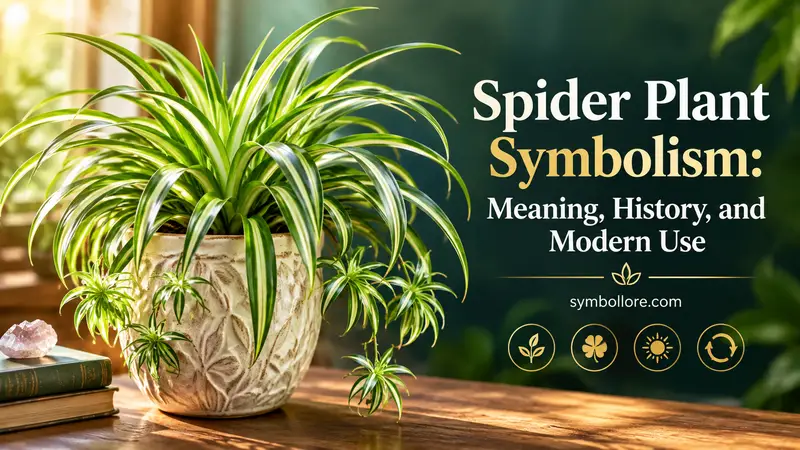
Spider plant symbolism most often centers on growth, resilience, renewal, family connection, and abundance. Those meanings make sense because Chlorophytum comosum produces numerous young plantlets on long stems and can recover well from ordinary growing stress.
Other meanings, including prosperity, protection, positive energy, and good luck, appear mainly in modern plant symbolism and practices such as Feng Shui. They should not be treated as universal historical beliefs.
The spider plant is therefore a useful example of how symbolism develops: some meanings grow directly from a plant’s physical behavior, while others come from later cultural interpretation, gift traditions, home design, and personal belief.
Quick Answer
Spider plant symbolism commonly represents growth, renewal, resilience, family bonds, abundance, and new beginnings because the plant readily produces many young offshoots and survives changing indoor conditions. Prosperity, luck, protection, and positive energy are also popular modern interpretations, especially in Feng Shui-inspired settings, but these meanings are cultural or personal rather than scientifically proven or universally traditional.
TL;DR
- The plant’s many young offshoots make growth, fertility, family, and abundance natural symbolic associations.
- Its toughness supports meanings of resilience, adaptability, and recovery.
- Easy propagation connects the plant with sharing, friendship, continuity, and new beginnings.
- Good luck and prosperity are popular meanings, but they are not universal historical facts.
- Feng Shui interpretations connect healthy plant growth with vitality, renewal, and abundance.
- Claims that one spider plant can significantly purify a normal room exaggerate laboratory research.
Spider Plant Meanings at a Glance
| Context | Possible Meaning | Why the Association Exists | Important Limit |
|---|---|---|---|
| Plantlets and propagation | Growth and new beginnings | Mature plants produce many small plantlets that can root independently | This meaning comes largely from observation rather than ancient tradition |
| Parent plant and “babies” | Family, nurturing, continuity | Young plants remain attached to the mother plant before rooting | Family symbolism is interpretive, not a botanical fact |
| Hardy growth | Resilience and adaptability | Spider plants tolerate a range of indoor conditions | “Indestructible” descriptions are exaggerations |
| Numerous offshoots | Abundance and fertility | One mature plant can produce many descendants | Fertility here is symbolic, not a medical claim |
| Gift giving | Friendship and shared growth | Plantlets are easy to separate, pot, and give away | Meaning depends on the giver and occasion |
| Feng Shui use | Vitality, prosperity, renewal | Living green plants are used symbolically within spatial-energy traditions | This belongs to Feng Shui practice rather than scientific evidence |
| Modern wellness symbolism | Freshness and purification | The plant became famous through indoor-air laboratory studies | Ordinary potted plants have limited real-room air-cleaning impact |
Why the Spider Plant Became a Symbol of Growth
Growth is the strongest and easiest spider plant meaning to explain.
Unlike many houseplants, Chlorophytum comosum often sends out long flowering stems that later carry small plantlets. Botanists describe this ability to form new plantlets on the inflorescence as a normal feature of the species.
For a person looking at a mature hanging plant, the symbolism is almost visual storytelling. One established plant creates many smaller versions of itself.
That makes growth a natural metaphor for:
- expanding families;
- growing friendships;
- new projects;
- personal development;
- fresh opportunities;
- ideas that spread from one source.
The meaning does not require a mystical tradition. It comes directly from the way the plant grows.
Why Spider Plants Symbolize Family and Connection
Family symbolism comes from the relationship between the mature plant and its attached plantlets.
The small offshoots hang from long stems while remaining connected to the parent plant. Eventually, they can form roots and grow independently.
That physical pattern resembles a simple human idea: one generation supports the next until it can stand on its own.
For this reason, modern plant symbolism often connects spider plants with parenting, family continuity, nurturing, and lasting relationships.
The interpretation can also extend beyond biological family. A spider plant passed from friend to friend can represent a social connection that continues to grow.
This makes the plant especially meaningful when it has a personal history. A plantlet taken from a parent’s or grandparent’s house, for example, may symbolize continuity because the actual plant was physically propagated from an older one.
That personal meaning can be stronger than any standardized symbolic definition.
Resilience and Adaptability Come From the Plant’s Real Behavior
Resilience is another symbolism that has a clear physical basis.
Spider plants became popular partly because they tolerate ordinary indoor conditions better than many delicate ornamentals. The Royal Horticultural Society describes them as easy to grow, tolerant of some neglect, and easy to propagate.
They are not impossible to kill. Poor drainage, severe neglect, unsuitable temperatures, and other problems can still damage them.
However, their forgiving nature makes them a convincing symbol of recovery.
Symbolically, resilience can mean:
- adapting after change;
- rebuilding after a difficult period;
- maintaining steady progress;
- surviving imperfect conditions;
- recovering instead of demanding perfection.
This interpretation is especially fitting when someone gives the plant during a move, career change, graduation, or new stage of life.
Spider Plant Symbolism and New Beginnings
New beginnings are closely tied to propagation.
A spider plantlet can start life attached to a larger plant, form roots, and then become an independent plant. The process provides an obvious visual metaphor for starting again.
That is why the plant can work well as a symbolic housewarming, graduation, new-job, or moving-away gift.
The meaning is not that the plant magically causes a successful beginning. Instead, the plant represents the hope behind the occasion.
A young plantlet says, in effect, that something small can establish itself, grow stronger, and eventually produce new growth of its own.
That makes new beginnings one of the most practical modern interpretations of the spider plant.
Does the Spider Plant Symbolize Fertility and Abundance?
Yes, in modern symbolism, but the reason should be stated carefully.
Spider plants produce many plantlets. This visible multiplication naturally encourages associations with fertility, reproduction, abundance, and continuing life.
Numerous modern houseplant-symbolism sources repeat those meanings.
However, symbolic fertility should not be confused with evidence that the plant affects human fertility.
It does not.
The meaning is metaphorical.
Abundance works in much the same way. A healthy spider plant can develop a full crown of arching leaves plus multiple stems carrying plantlets. Visually, one plant becomes many.
Therefore, “abundance” can refer broadly to growth, generosity, family, ideas, opportunities, or flourishing rather than literal financial wealth.
Is a Spider Plant a Symbol of Good Luck?
Spider plants are often described as lucky plants, but this idea appears stronger in modern symbolism than in clearly documented ancient tradition.
Contemporary articles commonly link the plant with prosperity, positive energy, and good fortune. Some Feng Shui-oriented interpretations also connect vigorous plant growth with abundance and renewal.
The safest interpretation is therefore contextual.
A spider plant may symbolize good luck when it is intentionally used or gifted that way.
Its natural traits support the idea. The plant spreads easily, produces many descendants, stays green under suitable conditions, and often rebounds after minor neglect.
All of these qualities can make it feel like an appropriate symbol for favorable progress.
Still, there is no scientific evidence that owning a spider plant changes a person’s luck.
Spider Plants in Feng Shui
In modern Feng Shui practice, living green plants can represent vitality, active growth, renewal, and expanding energy.
Spider plants fit that framework particularly well because of their cascading leaves and prolific plantlets.
Some contemporary practitioners associate them with family growth, prosperity, fresh opportunities, or supportive movement through a space. Others place greater emphasis on the Wood element because healthy vegetation naturally expresses living growth.
Different Feng Shui schools and practitioners may recommend different placements. Therefore, claims that one exact direction is universally “correct” should be treated cautiously.
More importantly, Feng Shui meaning should remain separate from botanical fact.
The plant genuinely grows and propagates.
Its ability to produce prosperity, balance energy, or attract fortune belongs to cultural and personal practice rather than experimentally verified science.
Purification Symbolism Needs an Important Scientific Correction
Purification has become one of the spider plant’s most popular modern meanings.
The association developed largely because spider plants appeared in laboratory research on indoor air pollutants.
NASA research in 1989 tested plants and associated root-zone systems in controlled environments. Those experiments helped popularize the idea that houseplants can remove substances such as formaldehyde from air.
However, the popular claim later became much broader than the original experimental setting justified.
A 2020 scientific review compared results from many chamber studies with the ventilation rates found in ordinary buildings. The researchers concluded that passive potted plants would need to be present at unrealistically high densities to compete with normal air exchange.
So a spider plant can still represent freshness, cleansing, or renewal symbolically.
What it should not represent is a substitute for ventilation or a proper air-cleaning system.
That distinction corrects one of the most repeated spider plant myths.
Did Spider Plants Have a Victorian Symbolic Meaning?
Spider plants were grown during the Victorian period, but claims that they had one standardized Victorian flower-language meaning need caution.
The plant was used as a decorative foliage plant, including in hanging arrangements. A University of Arkansas horticultural history notes that Victorians called it “ribbon plant” and used it in indoor decorative settings.
Modern websites often go further and claim that Victorian spider plants specifically meant good luck, hope, new beginnings, or even particular romantic messages.
Strong historical evidence for one universally recognized meaning is difficult to establish.
This matters because Victorian flower language was not a single fixed dictionary. Different books could assign different meanings even to well-known flowers.
Spider plant symbolism today is better understood through its growth pattern, gifting culture, houseplant history, and modern spiritual interpretation than through an unsupported claim about a universal Victorian code.
Where the Spider Plant Comes From
The spider plant is African in origin.
Modern botanical references place the native range of Chlorophytum comosum across a broad part of Africa, from western tropical regions through eastern areas and into southern Africa.
This botanical origin should not be confused with later symbolic traditions.
A plant can originate in one region and develop new cultural meanings elsewhere after cultivation spreads.
That is exactly what happened with many familiar houseplants.
As spider plants became common ornamental plants in Europe, North America, and other regions, their symbolism increasingly reflected domestic life: hanging baskets, propagation, sharing plantlets, family homes, easy care, and indoor greenery.
Its modern symbolic identity therefore owes as much to houseplant culture as to geography.
Why Sharing Spider Plant Babies Can Symbolize Friendship
Spider plants are unusually suited to symbolic gift giving because they are easy to divide and share.
A mature plant can produce many small plantlets. A person can root one, pot it, and give it to someone else without losing the original plant.
That creates a physical connection between two households.
The symbolism can be simple:
one plant, shared growth, continuing connection.
This explains why friendship is a reasonable modern spider plant meaning even without an ancient tradition behind it.
A gifted plantlet can carry the memory of the person who grew the parent plant. As the new plant matures, it may produce its own offshoots, allowing that connection to continue through another generation.
In this context, the symbolic value comes from the act of sharing, not from an invisible property of the species.
What Does a Spider Plant Gift Mean?
A spider plant gift can communicate encouragement, growth, resilience, friendship, family connection, or a fresh start.
The occasion helps determine the meaning.
For a housewarming, it can represent new roots and growth in a new place.
For a graduation, the plant can symbolize independence and continued development.
For a new job, it can represent adaptability and expanding opportunity.
For a friend, a propagated plantlet may symbolize connection and shared history.
For a family member, the parent-and-plantlet pattern can suggest continuity across generations.
The most meaningful interpretation is often the one the giver explains directly.
Plant symbolism works best as communication, not as a hidden universal code.
Spider Plant Color Meanings Are Mostly Modern Interpretations
Most familiar spider plants have green leaves, often with white or cream variegation.
Modern symbolism sometimes gives separate meanings to those colors.
Green may suggest growth, renewal, health, nature, and vitality.
White may suggest purity, clarity, peace, or simplicity.
These color associations are culturally familiar, but they do not prove that a variegated spider plant historically carried a fixed combined meaning of “growth plus purity.”
That type of interpretation is best treated as modern symbolic reading.
The plant’s shape and reproductive habit offer stronger evidence for growth, family, continuity, and abundance than leaf color alone.
Spider Plant Symbolism Is Not Spider Symbolism
The spider plant should not automatically inherit the symbolism of the spider animal.
Spiders have rich mythological associations involving weaving, creativity, patience, danger, fate, and interconnectedness.
The spider plant received its common name because its dangling plantlets can resemble small spiders hanging from the plant. The Royal Horticultural Society explicitly connects the familiar name with those suspended offspring.
That visual resemblance does not mean the plant automatically carries every symbolic meaning associated with spiders.
A writer or artist could deliberately combine the two.
However, ordinary spider plant symbolism is more strongly connected with propagation, growth, family, resilience, and domestic life.
Keeping the two symbols separate prevents a common interpretation error.
How Americans Commonly Use Spider Plant Symbolism Today
In modern U.S. settings, spider plant symbolism is most visible through houseplant culture rather than formal ceremony.
People often grow spider plants in apartments, offices, classrooms, dorm rooms, kitchens, and hanging baskets because they are familiar and relatively forgiving.
Their symbolism often emerges through how people use them.
Someone propagating plantlets for friends may associate the plant with generosity.
A parent passing a plant to an adult child may see continuity.
A person rebuilding a houseplant collection after a move may see resilience and renewal.
Someone following Feng Shui may use the plant as a symbol of living growth or supportive energy.
These meanings are flexible because modern symbolism often depends on intention.
The strongest interpretations remain grounded in something visible about the plant itself.
Common Misconceptions About Spider Plant Meaning
Several online claims deserve caution.
“Spider plants always bring good luck.”
Good luck is a symbolic belief, not a guaranteed effect.
“The plant has one ancient universal spiritual meaning.”
No strong evidence supports a single meaning shared across all cultures.
“Victorians universally used spider plants to mean new beginnings.”
Victorian cultivation is documented more clearly than any one standardized symbolic definition.
“Spider plants purify a normal room’s air.”
Laboratory studies found pollutant uptake, but later analysis showed that ordinary potted plants have little practical effect compared with building ventilation.
“Spider plant meaning is the same as spider meaning.”
The two symbols have different histories.
These distinctions make the symbolism more credible, not less interesting.
FAQs
The most common modern spiritual meanings are growth, renewal, resilience, abundance, and connection. Some Feng Shui interpretations also associate spider plants with prosperity or supportive energy. These meanings should be understood as symbolic or cultural interpretations rather than scientifically proven effects.
A spider plant can symbolize good luck, especially in modern gifting and Feng Shui-inspired contexts. Its vigorous growth and numerous plantlets make prosperity and expanding opportunity understandable associations. However, there is no evidence that the plant literally changes a person’s fortune.
It can symbolize connection, nurturing, shared growth, and continuity. The meaning comes largely from the way young plantlets remain connected to the mature plant before growing independently. A plant propagated and exchanged between partners or friends can add a stronger personal meaning.
Yes. Symbolically, it suits a housewarming because it can represent putting down new roots, adapting to a new environment, growth, and a fresh beginning. Its plantlets can also suggest abundance and family expansion without implying that those outcomes are guaranteed.
It often symbolizes fertility in modern plant symbolism because mature plants produce numerous offspring. The meaning is entirely metaphorical. A spider plant has no proven effect on human fertility or pregnancy.
Protection appears in some modern spiritual and Feng Shui-oriented interpretations. However, evidence for a broad historic tradition specifically treating Chlorophytum comosum as a protective plant is limited. It is safer to describe protection as one contemporary belief rather than a universal meaning.
Spider plants can remove some pollutants in sealed experimental systems, but a few potted plants do not meaningfully clean the air in a typical room. A major review found that an impractically large number of plants would be needed to match ordinary ventilation.
Conclusion
Spider plant symbolism is strongest when it stays connected to the plant itself. Its abundant plantlets explain meanings of growth, family, fertility, sharing, and new beginnings, while its forgiving nature supports resilience and adaptability.
Luck, prosperity, protection, and positive energy also appear in modern interpretations, especially in Feng Shui and gift culture, but they are not universal facts. Likewise, claims about Victorian symbolism and dramatic air purification deserve caution.
The most grounded way to interpret a spider plant is to look at its context, growth habit, and personal history. Its real ability to create new life from one established plant already gives it a powerful symbolic story.