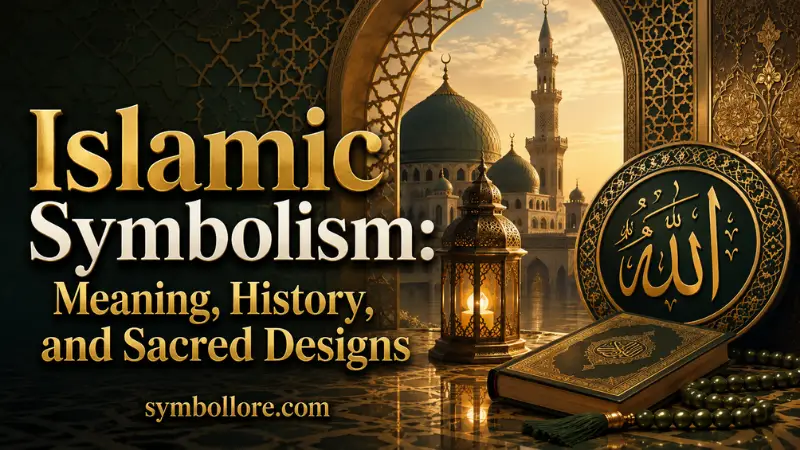
Islamic symbolism gives visible form to ideas such as faith in one God, guidance, unity, remembrance, knowledge, modesty, and devotion. However, Islam does not depend on one official logo. Its richest symbolic language appears in Qur’anic words, Arabic calligraphy, the direction of prayer, light imagery, geometric design, architecture, color, and religious practice.
These meanings grew across more than fourteen centuries and many regions, from Arabia and North Africa to Persia, Central Asia, South Asia, Southeast Asia, Europe, and the United States. As a result, an Ottoman crescent, a Persian calligraphic panel, and a West African Qur’an board may all belong to Muslim visual culture without carrying identical meanings.
Quick Answer
Islamic symbolism most strongly represents devotion to God, unity, guidance, sacred knowledge, remembrance, and an ordered religious life. Calligraphy honors revealed words, the Kaaba gives prayer a shared direction, and light can express divine guidance. The crescent and star identify Islam in many modern settings, but they are historical cultural emblems rather than a universally required symbol of the faith.
TL;DR
- Islam has no single symbol that functions everywhere like an official religious logo.
- Arabic calligraphy carries special importance because the Qur’an was revealed in Arabic.
- The Kaaba and qibla express a shared direction of worship and worldwide community.
- Geometry often suggests order, balance, unity, and continuing pattern, but designs have no universal code.
- The crescent and star gained their broad Islamic association mainly through later Muslim states, especially the Ottoman Empire.
- Region, period, object, and religious setting determine the most accurate meaning.
Islamic Symbols and Meanings at a Glance
| Form or context | Common meaning | Why the association developed | Important limit |
|---|---|---|---|
| Arabic calligraphy | Revelation, knowledge, remembrance, beauty | Writing transmits Qur’anic verses, prayers, names, poetry, and blessings | The text must be read before its meaning is identified |
| Kaaba and qibla | Unity, worship, shared direction | Muslims face the Sacred Mosque in Mecca during formal prayer | The Kaaba is a sacred focus, not an image of God |
| Light or lamp | Guidance, clarity, divine presence | Qur’anic language compares divine light with a lamp in a niche | Not every decorative lamp carries this meaning |
| Geometric pattern | Order, balance, unity, continuing creation | Repeated forms organize a surface without requiring a central figure | Shape meanings vary; no fixed dictionary applies |
| Garden or vegetal design | Life, beauty, abundance, sometimes paradise | Plants and gardens can recall Qur’anic descriptions and earthly flourishing | Many leaves and vines are mainly ornamental |
| Crescent and star | Muslim identity, community, calendar, state history | Ottoman and later national use made the emblem widely recognizable | It predates Islam and is not accepted as universal |
| Green | Life, blessing, paradise, Muslim identity | Religious texts, dynastic use, flags, and custom strengthened the association | Green also has secular and regional meanings |
What Does Islamic Symbolism Mean?
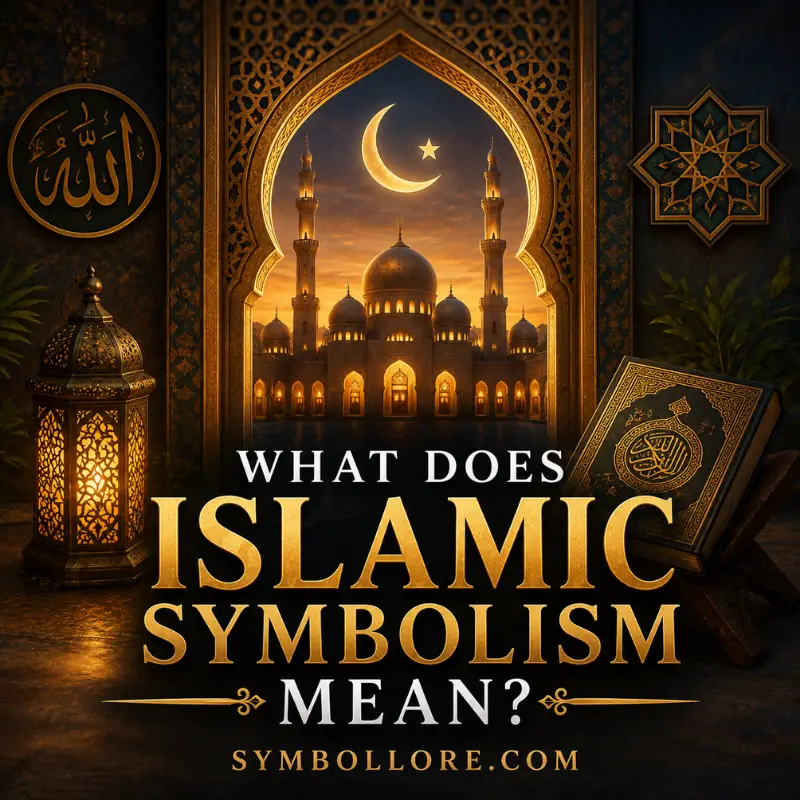
Islamic symbolism is the use of words, forms, colors, spaces, objects, and actions to communicate meanings connected with Islam or Muslim cultures. Some examples come directly from scripture and worship. Others developed through art, government, local custom, or modern identity.
That distinction matters because “Islamic” can describe more than mosque decoration. Art historians also use the term for works produced in lands ruled by Muslims, for Muslim patrons, or by Muslim artists. Such works may be religious, courtly, domestic, scientific, or commercial. Therefore, a ceramic bowl with Arabic poetry can be Islamic art without serving as a sacred object.
Why Islam Has No Single Universal Emblem
No central institution governs all Muslims or assigns one graphic mark to the whole faith. More importantly, Islam centers religious life on belief, worship, ethical conduct, community, and revelation rather than on an official logo.
Several forms still carry wide recognition. The Arabic word “Allah,” the declaration of faith, a mosque silhouette, the Kaaba, and the crescent can identify a Muslim context. Yet they are not interchangeable brand marks. Sacred text deserves particular respect, while a dome or minaret describes a building type rather than a required theological sign.
Muslims may also disagree about a design’s use. One community may place a crescent above a mosque, while another avoids it because early Islam did not establish it as an emblem. Islamic symbolic language is broader than a single badge and remains closely tied to words, worship, place, and practice.
The Crescent and Star: Recognizable but Not Foundational
The crescent and star now appear on national flags, mosque signs, holiday decorations, military emblems, humanitarian organizations, and digital icons. For many Americans, the pair provides the quickest visual shorthand for Islam. Still, that recognition is modern and historical, not a rule found at Islam’s beginning.
Both shapes existed long before the seventh-century rise of Islam. They appeared in several ancient cultures and political systems. Their later link with Muslims became especially strong through Ottoman state imagery. Yale’s overview of Islam notes that the
crescent and star predate Islam and became affiliated with the Muslim world after Ottoman adoption.
The crescent also feels relevant because Islamic months follow a lunar calendar. Communities look for the new crescent when establishing months, including Ramadan and Shawwal. However, that connection does not prove that the Prophet Muhammad designated it as the faith’s official sign. Today, the emblem may express Muslim identity, a country, a historical dynasty, or a Ramadan theme.
Arabic Calligraphy and the Power of the Written Word
Calligraphy stands near the center of Islamic visual culture because writing carries language, and Arabic carries the Qur’an. Artists made script beautiful while preserving its ability to communicate. Consequently, letters appear on manuscripts, mosque walls, ceramics, metalwork, textiles, coins, doors, lamps, and everyday objects.
The words matter more than a generic “Arabic look.” An inscription might contain a Qur’anic verse, one of God’s names, a prayer, a blessing, a ruler’s title, or secular poetry. Viewers should check what it says before assigning a religious meaning.
Styles also carry historical and regional information. Angular Kufic became important in early Qur’an manuscripts and architectural decoration. Naskh often served clear book writing, while thuluth suited large, flowing inscriptions. Persianate cultures developed nasta’liq for Persian poetry and other texts. The Smithsonian’s National Museum of Asian Art explains how
calligraphy first gave visual form to the Qur’an and later served both sacred and secular writing.
Calligraphy can symbolize sacred knowledge, remembrance, authority, blessing, or cultural belonging. Still, the meaning remains in the actual text and its use. Treating sacred wording as casual decoration can cause disrespect.
Geometry: Unity, Order, and Continuing Pattern
Circles, squares, stars, polygons, interlaced lines, and repeating grids became major features of Islamic ornament. Artists built complex compositions from simple units, then extended them over walls, woodwork, tile, manuscripts, carpets, metal, and pierced screens.
These designs often invite meanings such as unity within diversity, order, balance, harmony, and growth beyond the visible frame. Repetition directs attention toward relationships among parts. A circle may organize the pattern, while stars and polygons emerge through division and overlap.
However, geometry is not a secret code with one spiritual definition for every shape. The Metropolitan Museum of Art explains that Islamic artists adapted earlier Greek, Roman, and Sasanian forms, then developed patterns that stressed
unity and order while allowing intricate repetition and possible infinite growth.
Mathematics, craft, available materials, and regional taste shaped the work alongside religious ideas.
Therefore, an eight-pointed star does not automatically translate into one doctrine. Its date, location, inscription, function, and setting provide stronger evidence.
Vegetal Patterns, Gardens, and Images of Paradise
Vines, leaves, palmettes, blossoms, trees, and scrolling stems fill many works from Muslim societies. Their growth makes them natural images of life, beauty, abundance, renewal, and cultivated order.
Garden imagery sometimes carries a more specific religious association. The Qur’an frequently describes gardens in accounts of paradise. As a result, a planned garden with shade, water, fruit, and ordered planting may evoke divine generosity, rest, and promised reward. Water channels and fountains can strengthen that reading.
Still, not every painted leaf represents paradise. Many vegetal patterns serve beauty, rhythm, craft tradition, or courtly taste. Some forms came from Byzantine, Sasanian, Central Asian, or Chinese sources and changed as artists adapted them.
The Western term arabesque can hide this regional variety. “Vegetal scroll,” “floral pattern,” or a specific local name may be more precise.
The Kaaba, Qibla, and Mihrab: Direction and Unity
The Kaaba in Mecca holds a unique place in Muslim worship. Muslims around the world face its direction, called the qibla, during the five daily prayers. The Qur’an directs worshippers to turn toward the Sacred Mosque
Thus, one geographic focus creates a powerful experience of shared orientation.
The Kaaba symbolizes unity, devotion, pilgrimage, and continuity with the story of Abraham in Islamic tradition. However, Muslims do not worship the building. It organizes worship toward God and stands at the center of the Hajj pilgrimage.
Mosques usually mark the qibla wall with a mihrab, or prayer niche. Its placement directs the congregation, while calligraphy, tile, carved stone, or light may emphasize its importance. The niche expresses guidance and focused prayer, but it is not an altar.
The Kaaba’s cubical form and black covering make it instantly recognizable. Its image refers to a sacred place and practice, not merely a geometric icon.
Light, Lamps, and the Qur’anic Image of Guidance
Light commonly represents guidance, knowledge, truth, clarity, and divine generosity in Muslim devotional language and art. Its strongest foundation comes from the Qur’an’s “Light Verse,” which presents a parable of a niche holding a lamp in glass, followed by the phrase “light upon light.”
The full passage in Qur’an 24:35
connects this radiant image with God’s guidance.
That language helps explain why lamps can carry more than a practical meaning in mosques. Artists inscribed some mosque lamps with the Light Verse, joining the object’s function with the sacred metaphor. A glowing lamp could then make guidance visually present while illuminating a religious space.
Niches, glass, stars, olive trees, and radiance can echo parts of the same passage. Nevertheless, not every star or lamp refers to that verse. An inscription, mosque setting, or deliberate artistic program provides the strongest evidence. Modern mosque logos may also use light to express hope, learning, or moral direction.
Colors Across Muslim Traditions
Color meanings in Muslim societies come from scripture, dynasties, architecture, flags, and local custom. No universal chart can translate every hue.
A guide to color meanings across cultures
shows why one color can change with its setting.
Green has the strongest popular association with Islam. It may suggest life, gardens, blessing, paradise, hope, and Muslim identity. Green also appears in flags, mosque decoration, book covers, and Ramadan displays. Yet no rule requires all Islamic designs to use it.
White may suggest cleanliness, peace, simplicity, or the plain garments worn during the Hajj state of ihram. Black can recall the Kaaba’s covering, historic banners, solemnity, or authority. Gold may express honor, illumination, or royal patronage. Blue and turquoise became prominent in several regional tile traditions, often for aesthetic or local reasons.
Color combinations need equal care. Green and gold on a mosque flyer may signal celebration and dignity. The same palette on a flag may carry political history.
Amulets, Hands, Eyes, and Regional Religious Culture
Inscribed pendants, talismanic shirts, miniature Qur’ans, the hand-shaped hamsa, blue eye beads, and prayer cases appear in some Muslim communities. People use them for blessing, identity, remembrance, or hoped-for protection, but their status varies widely.
The hamsa belongs to a broader Middle Eastern and North African cultural world shared by Muslims, Jews, and others. It is not exclusively Islamic. Likewise, eye beads are regional customs, not a Qur’anic requirement.
An amulet may contain Qur’anic verses, divine names, number grids, prayers, or symbols from a local healing tradition. Some Muslims value such objects, while others reject wearing them or assigning protective power to them. Documented use does not settle the theological debate.
Islam teaches the reality of angels, but Western “guardian angel” images do not map neatly onto Muslim belief. This discussion of
angelic protection in Jewish, Christian, and Islamic contexts
explains the differences.
Figural Images and the Myth That Islamic Art Has None
Islamic religious spaces often avoid images of God, the Prophet Muhammad, and living beings as objects of devotion. This restraint helped calligraphy, geometry, architecture, and vegetal ornament flourish. It also reflects the belief that God cannot be reduced to a human-made image.
However, the statement “Islamic art never shows people or animals” is false. Courts and households across several Muslim societies produced illustrated histories, poetry manuscripts, portraits, hunting scenes, ceramics, textiles, and metalwork with figures. The boundaries differed by period, region, patron, religious interpretation, and type of space.
Smarthistory identifies complete aniconism as a misconception and notes that
humans and animals do appear in arts of the Islamic world.
A palace painting and a mosque wall follow different expectations. Viewers should distinguish worship settings from secular or courtly art.
How Islamic Symbols Differ Across Regions
Muslim visual culture formed through exchange. Early artists adapted Byzantine, Sasanian, Coptic, and late antique forms. Later networks connected West Africa, the Mediterranean, Central Asia, India, China, and Southeast Asia.
Ottoman art became known for monumental calligraphy, tile, mosque architecture, and later state crescents. Persianate traditions developed manuscript painting, nasta’liq script, gardens, and carpets. Mughal patrons combined Persian, Central Asian, Indian, and European influences. West African communities used Qur’an boards, textiles, mosque forms, and Arabic script in locally rooted ways.
Southeast Asian mosque roofs, wood carving, batik, and Arabic-derived scripts can look very different from Middle Eastern models. Chinese Muslim mosques may combine Islamic functions with Chinese architectural forms. Each tradition carries its own history.
This depth also appears in Black American life. An account of
African American sacred symbolism
notes Islamic calligraphy, crescents, and prayer garments alongside other traditions. Islam has belonged to American history for centuries.
Islamic Symbolism in Modern American Life
Americans encounter Islamic symbolism in mosques, museums, schools, holiday greetings, clothing, films, and social media. The crescent offers quick recognition, while domes and minarets serve as architectural shorthand. Ramadan and Eid designs often feature lanterns, moons, stars, dates, and rich blue, green, or gold palettes.
Some imagery reflects living practice. Dates connect with breaking the Ramadan fast, calligraphy may offer a greeting, and a mosque silhouette locates the celebration within a faith community. Food and fasting also carry religious and social meanings; this guide to
food symbolism and ritual practice
offers wider context.
Other images are commercial conventions. A package may use a crescent simply to signal Ramadan. Designers should ensure that sacred words are correct, upright, and respectful. Qur’anic text should not go on disposable items, floors, or shoes.
American Muslim communities also use different visual languages. A Bosnian mosque, Senegalese gathering, Black Muslim organization, and Indonesian American Eid event may choose different signs.
How to Interpret Islamic Symbolism Respectfully
Begin with the object, then identify its text, function, region, and date. This separates a national flag from a mosque symbol and a cultural amulet from a required practice.
Use five questions:
- What does the writing say? Never treat Arabic letters as meaningless decoration.
- Where does the form appear? A mosque, palace, home, flag, manuscript, and advertisement create different meanings.
- Which community and period made it? “Islamic culture” is too broad when a more precise name is available.
- Is the meaning scriptural, historical, local, or personal? Keep these levels separate.
- Does the community itself support the interpretation? Museum research, primary texts, makers, and community institutions offer stronger evidence than viral symbol charts.
Respect also affects use. Avoid placing God’s name or Qur’anic text on objects that may be discarded or stepped on. Do not copy sacred calligraphy incorrectly. Ask people what personal items mean instead of assuming belief from appearance.
FAQs
Islam has no single universally mandated graphic symbol. The crescent and star are the most widely recognized modern emblem, especially in flags and public signs, but they gained that status through history and culture. The Kaaba, Arabic calligraphy, and mosque imagery may identify Islam more directly in particular settings.
The crescent can represent the Islamic lunar calendar, the beginning of a month, Muslim identity, or the history of Muslim states. It is especially visible during Ramadan and Eid. However, the crescent existed before Islam and was not established by the Prophet Muhammad as an official emblem of the faith.
Calligraphy is important because it gives visual form to language, especially the Arabic words of the Qur’an. It can preserve revelation, prayers, poetry, blessings, and historical records while also creating beauty. The meaning depends on the actual inscription, so viewers should translate the words rather than judge the style alone.
Islamic geometric patterns may suggest unity, order, balance, harmony, and continuing growth. Their repeated structures can show how many parts form one organized whole. Still, every star, polygon, or number does not have one fixed spiritual translation; craft, mathematics, region, and setting also shape the design.
Green has a deep and widespread association with Islam, paradise, life, hope, and blessing. Yet Islam does not require one official sacred color for all communities or uses. Green may also carry national, dynastic, political, environmental, or decorative meanings, depending on where it appears.
They can appear in Muslim cultures, but neither is an exclusively or universally Islamic symbol. The hamsa and eye bead belong to wider regional traditions, and Muslims differ over their religious use. It is more accurate to name the community, object, and belief than to label either one a required Islamic emblem.
No. Many mosques and sacred manuscripts avoid figures, and Islamic traditions reject attempts to picture God. However, human and animal images appear in numerous courtly, historical, poetic, and domestic works made in Muslim societies. Rules and practices differ by setting, region, period, and religious interpretation.
Conclusion
Islamic symbolism expresses faith most clearly through sacred words, shared direction, light, ordered design, remembrance, and lived practice. Calligraphy honors language, the qibla unites worshippers toward Mecca, and geometric patterns turn balance and relationship into visible form. The crescent and star remain meaningful modern identifiers, but history does not make them a universal requirement.
The best interpretation names the object, reads its text, and respects its cultural setting. Islam spans many peoples, periods, and artistic traditions. Therefore, no single emblem, color, or pattern can carry every meaning on its own.
Five Related Articles from symbollore.com
- African American Symbolism: Meaning, History, and Modern Use — https://symbollore.com/african-american-symbolism/
- Color Symbolism Chart: What Different Colors Mean — https://symbollore.com/color-symbolism-chart/
- Guardian Angel Symbolism: Protection, Faith, and Art — https://symbollore.com/guardian-angel-symbolism/
- Food Symbolism: Meanings Across Culture, Art, and Life — https://symbollore.com/food-symbolism-meaning/
- Hair Symbolism: Identity, Power, Culture, and Change — https://symbollore.com/hair-symbolism/