
Licorice symbolism centers on sweetness, healing, harmony, resilience, and enduring strength. These associations come less from a single ancient symbolic system than from licorice’s unusual combination of a sweet-tasting root, long medicinal history, and use in different healing traditions. Licorice has been used in parts of Asia, the Middle East, North Africa, and Europe for centuries, giving the plant a cultural history much richer than its modern identity as candy.
At the same time, licorice does not have one universally accepted symbolic meaning. In Chinese herbal tradition, it has a strong association with moderation and harmonizing other ingredients. In European history, its reputation grew from medicinal use. Modern readers may also interpret its sweetness as pleasure or comfort. Those meanings should be understood as contextual associations rather than fixed spiritual rules.
Quick Answer
Licorice symbolism most often suggests sweetness, healing, harmony, resilience, and comfort. Its sweet root inspired associations with pleasantness, while centuries of medicinal use connected it with soothing and well-being. In Chinese traditions, licorice also became valued for its role in harmonizing herbal formulas. Modern symbolic interpretations vary, so no single meaning applies in every culture or setting.
TL;DR
- Licorice can symbolize sweetness and pleasure because its root has an unusually sweet flavor.
- Its long history in traditional medicine supports associations with healing and well-being.
- Chinese herbal traditions give licorice a particularly strong association with harmony and moderation.
- The plant’s persistent root supports modern interpretations of resilience and endurance, although these are symbolic readings rather than ancient universal rules.
- European and Middle Eastern history emphasizes licorice as a valuable medicinal plant more than as a standalone religious symbol.
- Today, licorice may represent comfort, nostalgia, natural healing, or distinctive personal taste depending on context.
Licorice Meanings at a Glance
| Context | Possible Meaning | Why the Association Exists | Important Limit |
|---|---|---|---|
| Sweet root | Sweetness, pleasure | The root is naturally very sweet | A sensory association is not a formal ancient symbol |
| Traditional medicine | Healing, soothing | Licorice was repeatedly used in historical medical traditions | Historical medical use does not prove every modern health claim |
| Chinese herbal tradition | Harmony, moderation | Licorice was used to harmonize or moderate formulas | This meaning belongs to a specific medical tradition |
| Root form | Resilience, endurance | A persistent underground root suggests strength beneath the surface | Modern symbolic interpretation |
| Confectionery | Comfort, nostalgia | Licorice became familiar as a sweet and treat | Candy symbolism differs from medicinal symbolism |
| Dark or black candy | Mystery, boldness, intensity | Visual color and strong flavor invite modern interpretation | These are aesthetic associations, not established universal meanings |
What Does Licorice Symbolism Mean?
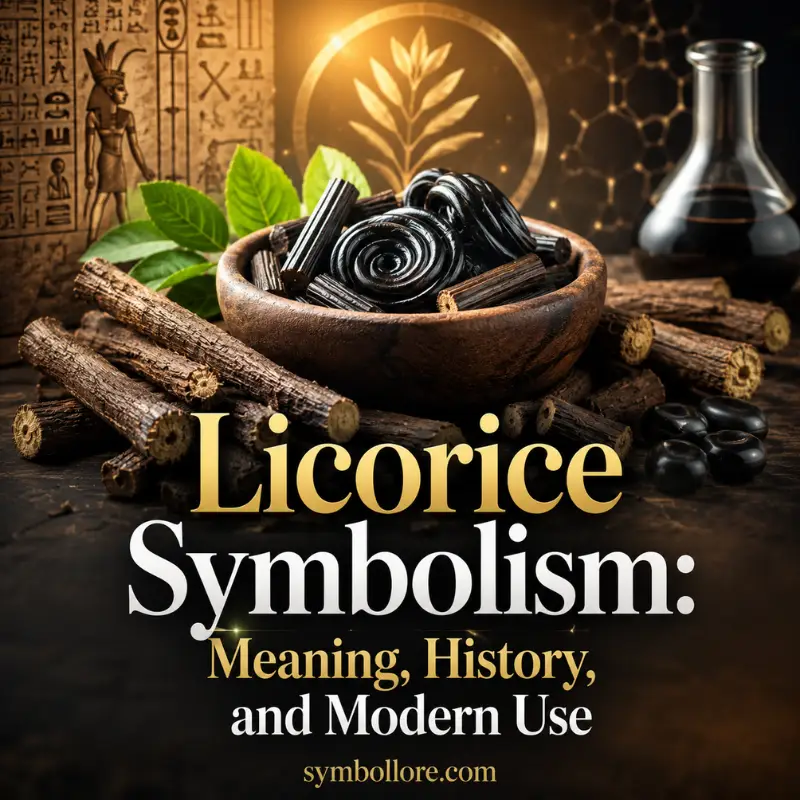
Licorice symbolism is best understood through the plant’s sweetness, usefulness, longevity in human traditions, and ability to work within mixtures.
The most grounded association is sweetness. The ancient Greek name for licorice, glukurrhiza, combines words meaning “sweet” and “root.” That name shows how striking the plant’s taste was to ancient observers.
A second association comes from healing. Licorice root appears in historical records from several major medical traditions. Ancient Greek and Roman writers described medicinal applications, while Chinese and Indian traditions also developed extensive uses for the plant.
A third meaning, especially useful for symbolism, is harmony. Licorice was often included in herbal formulas alongside other ingredients rather than treated only as an isolated substance. In Chinese herbal medicine, gan cao became especially known for its role in moderating and harmonizing formulas.
This gives licorice a distinctive symbolic pattern: something sweet that also brings different elements together.
Why Does Licorice Symbolize Sweetness?
Licorice symbolizes sweetness most directly because sweetness is one of its defining physical qualities.
The root contains glycyrrhizin, the compound responsible for much of its characteristic sweetness. The plant’s ancient Greek name essentially described it as a sweet root, showing that this quality was recognized long before licorice became a modern confection.
Symbolically, sweetness can suggest kindness, pleasure, welcome, generosity, or an agreeable experience. These meanings are not exclusive to licorice. They arise because humans often use taste as a metaphor for relationships and experiences.
Licorice is particularly interesting because its flavor is not simply sweet. Its strong, earthy, sometimes bitter taste makes it more complex than sugar or honey. That contrast can support a modern metaphor for sweetness mixed with difficulty.
A person might therefore use licorice imagery to represent a life experience that contains both comfort and hardship. That interpretation is reasonable as literary or personal symbolism, but it should not be presented as a documented universal tradition.
Licorice Symbolism and Healing Traditions
Healing is one of the strongest historical foundations for interpreting licorice.
Records show that licorice was used medicinally in ancient Assyrian, Egyptian, Greek, Roman, Chinese, and Indian contexts. European medical traditions continued to document it through the medieval and early modern periods.
Ancient Greek authors wrote about licorice’s medicinal value, and the Roman physician Dioscorides included it among plant-based substances in De Materia Medica. Later European writers continued to describe the root in herbal and medical works.
This long record helps explain why healing, soothing, vitality, and care are common symbolic interpretations today.
The historical evidence is stronger for medicinal use than for a formal symbolic meaning. That distinction matters. Licorice was not necessarily treated as a universal emblem of healing. Rather, its repeated use in healing practices naturally allowed later readers to associate the plant with health and restoration.
For symbolism, the difference is important: the historical fact is medicinal use; “healing” as a symbolic meaning is an interpretation built from that history.
Licorice as a Symbol of Harmony
Harmony is one of the most interesting meanings associated with licorice because it has a specific historical foundation.
In traditional Chinese medicine, licorice, known as gan cao, has been used extensively in herbal formulas. Historical scholarship describes it as a substance used to moderate or harmonize the properties of other ingredients. A 2022 review notes that licorice received the honorific name guo lao, often translated as “the nation’s elder,” in connection with its important role in traditional formulas.
This history gives rise to a useful symbolic idea: harmony does not always mean sameness.
Licorice can be understood metaphorically as something that helps different elements coexist. In that sense, it may represent compromise, balance, cooperation, moderation, or the ability to soften extremes.
This interpretation should remain tied to the Chinese medical context rather than being projected onto all cultures. The symbolic lesson is useful, but the historical tradition belongs to a particular system.
For comparison, SymbolLore’s discussion of
evergreen symbolism shows a similar principle:
a plant can inspire several related meanings, but those meanings become clearer when physical characteristics and cultural context are considered together.
The Root and the Meaning of Resilience
The root itself can inspire a modern symbolic reading of resilience.
Licorice is a perennial plant, and its roots and rhizomes are the parts most closely associated with its traditional use. Underground roots are naturally powerful symbols because they remain hidden while supporting visible growth.
That makes licorice easy to read metaphorically as strength beneath the surface.
The interpretation fits a broader pattern in plant symbolism. Roots can suggest ancestry, grounding, stability, survival, and connection to the earth. In licorice’s case, however, there is no strong evidence that ancient cultures universally assigned those exact symbolic meanings to the root.
Instead, resilience is best described as a modern interpretive association supported by the plant’s physical form and long history of human use.
The same interpretive method can be seen in
where a plant structure becomes a metaphor for potential and strength because of what it physically contains.
Licorice in Ancient Egypt
Licorice has a long history in ancient Egypt, although modern claims about its symbolism sometimes go beyond the evidence.
Historical reviews report that licorice was found among materials associated with ancient Egypt, including material connected with the tomb of Tutankhamun. Licorice also appears within the broader history of Egyptian medicinal plants.
It is tempting to conclude that licorice therefore represented immortality or protection in Egyptian religion. However, the evidence does not justify such a simple universal claim.
Egyptian funerary traditions certainly used plants, food, medicines, resins, and other substances in ways connected with burial and the afterlife. Yet the mere presence of licorice in a tomb does not prove that Egyptians treated licorice itself as a formal symbol of resurrection or protection.
This is a useful example of why symbolism research needs caution. An object found in a sacred or funerary setting is evidence of use, but not automatically evidence of a specific symbolic meaning.
Licorice in Greek and Roman Traditions
Greek and Roman history provides stronger evidence for licorice as a useful medicinal root than as a formal religious symbol.
Theophrastus, writing in the fourth or third century BCE, discussed licorice and associated it with the Scythians. Later, Dioscorides included it in De Materia Medica, while Roman authors such as Pliny the Elder also described the plant and its uses.
The Greek name itself is significant. Because it referred to the root’s sweetness, it shows that the sensory quality of licorice was central to how the plant was identified.
Over time, the combination of sweetness and medicinal usefulness helped create a recognizable cultural image: licorice was both pleasant and practical.
That combination can support modern symbolic readings of gentle strength, useful sweetness, and comfort. Still, those are interpretive extensions rather than proof that ancient Greeks used licorice as a standardized emblem.
Licorice Symbolism in Chinese Tradition
Chinese tradition deserves separate treatment because licorice has a particularly important place within Chinese herbal medicine.
Licorice, especially species such as Glycyrrhiza uralensis, is known as gan cao. Historical scholarship describes its use in Chinese medicine and notes its inclusion in the ancient Shennong Bencao Jing, a foundational materia medica traditionally associated with the early centuries of the Common Era.
Its symbolic importance is therefore closely connected with coordination and moderation.
Rather than treating licorice simply as a symbol of sweetness, a culturally careful interpretation recognizes its role within a larger medicinal system. The plant could be valued because it helped bring a formula together and moderate the character of other ingredients.
That makes “harmony” a particularly useful symbolic term when discussing Chinese contexts.
It would be misleading, however, to say that all Chinese people view licorice as a spiritual symbol of harmony. The historical evidence concerns a medical tradition, not a universal personal belief.
Licorice and Ayurvedic Traditions
Licorice also has a long history in Indian traditional medicine, where it is commonly known as yashtimadhu or mulethi.
Historical sources describe licorice as part of Ayurvedic practice, where the root was valued for various traditional medicinal purposes. Modern reviews likewise identify India among the regions with a long history of licorice use.
From a symbolism perspective, this history can support associations with care, restoration, nourishment, and traditional knowledge.
However, these terms should not be turned into claims that Ayurvedic tradition assigns one fixed symbolic meaning to licorice. Traditional medicine and symbolic language overlap at times, but they are not identical.
A medicinal plant can become culturally meaningful because generations of people use it without becoming a formal religious symbol.
Licorice and the Meaning of Sweetness Versus Bitterness
One of the most useful modern interpretations of licorice comes from its unusual taste.
Licorice is famous for being sweet, but its flavor is also strong, earthy, and sometimes bitter or medicinal. That combination makes it a natural metaphor for complex experience.
In literature or visual art, licorice could therefore suggest something attractive that carries an unexpected edge. It might represent a relationship that is comforting but complicated, success that came with hardship, or pleasure mixed with memory.
Literary criticism has even used the taste and blackness of licorice as part of a broader contrast between emotional states in discussions of Ernest Hemingway’s Hills Like White Elephants.
This does not establish a universal “licorice symbol.” Instead, it demonstrates how writers can use the sensory and visual qualities of licorice to create meaning within a particular work.
That distinction is central to responsible symbolism interpretation.
Black Licorice and Modern American Meaning
In the United States, many people encounter licorice primarily as candy rather than as a medicinal root.
That shift changes the symbolic associations. Black licorice may evoke childhood, nostalgia, distinctive taste, old-fashioned sweets, or strong personal preference. Some people enjoy its unusual flavor, while others strongly dislike it.
The modern candy form also separates licorice from its botanical identity. The National Center for Complementary and Integrative Health notes that many licorice-flavored products sold in the United States do not contain actual licorice and may instead use anise oil for a similar flavor.
That fact matters symbolically. A black candy labeled “licorice” may carry cultural associations with the plant even when the botanical ingredient is absent.
Therefore, modern licorice symbolism can belong to the idea of licorice rather than to the plant itself.
Red Licorice and the Problem of Assumed Symbolism
Red licorice illustrates how names can change symbolic meaning.
In American popular culture, “red licorice” usually refers to a fruit-flavored confection rather than traditional black licorice made with licorice extract. Its symbolism therefore comes more from candy culture, color, sweetness, childhood, and flavor than from the historical plant.
Red can independently suggest love, energy, passion, danger, celebration, or vitality. Yet those meanings belong to broader color symbolism rather than to a special historical tradition of red licorice.
Consequently, it would be misleading to claim that red licorice universally symbolizes romance or passion.
The safer interpretation is contextual: red licorice may combine the cultural meaning of candy with whatever associations the color red creates in a particular design or story.
This distinction resembles the way
changes with leaf color and cultural setting. A visual variation can influence interpretation without creating a completely separate historical symbol.
Licorice in Folklore and Spiritual Claims
Licorice appears in some modern occult and herbal folklore sources, where it is associated with love, attraction, protection, influence, or “sweetening” situations.
These claims should be treated as folklore or modern magical practice, not as established historical facts.
There is evidence that licorice appeared in older magical and ritual texts. For example, scholarship on a Coptic magical manuscript discusses the ritual use of honey and licorice root within a broader magical context.
That is meaningful evidence of ritual use, but it does not prove that licorice universally represented protection, love, domination, or good fortune.
Modern websites often present long lists of magical properties without distinguishing historical evidence from later occult traditions. A careful reader should therefore ask three questions:
- Which culture used the plant?
- What historical text or practice documents the association?
- Is the claim ancient, modern, folkloric, or personal?
Without those distinctions, a symbolic interpretation can easily become more confident than the evidence allows.
Licorice Symbolism in Art, Gifts, and Personal Meaning
Licorice can work well as a personal symbol because its meanings are unusually flexible.
A person who gives licorice candy may be expressing comfort, nostalgia, friendship, or familiarity. Someone using a licorice root in artwork might emphasize healing, natural knowledge, sweetness, or resilience.
In a literary setting, the taste can suggest complexity. In a botanical illustration, the root may emphasize traditional medicine. In packaging, black licorice can communicate an old-fashioned or distinctive character.
The meaning therefore depends heavily on surrounding elements.
A root beside medicinal herbs suggests healing. A candy jar suggests nostalgia. A dark root emerging from soil can suggest hidden strength. Licorice combined with flowers may create a different emotional message again.
This is why symbolic interpretation works best by examining object, setting, color, neighboring symbols, and cultural context together.
What Popular Claims About Licorice Symbolism Need Caution?
Several popular claims should be handled carefully.
First, there is no strong evidence that licorice has one universal spiritual meaning. Its history spans many regions and traditions, and its uses were not identical everywhere.
Second, the presence of licorice in an ancient tomb does not automatically mean that ancient people considered it a symbol of immortality. Archaeological context can demonstrate use without revealing every intended meaning.
Third, modern claims about licorice being a universal love, protection, or prosperity herb often come from later magical traditions rather than well-established ancient religious systems.
Finally, symbolic meanings should not be confused with medical claims. Licorice has a documented history in traditional medicine, but that history does not mean that consuming licorice is automatically safe or therapeutic. The modern NCCIH notes that excessive consumption of glycyrrhizin-containing licorice can cause serious adverse effects.
Symbolism is about cultural meaning. It should not be used as evidence for health treatment.
How to Interpret Licorice Symbolism Today
The most reliable way to interpret licorice is to begin with context rather than a fixed meaning list.
Ask what form of licorice appears. Is it a living plant, dried root, herbal preparation, black candy, or red confection? Then consider where it appears.
A traditional Chinese medical setting points toward harmony and moderation. A historical European herbal illustration emphasizes medicine and botanical knowledge. A bowl of black licorice candy may suggest nostalgia or distinctive taste. A fictional scene may use the flavor to represent emotional complexity.
Next, consider the creator’s intention. If an artist says that licorice represents resilience, that personal meaning matters even if resilience is not an ancient documented definition.
The broader principle is simple: symbolism becomes stronger when the interpretation can be connected to something observable, historical, cultural, or intentional.
For plant symbolism more generally,
demonstrates how physical processes such as planting, growth, harvest, and renewal can create meaningful symbolic associations without requiring a single universal definition.
FAQs
Licorice does not have one universally established spiritual meaning. Modern spiritual and occult traditions may associate the root with sweetness, attraction, protection, or influence, while historical evidence more strongly documents its medicinal and ritual uses. These interpretations should be identified as tradition-specific or personal rather than universal spiritual facts.
Licorice is associated with healing because its root was used in numerous traditional medical systems over many centuries. Greek, Roman, Chinese, Indian, and other medical traditions recorded medicinal uses of licorice. The symbolic association with healing therefore grows from documented practical use, although it should not be treated as proof of modern medical effectiveness.
Licorice can symbolize love in some modern folklore and magical traditions, but love is not its strongest historically documented universal meaning. Claims about licorice attracting romance or strengthening relationships generally belong to specific folk or occult traditions. They should not be presented as a universal cultural definition.
Licorice root can symbolize sweetness, healing, harmony, endurance, and traditional knowledge. Sweetness has a particularly direct connection to the plant’s physical taste, while healing comes from its long medicinal history. Resilience and hidden strength are more modern metaphorical interpretations of its root form.
Black licorice has a stronger connection to the actual licorice plant and its historical root-based traditions. Red licorice is usually a fruit-flavored confection and often contains no actual licorice. As a result, black licorice can evoke medicinal history and traditional symbolism, while red licorice tends to carry candy, color, and nostalgia associations.
Protection appears in some later magical and folkloric traditions involving licorice, but it is not a universal historical meaning. Stronger evidence supports licorice’s use in medicine and ritual contexts. When protection is attributed to licorice, the specific tradition should be identified rather than treating the association as a fact shared by all cultures.
Licorice may be connected with luck in some modern symbolic or folkloric interpretations, but there is no strong evidence for a universal ancient tradition in which licorice itself means good luck. If licorice appears as a lucky object in a story, gift, or ritual, the surrounding cultural context should determine the interpretation.
Conclusion
Licorice symbolism grows from an unusual combination of sweetness, medicinal history, cultural continuity, and the root’s role within traditional herbal practices. Its strongest grounded associations are sweetness, healing, harmony, comfort, and resilience, but not all of these meanings have equal historical weight. Chinese herbal traditions provide particularly clear evidence for harmony and moderation, while European and other medical histories explain the association with healing. Modern uses add nostalgia and personal meaning. The best interpretation therefore considers the plant, its setting, cultural tradition, and historical evidence rather than treating licorice as a symbol with one fixed definition.