
Leather symbolism often centers on strength, protection, endurance, craftsmanship, resilience, and connection to the natural world. These meanings did not come from a single ancient symbolic code. They developed from the material’s physical qualities and its long use in clothing, shields, footwear, containers, books, religious objects, and other important goods.
Leather also carries more complicated associations. Because it comes from animal hides, it can evoke sacrifice, mortality, transformation, or humanity’s relationship with animals. At the same time, finely worked leather can suggest skill, wealth, durability, and social status.
The meaning changes with the object and setting. A leather shield communicates protection. A leather-bound book may suggest knowledge and tradition. A worn leather jacket may signal independence or toughness. Understanding the material’s history helps explain why these associations feel so natural today.
Quick Answer
Leather symbolism commonly represents strength, protection, endurance, craftsmanship, resilience, and durability because leather transforms an animal hide into a flexible material that can survive extensive use. In religious and historical settings, it can also relate to sacrifice, humility, sacred texts, or protection. Modern meanings depend strongly on the object, culture, condition, and context.
TL;DR
- Leather commonly symbolizes durability and resilience because the material is flexible yet long-lasting.
- Its use for shields, armor, footwear, and protective clothing helped create associations with protection and strength.
- Leatherworking can represent craftsmanship, patience, skill, and transformation.
- Religious traditions use leather and parchment in ways that can connect it with devotion, sacred texts, or ritual practice.
- Worn leather can suggest experience, endurance, age, and survival, while luxurious leather can communicate status.
- There is no universal “leather meaning”; the object’s purpose and cultural setting determine the strongest interpretation.
Leather Meanings at a Glance
| Context | Possible Meaning | Why the Association Exists | Important Limit |
|---|---|---|---|
| Shield or armor | Protection and strength | Leather was historically used for defensive equipment | The object matters as much as the material |
| Worn leather | Endurance and experience | Use creates visible marks while the material can remain functional | Wear can also simply indicate age |
| Leatherworking | Craftsmanship and transformation | Raw hide becomes a finished, useful object through skilled labor | Symbolic meaning depends on context |
| Religious use | Devotion, tradition, or sacred practice | Leather and parchment appear in several religious traditions | Traditions must not be blended together |
| Leather book | Knowledge and continuity | Parchment and leather bindings preserved written works | The book’s cultural setting matters |
| Luxury leather goods | Status and refinement | Fine materials and skilled workmanship can signal wealth | Modern fashion meanings change over time |
| Leather clothing | Protection, independence, or toughness | Protective and occupational uses shaped later fashion imagery | Fashion symbolism is culturally specific |
What Does Leather Symbolism Mean?
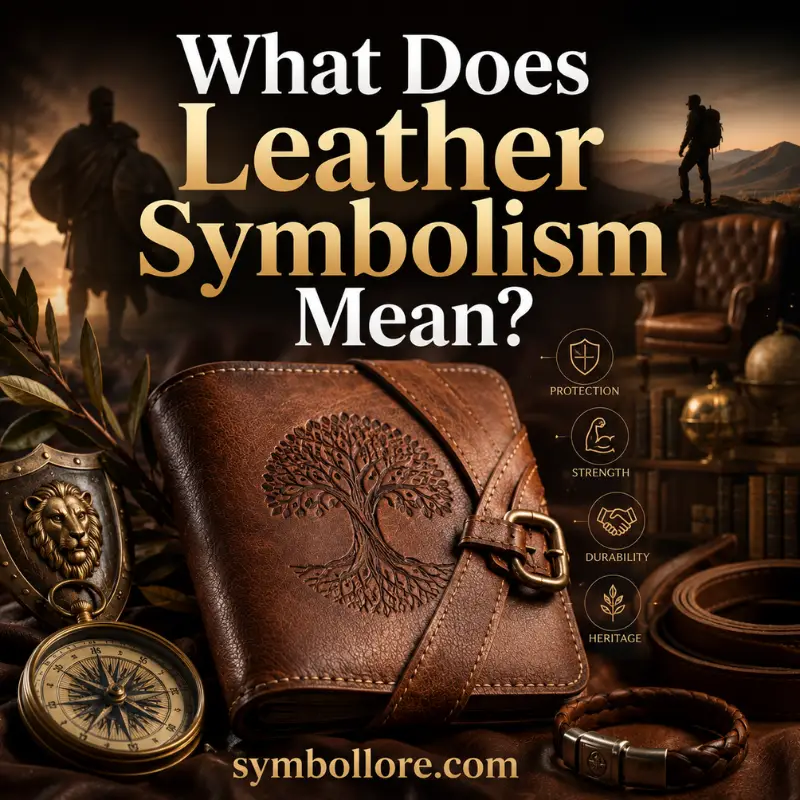
Leather’s strongest symbolic meaning comes from transformation.
A hide begins as an organic animal material. Through curing, tanning, cutting, stretching, dyeing, stitching, and finishing, it becomes something new. That physical process makes leather a useful metaphor for endurance through change.
The material also combines qualities that seem opposite. Leather is soft enough to bend but strong enough to protect. It can look rough while becoming highly refined through craftsmanship. It can age visibly without necessarily losing its usefulness.
These qualities support several recurring interpretations:
- Strength: leather can withstand repeated use.
- Protection: it has long been made into shields, footwear, gloves, armor, and coverings.
- Endurance: aging and wear can become part of its appearance.
- Craftsmanship: finished leather depends on skilled preparation and construction.
- Transformation: raw hide becomes a useful cultural object.
- Connection to nature: the material retains an association with animal life even after processing.
These are interpretive patterns rather than universal laws. A leather object does not automatically carry all six meanings.
Why Leather Became a Symbol of Strength and Endurance
Leather’s physical history provides the clearest foundation for its symbolism.
Ancient people used animal skins because they offered practical protection from weather and rough environments. The Global Egyptian Museum records leather use in ancient Egypt for clothing, sandals, containers, ropes, belts, military equipment, and shields. Leather was also used as a writing material.
This wide range of uses helped make leather familiar as a reliable working material.
A shield illustrates the symbolic connection particularly well. When leather covers or forms a defensive object, its practical function is protection. Later representations can then turn that physical protection into a metaphor for emotional or social defense.
The same process applies to endurance. A leather object that becomes worn but remains functional visibly demonstrates survival through use. Scratches, creases, and changes in color can therefore become signs of experience rather than defects.
This helps explain why modern imagery often uses aged leather to communicate toughness or a history of hardship.
Leather Symbolism and Protection
Protection is one of the strongest material-based meanings associated with leather.
Historical leather objects included shields, helmets, footwear, protective garments, containers, and other equipment. In ancient Egypt, leather was used for shields and parts of military equipment.
Biblical sources also describe leather in practical protective and everyday roles. The Encyclopedia of the Bible records leather clothing, belts, shields, footwear, containers, and coverings among its uses in the ancient Near East.
When a material repeatedly appears between the human body and an external threat, protection becomes an easy symbolic extension.
A leather shield can therefore represent:
- defense against danger;
- readiness;
- physical courage;
- safeguarding others;
- emotional boundaries;
- resilience under pressure.
However, leather itself is not necessarily a symbol of aggression. A protective object can communicate care as much as force. A shield protects because someone or something is considered worth protecting.
That distinction becomes important when interpreting leather armor, bags, belts, or clothing. The object determines whether the material communicates defense, travel, work, status, or something else.
The Transformation of Hide Into Leather
Leather also carries a powerful symbolism of transformation because tanning changes a perishable hide into a more stable material.
Historical leatherworking required preparation and technical knowledge. In ancient Egypt, hides could be dried, cured, salted, treated, tanned, and decorated. The Global Egyptian Museum documents several preparation methods and surviving leather objects from ancient periods.
The process creates an interesting symbolic pattern:
raw material → skilled transformation → durable object.
That sequence can represent growth through hardship. A difficult experience may change someone without destroying them, just as a hide becomes a different material through treatment.
For this reason, leather can work well as a symbol in stories about:
- personal development;
- survival;
- adaptation;
- discipline;
- learning a craft;
- rebuilding after hardship.
This interpretation is strongest when the surrounding story emphasizes change. Leather alone does not prove that a character has “overcome adversity.”
Leather Symbolism, Craftsmanship, and Human Skill
Leather can symbolize craftsmanship because its usefulness depends on human knowledge.
Cutting leather requires an understanding of grain, thickness, stretch, shape, and construction. Sewing, stamping, carving, dyeing, tooling, and finishing can turn the same basic material into very different objects.
Historical evidence shows that leatherworking was not limited to simple clothing. Ancient leather objects included containers, footwear, military equipment, furniture components, and writing surfaces.
This gives finished leather goods a second layer of meaning. They represent not only the material but also the work performed on the material.
A hand-tooled leather object may therefore suggest:
- patience;
- technical skill;
- tradition;
- attention to detail;
- handmade quality;
- respect for useful materials.
Modern craft culture often strengthens these associations. A handmade leather journal, saddle, belt, or bag can communicate a preference for durable objects and visible workmanship.
The symbolism here is different from the symbolism of luxury. Craftsmanship emphasizes how something was made, while luxury emphasizes what the object signifies socially.
Leather Symbolism and the Natural World
Leather retains a symbolic connection to animals even after tanning.
This creates a tension between nature and human transformation. The material originates in an animal body, yet humans reshape it into clothing, tools, books, containers, and artistic objects.
The Global Egyptian Museum’s collection description shows how extensively ancient societies used different animal skins, including those from goats, sheep, cattle, and other animals.
As a result, leather can symbolize:
- the use of natural resources;
- the relationship between humans and animals;
- survival;
- physical life;
- transformation;
- material continuity.
This interpretation should remain historically specific. Modern ethical debates about animal materials are different from ancient societies’ practical relationships with hides.
Therefore, a contemporary leather object may carry meanings that its historical maker never intended.
Leather in Ancient Egypt
Ancient Egyptian evidence shows leather functioning primarily as an important material rather than as a simple symbolic object.
The Global Egyptian Museum documents leather from the predynastic period onward. Leather appeared in clothing, sandals, bags, cushions, belts, ropes, chariot parts, shields, and writing materials. Tomb paintings also depict stages of leather production.
Leather was even used in funerary contexts. The museum records leather wrappings among objects associated with the dead.
These examples show why it is risky to claim that ancient Egyptians had one universal “leather meaning.” The same material served ordinary, military, decorative, funerary, and practical functions.
Its symbolism therefore depended on the object.
A leather shield belonged to the language of defense. A leather sandal belonged to movement and daily life. A leather funerary object belonged to death and burial. A leather writing surface belonged to knowledge and record keeping.
The material connected these objects, but it did not erase their differences.
Leather Symbolism in the Bible and Jewish Tradition
Leather appears in biblical contexts as a practical material, and later Jewish tradition gives leather an important role in religious objects.
The Encyclopedia of the Bible notes that Genesis 3:21 describes God making garments of skins for Adam and Eve. It also records leather belts, sandals, shields, containers, Tabernacle coverings, and parchment among biblical or ancient Near Eastern uses.
That makes covering and protection an especially relevant interpretive theme, although the biblical texts do not establish one universal symbolic definition for leather.
Jewish tradition provides another important example. Leather parchment is used for sacred texts, while leather forms part of tefillin, the small boxes worn during prayer. The Jewish Encyclopedia documents leather’s historical place in Jewish daily and religious life, including parchment, tefillin, footwear, and other objects.
Here, leather is connected to devotion, tradition, embodied religious practice, and preservation of sacred writing.
Those meanings belong to particular Jewish traditions. They should not be generalized into a claim that leather has the same religious meaning in every faith.
Leather, Parchment, and the Symbolism of Knowledge
Leather’s connection with writing gives it another symbolic dimension: preservation of knowledge.
Prepared animal skins became important writing surfaces in several historical settings. The biblical encyclopedia notes that carefully prepared leather was used for writing materials, including parchment, and identifies leather among the materials associated with ancient manuscripts.
The symbolism follows from function.
If a material preserves words across generations, it can become associated with:
- memory;
- knowledge;
- tradition;
- authority;
- history;
- continuity.
A leather-bound book can therefore feel symbolically different from a disposable notebook. Its binding may suggest that the contents deserve preservation.
Still, this does not mean every leather book is a symbol of ancient wisdom. Modern publishers and designers may choose leather simply for appearance or durability.
The symbolic reading becomes stronger when the book itself concerns history, religion, law, family records, or inherited knowledge.
Leather Symbolism in Clothing and Fashion
Leather clothing often symbolizes toughness, independence, rebellion, protection, or confidence in modern Western culture.
The meaning developed partly from practical clothing. Leather has long been useful for footwear, gloves, riding equipment, protective garments, and occupational gear. Over time, these functional associations became part of fashion imagery.
A leather jacket can therefore communicate several different ideas:
- independence;
- toughness;
- masculinity;
- rebellion;
- motorcycle culture;
- working-class identity;
- fashion-consciousness;
- personal confidence.
None of these meanings is automatic.
A leather jacket worn by a motorcyclist can communicate membership or practicality. The same jacket worn in a luxury fashion campaign may communicate sophistication. A costume designer may use it to make a fictional character look dangerous or self-reliant.
The symbolism comes from social associations built around the garment, not from leather having an inherent personality.
Leather as a Symbol of Status and Luxury
Fine leather can symbolize wealth, quality, refinement, and status when it appears in expensive goods.
Luxury handbags, luggage, shoes, furniture, and accessories often use carefully finished leather. In such settings, the material becomes part of a larger visual language of craftsmanship and exclusivity.
This creates an interesting contrast with leather’s older association with ordinary work.
Historically, leather was valuable because it was useful and versatile. In modern luxury markets, certain leather goods can become status objects because of craftsmanship, brand reputation, scarcity, and price.
The symbolism therefore shifts:
working leather → usefulness and durability
luxury leather → quality, prestige, and social distinction
Neither meaning is universally correct. A simple handmade belt and an expensive designer handbag can both be leather while communicating very different ideas.
Worn Leather and the Symbolism of Age
Worn leather often symbolizes experience because its surface records use.
Creases, scratches, fading, darkening, and softened edges can make an object appear older. Unlike many materials where wear simply looks like damage, leather’s changing surface is often valued as part of its character.
This makes worn leather useful in visual storytelling.
A weathered leather satchel might suggest:
- travel;
- long experience;
- adventure;
- memory;
- hard work;
- survival.
A worn leather chair could instead suggest family history and continuity.
A cracked leather object may also symbolize neglect or decline if the surrounding scene is darker.
The key distinction is between patina and deterioration. A beautifully aged object may suggest endurance. A severely damaged object may suggest loss or abandonment. The visual context determines which interpretation fits.
Leather Symbolism in Art, Literature, and Storytelling
Writers and artists can use leather because the material carries several meanings at once.
A leather-bound journal can represent hidden knowledge. A leather belt can establish a character’s occupation or historical setting. A leather shield can place a character within a world of conflict and protection.
Material symbolism becomes especially powerful when the object changes.
Imagine a character who begins with a new leather bag and later carries the same bag covered in scratches. The object’s changing surface can quietly show the passage of time and experience.
Likewise, a damaged leather shield can symbolize both protection and the cost of providing it.
This is an important feature of material symbolism: the object’s condition can modify its meaning.
The leather does not need to be explained in dialogue. Its appearance can communicate information visually.
Leather Symbolism in Modern American Culture
In the United States, leather symbolism is especially visible in fashion, motorcycles, Western imagery, crafts, books, furniture, sports equipment, and historical reenactment.
Different communities give the material different meanings.
A Western saddle may evoke horsemanship, frontier history, ranch work, and craftsmanship. A motorcycle jacket can suggest independence and subculture. A leather-bound Bible may communicate durability and religious devotion. A luxury handbag can represent refinement and status.
These examples show why a single definition of leather symbolism is inadequate.
The strongest interpretation asks:
- What object is made of leather?
- Who uses it?
- Why was leather chosen?
- Is the object new, worn, damaged, or decorated?
- What cultural setting surrounds it?
- Is the leather practical, sacred, fashionable, artistic, or luxurious?
These questions produce a more reliable interpretation than assigning one emotional meaning to the material.
What Leather Does Not Automatically Symbolize
Several popular interpretations should be treated carefully.
Leather does not automatically symbolize power. It can support that reading when used for armor, expensive goods, or authoritative clothing, but the object must establish the connection.
Leather does not automatically symbolize masculinity. Modern Western fashion has strongly associated some leather clothing with masculine toughness, but leather is used by people of all genders and across many cultures.
Leather does not universally symbolize sacrifice. Because leather comes from animal hides, sacrifice can become relevant in some religious or cultural contexts. Yet ordinary leather goods should not automatically be interpreted as religious symbols.
Leather also does not guarantee protection. A leather handbag may simply be a handbag. Symbolic interpretation becomes stronger when the object or story emphasizes defense, security, or shelter.
This distinction between material and context prevents symbolism from becoming a collection of unsupported claims.
How to Interpret Leather Symbolism
The most useful way to interpret leather is to begin with function.
Ask what the leather object does. If it protects the body, protection is likely important. If it preserves writing, knowledge or continuity may be relevant. If it is heavily worn, experience and endurance may enter the interpretation.
Next, examine craftsmanship. Hand-tooled patterns, stitching, carving, or decorative work can shift attention from raw strength toward human skill and cultural tradition.
Then examine condition. New leather may suggest possibility, wealth, or preparation. Worn leather can suggest experience. Damaged leather can suggest vulnerability, neglect, or the cost of survival.
Finally, identify the cultural setting.
A leather object in an ancient Egyptian tomb, a Jewish religious context, a medieval manuscript, a Western saddle, and a modern fashion photograph should not receive the same symbolic interpretation.
This contextual method also fits the broader approach used in SymbolLore’s discussions of material and object symbolism, where an object’s function, condition, history, and setting help determine meaning. For example, its
distinguishes material and condition from the wider social role of an object.
FAQs
Leather most commonly symbolizes strength, protection, endurance, resilience, craftsmanship, and transformation. These associations developed from its practical uses and physical qualities. However, the exact meaning depends on whether leather appears as clothing, armor, a book, a religious object, furniture, or a luxury product.
Leather symbolizes strength partly because it has historically been used for protective and durable objects. Ancient sources document leather shields, footwear, belts, containers, and military equipment. Its ability to remain flexible while enduring use also makes it a natural metaphor for resilience.
Yes, protection is one of its strongest contextual meanings. Leather has historically been placed between people and the environment through footwear, clothing, shields, and other protective objects. Still, leather itself is not automatically a protective symbol; the object’s function determines whether that interpretation applies.
Leather has different religious meanings in different traditions. In Jewish practice, leather is used in objects such as tefillin, while prepared animal skins have also been used for sacred writing. These traditions can connect leather with devotion, religious practice, and preservation. They should not be turned into one universal spiritual definition.
A leather jacket can symbolize independence, toughness, rebellion, confidence, motorcycle culture, or fashion. Its meaning depends on the wearer and setting. In a historical or occupational context, the garment may emphasize protection and practical work rather than rebellion.
Worn leather can symbolize experience, endurance, memory, travel, hard work, or survival because its surface records repeated use. In a darker setting, severe cracking or damage can instead suggest neglect or decline. The condition and surrounding story determine the stronger interpretation.
It can symbolize sacrifice in some religious interpretations because leather comes from animal hides and may appear within traditions involving animal sacrifice. However, ordinary leather should not automatically be labeled a symbol of sacrifice. The specific religious tradition and object must establish that connection.
Conclusion
Leather symbolism is rooted less in a single ancient definition than in the material’s long history of protection, craftsmanship, transformation, and endurance. Leather shields suggest defense, worn leather can suggest experience, and carefully crafted leather goods can represent skill or status. Religious traditions add other meanings, including connections with sacred writing and devotional practice.
The most reliable interpretation always begins with context. Ask what the leather object does, who uses it, how it has changed, and which cultural tradition surrounds it. Leather can represent strength in one setting and knowledge, luxury, humility, or memory in another. Its symbolism becomes clearest when the material and its human use are considered together.


