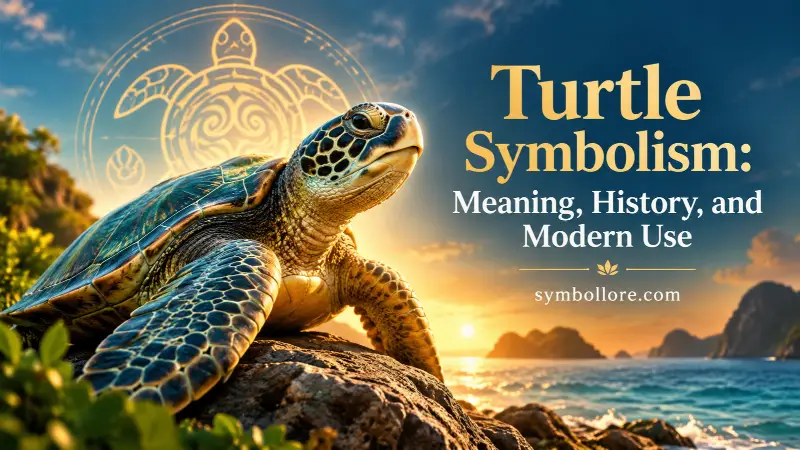
Turtle symbolism often represents patience, wisdom, protection, longevity, and steady progress. Across different cultures, turtles have become meaningful symbols because of their long lives, protective shells, and calm movements. Their ability to live on land or in water also connects them with balance, nature, and adaptability.
For centuries, people have included turtles in creation stories, spiritual traditions, artwork, and personal symbols. Today, turtles continue to represent resilience, emotional strength, and the importance of moving through life at a comfortable pace.
However, not every culture gives turtles the same meaning. Their significance depends on local traditions, religious beliefs, and personal experiences.
Quick Answer: What Does a Turtle Symbolize?
Turtle symbolism commonly represents wisdom, patience, protection, longevity, stability, and perseverance. A turtle’s hard shell suggests safety, while its slow movements encourage careful decisions and steady progress. In some Indigenous North American traditions, turtles also connect with creation and the Earth. Chinese traditions frequently associate turtles with long life, while Hindu stories connect the tortoise with divine support and stability.
TL;DR: Key Meanings of Turtle Symbolism
- Wisdom: Learning through experience and thoughtful choices.
- Patience: Moving forward without unnecessary pressure.
- Protection: Creating safety and maintaining personal boundaries.
- Longevity: Representing long life and lasting strength.
- Perseverance: Continuing despite difficulties or slow progress.
- Balance: Staying connected to emotions and everyday responsibilities.
- Stability: Building a secure foundation for the future.
9 Powerful Turtle Symbolism Meanings
Turtles have several symbolic meanings because people connect their physical features with human experiences. Their protective shells, long lifespans, and measured movements help explain these associations.
| Symbolic Meaning | What It Represents | Connection to Turtles |
|---|---|---|
| Wisdom | Knowledge and good judgment | Association with age and experience |
| Patience | Calm and careful progress | Slow, deliberate movements |
| Protection | Safety and personal boundaries | Strong protective shell |
| Longevity | Long life and endurance | Many species live for decades |
| Perseverance | Determination through challenges | Steady movement and survival |
| Stability | Security and a strong foundation | Grounded appearance and shell |
| Balance | Emotional and practical harmony | Movement between land and water |
| Adaptability | Adjusting to changing conditions | Different habitats and behaviors |
| Connection to Nature | Respect for the natural world | Roles in ecosystems and traditional stories |
1. Wisdom and Life Experience
Turtles often symbolize wisdom because people associate their long lives with accumulated experience.
This meaning reflects the idea that valuable knowledge develops over time. Instead of making quick decisions, a wise person considers the situation carefully.
In stories and artwork, a turtle may represent someone who stays calm, observes others, and acts thoughtfully.
However, turtles are not symbols of wisdom because science proves they possess special knowledge. The connection comes from cultural interpretation.
2. Patience and Slow Progress
Patience is one of the most recognizable meanings of turtle symbolism.
Many land turtles and tortoises move slowly compared with familiar mammals. As a result, people connect them with careful progress rather than unnecessary speed.
The turtle teaches a simple symbolic lesson: success does not always require rushing.
For example, someone learning a new skill might identify with a turtle because improvement takes consistent practice.
In this context, patience does not mean doing nothing. Instead, it means continuing forward while accepting that meaningful growth takes time.
3. Protection and Personal Boundaries
A turtle’s shell is its most recognizable protective feature.
Because of this natural defense, turtles commonly symbolize security, shelter, and emotional boundaries.
Their symbolism can remind people to protect their well-being without becoming disconnected from others.
For instance, a turtle illustration might represent a person’s need for privacy after a stressful experience.
The shell also creates a connection with the idea of home. It suggests a secure place where someone can feel comfortable.
Still, a turtle cannot completely leave its shell behind. The shell forms part of its skeleton. Therefore, the familiar idea of a turtle carrying its home is a metaphor rather than a literal description of a portable house.
4. Longevity and Lasting Strength
Longevity means living for a long time.
Many turtles and tortoises have impressive lifespans, although the length varies greatly by species. Some large tortoises can live for more than a century.
Consequently, turtles became natural symbols of long life in several cultures.
In Chinese art, turtles and tortoises have represented longevity for centuries. They appear in decorative objects, carvings, and traditional imagery.
This association can also express a wish for lasting health, family continuity, and endurance.
5. Perseverance and Determination
Turtles also represent perseverance because they provide an easy visual metaphor for steady effort.
Their measured movements suggest that consistent progress matters more than speed.
The familiar fable The Tortoise and the Hare, traditionally attributed to Aesop, illustrates this idea.
In the story, the tortoise wins a race against a faster but overconfident hare.
The central lesson concerns persistence and avoiding complacency.
For modern readers, this symbolism may apply to education, work, personal improvement, or long-term goals.
6. Stability and Grounding
Turtles can symbolize stability because of their solid shells and close connection with land and water.
Grounding means feeling steady, present, and connected to everyday reality.
In symbolic artwork, a turtle may represent someone who remains calm during uncertainty.
This meaning is especially relevant when a person experiences major changes.
For example, a turtle necklace might serve as a personal reminder to make careful decisions during a difficult period.
The object does not create stability by itself. Rather, its meaning comes from the intention someone gives it.
7. Emotional Balance and Inner Peace
Turtles sometimes represent emotional balance because many species move between water and land.
In modern symbolism, water frequently represents emotions, while land suggests practical responsibilities and physical stability.
A turtle moving between these environments can therefore illustrate the relationship between feelings and everyday life.
This interpretation is metaphorical, not a universal traditional belief.
Someone might use turtle imagery to express the desire for a calmer lifestyle or healthier emotional boundaries.
8. Adaptability and Resilience
Turtles inhabit many environments, including oceans, rivers, lakes, wetlands, deserts, and forests.
Different species have developed features that help them survive in their particular habitats.
As a result, people may interpret turtles as symbols of adaptation and resilience.
Resilience means recovering or continuing after challenges.
For example, a sea turtle swimming through strong ocean currents may represent the determination needed to face difficult circumstances.
However, resilience should not be confused with invulnerability. Real turtles face threats from habitat loss, pollution, climate change, and other pressures.
9. Connection to Nature and the Earth
Turtle symbolism also connects with the natural world.
Some Indigenous North American creation traditions describe land forming on the back of a great turtle.
These stories create meaningful relationships between turtles, the Earth, and the origins of life.
In modern environmental artwork, turtles may represent wildlife protection and ecological responsibility.
Sea turtles, in particular, have become recognizable figures in ocean conservation.
Their symbolic meaning can encourage respect for natural habitats and the animals that depend on them.
Turtle Symbolism in Different Cultures
Although turtles appear in traditions worldwide, their meanings are not identical.
Religious stories, historical experiences, and local environments influence how communities understand these animals.
Turtle Symbolism in Native American Traditions
Turtles hold important roles in the traditions of several Indigenous North American nations.
In some Haudenosaunee and Anishinaabe creation narratives, a great turtle supports land that becomes the world. Related traditions help explain the name Turtle Island, which many Indigenous people use for North America.
These stories connect turtles with creation, the Earth, and the foundations of life.
However, Indigenous nations have distinct beliefs and practices. No single turtle interpretation represents every Native American community.
For example, the Natural History Museum of Utah describes how turtles connect with perseverance and protection in Diné traditions.
Some historical Plains Indigenous communities also used turtle-shaped amulets for children. These objects could express hopes for health and protection.
Understanding the particular community behind a symbol matters more than assigning one meaning to every tradition.
Turtle Symbolism in Chinese Culture
Turtles and tortoises have long represented longevity, endurance, and stability in Chinese traditions.
Their long lifespans made them powerful symbols of lasting life.
Ancient Chinese divination also involved turtle shells. During the Shang dynasty, people used turtle plastrons and animal bones in rituals associated with questions about important matters.
Some of the earliest surviving forms of Chinese writing appear on these oracle bones.
Traditional Chinese cosmology also includes the Black Tortoise, or Xuanwu, associated with the north and winter.
As a result, turtle imagery in Chinese cultural contexts can express several related ideas:
- Long life and endurance
- Stability and protection
- Cosmological order
- Traditional divination
- Strength through time
The exact interpretation depends on the object, story, and historical setting.
Turtle Symbolism in Hinduism
In Hindu traditions, the tortoise has an important connection with Vishnu.
One of Vishnu’s avatars, or divine forms, is Kurma, the tortoise.
In the well-known story of the churning of the ocean, Kurma supports Mount Mandara so the gods and asuras can use the mountain in their effort to obtain amrita, the nectar of immortality.
The story connects Kurma with divine support and the preservation of cosmic order.
A tortoise in Hindu religious artwork may therefore represent a foundation that supports something much greater.
This meaning differs from a modern interpretation of a turtle as simply a reminder to move slowly.
Turtle Symbolism in Japanese Culture
In Japan, turtles are traditional symbols of longevity and good fortune.
They sometimes appear alongside cranes, another animal associated with long life.
Both animals feature in celebratory artwork and decorations.
Japanese folklore also includes the story of Urashima Tarō, a fisherman who helps a turtle and later visits an extraordinary underwater palace.
Versions of this story explore kindness, the passage of time, and the consequences of returning to a changed world.
Therefore, Japanese turtle imagery can express longevity, gratitude, and the unusual passage of time.
Spiritual Meaning of a Turtle
In contemporary spiritual interpretation, a turtle often represents patience, inner security, personal growth, and the importance of staying grounded.
Some people view a turtle as a reminder to trust their own pace. Others associate it with emotional protection or the need to simplify their lives.
These interpretations are personal rather than scientifically established messages.
A turtle appearing in everyday life does not provide reliable evidence of a supernatural event.
Nevertheless, people can use its symbolism for reflection.
For example, seeing a turtle might encourage someone to think about a difficult decision, their responsibilities, or their need for rest.
The value comes from the reflection itself rather than a proven ability of turtles to communicate spiritual predictions.
What Does Seeing a Turtle Symbolize?
Seeing a turtle may carry different personal meanings depending on the circumstances.
An encounter with a turtle can remind someone of patience, resilience, or respect for the environment.
Consider these possible interpretations:
| Encounter | Possible Personal Interpretation |
|---|---|
| Turtle crossing a path | Take your time before deciding |
| Turtle swimming | Adapt to changing emotions |
| Turtle resting | Make space for recovery |
| Turtle hiding in its shell | Review personal boundaries |
| Turtle moving steadily | Continue toward a long-term goal |
| Turtle near water | Reflect on emotional balance |
These meanings are modern symbolic associations, not fixed rules.
A turtle crossing a road, for example, is usually moving through its habitat. Its behavior does not prove that a special event is about to happen.
If you encounter a wild turtle, respect its space and avoid disturbing it unnecessarily.
Sea Turtle Symbolism and Meaning


Sea turtle symbolism often emphasizes endurance, adaptation, safe journeys, and the connection between life and the ocean.
Sea turtles travel long distances and spend most of their lives in marine environments. Many females return to nesting areas connected with their origins.
These behaviors have inspired modern symbolic connections with determination and the idea of returning home.
Freedom and Exploration
Because sea turtles move through enormous ocean environments, they can represent exploration and independence.
A sea turtle image may symbolize someone’s desire to experience new places while maintaining a connection with home.
Persistence Through Challenges
Sea turtles face many natural obstacles throughout their lives.
Hatchlings must reach the ocean, while adults navigate changing conditions and human-created threats.
Their survival challenges have made them symbols of determination in contemporary environmental and personal artwork.
Ocean Conservation
Sea turtles also represent the need to protect marine life.
Plastic pollution, accidental capture in fishing gear, coastal development, and other threats affect different species.
Therefore, sea turtle designs often appear in conservation campaigns.
In this setting, the turtle communicates a practical message about environmental responsibility rather than a supernatural meaning.
Turtle Shell Symbolism
A turtle’s shell commonly symbolizes protection, personal boundaries, stability, and home.
Unlike a removable shield, the shell forms part of the turtle’s body. Its backbone and ribs connect with the shell structure.
This biological detail makes the shell a useful metaphor for deeply personal safety.
In art, a turtle retreating into its shell may represent the need for privacy or emotional recovery.
However, the same image can suggest isolation when a story emphasizes fear or withdrawal.
Context determines which interpretation fits best.
A strong boundary protects personal well-being. Yet healthy relationships also require communication and trust.
Turtle shell symbolism can express both sides of that balance.
Turtle Symbolism in Dreams
Dreaming about a turtle may reflect personal experiences involving patience, boundaries, responsibilities, or long-term goals.
Dream interpretation is subjective. Research does not establish one universal meaning for every turtle dream.
A dream’s emotional tone and surrounding events usually matter more than the animal alone.
Dreaming of a Turtle Swimming
A swimming turtle might reflect feelings about navigating change or managing emotions.
A peaceful dream could suggest comfort with gradual progress. In contrast, rough water might connect with recent stress.
Dreaming of a Turtle Hiding
A turtle withdrawing into its shell may represent a desire for safety or privacy.
Someone who feels overwhelmed might connect this image with the need to rest.
However, the dream does not prove that the person is emotionally withdrawn.
Dreaming of a Baby Turtle
A baby turtle can symbolize something new, fragile, or still developing.
For example, someone beginning a project might associate the image with early progress and the need for care.
Dreaming of a Large Turtle
A large turtle may symbolize stability, an important responsibility, or a long-standing influence.
The meaning depends on whether the dreamer feels safe, curious, worried, or threatened.
Dreams are not reliable predictions of future events. They often draw on memories, emotions, and everyday concerns.
Turtle Tattoo Symbolism


8
Turtle tattoos often represent resilience, protection, patience, longevity, and personal growth.
Some people choose a turtle design to mark a difficult period they have overcome. Others use it to express their connection with nature or their desire for a calmer lifestyle.
The style of the tattoo can influence its meaning.
| Tattoo Design | Common Personal Meaning |
|---|---|
| Small turtle | Patience and quiet strength |
| Sea turtle | Freedom and perseverance |
| Turtle with waves | Connection with the ocean |
| Turtle with flowers | Growth and renewal |
| Turtle with a geometric shell | Structure, protection, and balance |
| Turtle with a family theme | Security and lasting relationships |
These are possible interpretations, not universal rules.
Traditional Pacific tattoo designs may have specific cultural meanings involving ancestry, identity, place, and community.
For that reason, people considering culturally significant patterns should learn about the tradition and consult artists with appropriate cultural knowledge.
Turtle Symbolism in Literature and Storytelling
Writers often use turtles and tortoises to represent persistence, vulnerability, security, or the passage of time.
The meaning depends on the character’s role and the larger message of the story.
The Tortoise and the Hare
In The Tortoise and the Hare, the tortoise represents steady effort and determination.
The hare moves faster but becomes overconfident.
As a result, the slower character succeeds because of persistence.
The story makes the tortoise a familiar symbol of consistency and patience.
The Grapes of Wrath
In John Steinbeck’s novel The Grapes of Wrath, a turtle appears in an early chapter while attempting to cross a road.
Despite obstacles, it continues moving.
Readers commonly interpret the turtle as a symbol of endurance and the struggle to survive.
Its difficult journey also reflects themes that later shape the experiences of the Joad family.
Modern Stories
Modern fiction may use a turtle to represent a quiet character who possesses more strength than others recognize.
Alternatively, an animal withdrawing into its shell might symbolize fear, isolation, or the desire for safety.
Writers can also challenge familiar turtle meanings.
A fast-moving or unusually aggressive turtle, for example, may create humor by reversing reader expectations.
Turtle vs. Tortoise Symbolism: Is There a Difference?
Turtle and tortoise symbolism often overlap, but their different habitats and familiar behaviors can shape their meaning.
A tortoise is a type of turtle that typically lives on land. In everyday American English, turtle is the broader term.
| Feature | Turtle | Tortoise |
|---|---|---|
| Typical habitat | Aquatic, semi-aquatic, or terrestrial | Primarily terrestrial |
| Common symbolic themes | Adaptability, protection, longevity | Patience, stability, endurance |
| Familiar image | Swimming or moving near water | Walking steadily on land |
| Symbolic connection | Water, movement, and change | Earth, grounding, and persistence |
These distinctions describe common modern interpretations rather than fixed cultural rules.
In historical traditions, translations of turtle and tortoise terminology may also overlap.
The specific species and cultural context matter more than the English label alone.
Is Turtle Symbolism Good or Bad?
Turtle symbolism is generally positive in many well-known cultural and modern contexts.
It often expresses patience, long life, protection, endurance, and wisdom.
However, a turtle can also carry less comfortable meanings.
For example, slow movement may symbolize hesitation when a story focuses on missed opportunities.
Similarly, hiding inside a shell can suggest fear or social withdrawal rather than healthy protection.
The symbolism depends on how the turtle appears and what the larger story communicates.
A turtle is not automatically a good-luck or bad-luck sign. Its meaning comes from cultural tradition, artistic context, or personal interpretation.
How to Interpret Turtle Symbolism in Everyday Life
The most useful way to understand a turtle symbol is to consider its context.
Start by asking what the turtle represents in the particular artwork, story, dream, or personal experience.
Next, consider its behavior.
A swimming turtle may suggest a different idea from one hiding inside its shell.
Cultural background matters as well. A turtle in a Hindu religious image can carry a meaning very different from a turtle on a modern conservation poster.
Finally, distinguish traditional meanings from personal associations.
You can find a turtle meaningful without believing that every encounter contains a hidden message.
Frequently Asked Questions About Turtle Symbolism
A turtle often symbolizes patience, inner peace, protection, and personal growth in modern spiritual interpretations. Some people also connect it with grounding and wisdom. However, spiritual meanings vary across cultures and individuals, and they are not scientifically established messages.
Turtles are associated with good fortune and longevity in some cultural traditions, including Chinese and Japanese contexts. However, not every culture treats turtles as lucky symbols. Their meaning depends on the historical or personal setting.
In modern personal symbolism, a turtle may represent commitment, patience, emotional security, and a lasting relationship. These meanings come from associations with longevity and protection. They do not form a universal traditional symbol of romantic love.
Turtles have different meanings among Indigenous North American nations. Some traditions connect them with creation and the Earth, while others emphasize protection or perseverance. Turtle Island stories are especially important in certain northeastern Indigenous traditions.
A baby turtle may symbolize new beginnings, vulnerability, growth, or developing independence. People sometimes connect hatchlings with the courage needed to begin something new. This is a modern personal interpretation rather than a universal cultural rule.
Seeing a turtle does not reliably predict future events. However, someone may interpret the encounter as a personal reminder to be patient, remain steady, or appreciate nature. Its symbolic value depends on individual beliefs and circumstances.
Conclusion
Turtle symbolism brings together meaningful ideas about patience, wisdom, protection, longevity, and perseverance. Its significance developed through traditional stories, observations of nature, and cultural practices across different societies.
From Indigenous creation narratives to Chinese longevity imagery and modern sea turtle conservation, the turtle carries many distinct meanings. The strongest interpretation always depends on its context. Above all, the turtle remains a familiar reminder that steady progress, thoughtful choices, and lasting strength can matter more than speed.