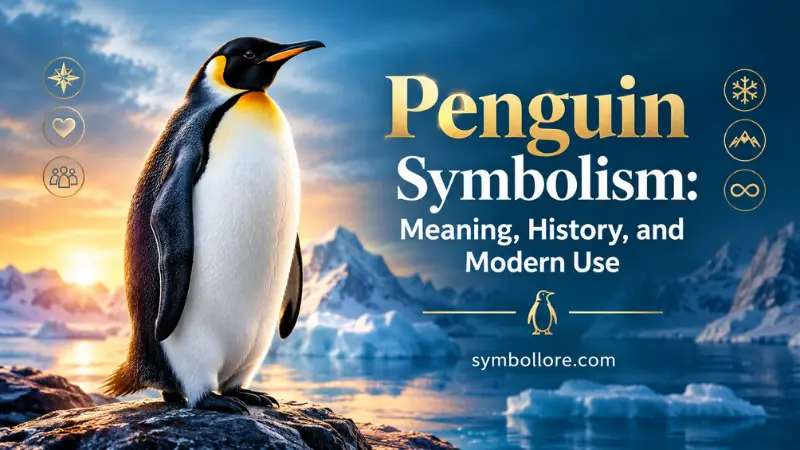
Penguin symbolism commonly represents resilience, loyalty, cooperation, adaptability, and close community bonds. These meanings come largely from the bird’s real behavior and the environments where penguins live. Their ability to move between land and sea also makes them useful images of flexibility and change.
However, penguins do not have one ancient symbolic meaning shared by every culture. Unlike animals that appear throughout classical mythology, penguins became widely known outside the Southern Hemisphere relatively recently. Their modern meanings therefore developed through observation, exploration, wildlife science, popular culture, and conservation.
One important cultural exception is Māori tradition in Aotearoa New Zealand. The Fiordland crested penguin, or tawaki, has a documented connection with a figure associated with lightning. This gives penguin symbolism a deeper cultural history than a simple list of modern personality traits suggests.
Quick Answer
Penguin symbolism most often represents resilience, loyalty, cooperation, adaptability, and community. These associations come from penguins’ survival in difficult environments, social behavior, parenting, and movement between land and sea. However, meanings vary by species and culture. Māori traditions give the Fiordland penguin, or tawaki, a distinct connection with lightning and a named ancestral figure.
TL;DR
- Penguins can symbolize resilience because they survive demanding marine and coastal environments.
- Their social lives support meanings of community, cooperation, and family care.
- Their movement between land and water makes adaptability a natural modern interpretation.
- Penguin symbolism is largely modern rather than rooted in one widespread ancient mythology.
- Māori tradition gives the Fiordland crested penguin, or tawaki, a specific cultural connection with lightning.
- Today, penguins also symbolize conservation and vulnerable ecosystems.
Penguin Meanings at a Glance
| Context or Feature | Possible Meaning | Why the Association Exists | Important Limit |
|---|---|---|---|
| Harsh environments | Resilience | Penguins survive cold, wind, predators, and demanding marine conditions | Survival does not create one universal human lesson |
| Social groups | Community | Many penguins breed or live in colonies and depend on social behavior | Species differ in colony structure |
| Parenting | Care and responsibility | Both penguin parents can contribute to feeding and protecting young | Parenting patterns vary by species |
| Land and sea | Adaptability | Penguins are highly adapted for life in water but also depend on land | “Balance” is a modern metaphor |
| Black-and-white appearance | Formality or contrast | The plumage resembles formal clothing to many modern viewers | This is primarily a modern visual association |
| Tawaki in Māori tradition | Lightning and sacred ancestry | The Fiordland penguin’s name is connected with a tradition involving lightning | This association belongs to a specific cultural context |
| Conservation imagery | Environmental responsibility | Several penguin species face habitat and human-related threats | Conservation meaning is modern |
What Does Penguin Symbolism Mean?
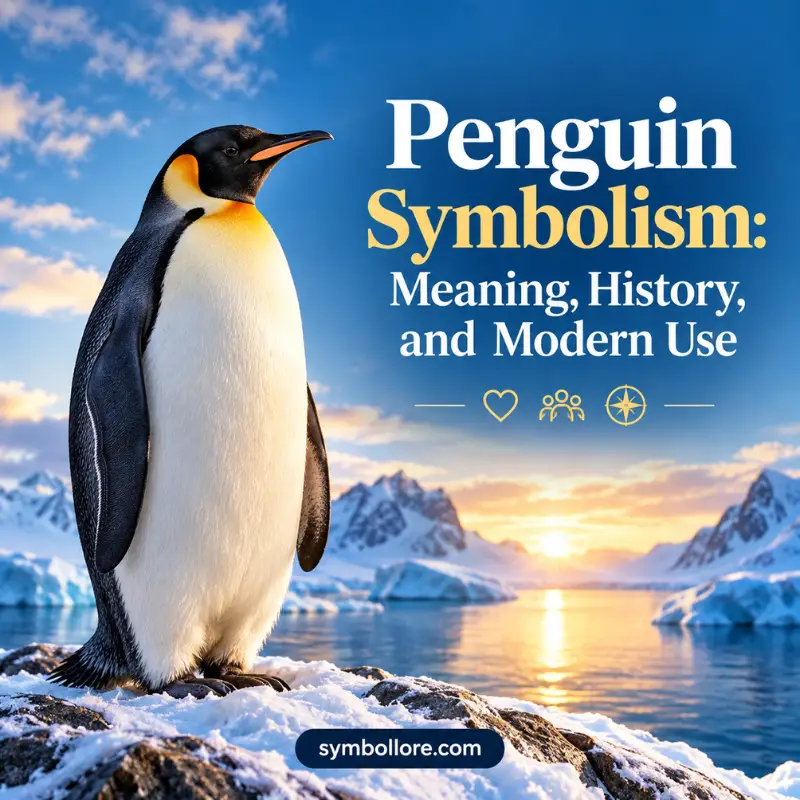
Penguin symbolism centers on resilience, loyalty, cooperation, adaptability, and belonging. These meanings are strongest when they arise from observable traits rather than unsupported claims about supernatural powers.
Resilience is one of the clearest modern associations. Penguins live in environments that can demand substantial physical adaptation. They depend on the sea for food and return to land or coastal areas for important parts of their life cycle.
Community is another major theme. Penguins can gather in colonies, communicate with one another, and cooperate around breeding and survival. This makes the bird a useful modern image for shared responsibility.
Adaptability comes from the penguin’s unusual relationship with two environments. Penguins are birds, yet they cannot fly. Instead, their wings became specialized for swimming. Their bodies therefore challenge the idea that strength must look conventional.
That contrast gives the penguin a particularly accessible symbolic message: a limitation in one setting can become an advantage in another.
Why Penguins Became Symbols of Resilience
Penguins represent resilience largely because their real lives involve demanding environmental conditions.
Different species occupy different habitats, so the popular image of every penguin living on Antarctic ice is inaccurate. New Zealand, for example, has several penguin species, including the little penguin, yellow-eyed penguin, and Fiordland crested penguin.
The Fiordland crested penguin is especially useful for understanding this point. It breeds in coastal forests and spends much of its time at sea outside the breeding season. Te Papa notes that tawaki can travel thousands of kilometers during their migrations.
Consequently, resilience does not simply mean “being strong.” It can mean adjusting to changing environments while maintaining essential life patterns.
Modern readers often turn that natural adaptability into a human metaphor. A penguin image may therefore communicate persistence without suggesting aggression or dominance.
Penguin Symbolism and Community
Penguins often symbolize community because many species depend on social behavior during important stages of life.
Colonies can create striking visual images. Hundreds or thousands of birds gathered together suggest cooperation, shared space, and collective survival. This is one reason penguin imagery works well in children’s media, educational settings, and environmental campaigns.
However, the word “community” should not imply that every penguin behaves identically. Penguin species differ in nesting locations, colony sizes, breeding patterns, and social organization.
The symbolism becomes stronger when it stays connected to the specific behavior being represented.
For example, a group of penguins standing together can suggest solidarity. A single penguin returning to the sea may suggest independence or a temporary journey away from the group.
The same animal can therefore express both belonging and individual movement.
Penguin Symbolism and Family Bonds
Penguins are also associated with family care and parental responsibility.
Both parents contribute to raising young in penguin species, although the exact roles differ. The New Zealand Department of Conservation notes that both parents are involved in feeding and protecting young penguins.
This observable behavior supports modern interpretations involving devotion, responsibility, and shared caregiving.
It is still important to avoid turning animal behavior into a human relationship rule. Popular culture sometimes claims that all penguins mate for life or always remain with one partner forever. Such statements oversimplify the diversity of penguin species and individual behavior.
A more accurate symbolic interpretation is simpler: penguins can represent commitment, shared responsibility, and returning care.
That distinction makes the symbolism more useful because it respects the animal rather than forcing human ideals onto it.
Adaptability: The Penguin Between Land and Sea
The penguin’s body creates one of its strongest symbolic contrasts.
Penguins are flightless seabirds. Their wings are not designed for powered flight through the air. Instead, they function as highly effective swimming structures.
This creates a natural metaphor for adapting to circumstances.
A penguin does not succeed by becoming more like a flying bird. It succeeds through a different physical strategy. In symbolic language, that can suggest finding a strength that fits your actual environment.
The image also creates a useful contrast between appearance and ability. A penguin can look awkward while walking on land, yet it becomes highly capable in the water.
Modern penguin symbolism therefore sometimes represents hidden ability or the difference between appearance and performance.
This interpretation is not an ancient doctrine. It is a modern metaphor built from observation.
Why the Penguin’s Black-and-White Appearance Matters
The penguin’s black-and-white coloring has encouraged several modern symbolic interpretations.
Its dark back and pale underside create strong visual contrast. In popular American culture, the pattern is often compared with a formal suit or tuxedo. As a result, penguins can symbolize elegance, dignity, ceremony, or understated formality.
The same contrast can also suggest duality.
A penguin moves between land and water. Its body combines dark and light areas. Its behavior can appear awkward in one environment and graceful in another.
Together, these features make the bird visually useful for themes involving contrast and balance.
Still, black-and-white penguin symbolism should not be treated as an established universal tradition. The formal “tuxedo” reading is largely a modern visual association.
Penguin Symbolism in Māori Tradition
The most important documented cultural distinction involves the Fiordland crested penguin, known as tawaki.
Te Papa explains that tawaki may have been named after a tipuna in a pūrākau who revealed supernatural abilities by grasping lightning and adorning the head with it. The yellow crest of the penguin may have encouraged the connection.
This association should not be expanded into a claim that all penguins symbolize a Māori deity.
The cultural connection is specific to the Fiordland crested penguin and its Māori naming tradition.
Te Ara also records that the Fiordland penguin’s Māori name relates to its yellow crest and eyebrow markings. The yellow-eyed penguin and little penguin have different Māori names connected with their own features or calls.
This is an important lesson in cultural symbolism. Different birds within the same broad animal group can have different names, histories, and associations.
The Māori example therefore adds depth to penguin symbolism while also showing why universal claims should be avoided.
Tawaki, Lightning, and Symbolic Transformation
The tawaki connection becomes more interesting when placed beside Māori traditions surrounding Tāwhaki.
Te Ara describes Tāwhaki as a figure linked with lightning. A carving at the University of Waikato Library shows Tāwhaki grasping the vine by which he climbed toward the heavens.
Te Papa’s account connects the Fiordland penguin’s name with a tradition in which a figure revealed supernatural abilities by taking hold of lightning.
The penguin’s yellow crest therefore creates a visual bridge between the bird and the lightning-associated figure.
This is not the same as saying that the penguin itself is a god. The evidence supports a naming and cultural association rather than a universal theological identity.
For readers studying symbolism, that distinction matters. Symbolic interpretation works best when the exact species, community, language, and tradition remain visible.
Penguin Symbolism and Conservation
Modern conservation has added another layer to penguin symbolism.
Penguins are increasingly used to communicate environmental vulnerability, habitat protection, and responsibility toward marine ecosystems. This meaning is especially clear in New Zealand, where several mainland penguin species face serious conservation pressures.
The Department of Conservation identifies threats to Fiordland crested penguins that include dogs, human disturbance, and climate change. It also describes the species as declining.
The yellow-eyed penguin has an especially strong conservation context. A joint strategy from the New Zealand Department of Conservation and Te Rūnanga o Ngāi Tahu describes hoiho as a treasured species and emphasizes the need to protect its marine and terrestrial ecosystems.
In this context, penguin imagery can represent more than endurance.
It can represent the responsibility to protect a living species and the environments on which it depends.
That is a documented modern use, not simply a personal spiritual interpretation.
Penguin Symbolism in Modern American Culture
In the United States, penguins often appear as friendly, approachable symbols.
Children’s books, aquariums, documentaries, winter decorations, clothing, toys, advertising, and animated films have helped create this image. Their upright posture and unusual movement also make them easy to recognize.
American popular culture often uses penguins to communicate:
- friendliness;
- perseverance;
- family connection;
- teamwork;
- winter;
- playfulness;
- environmental awareness; and
- quiet confidence.
Their popularity also creates a separation between geographic fact and artistic convention.
Penguins are often placed beside snowflakes, ice, and polar imagery. However, not every penguin species lives in Antarctica, and penguins do not naturally share the Arctic with polar bears.
Therefore, a winter penguin design can be symbolically effective while still being geographically simplified.
What Penguins Can Symbolize in Art and Design
Penguins work well in visual symbolism because their shape communicates several ideas at once.
A standing penguin can suggest dignity or curiosity. A pair can emphasize companionship. A parent with a chick can suggest care. A group can communicate community. A penguin swimming can represent freedom, ability, or movement.
The surrounding imagery matters just as much.
For example:
- Penguin with ocean: adaptability, exploration, or environmental connection.
- Penguin with a chick: caregiving and family responsibility.
- Penguin pair: companionship or shared commitment.
- Penguin colony: cooperation and belonging.
- Penguin in snow: endurance, winter, or remote wilderness.
- Penguin with conservation imagery: ecological responsibility.
- Tawaki imagery: a specific connection with Māori cultural tradition and lightning.
This approach avoids the common mistake of treating an animal image as a fixed symbolic code.
Does Penguin Symbolism Have an Ancient European Origin?
No strong evidence supports a major ancient European penguin symbolism tradition.
Penguins live naturally in the Southern Hemisphere. Many ancient Mediterranean and northern Eurasian cultures therefore had no direct experience with them.
Their wider symbolic history is comparatively recent and developed through exploration, natural history, museums, photography, literature, and popular culture.
This makes penguins different from animals such as lions, snakes, eagles, or owls, which appear repeatedly in older mythological and religious traditions.
The absence of an ancient European symbolism tradition does not mean penguins lack cultural meaning. Instead, it explains why much of their modern symbolism is based on observed behavior rather than inherited classical mythology.
Common Misconceptions About Penguin Symbolism
Several popular claims need more careful wording.
“Penguins always symbolize lifelong love.”
Not necessarily. Penguins can symbolize commitment and family care, but species and individual behavior vary.
“Penguins are symbols of Antarctica.”
Only partly. Antarctica is home to several penguin species, but penguins also live in places such as New Zealand, South Africa, Australia, and South America.
“Penguins have one universal spiritual meaning.”
There is no evidence for a universal spiritual meaning. Modern spiritual interpretations are personal or tradition-specific.
“The penguin is a Māori god.”
This is too broad. The Fiordland crested penguin, or tawaki, has a documented connection with a Māori tradition involving a lightning-associated figure.
“All penguins live on ice.”
False. Some penguins breed in forests, rocky coasts, islands, and temperate environments. Te Papa specifically describes tawaki breeding in coastal forests.
These corrections make the symbolism more accurate without removing its imaginative value.
How to Interpret Penguin Symbolism in Context
The best interpretation starts with the exact image and setting.
First, identify the species if possible. A generic emperor penguin image has a different cultural background from a documented Māori representation of tawaki.
Next, examine what the penguin is doing.
A penguin swimming may emphasize adaptability. A parent caring for a chick may emphasize responsibility. A colony may highlight community. A solitary bird may suggest independence or simply reflect the composition of the artwork.
Then consider the surrounding symbols.
Ice can reinforce endurance. Ocean imagery can suggest movement or exploration. A family scene can emphasize care. Conservation imagery can shift the meaning toward environmental responsibility.
Finally, ask whether the interpretation comes from documented tradition or personal reflection.
A personal symbol does not need an ancient origin to be meaningful. It simply should not be presented as an established cultural fact when the evidence does not support that claim.
Penguin Symbolism in Dreams and Personal Reflection
Penguin dreams can be interpreted as personal imagery rather than fixed predictions.
A penguin appearing in a dream might remind someone of companionship, resilience, isolation, adaptability, or the need to work with others. The dream’s emotional tone and setting matter more than a generic dream dictionary.
For example, a penguin comfortably swimming could evoke confidence in an unfamiliar environment. A lost penguin might suggest feelings of disconnection. A group of penguins could bring attention to belonging or social pressure.
These interpretations are personal metaphors.
There is no reliable evidence that dreaming about a penguin predicts a particular event or guarantees a spiritual message.
The same principle applies to seeing a penguin unexpectedly. A meaningful personal association can be useful for reflection, but it should not be confused with an objective omen.
How Penguin Symbolism Differs From Other Bird Symbols
Penguin symbolism becomes clearer when compared with other bird imagery.
A heron often centers on patience, independence, and careful timing because of its hunting behavior. Symbollore’s discussion of heron symbolism makes that connection while stressing that cultural context changes interpretation.
A blue jay creates a different symbolic pattern. Its loud calls, visible crest, social behavior, and defensive actions support themes of communication, confidence, protection, and sometimes aggression.
Blue jay symbolism on Symbollore
Penguins stand apart because their symbolism often comes from adaptation, community, family care, and the contrast between land and water.
That difference shows why bird symbolism works best when it begins with the actual bird rather than a generic list of traits.
Why Penguin Symbolism Remains Popular
Penguins remain powerful symbols because they combine vulnerability with capability.
Their appearance can seem gentle or humorous. Their environments can be severe. Their bodies look unusual, yet they are highly adapted to their way of life.
That combination creates an appealing symbolic message.
Strength does not always look intimidating. Adaptation does not always mean becoming harder. Community does not require giving up individuality.
Modern audiences can therefore use the penguin as a symbol of quiet endurance and practical cooperation.
At the same time, the bird’s conservation status adds a more serious meaning. Penguins are living animals with real ecological needs, not simply inspirational characters.
Their symbolism becomes richer when appreciation for the image remains connected to respect for the species.
FAQs
A penguin commonly symbolizes resilience, adaptability, cooperation, loyalty, family care, and community. These meanings largely come from observed behavior and the demanding environments in which penguins live. Cultural traditions can add more specific meanings.
The Fiordland crested penguin, or tawaki, has a documented connection with a Māori tradition involving a figure associated with lightning. Te Papa notes that the penguin’s yellow crest may relate to this story. This association should not be generalized to every penguin species.
Penguins can symbolize love, loyalty, and commitment in modern culture, especially when shown as a pair or family. However, the idea that every penguin forms an identical lifelong partnership is an oversimplification. Species and individual behavior differ.
Penguins symbolize resilience because many species survive challenging marine and coastal conditions while remaining highly adapted to their environments. Their ability to function on land and in water also makes adaptability a natural modern metaphor.
Modern spiritual writing may interpret penguins as symbols of community, emotional balance, perseverance, or devotion. These are personal or contemporary interpretations rather than universal spiritual facts. A specific religious or cultural tradition should be identified before making a stronger claim.
A penguin in a dream may personally suggest resilience, belonging, adaptability, companionship, or feeling out of place. The meaning depends on the dream’s setting and emotional tone. Dream symbolism does not provide a reliable method for predicting future events.
Penguins can symbolize Antarctica because several species are strongly associated with Antarctic environments. However, penguins are not limited to Antarctica. Many species live farther north in the Southern Hemisphere, including around New Zealand, Australia, southern Africa, and South America.
Conclusion
Penguin symbolism most often centers on resilience, community, adaptability, family care, and steady cooperation. These meanings grow mainly from the bird’s observable life rather than from one universal ancient mythology.
The cultural history is more specific than many popular lists suggest. The Fiordland crested penguin, or tawaki, has a documented Māori connection with lightning and a named cultural tradition. Modern conservation has also given penguin imagery a stronger environmental meaning.
Understanding penguin symbolism therefore requires attention to species, culture, behavior, artwork, and setting. A penguin can represent many meaningful qualities, but its strongest interpretations remain grounded in the real bird and the context surrounding its image.