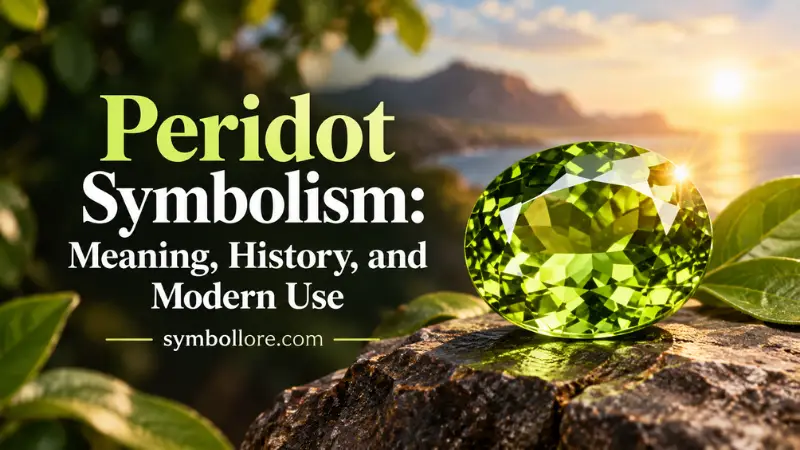
Peridot symbolism centers on light, protection, renewal, happiness, and abundance. Its bright yellow-green color recalls sunlight on fresh leaves, while its long use as a protective jewel connects it with safety and freedom from fear.
However, not every meaning comes from the same source. Ancient Egyptian associations with the sun differ from medieval European religious use and modern crystal beliefs about emotional balance. Peridot’s role as the August birthstone has also given it a personal meaning tied to identity, celebration, and new stages of life. Understanding these layers helps separate recorded history from later folklore and individual interpretation.
Quick Answer
Peridot symbolism most often represents light, protection, renewal, prosperity, and happiness. Its glowing green color inspired links with sunlight, plant growth, and fresh beginnings, while ancient and medieval traditions treated it as a protective jewel. These meanings are cultural associations rather than scientifically proven powers, and their importance changes by period, tradition, and personal use.
TL;DR
- Peridot’s brightness created its strongest historical link: light overcoming darkness.
- Green connects the stone with growth, renewal, nature, and abundance.
- Ancient and medieval people used peridot as a protective talisman.
- August birthstone jewelry can represent identity, affection, and celebration.
- Crystal-healing meanings belong to modern spiritual practice, not medical science.
- Cleopatra’s supposed peridot collection remains an interesting theory, not a confirmed fact.
Peridot Meanings at a Glance
| Context | Possible Meaning | Why the Association Exists | Important Limit |
|---|---|---|---|
| Ancient Egyptian lore | Sunlight and protection | The luminous gem was linked with the sun and worn against nighttime fears | Surviving accounts do not establish one belief shared by all Egyptians |
| Green color | Growth, renewal, and hope | Yellow-green resembles young leaves and spring vegetation | Color meanings change between cultures and settings |
| Protective jewelry | Safety and courage | People historically wore the gem as a talisman against harmful forces | Talismanic protection is a traditional belief |
| Wealth and abundance | Prosperity and good fortune | Fine gemstones signaled value, status, and access to rare materials | Peridot does not guarantee financial success |
| August birthstone | Identity, joy, and celebration | Modern birthstone customs connect the gem with August birthdays | This association is conventional rather than universal |
| Modern crystal practice | Emotional release and balance | Practitioners connect green stones with the heart and personal growth | Scientific evidence does not confirm healing powers |
| Personal jewelry | Fresh starts and meaningful change | Wearers may choose the gem to mark recovery, a goal, or a new chapter | Personal meaning depends on the wearer |
What Does Peridot Symbolism Mean?
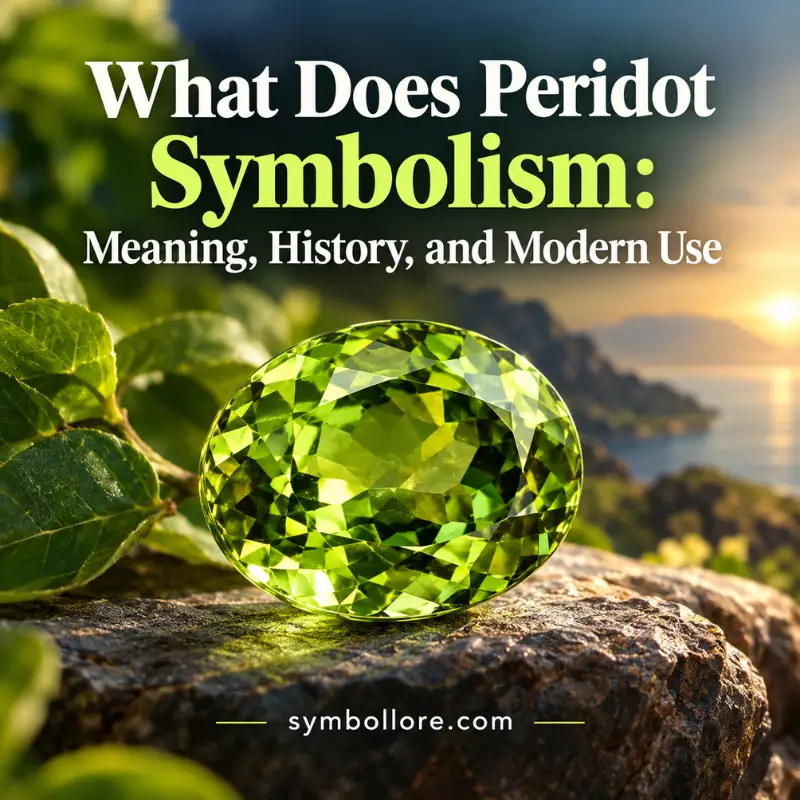
Peridot most strongly represents light, renewal, protection, and positive change. These meanings developed from both its appearance and its history.
Unlike many gemstones that occur in several colors, peridot remains within a yellow-green range. The Gemological Institute of America identifies it as the gem variety of olivine and explains that iron produces its characteristic color. Peridot can form deep in Earth’s mantle, in lava, and even in rare meteorites. These unusual origins add modern ideas of endurance, transformation, and connection with the natural world to its symbolism.
documents these gemological features.
The stone’s brightness also matters. Its lively color stays visible in different lighting conditions, encouraging comparisons with the sun, warmth, and illumination. For that reason, light is not merely a decorative modern interpretation. It reflects one of peridot’s oldest recorded associations.
Why Peridot Became a Symbol of Light
Peridot’s connection with light grew from its appearance and its ancient Egyptian history. The stone can show a warm golden or yellow cast within its green body, making it look as though it holds sunlight.
Ancient Egyptians mined the gem on Zabargad, an island in the Red Sea. According to the
Egyptians called it the “gem of the sun.” Some people also believed that peridot set in gold could protect its wearer from nighttime terrors and harmful spirits.
This tradition created a symbolic contrast between light and darkness. Light suggested safety, awareness, confidence, and order. Darkness represented fear, uncertainty, or unseen danger. Therefore, peridot could serve as a visible reminder of courage even when its supposed protective power remained a matter of belief.
Today, someone may wear peridot to represent optimism, mental clarity, or the decision to face a difficult situation openly. That meaning continues the light theme without claiming that the stone produces a supernatural result.
Protection in Ancient and Medieval Traditions
Protection is one of peridot’s best-documented traditional meanings. Historical lore describes the stone as a talisman worn against evil spirits and frightening dreams. The material, setting, and method of wearing it could all affect the old ritual meaning.
Peridot later appeared in European religious objects and church decoration. GIA reports that it appeared in priests’ jewelry by the second century BCE and later decorated medieval chalices and churches. Large green stones in Cologne Cathedral’s Shrine of the Three Kings were once regarded as emeralds but were eventually identified as peridots.
provides this historical context.
These examples do not prove that peridot physically protects a person. Instead, they show that people gave precious materials protective and sacred roles. Wearing such a gem could express faith, status, hope, or a desire for reassurance.
In modern jewelry, protection may work as a personal metaphor. A pendant might remind its wearer to maintain boundaries, leave a harmful situation, or carry the memory of a supportive person.
Green Peridot as a Symbol of Renewal and Growth
Peridot’s green color naturally supports meanings of growth, freshness, and renewal. Young plants, new leaves, and returning vegetation all make green a familiar sign of life.
This interpretation resembles the growth theme seen in
where a small natural object represents future potential. Peridot expresses the idea differently. The stone does not grow like a seed, but its fresh green color can suggest that life has begun moving again after a difficult or inactive period.
Renewal may refer to:
- starting a new job, relationship, or creative project;
- releasing an old resentment;
- rebuilding confidence after a setback;
- marking recovery or a personal turning point; or
- returning to habits that support a meaningful life.
These are symbolic uses, not effects produced by the mineral. A person gives the jewelry meaning through intention, memory, and context.
Renewal can also contain impermanence. Natural cycles do not stay at one stage forever. This idea appears more directly in
which connects seasonal flowering with beauty and change. Together, green gemstones and flowering plants can create a visual language of change, growth, and limited time.
Prosperity, Abundance, and Good Fortune
Peridot commonly symbolizes prosperity and abundance. Several forces likely shaped this association.
First, green often recalls fertile land and successful crops. In farming communities, healthy green growth can promise food and survival. Second, valuable gemstones have long displayed wealth, trade connections, and social rank. A rare green jewel could therefore represent material success even before later spiritual traditions described it as an “abundance stone.”
The gem’s golden-green tones strengthen the connection. Gold suggests value and prestige, while green may suggest fertility, money, or growth in many modern Western settings. Together, the colors create a convincing visual symbol of thriving.
Still, peridot does not attract money in any measurable way. Wearing it may serve as a reminder to build better habits, appreciate existing resources, or pursue a goal. The symbol can support an intention, but it cannot replace planning, work, or financial judgment.
Peridot as the August Birthstone
As the principal modern birthstone for August, peridot represents personal identity, celebration, and affection. Birthstone jewelry connects a gem with a specific month, making it easy to personalize without requiring a religious or spiritual belief.
Peridot is also traditionally associated with wedding anniversaries, although lists differ about the exact year. GIA currently identifies it with the fifteenth anniversary on its main gem page, while some jewelry traditions use it for the sixteenth. This variation shows that anniversary lists are conventions rather than ancient universal rules.
An August birthstone gift may symbolize:
- pride in the recipient’s identity;
- warmth and happiness;
- a wish for growth in the coming year;
- lasting friendship or family connection; or
- a fresh beginning after a major milestone.
The gift’s relationship and occasion usually matter more than a fixed gemstone dictionary. A ring from a parent can carry a different meaning from a partner’s necklace or a self-purchased piece marking personal progress.
Ancient Egypt, Zabargad, and the Cleopatra Question
Zabargad is central to peridot’s recorded history. Mining on the Red Sea island may have begun between 340 and 279 BCE, and its deposits produced stones valued across the ancient and later Mediterranean world.
The island’s gems also caused confusion. Earlier societies did not classify minerals using modern chemical tests. People often grouped stones by color and appearance. As a result, peridot could be called topaz, chrysolite, or even mistaken for emerald.
This confusion produced the famous claim that Cleopatra’s emerald collection may have contained peridot. GIA says some historians consider the possibility, but surviving evidence does not prove that all or even most of her green jewels were peridot. The responsible conclusion is simple: misidentification was possible, but Cleopatra’s supposed preference should not be presented as a confirmed fact.
This uncertainty adds an interesting symbolic layer. Peridot can represent hidden identity or value that others overlook because its historical name and classification changed.
Does Peridot Have a Biblical Meaning?
Peridot does not have one secure, universally accepted biblical meaning. Some readers connect it with “chrysolite” or with ancient stones translated as “topaz.” However, biblical gemstone identification is difficult because ancient names often referred to color, origin, or general appearance rather than a modern mineral species.
Different English translations may use different gemstone names for the same Hebrew or Greek word. Therefore, a stone called chrysolite in one translation cannot automatically be identified as modern peridot.
Where readers accept the connection, they may associate the stone with sacred beauty, divine creation, holiness, or the splendor of heavenly imagery. These are religious interpretations of a possible historical identification. They should not be treated as a unique biblical code assigned with certainty to peridot.
Modern Spiritual and Crystal Meanings
Modern crystal traditions associate peridot with emotional balance, compassion, confidence, and the release of jealousy or resentment. Some practitioners also connect green stones with the heart chakra, a concept rooted in modern adaptations of South Asian spiritual ideas.
These beliefs can offer personal meaning within meditation or reflective practice. For example, a person might hold or wear peridot while thinking about forgiveness, gratitude, or healthier relationships.
However, no reliable scientific evidence shows that peridot treats anxiety, improves organ function, changes metabolism, or cures physical illness. It should never replace medical or mental-health care. The safest approach is to treat crystal meanings as personal, cultural, or spiritual practices rather than medical facts.
How Peridot’s Color Changes Its Modern Meaning
All natural peridot belongs to the green color family, but individual stones range from pale yellow-green to deep olive or grass green. Modern interpretations often change with the visible shade.
Pale or lime-green peridot
Lighter stones can suggest playfulness, youth, curiosity, and a fresh start. Their bright appearance works well for celebrations and informal gifts.
Grass-green peridot
Balanced green shades often represent natural growth, stability, and prosperity. This color most clearly supports the stone’s renewal theme.
Golden-green peridot
A stronger yellow or golden cast can suggest sunlight, confidence, warmth, generosity, and achievement.
Olive-green peridot
Darker stones may express maturity, endurance, grounding, or a close relationship with the earth.
These meanings are flexible design interpretations. There is no established historical system in which each peridot shade carries a fixed spiritual power.
Peridot Symbolism in Jewelry and Gifts
Peridot jewelry often communicates hope, warmth, and positive change. The design can narrow the message further.
- A ring may represent commitment, a personal promise, or a milestone.
- A pendant can suggest protection because it rests close to the wearer’s body.
- Earrings may express brightness, confidence, or celebration.
- A family birthstone piece can represent an August-born relative.
- A vintage setting may highlight continuity, inheritance, and memory.
- A sun-shaped design strengthens the stone’s ancient light association.
- A leaf or floral setting emphasizes renewal and natural growth.
Gold settings reinforce warmth, sunlight, and prosperity. Silver or white-gold settings create a cooler look that may suggest clarity, calm, or freshness.
The most convincing meaning comes from the relationship between the stone, setting, occasion, and recipient. A symbol becomes stronger when its context supports the intended message.
How to Interpret Peridot Without Overclaiming
Begin with the context rather than assuming every peridot means the same thing.
Consider four questions:
- Where does the peridot appear? A church object, birthday ring, meditation space, and fictional crown create different meanings.
- What surrounds it? Sun imagery may suggest light, while leaves reinforce growth and renewal.
- Who chose it? The designer, giver, wearer, or writer may have assigned a personal meaning.
- What evidence supports the interpretation? Historical protection lore has a different basis from a modern claim about healing energy.
This method prevents symbolic interpretation from becoming guesswork. It also leaves room for personal meaning without presenting that meaning as a universal rule.
FAQs
In modern spiritual practice, peridot may symbolize emotional renewal, compassion, confidence, gratitude, and release from resentment. Some crystal practitioners connect it with the heart chakra. These are spiritual interpretations rather than scientifically demonstrated properties.
Ancient Egyptian tradition connected peridot with the sun because of its luminous yellow-green appearance. Historical lore also linked the stone with protection from nighttime fears. The title therefore expresses both its appearance and its protective role.
Peridot traditionally represents good fortune and abundance, but it cannot guarantee luck or financial success. A wearer may use it as a personal reminder to remain hopeful, notice opportunities, and work toward a goal.
Peridot can represent openness, harmony, friendship, and growth within a relationship. However, it is not as universally tied to romantic love as a red rose or heart. Its relationship meaning usually depends on the giver, occasion, and jewelry design.
Cleopatra may have owned green stones that were later assumed to be emeralds but could have been peridot. Ancient gem names and classifications were imprecise, making confusion possible. However, historians have not confirmed that her famous collection was primarily peridot.
A peridot in a dream may personally suggest growth, money, hope, jealousy, protection, or an August connection. Dream symbolism has no fixed scientific dictionary, so the dreamer’s feelings and current circumstances offer better clues than the stone alone.
Sources and Further Reading
- GIA: Peridot Gemstone Overview
- GIA: Peridot History and Lore
- GIA: August Birthstones
- American Gem Society: Peridot Overview
Conclusion
Peridot symbolism brings together light, protection, renewal, prosperity, and happiness. Its bright green color recalls new plant growth, while its warm glow explains why ancient Egyptians linked it with the sun. Historical use as a talisman strengthened its protective meaning, and the August birthstone tradition later added identity and celebration.
Culture, period, design, and personal experience still shape every interpretation. Ancient folklore should not be confused with modern crystal practice or scientific evidence. The most grounded way to understand peridot is as a meaningful visual reminder of hope, growth, courage, or a fresh beginning.


