

Greek mythology color symbolism is not a fixed chart that assigns one permanent hue to every god. Ancient Greek poets, worshippers, and artists used color through light, darkness, materials, clothing, blood, flowers, and painted surfaces. A shade could change meaning with its object and setting.
Therefore, familiar pairings such as Poseidon with blue, Ares with red, or Hades with black are useful modern shorthand, not universal ancient rules. The strongest interpretations begin with surviving texts, ritual practices, pigments, dyes, and objects. That evidence reveals a richer system built as much on brilliance, value, and contrast as on hue.
Quick Answer
Greek mythology color symbolism links colors with divine radiance, grief, blood, status, nature, and ritual action. However, ancient Greeks had no single god-to-color code. Meanings came from the colored object, its material, brightness, scene, and cultural use. Modern deity palettes can still work when they are labeled as interpretations rather than historical facts.
TL;DR
- No universal ancient god-to-color chart survives.
- Brightness and material could matter as much as hue.
- Homeric words rarely match one English color exactly.
- Painted sculpture makes Greek visual culture far more colorful than bare marble suggests.
- Modern palettes work best when their historical limits remain clear.
Greek Mythology Color Meanings at a Glance
| Color or Quality | Ancient Context | Careful Modern Reading | Avoid Claiming |
|---|---|---|---|
| Red or crimson | Blood, war, life, transition, dyed cloth | Vitality, danger, passion, Ares-inspired conflict | Red was Ares’s official color |
| Black or deep dark | Mourning, grief, night, death, underground space | Loss, mystery, Hades-inspired atmosphere | Every dark object signified evil |
| White or brilliant | Light, pale skin, ritual dress, divine brightness | Purity, clarity, Olympian presence | White marble proves colorless art |
| Gold or saffron | Precious material, fire, dawn, splendor, radiant gods | Divinity, rank, Apollo or Eos imagery | Yellow and metallic gold meant the same thing |
| Purple or wine-red | Costly dye, vividness, sheen, sea movement | Prestige, Dionysian wine, royal mood | Purple belonged to one god alone |
| Blue or blue-gray | Sea, eyes, metal, darkness, changing light | Poseidon, Athena, distance, storm | One Greek term equals modern blue |
| Green or yellow-green | Fresh growth, pallor, moisture, unripe life | Nature, Demeter, renewal | Chloros always meant leaf green |
| Rainbow or many-colored | Iris, divine messaging, atmospheric wonder | Connection, movement, transition | Ancient texts used today’s seven-color spectrum |
What Greek Mythology Color Symbolism Really Means
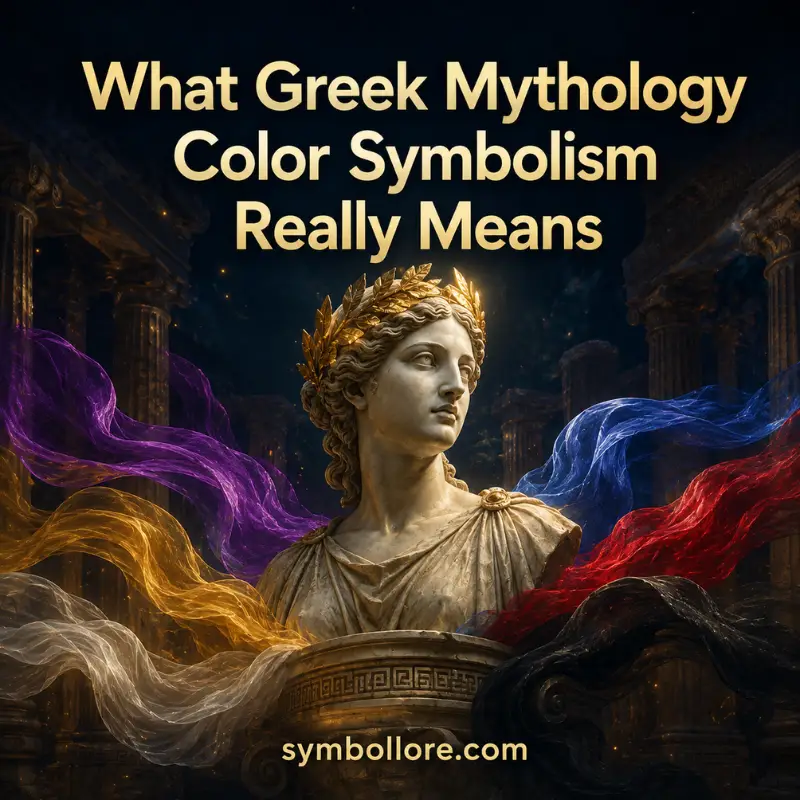
Greek mythology color symbolism works through relationships, not isolated swatches. Ask what carries the color, what happens in the scene, and whether the surface shines, darkens, bleeds, blooms, or changes. A dark robe on a grieving goddess does more symbolic work than “black equals sadness” by itself.
Ancient Greek colors also belonged to materials. Gold reflected light, purple required costly dye, and amber joined warmth with translucence.
The site’s guide to amber’s material history
gives that relationship a useful modern comparison. Likewise, red ochre could be pigment, earth, or bodily color. In every case, the myth, object, period, and medium must confirm the reading.
This approach separates three levels of confidence: direct ancient evidence, a reasonable reading of that evidence, and a later creative convention. All three can be useful. However, they should not receive the same historical label.
Why Ancient Greek Colors Do Not Map Cleanly to English
Ancient Greek colors divide the visual world differently from modern English. Their words can include hue, brightness, saturation, texture, movement, and surface sheen. Therefore, a dictionary substitute may fit one passage and fail in another.
The terms glaukos, kuaneos, and chloros show the problem. Glaukos can suggest a pale, gray-blue, greenish, or gleaming quality. Kuaneos often moves through dark blue toward black. Meanwhile, chloros can describe fresh vegetation, yellow-green color, moisture, or a face made pale by fear.
Maria Michela Sassi’s analysis of Greek color categories
explains that color events, materials, and glittering effects matter alongside hue.
This vocabulary does not prove defective color perception. Instead, it shows that languages place different boundaries around shared human vision.
Red, Black, White, and Gold in Myth and Ritual
Yet its exact force depends on whether it colors a wound, garment, flower, painted vessel, or sacrificial scene.
Black and deep darkness often frame mourning, night, death, and the underworld. In contrast, white or intense brightness can signal cleanliness, ceremony, youthful skin, or supernatural presence. Neither color stays morally fixed. White may mark ritual order, while blinding light can also inspire fear.
Gold carries value because it is both precious and radiant. The Getty’s study of
connects shining materials with gods and heroes, including radiant Apollo and gleaming-eyed Athena. The nearby hue may look yellow, but material brilliance drives much of the meaning. For a broader modern comparison,
show how darkness and luminosity still create powerful contrast.
Blue, Green, and Purple: Homeric Color Terms in Context
Homeric color terms describe appearances in motion, not paint chips. The famous wine-dark sea may evoke depth, danger, reflective movement, or a wine-like surface. It need not report a single maroon hue. Likewise, a bronze sky can emphasize hardness or glare rather than literal metallic color.
Blue is especially risky to simplify. Athena’s glaukopis can mean gleaming-eyed or gray-eyed, so “blue-eyed” is only one possible rendering. Green also resists a single match because freshness and pallor overlap in chloros.
Purple terms can range across red-purple, violet, and dark or vivid surfaces. Moreover, the sea’s shifting shine may matter more than a stable hue. Real Tyrian purple also carried material value. The University of Chicago Library notes that
the dye came from Mediterranean mollusks and was exceptionally costly.
Thus, status grew from production and rarity, not from an abstract purple rule.
Greek Gods and Their Colors: Evidence Versus Modern Convention
Greek gods often gain colors through attributes, stories, materials, and later art. The following pairings are useful creative shorthand, but the ancient basis varies.
| Deity | Useful Palette | Ancient Anchor | Historical Caution |
|---|---|---|---|
| Zeus | White, gold, storm gray | Lightning, sky, shining power | Purple or royal blue is mainly later visual convention |
| Hera | White, gold, purple | Radiance, rank, rich dress | No universal bridal-white code defined her |
| Athena | Gray-blue, olive, bronze | Glaukopis, olive, armor | Bright blue alone oversimplifies her epithet |
| Poseidon | Deep blue, gray, sea-green | Sea, storm, horses, bronze | Homer’s sea vocabulary is not one blue swatch |
| Apollo | Gold, saffron, white | Radiance, music, prophecy | Solar yellow grew stronger in later interpretation |
| Ares | Red, black, bronze | Blood, battle, weapons | Red is fitting, not an official sacred assignment |
| Aphrodite | Gold, white, rose | Beauty, brightness, flowers, adornment | Pink is largely a modern romantic code |
| Demeter and Persephone | Gold, green, black, red | Grain, growth, dark grief, pomegranate | Seasonal palettes combine text with later interpretation |
| Dionysus | Wine-red, purple, ivy green | Wine, grapes, ivy, rich textiles | One fixed purple ignores his varied imagery |
| Hades | Black, charcoal, dull gold | Darkness, hidden wealth, underground realm | “Evil black” distorts his role and Greek afterlife beliefs |
Therefore, start with an attribute rather than a color stereotype. Olive strengthens an Athena palette because it names a meaningful relationship. By contrast, blue without armor, an owl, an olive branch, or a gleaming eye says little about her.
How Homer Uses Color to Show Emotion and Power
Color in Greek poetry can change with a character’s condition. The Homeric Hymn to Demeter gives a clear example. After Persephone disappears, Demeter tears off her headband and places a dark cloak over her shoulders. Later, when the goddess reveals herself, her immortal complexion shines and fills the palace with lightning-like light.
Gregory Nagy’s translation of the Hymn to Demeter
makes that movement visible: darkness belongs to grief, concealment, and withdrawal, while radiance marks divine identity and restored power. This is stronger evidence than assigning Demeter a permanent green or gold swatch.
Objects deepen the scene. Torches blaze during the search, grain stays hidden, a golden chariot crosses worlds, and a red pomegranate binds Persephone to return. The objects gain force through the story’s actions rather than through a detachable color key.
Polychromy: Why Greek Statues Were Not Plain White
Polychromy means the use of several colors on one object. Many ancient Greek sculptures and architectural details originally carried pigments, patterned clothing, colored hair, eyes, jewelry, and gilding. Weathering, burial, cleaning, and changing taste later removed or hid much of that surface treatment.
The Metropolitan Museum of Art’s 2025 volume
Chroma: Sculpture in Color from Antiquity to Today
summarizes research showing that many works now seen as monochrome once had paint and other surface treatments. Therefore, bare white marble should not define the visual world of Greek myth.
This correction changes interpretation. Pigment could distinguish flesh, cloth, pattern, armor, hair, and divine attributes. At the same time, a modern reconstruction remains an evidence-based proposal. Different tests and scholars may restore details differently when traces are incomplete.
Ritual Color in Clothing, Sacrifice, Mourning, and Status
Ritual color became meaningful through action. A garment’s shade mattered because someone wore it during a procession, wedding, initiation, funeral, or priestly duty. Likewise, an animal’s color could help match an offering to a particular ritual setting. Local rules varied, so no single scheme governed every Greek city and century.
Dark clothing often supported grief or funerary associations. White clothing could support cleanliness, celebration, or orderly worship. Meanwhile, colored or richly dyed garments could signal rank and expense. Costly purple communicated access to labor, trade, and rare material as much as symbolic royalty.
Pigments and valuable substances could also function as offerings. Consequently, interpretation should track four facts: the object, the actor, the occasion, and the material cost. A robe in a hymn, a painted votive figure, and a designer’s digital swatch may share a hue. Still, they do not share one meaning.
Iris Goddess and the Rainbow in Greek Myth
The Iris goddess personifies the rainbow and serves as a swift divine messenger. Her path connects sky and earth, so rainbow imagery can support movement, communication, transition, and the sudden appearance of divine will. Yet ancient stories do not reduce her to a modern seven-band diagram.
In the Homeric Hymn to Demeter, Zeus sends golden-winged Iris to summon the grieving goddess. The passage stresses speed, message, gold, dark clouds, and Demeter’s dark robe. It does not pause to decode each rainbow hue. Therefore, a many-colored Iris palette is suitable for modern art, while the ancient narrative anchor remains her role as messenger.
The iris flower creates a separate layer. Its name and broad range of colors later strengthened the connection, but flower meanings should not replace evidence about the deity.
How to Build a Responsible Modern Color Palette
A responsible modern color palette can feel mythic without pretending to be an ancient code. Use four steps:
- Choose the mythic anchor. Start with a deity, object, place, ritual, or episode.
- Select one evidenced quality. Use darkness, radiance, blood, sea movement, costly dye, grain, or painted pattern.
- Add modern visual shorthand. Deep blue can clarify Poseidon, while red can sharpen Ares.
- Label the result honestly. Call it “inspired by” the figure unless an ancient source supports the exact association.
For example, an Athena palette might combine olive green, bronze, stone gray, and a muted blue-gray highlight. Each shade links to an attribute, surface, or epithet. A Hades palette could use charcoal, iron gray, muted purple, and dull gold to suggest darkness and hidden wealth without turning the god into a simple villain.
Finally, compare the finished design with a general
then test readability and skin-tone contrast. Symbolism should guide a composition, not make text or figures hard to see.
Common Misconceptions About Greek Mythological Colors
Several popular claims need correction:
- “Each god had one official color.” Surviving evidence shows recurring attributes and contexts, not a universal chart.
- “Greeks could not see blue.” Their language categorized blue-range colors differently; vision and vocabulary are not identical.
- “The wine-dark sea was literally red.” The phrase may communicate appearance, depth, sheen, or movement.
- “Greek statues were plain white.” Pigment and surface research demonstrates widespread ancient color.
- “Black always meant evil.” It could mark grief, night, death, depth, or visual contrast.
- “Modern palette names are ancient facts.” Olympian gold or Poseidon blue can be useful present-day design labels.
These corrections do not make symbolic interpretation impossible. Instead, they give it firmer ground and more interesting choices.
FAQs
White, gold, and storm gray fit Zeus through lightning, sky, brightness, and divine authority. Purple or royal blue can also communicate kingship in modern art. However, no surviving pan-Greek rule identifies one official color for Zeus, so attributes such as the thunderbolt provide stronger evidence than a swatch alone.
Deep blue, sea-green, gray, and bronze create a clear Poseidon palette because they evoke sea, storm, saltwater, and the god’s weapons. Still, ancient Greek sea descriptions do not map neatly to modern blue. Pair the colors with waves, horses, a trident, or shifting light to make the reference specific.
Red suits Ares because blood, wounds, violence, and battle make the association easy to understand. Yet ancient Greece left no official red-Ares code. Treat the pairing as a strong contextual inference or modern convention, then support it with armor, bronze, spears, or a battle scene.
Blue-gray reflects possible readings of Athena’s epithet glaukopis, which can emphasize a pale, gray, greenish, or gleaming eye. Olive green comes from her strong link with the olive tree and Athens. Neither shade works as a complete translation of the goddess, but together they form a well-grounded palette.
Yes. Many Greek sculptures and buildings carried pigments, patterns, and sometimes gilded details. Researchers identify traces through close examination and scientific imaging. However, surviving color is often incomplete, so reconstructions can show evidence-based possibilities rather than a perfectly certain original appearance.
Rainbow colors primarily point to Iris, the divine messenger who travels between sky and earth. They can therefore suggest communication, speed, transition, and a link between mortal and divine realms. Assigning a separate fixed meaning to every band is usually a modern symbolic system, not a rule preserved in early Greek poetry.
Conclusion
Greek mythology color symbolism becomes clearer when color is read as part of a scene, material, action, and text. Red can mark blood or vitality; darkness can express grief or hidden space; gold can shine with divine value. Yet none of these meanings creates a universal deity code.
For accurate interpretation, begin with the ancient anchor, then state where modern convention enters. That method respects the evidence while leaving artists, writers, designers, and readers plenty of room for meaningful color choices.