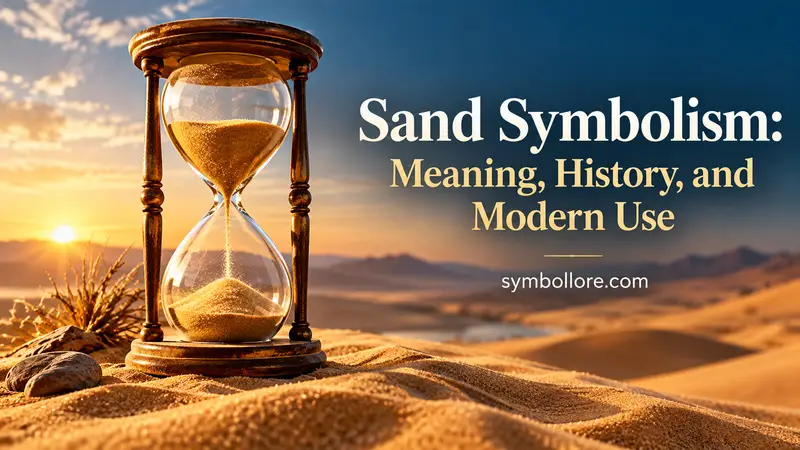
Sand symbolism most often centers on time, impermanence, change, multitude, and unstable foundations. Those meanings come from what sand visibly does. Individual grains flow through an hourglass, wind reshapes dunes, tides erase footprints, and enormous landscapes grow from particles almost too small to notice.
Yet sand has no single universal meaning. Tibetan Buddhist ritual, biblical imagery, Diné ceremonial art, Romantic poetry, and modern American imagery use it in different ways. Understanding those differences makes sand more interesting than a simple symbol of “time running out.”
Quick Answer
Sand symbolism commonly represents time, impermanence, change, countlessness, and the tension between stability and instability. Falling grains make time visible, while moving dunes and disappearing footprints suggest that forms do not remain fixed. Specific traditions add distinct meanings, so Buddhist ritual, biblical passages, literature, dreams, and personal designs should not be treated as one universal symbolic system.
TL;DR
- Flowing sand commonly suggests passing time and mortality.
- Shifting dunes and erased footprints support meanings of change and impermanence.
- Countless grains can represent multitude, abundance, or vastness.
- Tibetan sand mandalas use deliberate destruction to express impermanence.
- Biblical passages use sand differently for countless descendants and insecure foundations.
- Dreams and tattoos have no single fixed meaning; context and personal intent matter.
Sand Meanings at a Glance
| Context | Possible Meaning | Why the Association Exists | Important Limit |
|---|---|---|---|
| Hourglass | Time, mortality, urgency | Grains visibly measure an interval | Not every sand image involves death |
| Moving dunes | Change, adaptation, impermanence | Wind continually reshapes the surface | A dune may also suggest endurance |
| Countless grains | Multitude, abundance, vastness | Individual grains are difficult to count | Meaning depends on the text or tradition |
| Footprints in sand | Memory, temporary presence | Marks remain briefly and can disappear | May simply indicate travel or passage |
| Weak sandy ground | Instability, poor foundation | Loose sand can shift under pressure | Compacted sand can physically support weight |
| Sand mandala | Impermanence in Tibetan Buddhism | The completed work is intentionally dismantled | This meaning belongs to a specific tradition |
| Desert sand | Emptiness, exposure, testing, vastness | Sparse landscapes magnify distance and vulnerability | Deserts are not culturally “empty” places |
Why Sand Became a Symbol of Time and Change

Sand makes change easy to see. A rock can appear unchanged for years. A sandy surface can alter in minutes.
Wind transports grains, builds dunes, and moves their slopes. The National Park Service explains that dunes form through the erosion, movement, and deposition of sediment, while active dunes can advance and change shape over time.
National Park Service explanation of dune processes
That physical mobility helps explain why sand works so well as a metaphor for impermanence. A footprint is real, yet temporary. A dune has a recognizable form, yet its grains move. The symbol therefore does not have to mean that “nothing matters.” It can express a subtler idea: something can remain meaningful even when its shape changes.
This contrasts with the firmer associations of stone and soil. Readers interested in those neighboring ideas can compare the site’s discussion of
earth element symbolism and physical stability.
Why the Hourglass Connects Sand With Mortality
The hourglass turned invisible time into visible movement. Instead of merely knowing that time passes, a person could watch a measured quantity of grains move from one chamber to another.
The Library of Congress explains that a sandglass measures an interval through a calibrated quantity of fine granular material moving through a narrow opening. Historically, the material was not always ordinary beach sand; finely powdered marble and eggshell could also be used.
Library of Congress history and mechanics of the hourglass
That mechanism naturally supports images of deadlines, aging, mortality, waiting, and limited opportunity. “Sand running out” feels urgent because the remaining material can be seen shrinking.
Still, turning an hourglass over also starts another measured interval. In modern art or personal symbolism, that reversal may suggest renewal or another beginning. That is an interpretation of the object, not a universal historical doctrine.
Sand Symbolism in Tibetan Buddhism
One of the clearest documented religious uses of sand appears in Tibetan Buddhist mandalas.
The Smithsonian’s National Museum of Asian Art explains that monks can spend days constructing elaborate mandalas from millions of colored grains. After completion and consecration, the design is swept apart. The museum explicitly describes this dismantling as an enactment of the impermanent nature of existence.
Smithsonian explanation of Tibetan sand mandalas
This gives sand a powerful role because the artwork is beautiful, precise, labor-intensive, and intentionally temporary. Destruction is not an accident that ruins the work. It belongs to the ritual process.
However, this meaning should stay attached to its Tibetan Buddhist setting. It does not prove that every religion or culture treats sand as a universal emblem of non-attachment.
Biblical Sand: Countlessness and Unstable Foundations
Biblical imagery gives sand more than one meaning.
In Genesis 22:17, sand on the seashore helps express an enormous number of descendants promised to Abraham. The image works because grains appear beyond practical counting.
Genesis 22:17 and its sand imagery
Here, sand suggests multitude and abundance, not weakness.
Matthew 7 uses the material differently. Jesus contrasts acting on his teaching with failing to act on it. The person who hears but does not act is compared with someone building a house on sand.
Matthew 7:26 and the house built on sand
In that passage, sand functions as an insecure foundation within a moral teaching. The image should not be expanded into a claim that sand itself is spiritually evil.
For a related contrast, see the site’s discussion of
rock symbolism in biblical passages,
where firmness, refuge, and secure foundations take the dominant role.
Diné Sandpainting Has Its Own Cultural Context
Sand also appears in Diné, or Navajo, ceremonial practice, but its role should not be blended with Tibetan mandalas.
Smithsonian archival material describes Diné sandpaintings, or drypaintings, as ceremonial works created with materials such as colored sand, crushed plants, and crushed stone. The designs can represent stories and sacred figures connected with particular chants and ceremonies.
Smithsonian record on Diné ceremonial sandpaintings
The important point is precision. “Native American sand symbolism” is too broad a category because Indigenous nations maintain distinct religions, histories, languages, and artistic traditions.
A Diné ceremonial image therefore should not be reduced to generic modern meanings such as “go with the flow” or “manifest change.” Its significance comes from the ceremonial system in which it belongs.
Sand in Literature: Infinity, Time, and Fallen Power
Writers use sand effectively because it can suggest both something extremely small and something seemingly limitless.
William Blake opens Auguries of Innocence by imagining a whole world within a grain of sand and infinity held in a human hand. The image joins the microscopic and the immeasurable.
William Blake’s Auguries of Innocence
Percy Bysshe Shelley’s Ozymandias produces almost the opposite emotional effect. A ruined monument to a powerful ruler stands amid an immense desert. The surviving boast of political greatness is surrounded by empty sand.
Percy Bysshe Shelley’s Ozymandias
The Poetry Foundation’s guide explains how the vast desert undermines Ozymandias’s attempt to preserve his political reputation. Time survives the ruler’s claim to permanence.
These examples show why literary sand symbolism cannot be reduced to one word. In Blake, a grain opens toward infinity. In Shelley, endless sand overwhelms human pride.
Moving Dunes: An American Symbol of Time and Eternity
Sand has also gained specific meanings through American landscapes.
At Indiana Dunes, writer Carl Sandburg described the dunes in 1958 as a “signature of time and eternity.” National Park Service historical material explains how conservation writers saw the moving dunes as a meeting of apparent opposites: change and continuity, movement and rest, mortality and endurance.
This is especially useful because it shows symbolism developing from an actual landscape. The dunes looked enduring at a large scale but remained physically mobile.
A similar tension appears in coastal imagery. Firm land meets moving water, while sand records that contact.
Sand, Soil, and Dust Are Not the Same Symbol
These materials overlap, but word choice changes meaning.
Sand emphasizes grains, movement, accumulation, erosion, shorelines, deserts, and unstable or temporary forms.
Soil more often suggests fertility, cultivation, roots, nourishment, and biological growth.
Dust often stresses smallness, dryness, disappearance, age, mortality, or decay.
Because of these differences, replacing one term with another can change an image dramatically. A footprint in sand suggests a temporary trace. A seed in soil suggests hidden growth. Dust covering an abandoned object suggests neglect or time passed.
What Does Sand Mean in Dreams?
There is no scientifically established dictionary that assigns one fixed meaning to sand in every dream.
Still, sand can provide useful material for personal reflection because its familiar qualities already carry strong associations. An hourglass may bring up concerns about time. Sinking sand may reflect a feeling of insecurity. Warm beach sand may connect with rest, memory, travel, or comfort.
The strongest interpretation begins with the dream itself:
- What kind of sand appeared? Beach, desert, wet sand, dunes, an hourglass, and quicksand create different situations.
- What was happening? Walking, sinking, building, digging, or watching sand fall changes the meaning.
- How did the dream feel? Calm, fear, grief, urgency, and curiosity matter.
- What does sand mean personally? A childhood beach may carry a very different meaning from a desert associated with hardship.
A dream can support reflection, but it does not reliably predict an event or prove that a supernatural message has been sent.
Spiritual and Tattoo Meanings in Modern Use
Modern spiritual writing often uses sand for adaptability, letting go, patience, grounding, transformation, or life’s changing cycles.
These interpretations can be meaningful as personal metaphors. However, they should not be mislabeled as universal ancient teachings.
A sand-themed tattoo follows the same rule. An hourglass may commemorate time, aging, mortality, a deadline, or a second chance. Footprints can honor travel, family, grief, childhood, or a particular beach. A dune may represent survival through change or attachment to a desert landscape.
Context also changes the tone. A broken hourglass, rising tide, skull, flower, compass, or name can transform what the sand contributes to the design.
How to Interpret Sand Symbolism in Context
A reliable interpretation begins with what the sand is doing, not with a memorized list of meanings.
First, identify its form. Falling grains emphasize time differently from a motionless beach.
Next, examine the setting. Biblical scripture, Tibetan ritual, Diné ceremony, Romantic poetry, a dream, and a tattoo follow different symbolic conventions.
Then ask what contrasts with the sand. Rock may sharpen the idea of instability. Water can emphasize change or a boundary. A ruined monument can turn the desert into a comment on human pride.
Finally, distinguish documentation from interpretation. If a museum or religious text assigns a specific role to sand, that association can be described historically. If a modern reader sees patience or personal transformation in a dune, present that as a reasonable personal reading rather than an ancient universal fact.
FAQs
Sand most often symbolizes time, impermanence, change, multitude, and temporary forms. Those associations grow from familiar experiences: grains flow through hourglasses, dunes move, shorelines change, and footprints disappear. The strongest meaning still depends on the surrounding image or tradition.
In modern spiritual use, sand may represent impermanence, adaptability, patience, humility, or letting go. These are interpretive meanings rather than one universal doctrine. Tibetan Buddhism provides a documented example in which dismantling a completed sand mandala expresses impermanence, but other traditions use sand differently.
Biblical sand has multiple meanings. Genesis uses seashore sand to express an immense number of descendants, while Matthew’s house-on-sand comparison represents an insecure foundation when teaching is heard but not practiced. Reading the individual passage is more reliable than assigning sand one fixed biblical meaning. Bible Gateway
The hourglass provides the clearest reason. Fine grains move at a measurable rate from one chamber to another, turning the passage of an interval into something visible. That physical process helped make flowing sand a powerful metaphor for limited time, aging, deadlines, and mortality. Library of Congress
No. Loose sand can suggest insecure ground, but sand can also represent accumulation, adaptability, multitude, ritual creation, or endurance through change. Dunes themselves show how countless mobile grains can gather into large and recognizable landforms.
Footprints in sand often suggest passage, memory, presence, travel, or the temporary marks people leave behind. Their meaning becomes especially strong when waves or wind erase them. In personal art, however, footprints may simply preserve a specific journey, person, child, beach, or memory.
Sources and Further Reading
- Smithsonian National Museum of Asian Art — About the Mandala
- Library of Congress — How Does an Hourglass Measure Time?
- National Park Service — Aeolian Dune Landforms
- Smithsonian — Diné Ceremonial Sandpainting Records
- Poetry Foundation — Percy Bysshe Shelley: Ozymandias
- National Park Service — A Signature of Time and Eternity
Conclusion
Sand symbolism draws much of its power from a simple contradiction: sand can form enormous landscapes while every grain remains small and movable. That tension supports meanings of time, impermanence, change, multitude, memory, and unstable foundations.
Specific traditions make those ideas more precise. Tibetan sand mandalas demonstrate impermanence, biblical passages use sand for both countlessness and insecure foundations, and poets use it to confront infinity or fallen power. The most reliable interpretation therefore starts with context. Sand does not carry one hidden message everywhere; its meaning grows from what the grains are doing, where they appear, and the cultural or artistic system surrounding them.