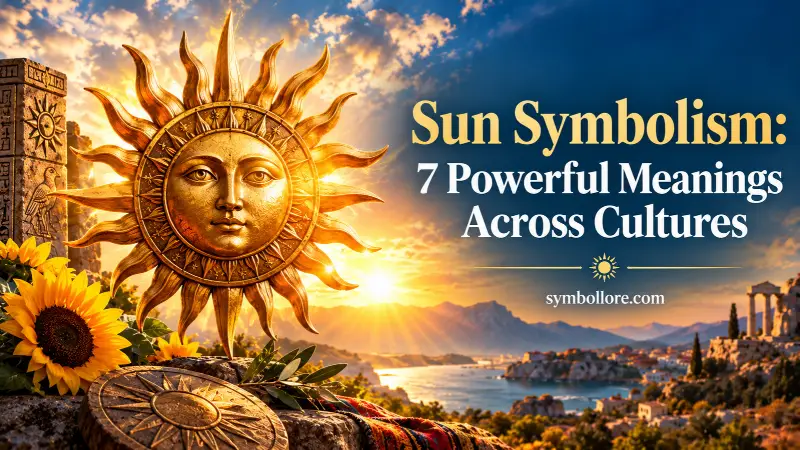
The sun rises each morning, bringing light, warmth, and the promise of another day. Across history, people have connected this familiar sight with life, hope, power, and spiritual understanding. Ancient civilizations honored solar deities, while artists and writers used sunlight to express ideas about growth and change.
But what does the sun actually symbolize?
Sun symbolism has different meanings depending on culture, religion, and personal experience. A sunrise may represent a fresh beginning, while a blazing midday sun can suggest strength or danger. This guide explores seven important meanings, their historical roots, and how people interpret the sun today.
Quick Answer: What Does the Sun Symbolize?
The sun commonly symbolizes life, energy, hope, renewal, divine power, knowledge, and personal growth. Its light and warmth make it a natural image of vitality and new beginnings. In ancient religions, the sun was often linked to powerful deities. However, its meaning changes across cultures, and sunlight can also represent danger, harsh judgment, or overwhelming power.
Key Takeaways
- Life and energy: The sun supports life on Earth, making it a powerful symbol of vitality.
- Hope and renewal: Sunrise often represents fresh starts, recovery, and new possibilities.
- Religious importance: Solar deities and sacred sun images appear in many distinct traditions.
- Knowledge and truth: Sunlight can symbolize clarity, understanding, and enlightenment.
- Changing meanings: Sunrise, sunset, and the blazing midday sun can communicate very different ideas.
What Is Sun Symbolism?
Sun symbolism refers to the meanings people attach to the sun in religion, mythology, art, literature, and everyday life.
The sun is the star at the center of our solar system. Its light provides the energy that drives photosynthesis, supports food webs, and helps shape Earth’s climate.
These essential roles help explain why many societies have treated it as a powerful image of life.
However, different cultures have developed their own solar traditions. Some honor the sun as a deity, while others use it as a symbol of divine power or spiritual understanding.
Modern sun symbols can also express happiness, confidence, creativity, or personal growth.
A sun in an ancient temple, a sunrise in a novel, and a small sun tattoo may have different meanings. Their interpretation depends on context.
7 Powerful Meanings of Sun Symbolism
1. Life and Vitality
Life is one of the sun’s most widespread symbolic associations.
Sunlight supports the growth of plants, which form the foundation of many ecosystems. People have long recognized its importance for food, warmth, and survival.
As a result, the sun became a natural symbol of life-giving energy.
In ancient Egypt, solar imagery played a major role in beliefs about creation and the continuing order of the world.
Today, people may use a bright sun image to express enthusiasm, health, or a love of life.
Central meaning: The sun represents the energy and conditions that help life flourish.
2. Hope and New Beginnings
Sunrise is widely associated with hope.
Each morning marks the beginning of a new day. Because darkness gives way to daylight, sunrise often becomes a metaphor for recovery after hardship.
Writers may describe the first morning light after a difficult night to suggest that circumstances are improving.
A person might also choose a sunrise tattoo to remember an important turning point.
This interpretation is especially common in modern art and personal symbolism.
Central meaning: The rising sun represents fresh opportunities, optimism, and the possibility of change.
3. Divine Power and Sacred Presence
Many ancient societies connected the sun with divine beings.
In ancient Egyptian religion, Ra was an important solar deity. His journey across the sky formed part of a larger religious understanding of cosmic order.
Greek mythology portrayed Helios driving a chariot across the heavens.
In Hindu traditions, Surya is a solar deity associated with light and divine power.
These traditions have different religious teachings. Therefore, their solar meanings should not be treated as identical.
Central meaning: The sun can represent sacred authority, cosmic order, and divine power within particular religious traditions.
4. Knowledge and Enlightenment
Sunlight allows people to see their surroundings clearly.
This physical quality inspired symbolic connections between light and understanding.
In Plato’s Republic, the sun appears in a philosophical comparison that helps explain the Form of the Good and the conditions for knowledge.
The relationship between light and truth later became an important theme in Western literature.
Even everyday expressions about bringing something into the light reflect this association.
Central meaning: The sun can symbolize knowledge, clarity, truth, and deeper understanding.
5. Strength and Authority
The sun’s brightness and heat make it a powerful natural presence.
It influences seasons, weather patterns, and the growth of living things.
These qualities help explain its association with strength and authority.
In Roman religious and imperial imagery, Sol Invictus, meaning the Unconquered Sun, represented an enduring solar power.
Modern artwork may use a bold sunburst to express confidence or personal determination.
Central meaning: The sun can represent power, endurance, authority, and the ability to overcome obstacles.
6. Renewal and the Cycles of Life
The sun’s apparent daily movement creates a repeating pattern of day and night.
Its changing position in the sky also helps mark seasonal cycles.
These patterns have inspired ideas about renewal, time, and continuity.
In ancient Egyptian religion, the sun’s daily journey could express regeneration and the preservation of cosmic order.
In modern symbolism, its return each morning may suggest that life continues despite setbacks.
Central meaning: The sun represents cycles, continuity, renewal, and the passage of time.
7. Transformation and Personal Growth
The sun can also represent transformation.
As daylight changes from morning to evening, the appearance of the world changes with it.
Artists and writers use these shifts to show developments in a character’s life.
A sunrise following a difficult experience may suggest personal growth. Strong sunlight revealing a hidden object could symbolize the discovery of truth.
These meanings are usually artistic or personal rather than universal religious teachings.
Central meaning: The sun can represent change, self-discovery, and the development of a new perspective.
Sun Symbolism in Different Cultures
Solar imagery appears across the world, but each tradition deserves its own explanation.
| Culture or Tradition | Solar Figure or Image | Documented Association |
|---|---|---|
| Ancient Egypt | Ra and the solar disk | Divine power, creation, cosmic order |
| Ancient Greece | Helios | The sun’s journey across the sky |
| Ancient Rome | Sol Invictus | Enduring solar power |
| Hindu traditions | Surya | Solar divinity, light, religious devotion |
| Japanese Shinto | Amaterasu | Sun goddess and imperial mythology |
| Mexica tradition | Tonatiuh | Solar power and the journey of life |
| Diné tradition | Jóhonaaʼéí, the Sun Carrier | Power, discipline, and sacred teachings |
| Aboriginal Flag of Australia | Central yellow circle | The sun as a renewer of life |
Ancient Egyptian Sun Symbolism
The sun held an important place in ancient Egyptian religion.
Ra was among Egypt’s most significant deities. Artists often portrayed him with a falcon’s head and a solar disk.
Egyptian religious narratives described his movement across the sky and through the nighttime world.
His journey formed part of the struggle to preserve order against chaos.
The solar disk also had a special role during the reign of Akhenaten, who promoted the worship of Aten.
Egyptian sun imagery therefore expressed more than warmth or happiness. It carried deep religious and political meaning.
Sun Symbolism in Greek Mythology
Helios was the personification of the sun in Greek mythology.
He was commonly described as traveling across the sky in a chariot drawn by horses.
Apollo later developed strong solar associations, but Helios and Apollo were originally distinct divine figures.
In Greek philosophical writing, sunlight also became an important image of understanding.
The sun could therefore appear in religious stories and philosophical explanations with different meanings.
Sun Symbolism in Hinduism
Surya is an important solar deity in Hindu traditions.
He appears in religious stories, temple imagery, and devotional practices.
The sun is associated with light, vitality, and sacred power.
Some Hindu practices include prayers or offerings connected with the sun.
However, Hindu traditions are diverse. The meaning of solar imagery depends on the text, community, and religious setting.
Sun Symbolism in Japanese Culture
Amaterasu is the sun goddess in Shinto tradition.
She plays an important role in Japanese mythology and accounts of imperial ancestry.
One famous story describes her withdrawal into a heavenly cave, leaving the world in darkness.
Her return restores light.
The story connects sunlight with divine presence and the restoration of order.
Sun Symbolism in Indigenous Cultures
There is no single Native American meaning of the sun.
Indigenous nations have distinct languages, beliefs, and histories.
For example, Diné tradition includes Jóhonaaʼéí, the Sun Carrier, a sacred figure associated with power and discipline.
The Smithsonian also documents Mexica imagery in which the path of the sun reflects the journey of life.
Such examples show why cultural specificity matters.
An unfamiliar sun design should not automatically be labeled an ancient Native American symbol.
Sunrise, Midday Sun, and Sunset Symbolism
The sun’s position can change how viewers interpret it.
| Solar Image | Common Symbolic Meaning | Possible Use |
|---|---|---|
| Sunrise | Hope, beginnings, renewal | A character starting a new life |
| Morning sun | Growth, opportunity, optimism | Artwork celebrating fresh energy |
| Midday sun | Power, clarity, intensity | A scene emphasizing strength or harsh exposure |
| Setting sun | Closure, reflection, transition | The end of a journey or life stage |
| Sun behind clouds | Hope amid uncertainty | A story about difficult circumstances |
| Solar eclipse | Disruption, mystery, temporary darkness | A dramatic turning point |
What Does Sunrise Symbolize?
Sunrise usually suggests beginnings, hope, and new possibilities.
Its association comes from the return of daylight after darkness.
However, not every sunrise has a positive meaning. A writer may describe an unwanted dawn to emphasize fear or the arrival of an unavoidable event.
The surrounding story determines the interpretation.
What Does Sunset Symbolize?
Sunset often represents completion, reflection, and transition.
Its fading light can suggest the end of a chapter, aging, or approaching loss.
However, sunsets can also express peace, beauty, and gratitude.
A couple watching a sunset may experience a moment of connection rather than sadness.
What Does the Midday Sun Symbolize?
The midday sun can express energy, power, and full visibility.
Its intense brightness may suggest that nothing remains hidden.
However, strong heat can also become a symbol of danger or exhaustion.
This contrast makes midday sunlight useful in stories about both power and vulnerability.
Sun Symbolism in Christianity
In Christianity, the sun can serve as an image of divine light, righteousness, and spiritual understanding.
The Bible uses light imagery to describe God’s goodness and guidance.
Malachi 4:2 refers to the sun of righteousness, an image that Christians have sometimes interpreted in relation to Christ.
Christian artists also use radiant halos and beams of light to express holiness.
However, the sun is not universally treated as a direct symbol of Jesus.
Christian solar imagery differs from the worship of solar deities in ancient religions.
The theological context matters more than the sun’s appearance alone.
Sun and Moon Symbolism: What Is the Difference?
The sun and moon frequently appear together in art, jewelry, and tattoos.
Their contrast creates a visual relationship between light and darkness.
| Sun Symbolism | Moon Symbolism |
|---|---|
| Daylight and visible energy | Night and reflected light |
| Activity and outward expression | Reflection and quiet observation |
| Clarity and illumination | Mystery and uncertainty |
| Vitality and growth | Change and recurring phases |
| Fresh beginnings | Cycles and transition |
These associations are common in modern symbolism, but they are not universal.
Some modern designs describe the sun as masculine and the moon as feminine. Yet cultural traditions do not follow one fixed gender pattern.
For example, Japanese Shinto includes the sun goddess Amaterasu.
The sun and moon may also represent balance, partnership, or complementary forces in personal artwork.
Examples of Sun Symbolism in Art and Literature
Example 1: Claude Monet’s Impression, Sunrise
Claude Monet’s 1872 painting Impression, Sunrise depicts the sun above a harbor.
Its glowing disk contrasts with the hazy surroundings.
The painting became closely associated with the name of the Impressionist movement.
Rather than presenting a fixed religious meaning, Monet explored the effects of light, color, and perception.
What it demonstrates: Sun imagery can express visual experience without requiring a spiritual interpretation.
Example 2: Edvard Munch’s The Sun
Edvard Munch painted The Sun in 1910–1911.
The work depicts powerful sunlight spreading over a coastal landscape.
Its radiant energy creates a strong impression of life and vitality.
What it demonstrates: The sun can serve as an image of life-giving natural power.
Example 3: Emily Dickinson’s Sunrise Poetry
Emily Dickinson’s poem commonly identified by its opening line, I’ll tell you how the Sun rose, describes sunrise and sunset through unusual images.
The speaker begins with confidence but becomes less certain when describing sunset.
What it demonstrates: Sun imagery can explore the limits of human knowledge rather than simply represent happiness.
Example 4: A Sun Tattoo After a Difficult Period
Imagine someone choosing a rising sun tattoo after recovering from a major personal setback.
The design may represent a new beginning and renewed confidence.
This is a personal modern interpretation, not evidence of an ancient tattoo tradition.
What it demonstrates: Sun symbolism can connect an established image of renewal with individual experience.
Sun Symbolism in Tattoos, Jewelry, and Modern Life
Sun designs remain popular because they are simple, recognizable, and visually flexible.
A small rising sun tattoo may symbolize hope or personal growth.
A sunburst necklace might represent energy, confidence, or a connection with nature.
Some people choose a sun and moon design to express balance between different aspects of life.
However, the meaning of these designs is often personal.
A decorative sun on clothing or household artwork does not necessarily carry a spiritual message.
When using a design from a specific cultural tradition, understanding its origin is more accurate than assigning a generic meaning.
Common Misconceptions About Sun Symbolism
The Sun Always Represents Happiness
Sunlight can symbolize warmth and optimism, but it can also express danger.
A blazing sun in a desert story may represent exhaustion and vulnerability.
Its meaning depends on context.
All Cultures Worshipped the Sun
Many societies developed solar deities or sacred solar imagery.
However, this does not mean every culture practiced sun worship.
Some used the sun for calendars, navigation, artistic expression, or seasonal observation.
The Sun Is Always a Masculine Symbol
Solar deities have different genders across religious traditions.
Amaterasu is a Japanese sun goddess.
Therefore, describing the sun as universally masculine is historically inaccurate.
Seeing the Sun in a Dream Predicts Success
A dream involving sunlight may feel hopeful or meaningful.
However, no universal dream rule proves that a bright sun predicts success, wealth, or spiritual transformation.
Dream interpretation depends on personal experience and context.
Every Sun Design Has an Ancient Spiritual Meaning
Many sun tattoos and decorative designs are modern creations.
Their symbolic meaning may come from the wearer’s intentions.
It is misleading to assign an ancient cultural origin without reliable evidence.
Expert Insights and Important Facts
The Sun’s Importance Has a Real Physical Foundation
Sunlight supplies energy essential to most ecosystems on Earth.
This physical role helps explain the sun’s widespread association with life and growth.
However, science describes its physical effects, while symbolism expresses cultural and personal meanings.
These explanations should remain distinct.
The Sun Can Represent Opposite Ideas
The sun may suggest hope and comfort in one artwork.
In another, it may represent exposure, oppression, or destructive heat.
This contrast makes it a flexible literary image.
A reliable interpretation must consider the scene rather than relying only on a list of positive meanings.
Cultural Meaning Is More Specific Than General Symbolism
Ra, Helios, Surya, and Amaterasu are not interchangeable figures.
Each belongs to a distinct religious and historical setting.
Understanding those differences provides a more meaningful explanation than calling all of them symbols of energy.
People Also Ask About Sun Symbolism
What Does the Sun Symbolize Spiritually?
The sun may symbolize sacred power, illumination, renewal, and life. Its meaning varies across religious traditions. Ancient Egypt, Hinduism, and Japanese Shinto developed different solar beliefs, so there is no single universal spiritual interpretation.
What Does a Rising Sun Symbolize?
A rising sun commonly symbolizes hope, new beginnings, and recovery after difficulty. The meaning comes from daylight returning after darkness. However, the interpretation of a rising sun in a particular artwork depends on its cultural and historical context.
What Does the Sun Represent in Literature?
The sun can represent knowledge, life, hope, authority, or exposure. Writers use its changing light to influence mood and meaning. For example, dawn may signal a fresh beginning, while harsh midday light can suggest danger or emotional pressure.
Is the Sun a Symbol of Strength?
Yes. The sun can represent strength because of its powerful light and central role in supporting life on Earth. In some ancient religions, it also carried associations with divine authority. Modern sun designs may express confidence, endurance, or personal determination.
Frequently Asked Questions
A sun tattoo commonly represents life, hope, energy, confidence, or personal renewal. A rising sun may mark a new beginning, while a sunburst might emphasize vitality. However, the meaning depends on the design and the person wearing it. Culturally specific solar imagery may also carry historical or religious meanings beyond modern tattoo symbolism.
A sun with rays may symbolize warmth, energy, illumination, or influence. Radiating lines emphasize the spread of light from a central source. In religious artwork, they can suggest sacred power. In modern designs, they may simply communicate joy or optimism. The number and arrangement of rays do not have one universal meaning.
The term black sun can describe several different images and ideas. In some artistic settings, a darkened sun may represent mystery, despair, or an eclipse. However, a specific radial design known as the Black Sun or Sonnenrad has associations with Nazi and neo-Nazi symbolism. These meanings should not be confused with ordinary dark sun artwork.
The sun in a dream may personally suggest clarity, hope, warmth, or an important change. A sunrise could remind someone of a fresh beginning, while an intense sun might reflect feelings of pressure. These are possible reflections, not proven predictions. Dreams do not have one scientifically established symbolic interpretation that applies to everyone.
In ancient Egyptian religion, the sun was closely connected with Ra, divine authority, and cosmic order. Religious accounts described Ra’s journey across the sky and through the nighttime world. The solar disk also became central to the worship of Aten during Akhenaten’s reign. These traditions gave the sun important religious meaning beyond its everyday role.
The sun can represent good fortune or optimism in some modern interpretations because of its associations with light and new beginnings. However, it is not a universal good-luck symbol across all cultures. Some traditions emphasize sacred power or cosmic order instead. The meaning of a particular sun charm depends on its cultural background and intended use.
The sun is a star, but its symbolic meaning is often more closely connected with daylight, life, and visible energy. Other stars commonly symbolize guidance, distant hopes, or navigation in modern art. These associations vary by culture. A star in a religious image may carry a very different meaning from one in a personal tattoo.
Conclusion: What Does the Sun Ultimately Symbolize?
Sun symbolism centers on life, energy, hope, renewal, divine power, and understanding.
Ancient societies developed rich solar traditions, while modern artists and individuals use the sun to express confidence, growth, and new beginnings.
The most important lesson is that context shapes meaning. A rising sun may represent hope, while harsh sunlight can suggest danger. Understanding the culture, imagery, and setting reveals what the sun truly symbolizes in each example.