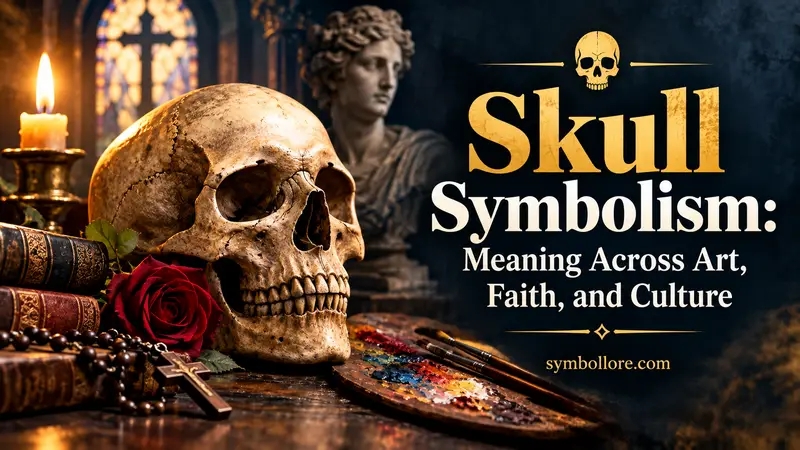
Skull symbolism begins with one unmistakable fact: a skull is a human face after life has ended. That makes mortality, death, impermanence, and remembrance its strongest and most widely recognizable meanings.
Yet skulls do not mean the same thing everywhere. A skull beside an hourglass in Christian art can urge reflection on death. A Mexican calavera may honor the dead with humor and affection. A pirate flag threatens violence, while a chemical label warns of acute toxicity. In Tibetan religious art, a skull cup belongs to a specific ritual tradition.
The skull’s meaning therefore comes from context, culture, time period, and surrounding imagery, not from one universal symbolic code.
Quick Answer
Skull symbolism most strongly represents mortality, death, remembrance, impermanence, and awareness of life’s limited span. In specific settings, skulls can also signify repentance, danger, transformation, ancestral memory, defiance, or spiritual practice. These meanings are not interchangeable: Christian devotional art, Día de los Muertos, Tibetan ritual imagery, pirate flags, tattoos, and hazard labels all use the skull differently.
TL;DR
- Mortality is the skull’s strongest recurring meaning because it is the visible remains of a once-living human face.
- European memento mori and vanitas art used skulls to remind viewers that wealth, youth, learning, and pleasure do not last.
- Mexican Día de los Muertos calaveras can express remembrance, affection, family, humor, and life’s closeness to death.
- Christian, Tibetan Buddhist, and Hindu skull imagery belongs to different religious histories and should not be blended together.
- The skull and crossbones can communicate literal danger, from pirate intimidation to modern toxic-chemical labels.
- Tattoos and modern spiritual interpretations can carry personal meanings, but no fixed supernatural message applies to every skull.
Skull Meanings at a Glance
| Context | Main Meaning | Why the Skull Appears | Important Limit |
|---|---|---|---|
| Memento mori | Mortality, reflection | The skull shows the physical end shared by all people | It is not simply a horror symbol |
| Vanitas art | Impermanence, vanity of worldly achievement | Skulls appear beside books, flowers, candles, wealth, or clocks | Meanings depend on the full composition |
| Christian devotional art | Death, repentance, preparation, resurrection context | Saints and crucifixion scenes use skull imagery in specific theological settings | Christianity has no single skull meaning |
| Día de los Muertos | Remembrance, family, mortality, celebration | Calaveras appear with ofrendas and commemorative traditions | It should not be reduced to Halloween imagery |
| Tibetan ritual art | Impermanence and tantric ritual context | Kapalas are skull-shaped or actual skull ritual vessels | Meaning belongs to specific Buddhist traditions |
| Pirate imagery | Threat, death, intimidation | Skull motifs warned targets of violent consequences | Pirates used many flag designs |
| Hazard labeling | Acute toxicity and danger | The standardized pictogram warns of poisonous substances | This is a regulated safety meaning |
| Modern tattoos and design | Mortality, remembrance, rebellion, resilience | Wearers adapt older imagery to personal identity | Personal meaning is not universal |
Why the Skull Became a Symbol of Mortality
The connection between skulls and death needs little invented symbolism. A skull is part of every human skeleton, but it becomes most visible when the soft tissues that created a person’s familiar appearance are gone.
That creates a powerful contrast. The eye sockets, teeth, jaw, and shape still resemble a face, yet the individual expression has disappeared. A skull can therefore show both a person who once lived and the physical fact that life ends.
This helps explain why skulls can feel unsettling without necessarily meaning evil. They collapse distinctions that matter greatly during life. Wealth, beauty, occupation, fashion, status, and age become difficult to read from the simplified form.
Artists have repeatedly used that visual equality to raise questions about limited time and human ambition.
Memento Mori: The Skull as a Reminder to Remember Death
One of the clearest documented uses of skull imagery appears in the European tradition of memento mori, a Latin expression commonly understood as “remember that you must die.”
The goal was not always to frighten the viewer. A skull could encourage spiritual preparation, humility, repentance, or a more thoughtful use of one’s remaining life.
A late-16th-century image of Saint Jerome in the National Gallery of Art, for example, includes both a skull and an hourglass. The museum identifies them specifically as memento mori symbols. Jerome’s Bible, crucifix, penitential posture, and other attributes give the skull a devotional context rather than a generic horror meaning.
That setting matters. Remove the crucifix and saint, add a poison bottle, and the same basic skull would communicate something very different.
Vanitas Art: When Skulls Symbolize the Short Life of Worldly Things
Seventeenth-century European vanitas still lifes developed mortality symbolism in a particularly detailed way.
A skull might appear with expensive goods, musical instruments, books, flowers, bubbles, clocks, food, or extinguished candles. The surrounding objects helped create a message about life’s transience.
The National Gallery of Art’s Vanitas Still Life by François van Daellen, dating to about 1650, places a skull and bone with books, papers, and a recently extinguished candle. The museum explains that the composition contrasts scholarly and artistic achievement with the fleeting nature of human life.
Another National Gallery vanitas includes a skull, flowers, an hourglass, and bubbles. Such combinations make an important point: the skull’s message comes partly from what surrounds it.
A skull with wilting flowers can suggest beauty passing away. A skull with books can place knowledge beside mortality. An hourglass adds time. An extinguished candle makes life’s ending immediate.
Readers interested in other death-related imagery can compare these themes with Flowers That Symbolize Death: Meanings Across Cultures. SymbolLore
Skull Symbolism in Christianity
Christian skull imagery can express mortality, repentance, human fallenness, contemplation of death, or resurrection theology depending on the work.
Saint Jerome provides one well-documented example. Renaissance and later artists often depicted the scholar-saint near a skull while he prayed, studied, or performed penance. The skull reminded the viewer of mortality while Jerome’s religious setting directed that reflection toward spiritual preparation. National Gallery of Art
The Skull Beneath the Cross
A different skull appears in some Crucifixion images.
Golgotha, where the Gospels place the Crucifixion, is called the “Place of the Skull.” In later Christian artistic tradition, a skull beneath Christ’s cross can also represent Adam.
Smarthistory explains that some Byzantine Crucifixion images show a skull at the foot of the cross because tradition identified Golgotha with Adam’s burial place. Christ is then understood as the “New Adam,” connecting the first man’s death with Christian beliefs about salvation and restored life. Smart History
This is much more specific than saying, “In Christianity, skulls mean death.”
The same object can participate in a larger theological argument about mortality, sin, sacrifice, and resurrection.
For another documented Christian image of life returning after death, see Phoenix Symbolism in Christianity: Resurrection, Hope, and Eternal Life. SymbolLore
Día de los Muertos: Skulls, Remembrance, and the Living-Dead Relationship
Mexican Día de los Muertos provides one of the strongest examples of why skulls should not automatically be read as frightening.
Calaveras, including decorated sugar skulls, appear alongside ofrendas, photographs, flowers, food, candles, and other objects used to remember deceased loved ones.
The Smithsonian explains that brightly decorated sugar skulls are associated with the observance and can function as whimsical reminders of life’s cycle rather than purely morbid objects. Ofrendas center remembrance and relationships with deceased family members. Smithsonian Institution
The history is also more complex than simply calling Día de los Muertos “an ancient skull festival.” Contemporary observance combines Indigenous roots, Catholic elements, regional practice, family tradition, and later artistic developments. Smithsonian Folklife Festival
La Catrina and Social Satire
Mexican skull imagery also carries a major artistic and political history.
Graphic artist José Guadalupe Posada became famous for satirical calaveras. The Smithsonian American Art Museum notes that Posada used skeletal figures to critique Mexican politics and society. His imagery later became strongly associated with Día de los Muertos and influenced later Mexican and Chicanx artists. Smithsonian American Art Museum
A dressed skeleton can therefore communicate more than death. It may mock social pretension by showing that wealth and status cannot defeat mortality.
For a deeper guide to the celebration’s specific objects, see Day of the Dead Symbolism: What Each Symbol Means. SymbolLore
Skull Imagery in Tibetan Buddhist Traditions
Skulls also appear in Tibetan Buddhist ritual and art, but their use should not be reduced to a generic phrase like “spiritual awakening.”
A kapala, or skull cup, is a ritual vessel associated especially with tantric and Vajrayana contexts. The British Museum preserves several historical Tibetan examples made from human skull bone, sometimes mounted with metal, turquoise, or other materials. British Museum
The museum also documents an image of Padmasambhava holding a kapala containing what its catalog describes as the “nectar of deathless wisdom.” That specific object combines death imagery with a ritual vocabulary about transcending ordinary mortality. British Museum
The responsible interpretation is not “Buddhists believe skulls mean wisdom.”
Rather, skull imagery appears in particular tantric Buddhist objects and iconographic systems, where impermanence, ritual transformation, wisdom, death, and religious practice can intersect.
Skull Imagery in Hindu Traditions
Certain Hindu deities also appear with heads, skulls, or skull vessels, especially in fierce or tantric iconography.
For example, the Metropolitan Museum of Art documents an image of the goddess Tara from Bengal that shares visual attributes with Kali. The figure wears severed heads, carries a skull cup, and stands on Shiva. The museum identifies Tara in this context with transcendent wisdom and salvation while also emphasizing her relationship with Kali’s fearsome visual language. The Metropolitan Museum of Art
Such imagery should not be flattened into the statement “Hindu skulls symbolize death.”
Depending on the deity and tradition, human remains can participate in imagery involving mortality, divine power, destruction, transcendence, or the overcoming of ordinary attachments.
Specific iconography matters more than the skull alone.
From Pirate Flags to Warning Labels: When a Skull Means Danger
Not every skull meaning is philosophical or religious.
The skull and crossbones became closely associated with pirates during the late 17th and early 18th centuries. However, not every pirate used the same flag.
Britain’s National Maritime Museum explains that pirates employed many designs involving skulls, skeletons, crossed bones, hourglasses, and other mortality symbols. The purpose was practical: frightening potential victims into surrender before a fight. Royal Museums Greenwich
Here the skull communicates credible threat.
The Modern Toxicity Symbol
That warning function continues in modern safety systems.
Under U.S. Occupational Safety and Health Administration rules, the skull-and-crossbones pictogram identifies specified categories of acute toxicity, including chemicals that can be fatal or toxic if swallowed, inhaled, or absorbed through skin. OSHA
This meaning should not be spiritualized.
A skull on a chemical container is not telling the viewer to “transform.” It means: this substance can seriously harm or kill you.
That contrast shows why context is the central rule of skull interpretation.
Yorick’s Skull in Hamlet: Death, Memory, and Human Equality
One of the most famous skulls in literature belongs to Yorick, the dead court jester in Shakespeare’s Hamlet.
In Act 5, a gravedigger identifies the skull, and Hamlet remembers the living man who once entertained him. The object is no longer anonymous bone. It becomes connected to childhood, laughter, personality, touch, and memory. Folger Shakespeare Library
The Folger Shakespeare Library describes Hamlet more broadly as a sustained meditation on death and notes how the graveyard scene reduces politicians, courtiers, lawyers, jesters, and others to remarkably similar remains. Folger Shakespeare Library
This creates several overlapping meanings:
- mortality erases visible social rank;
- physical beauty and expression do not last;
- memory briefly restores individuality to anonymous remains;
- death turns a person once full of speech and movement into an object;
- humor and mortality can exist in the same scene.
The skull therefore does more than stand for death. It forces Hamlet to connect an abstract fact with someone he personally knew.
Why Skull Symbolism Can Mean Remembrance
A skull can signify not only death but also the person who is no longer physically present.
That difference is important.
In memorial settings, skull imagery may express continued memory rather than fear. Día de los Muertos offers a culturally specific example. A personal tattoo may serve the same function for an individual, although that tattoo meaning is not automatically traditional.
Remembrance works because a skull retains the general architecture of a human face while losing many markers of individual appearance.
The contrast can make memory feel more urgent: the living person has disappeared, but the relationship, name, story, or impact remains.
For another historically strong remembrance symbol, compare Rosemary Symbolism: Meaning, History, and Cultural Roots. SymbolLore
Do Skulls Symbolize Transformation and Rebirth?
They can, but transformation is not the skull’s automatic universal meaning.
The logic is easy to understand. A skull marks a profound change from living body to physical remains. Religious traditions that place death within a larger teaching about resurrection, rebirth, liberation, or impermanence may therefore give skull imagery an additional transformative layer.
Modern tattoo culture and spiritual writing often extend this idea into personal themes such as:
- surviving hardship;
- ending an old identity;
- recovery;
- accepting change;
- beginning again;
- confronting fear.
Those interpretations can be meaningful. However, a modern personal transformation reading should not be described as an ancient teaching unless a specific tradition supports it.
A related symbol with a much clearer transformation mechanism is the butterfly. The site’s Butterfly Tattoo Symbolism guide also notes that pairing a butterfly with a skull can emphasize life, change, and mortality together. SymbolLore
Skull Tattoos and Modern American Meaning
In contemporary American tattoo, fashion, music, motorcycle, gaming, and graphic-design culture, skulls can carry meanings that draw from several older traditions without duplicating them exactly.
Common personal readings include:
- mortality;
- remembrance;
- survival;
- toughness;
- rebellion;
- independence;
- defiance;
- transformation;
- danger;
- acceptance of death.
The surrounding design usually changes the message.
A skull and clock may emphasize limited time. A skull with flowers creates tension between life, beauty, and death. A butterfly beside a skull can contrast metamorphosis with mortality. A crowned skull can mock status or show power made temporary.
A skull tattoo does not have a dictionary-style translation. The wearer’s intention, design tradition, surrounding motifs, and cultural source all matter.
Spiritual Meaning of a Skull Today
Modern spiritual writing often interprets skulls as reminders to confront mortality, release attachment, face fear, accept change, or focus on what matters.
Those ideas can function well as personal reflection.
For example, someone may use a skull pendant as a private memento mori. Another person may see it as a reminder of surviving illness or grief. Someone else may connect it with a specific religious tradition.
The unsupported step comes when personal symbolism becomes a universal supernatural claim.
A skull image does not prove that a spirit is contacting someone, that death is approaching, or that a predetermined transformation will occur.
Meaning can be personally powerful without being predictive.
What Does a Skull Mean in a Dream?
A skull dream has no scientifically established universal symbolic translation.
However, the image can provide useful material for personal interpretation.
A frightening skull might connect with anxiety about death, illness, loss, or danger. A familiar skull could evoke grief or memory. A decorated skull might recall Día de los Muertos, art, tattoos, or personal cultural associations.
Context matters more than a generic dream dictionary.
Consider:
- Who or what was connected with the skull?
- Did you feel fear, peace, curiosity, grief, or disgust?
- Was the skull hidden, displayed, speaking, broken, decorated, or held by someone?
- What does skull imagery already mean to you personally?
A dream can prompt reflection, but it does not reliably predict death or another future event.
How to Interpret Skull Symbolism Correctly
The most reliable way to read a skull is to begin with where it appears.
A useful sequence is:
- Identify the setting. Is it religious art, a tattoo, a chemical label, a pirate flag, a Mexican ofrenda, literature, or contemporary fashion?
- Identify the culture and period. A 17th-century Dutch painting and a 21st-century American tattoo should not be interpreted by the same rules.
- Look at surrounding symbols. Flowers, clocks, crosses, weapons, books, butterflies, crowns, or candles can change the meaning.
- Separate documented tradition from personal interpretation.
- Avoid treating the skull as automatically evil or automatically spiritual.
This context-first method explains why one image can move between mourning, warning, satire, devotion, identity, celebration, and philosophical reflection without contradiction.
FAQs
What is the main meaning of a skull symbol?
The strongest recurring meaning is mortality. A human skull visibly represents what remains after death, so artists, religions, writers, warning systems, and popular culture have repeatedly used it to express death or life’s limited span. Other meanings depend on context.
Is a skull always a symbol of death?
Death is its strongest underlying association, but the skull may communicate remembrance, repentance, warning, satire, family connection, rebellion, spiritual practice, or transformation in a specific setting. A Día de los Muertos calavera, for example, functions differently from a hazardous-chemical pictogram.
Does a skull mean evil?
No. A skull does not automatically mean evil. Christian devotional art can use it for mortality and repentance; Mexican traditions can connect it with affectionate remembrance; standardized safety labels use it for toxicity. “Evil” is only one possible interpretation in certain fictional or ideological settings.
What does a skull and crossbones symbolize?
Its meaning depends on where it appears. Historically, variations of skull-and-bones imagery appeared on pirate flags as threatening mortality imagery. Today, OSHA uses the skull-and-crossbones pictogram for specified forms of acute chemical toxicity. Royal Museums Greenwich
What does a skull with flowers symbolize?
A skull with flowers often creates a deliberate contrast between mortality and living beauty. It may express remembrance, life’s short duration, decay beside renewal, or a personal relationship with grief. However, flower species, culture, artistic genre, and the wearer’s intention can alter that meaning.
Why do saints appear with skulls in Christian art?
In some Christian devotional art, a skull functions as a memento mori, encouraging contemplation of death, repentance, and spiritual preparation. The National Gallery of Art specifically identifies the skull and hourglass in an image of Saint Jerome as memento mori symbols. National Gallery of Art
Are sugar skulls symbols of death?
They relate to death, but “death” alone is incomplete. In Día de los Muertos contexts, decorated calaveras can participate in remembrance, family connection, humor, affection, and reflection on life’s cycle. The Smithsonian notes that brightly decorated sugar skulls are not merely morbid decorations. Smithsonian Institution
Sources and Further Reading
- National Gallery of Art — Vanitas Still Life, c. 1650
- Smithsonian Institution — Five Facts About Día de los Muertos
- British Museum — Tibetan Kapala Skull Cup
- Royal Museums Greenwich — Pirate Flags and the Jolly Roger
- OSHA — Hazard Communication Pictograms
- Folger Shakespeare Library — Hamlet, Act 5, Scene 1
Conclusion
Skull symbolism begins with mortality, but its meaning changes dramatically with context. European devotional and vanitas art used skulls to confront life’s brevity. Mexican calaveras can honor memory and family. Christian, Tibetan Buddhist, and Hindu imagery gives skulls specific religious roles, while pirate flags and chemical labels turn the same basic form into a warning.
Modern tattoos and spiritual interpretations add personal meanings such as resilience, transformation, or rebellion. None replaces the need for context. The best interpretation asks who created the image, when, where, and why. A skull becomes meaningful not because it carries one secret code, but because human cultures repeatedly use mortality to think about how life should be remembered and lived.