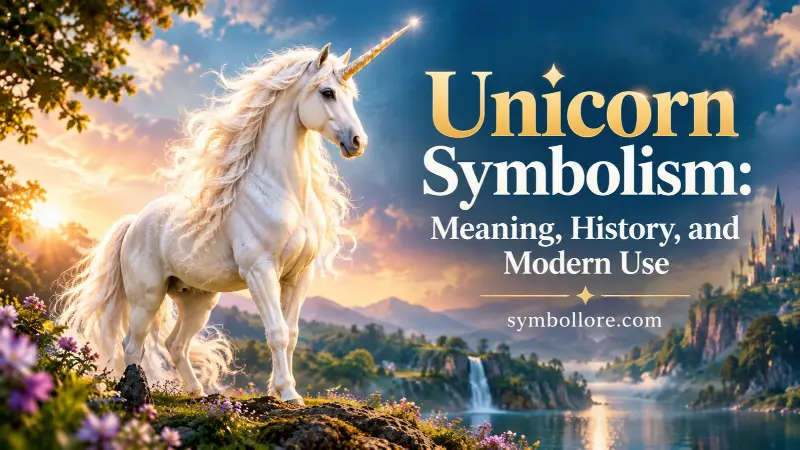
Unicorn symbolism carries a powerful mix of beauty, mystery, innocence, and strength. For centuries, people have pictured unicorns as rare creatures with magical horns and remarkable powers. Yet their meaning goes far beyond fairy tales.
In medieval Europe, unicorns appeared in religious paintings, royal emblems, and stories about love. Today, they often represent individuality, imagination, and the courage to be different.
But what does a unicorn truly symbolize, and why have its meanings changed?
This guide explores the unicorn’s historical origins, spiritual associations, cultural importance, and modern interpretations.
Quick Answer: What Does a Unicorn Symbolize?
A unicorn symbolizes purity, innocence, strength, rarity, freedom, and magic. In medieval Christian art, it sometimes represented Jesus Christ, while European folklore connected it with healing and virtue. Today, unicorns often symbolize imagination, hope, individuality, and embracing what makes someone unique. Their exact meaning depends on the culture, artwork, and personal context.
Key Takeaways
- Purity and innocence: Medieval European traditions associated unicorns with virtue and moral purity.
- Strength and independence: Older legends described unicorns as fierce, powerful creatures that resisted capture.
- Spiritual meaning: Christian artists sometimes used unicorns to represent Christ, while modern spiritual interpretations focus on hope and inner growth.
- Love and devotion: Medieval artwork also connected unicorns with romantic love, marriage, and commitment.
- Individuality and imagination: Modern unicorn imagery often celebrates originality, creativity, and self-expression.
What Is Unicorn Symbolism?
Unicorn symbolism refers to the ideas, beliefs, and emotions represented by the legendary one-horned creature.
A unicorn typically looks like a white horse with a single horn rising from its forehead. However, older descriptions sometimes gave it the body of a goat, the tail of a lion, or other unusual features.
The word unicorn comes through Latin from words meaning “one-horned.”
Although unicorns are mythical creatures, their stories developed from ancient accounts of unusual animals, religious teachings, and human imagination.
Over time, the unicorn became more than a mysterious beast. It grew into a symbol of things people admired but found difficult to obtain, including perfect love, innocence, freedom, and extraordinary beauty.
The Historical Origins of Unicorn Symbolism
Ancient Greek writers described strange one-horned animals believed to live in distant regions.
The Greek physician Ctesias discussed such a creature in the fourth century BCE. His account differed from the familiar horse-like unicorn seen today.
During the Middle Ages, European writers included unicorns in illustrated animal books called bestiaries. These works mixed descriptions of animals with moral and religious lessons.
Eventually, artists began portraying unicorns as elegant creatures with white bodies and long, spiraling horns.
Their appearance changed, but the idea of something rare, powerful, and difficult to capture remained important.
Unicorn Symbolism Meaning and Importance
The unicorn carries several meanings because different cultures and artistic traditions have used it for different purposes.
Purity and Innocence
Purity is one of the unicorn’s oldest and most recognizable symbolic associations in medieval Europe.
According to medieval legends, only a virgin maiden could calm or capture a unicorn. Artists used this story to connect the animal with chastity, innocence, and virtue.
These meanings reflected the religious and social beliefs of that period.
Today, a unicorn may represent a pure heart, honest intentions, or someone who tries to remain kind despite difficult experiences.
Modern readers do not have to accept medieval ideas about virginity to understand the symbol’s broader connection with sincerity and goodness.
Magic and Wonder
Unicorns also represent the extraordinary.
Their mythical nature encourages people to imagine possibilities beyond everyday life.
In fantasy stories, unicorns may appear in enchanted forests, protect hidden places, or possess magical abilities.
As a modern symbol, the unicorn can express curiosity, creativity, and the joy of discovering something unexpected.
This meaning helps explain why unicorn imagery remains popular in children’s books, decorations, and fantasy entertainment.
Strength and Courage
Although modern unicorns often appear gentle, medieval legends described them as fierce animals.
They could fight hunters, defend themselves with their horns, and resist capture.
Because of these stories, unicorns can symbolize courage, determination, and personal strength.
A unicorn may appear graceful while still possessing the power to defend itself.
This combination creates an important message: gentleness and strength do not have to be opposites.
Freedom and Independence
Wild unicorns were difficult to control in traditional stories.
Their refusal to submit easily made them useful symbols of independence.
In modern interpretations, a unicorn may represent someone who follows a personal path instead of copying others.
It can also express the desire to live freely, protect personal boundaries, and remain true to one’s values.
Hope and Possibility
Unicorns are often linked with hope because they represent something rare and wonderful.
Seeing a unicorn in a modern fantasy story may suggest that extraordinary things remain possible.
However, this meaning is mainly a modern emotional interpretation rather than a fixed historical tradition.
A unicorn can serve as a reminder to remain hopeful while recognizing the difference between imagination and reality.
Different Types of Unicorn Symbolism
Color, appearance, and artistic setting can influence how someone interprets a unicorn.
These associations are especially common in modern fantasy, tattoos, and decorative art. They are not universal meanings.
White Unicorn Symbolism
White unicorns commonly represent purity, innocence, peace, and goodness.
Their pale appearance reinforces the moral purity associated with medieval unicorn imagery.
In modern artwork, a white unicorn may also communicate calmness, honesty, or a fresh beginning.
Black Unicorn Symbolism
Black unicorns often appear in modern fantasy art as symbols of mystery, independence, and hidden strength.
Their dark appearance can challenge the familiar image of a gentle white unicorn.
Some artists use black unicorns to represent unconventional beauty or the courage to stand apart.
There is no single established ancient meaning for black unicorns.
Pink Unicorn Symbolism
Pink unicorns commonly suggest affection, playfulness, tenderness, and imagination.
They often appear in children’s products and modern fantasy illustrations.
A pink unicorn may represent a cheerful personality or a love of whimsical things.
These associations come mainly from contemporary color symbolism.
Rainbow Unicorn Symbolism
Rainbow unicorns frequently represent creativity, happiness, diversity, and self-expression.
Their colorful appearance emphasizes individuality rather than traditional ideas of purity.
In some modern settings, rainbow unicorns also communicate inclusion and acceptance.
However, not every rainbow unicorn image has an LGBTQ+ meaning. The intended message depends on the setting and creator.
Unicorn Spiritual Meaning
In modern spiritual interpretations, unicorns often symbolize inner purity, hope, personal growth, and the search for a meaningful life.
Some people view the unicorn as a reminder to trust their values and approach life with compassion.
Others associate it with imagination, intuition, or an emotional connection to nature.
These interpretations can hold personal meaning, but they are not scientific findings or universal religious teachings.
Unicorn Symbolism in Christianity
Christian unicorn symbolism became especially important during the Middle Ages.
Certain Christian writers interpreted the unicorn as a symbol of Jesus Christ.
The creature’s purity, uniqueness, and strength made it suitable for religious allegory.
In one common medieval interpretation, the maiden who calmed the unicorn represented the Virgin Mary.
The unicorn approaching her could symbolize the Incarnation, while scenes involving its capture or death could suggest Christ’s suffering.
These were artistic and theological interpretations, not descriptions of actual animals.
What Does a Unicorn Symbolize in the Bible?
Some older English Bible translations, including the King James Version, contain the word unicorn.
However, the underlying Hebrew term, re’em, is generally understood as referring to a powerful wild bovine animal, often translated as wild ox.
Therefore, these passages do not provide reliable evidence that the mythical horse-like unicorn existed.
The Christian symbolism of unicorns developed mainly through later religious writings, stories, and medieval artwork.
Unicorn Symbolism in Dreams
Dreaming about a unicorn can invite reflection on imagination, personal values, or the desire for something special.
For example, a peaceful unicorn might remind someone of innocence or emotional comfort.
A unicorn running freely could suggest a personal wish for independence.
However, dream research does not establish one fixed meaning for unicorn dreams.
The dreamer’s feelings, memories, and daily experiences provide better clues than a universal dream dictionary.
Unicorn Symbolism in Different Cultures
Unicorn symbolism developed through several traditions, although not every one-horned mythical creature shares the same origin or meaning.
Medieval European Culture
Medieval European writers associated unicorns with purity, power, love, and religious virtue.
Illustrated manuscripts often showed unicorns beside young women or involved in dramatic hunts.
These stories reflected moral ideas as well as fascination with mysterious animals.
The unicorn could represent something beautiful that people desired but could not easily possess.
Scottish Unicorn Symbolism
The unicorn is Scotland’s national animal.
It appears in Scottish royal heraldry and has long represented qualities such as strength, pride, and independence.
Its fierce reputation made it an appropriate emblem of royal power.
In the United Kingdom’s royal coat of arms, the unicorn appears alongside the lion.
This imagery connects the mythical creature with a real history of monarchy, identity, and national symbolism.
Chinese Mythology and the Qilin
Chinese mythology includes a legendary creature called the qilin.
It sometimes appears in English descriptions as a Chinese unicorn, but it is not identical to the European unicorn.
The qilin may have one horn or other features depending on the artistic tradition.
It is associated with auspicious events, virtue, and the arrival of wise or exceptional people.
Unlike the European unicorn, its traditional symbolism does not center on a maiden capturing a wild animal.
Recognizing this difference helps preserve the distinct meaning of Chinese folklore.
Examples of Unicorn Symbolism in Art and Literature
Real historical objects and familiar storytelling patterns show how unicorn meanings change with context.
The Unicorn Tapestries
The famous Unicorn Tapestries, made around 1495–1505, depict a dramatic unicorn hunt.
They include scenes of the unicorn defending itself, approaching a maiden, and resting in an enclosed garden.
Scholars have interpreted these images through Christian religion, romantic love, marriage, and courtly traditions.
The garden scene is especially meaningful because the unicorn appears peacefully confined.
Its surroundings suggest that restraint may represent devotion rather than simple defeat.
Unicorns in Fantasy Literature
Modern fantasy writers often portray unicorns as rare, intelligent, or magical creatures.
Their presence can signal that a fictional world contains mysteries beyond ordinary human understanding.
For example, a unicorn that avoids humans may represent the natural world’s independence.
A unicorn that protects a forest could symbolize innocence, beauty, or the importance of protecting vulnerable things.
These are examples of how authors can use the symbol, not universal rules for every fantasy story.
Unicorns in Modern Illustrations
A colorful unicorn on a school notebook usually communicates a different message from a unicorn in medieval religious art.
The notebook design may express fun, creativity, and playful imagination.
Meanwhile, a unicorn painted beside a medieval maiden could communicate purity or a religious lesson.
The setting matters as much as the creature itself.
Modern Uses of Unicorn Symbolism
Unicorn symbolism remains popular because it can express several positive qualities without requiring a complicated explanation.
Unicorn Tattoo Meaning
Unicorn tattoos commonly represent individuality, imagination, freedom, or inner strength.
Some people choose a unicorn tattoo to celebrate their unique personality.
Others prefer it as a reminder of childhood wonder, personal hope, or the desire to remain independent.
A white unicorn tattoo may emphasize innocence or peace, while a colorful design may celebrate creativity.
The wearer’s intended meaning is more important than any supposed universal tattoo definition.
Unicorns as Symbols of Individuality
Modern culture often uses the word unicorn to describe someone or something unusually rare.
Calling a person a unicorn may suggest that they possess a remarkable combination of qualities.
This expression also appears in business, where a unicorn startup refers to a privately held startup valued at $1 billion or more.
Although these uses differ, both build on the idea of exceptional rarity.
Unicorns in Gifts and Celebrations
Unicorn-themed gifts often express affection, encouragement, and admiration for someone’s creativity.
A unicorn birthday decoration might simply communicate happiness and fun.
Likewise, a unicorn greeting card can celebrate a person’s unique character.
Not every appearance of a unicorn carries a serious spiritual message.
Sometimes, its purpose is simply to bring joy.
Unicorn Symbolism Compared With Other Mythical Creatures
Unicorns share certain qualities with other legendary animals, but their symbolic roles differ.
| Mythical Creature | Common Symbolism | Key Distinction |
|---|---|---|
| Unicorn | Purity, uniqueness, freedom, strength | Combines innocence with fierce independence |
| Dragon | Power, danger, wisdom, or protection | Meanings vary widely across cultures |
| Phoenix | Rebirth, renewal, transformation | Emphasizes recovery after destruction |
| Pegasus | Freedom, inspiration, imagination | Represents a winged horse from Greek mythology |
| Qilin | Virtue, good fortune, auspicious events | Belongs to Chinese mythological traditions |
These differences help explain why artists choose one mythical creature instead of another.
A phoenix works well as a symbol of renewal, while a unicorn may better express rare beauty or personal independence.
Common Misconceptions About Unicorn Symbolism
Several popular ideas about unicorns need historical context.
Unicorns Have Always Represented Rainbows
Rainbow unicorns are especially common in modern popular culture.
Historical European unicorn images, however, usually focused on different ideas, including purity, strength, and religious meaning.
Colorful unicorn designs reflect more recent artistic tastes.
Unicorns Were Always Gentle Creatures
Medieval unicorns could be dangerous and difficult to capture.
Their power and wild nature were essential parts of many legends.
The gentle, friendly unicorn familiar today represents only one side of the creature’s history.
Unicorn Horns Had Real Healing Powers
European folklore claimed that unicorn horns could detect poison, purify water, or cure disease.
People sometimes traded real narwhal tusks as unicorn horns.
These objects had commercial and cultural value, but they did not possess the magical medical powers attributed to them.
Every Unicorn Has the Same Spiritual Meaning
There is no universal spiritual interpretation of unicorns.
A medieval Christian artist, a Scottish heraldic designer, and a modern fantasy writer may use the creature for different reasons.
The most accurate interpretation considers the culture, time period, and specific image.
Important Historical Facts About Unicorns
The history of unicorns reveals how imagination, religion, and natural history influenced one another.
First, unicorns did not begin as the friendly, rainbow-colored creatures common in today’s children’s entertainment. Earlier accounts described unusual animals that were sometimes frightening.
Second, many medieval Europeans accepted unicorns as possible real animals. Their beliefs drew on classical writings, religious allegories, and accounts of distant lands.
Third, narwhal tusks helped strengthen those beliefs. Their long, spiral shape resembled the horns shown in unicorn illustrations.
Finally, medieval artwork did not always carry a single meaning. One unicorn image could suggest religious devotion, romantic commitment, or untamed power.
Together, these facts show why unicorn symbolism has survived for centuries.
People Also Ask About Unicorn Symbolism
Why Is the Unicorn a Symbol of Purity?
The unicorn became a symbol of purity largely because medieval European legends claimed that only a virgin maiden could calm it. Christian artists later connected this story with the Virgin Mary and religious virtue.
What Does a Unicorn Represent in Love?
In medieval courtly traditions, unicorns sometimes symbolized romantic devotion, marriage, and the power of love. Today, they may also represent a rare connection or an ideal relationship.
Does a Unicorn Symbolize Good Luck?
A unicorn may symbolize good luck in some modern personal or spiritual interpretations. However, luck is not its only or most consistent historical meaning. Purity, power, and rarity have stronger associations in medieval European sources.
What Does a Unicorn Horn Symbolize?
The unicorn’s horn traditionally represents unusual power, protection, and legendary healing abilities. Medieval stories claimed it could purify poisoned water. Today, its magical qualities are understood as folklore rather than proven facts.
Frequently Asked Questions
The deeper meaning of a unicorn often involves the relationship between innocence and strength. It represents something beautiful and rare that cannot easily be controlled. In modern interpretations, this can suggest protecting personal values, embracing individuality, and remaining hopeful without giving up independence.
Seeing a unicorn in artwork, meditation, or imagination may inspire thoughts about hope, purity, creativity, or personal growth. Some people consider it a meaningful spiritual reminder. However, no scientific evidence shows that seeing a unicorn image predicts future events or delivers a universal supernatural message.
Unicorns generally carry positive associations in European symbolism, including virtue, purity, and strength. However, older legends also portrayed them as fierce and dangerous. Their actions and setting determine whether an individual story presents them as comforting, threatening, or morally complex.
A unicorn may represent independence, uniqueness, imagination, or personal strength for a woman. Medieval images also connected unicorns with maidens and ideas about chastity. Those historical associations should not be treated as rules about modern womanhood. Anyone can choose a unicorn as a personal symbol.
A unicorn necklace may express creativity, innocence, hope, or individuality. It can also be a playful fashion accessory without a deeper message. When someone gives a unicorn necklace as a gift, its intended meaning may involve celebrating the recipient’s personality or reminding them that they are special.
Unicorns have a historical association with healing because medieval legends credited their horns with the power to neutralize poison and cleanse water. Modern spiritual interpretations sometimes use unicorn imagery to represent emotional recovery. These symbolic meanings should not be confused with medical treatment or scientifically established healing effects.
Unicorns are associated with magic because legendary stories described them as extraordinary creatures with mysterious abilities. Their supposed healing horns, rarity, and difficult-to-capture nature made them appealing subjects for fantasy. Modern storytelling has strengthened this association through enchanted landscapes, magical adventures, and imaginative characters.
Conclusion: What Does Unicorn Symbolism Teach Us?
Unicorn symbolism brings together purity, strength, independence, imagination, and the beauty of being different.
Its meanings developed through ancient descriptions, medieval religious artwork, royal traditions, and modern fantasy.
Although interpretations vary, one idea connects many of them: the unicorn represents something extraordinary that deserves respect.
Whether it appears in a painting, tattoo, dream, or favorite story, the unicorn invites us to value imagination, personal freedom, and the qualities that make each individual unique.