
Rooster symbolism in the Bible centers on one unforgettable Gospel scene: Peter denies Jesus three times, then a rooster crows. The sound immediately connects Peter’s failure with Jesus’ earlier warning and forces Peter to face what he has done. The moment therefore carries themes of human weakness, recognition, repentance, and the reliability of Jesus’ words.
Later Christian tradition added other meanings. Because a rooster announces the approach of morning, Christians also connected it with vigilance, spiritual awakening, and the movement from darkness toward light. Those later meanings are real parts of Christian symbolism, but they should not be confused with a single fixed meaning stated by the Bible itself.
Quick Answer
Rooster symbolism in the Bible is most strongly connected with Peter’s denial of Jesus, recognition of failure, repentance, and the fulfillment of Jesus’ warning. Because the rooster’s crow also marked the approaching morning, later Christian tradition connected the bird with vigilance and spiritual awakening. The Gospel text itself, however, primarily uses the rooster within Peter’s denial story.
TL;DR
- The rooster’s most important biblical role appears in the four Gospel accounts of Peter’s denial.
- Its crow reminds Peter that Jesus accurately predicted his three denials.
- Peter’s reaction connects the moment with grief, recognition, and repentance.
- “Cockcrow” could also function as a familiar night-time marker.
- Later Christian art made the rooster an emblem of Peter.
- Vigilance and resurrection are important later Christian associations, but they should not be presented as the rooster’s only biblical meaning.
Rooster Meanings in the Bible at a Glance
| Biblical or Christian context | Meaning or association | Why the association developed | Important limit |
|---|---|---|---|
| Peter’s three denials | Failure and recognition | The crow follows the predicted denials and prompts Peter to remember Jesus’ words | The rooster itself does not cause Peter’s failure |
| Peter’s remorse | Repentance | Peter remembers the warning and responds with bitter grief | Repentance is shown through Peter’s response, not defined as a property of the bird |
| Jesus’ prophecy | Fulfillment and reliability | The predicted crow occurs after Peter’s denials | This is a narrative function, not a general animal omen |
| Cockcrow as night marker | Watchfulness and time | The crow marked the approach of morning | “Cockcrow” can refer to a time period as well as an actual bird |
| Christian art | Peter’s betrayal and repentance | Artists used the bird to identify the Peter story | This is later iconography, not a separate Gospel teaching |
| Dawn symbolism | Awakening and light | The rooster announces morning | This association became stronger in Christian tradition than in the Gospel narratives themselves |
Why Does the Rooster Appear in the Story of Peter’s Denial?
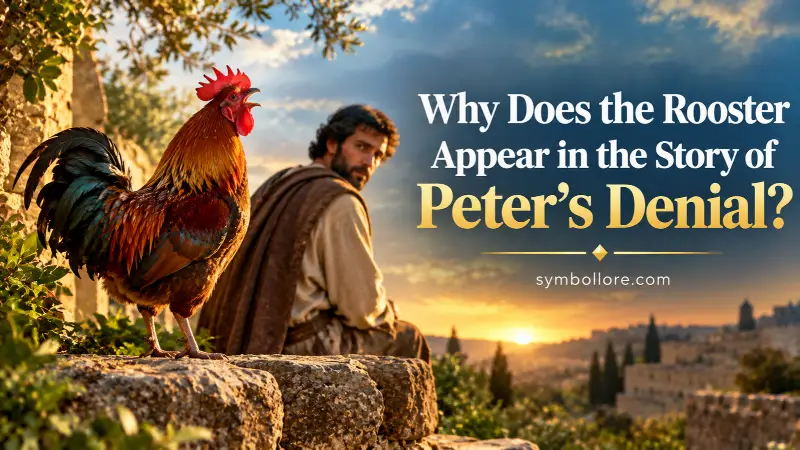
The rooster appears at a precise moment in the Passion narratives. Jesus warns Peter that he will deny knowing him. Peter strongly rejects the prediction. Later, during the night of Jesus’ arrest, Peter is questioned about his relationship with Jesus and denies him three times.
After the third denial, the rooster crows. Matthew says that Peter remembers Jesus’ words and goes out weeping bitterly. Mark likewise connects the second rooster crow with Peter remembering the prediction. Luke adds an especially striking detail: Jesus turns and looks at Peter. John simply reports the crow after Peter’s third denial.
The bird therefore works as a narrative signal. Its crow tells the reader that Jesus’ warning has come true. For Peter, the sound becomes a trigger for recognition.
This is why the rooster’s most secure biblical meaning is not “good luck,” “power,” or even “resurrection.” Its clearest function is tied to Peter’s failure and sudden awareness of that failure.
The Rooster as a Reminder of Peter’s Denial
The rooster became strongly associated with Peter because all four canonical Gospels connect the bird or its crow with the denial episode. Academic analysis of the Gospel narratives notes that the rooster becomes a recognizable sign in the Synoptic accounts, awakening Peter to his error and grief.
That association became especially powerful in Christian art. The rooster can appear beside Peter, near the courtyard scene, or as a separate emblem identifying the apostle.
The Vatican’s digital presentation of St. Peter’s Basilica provides several examples. A 1618 stucco panel depicts the rooster beside Peter’s denial, while another work shows Peter weeping after the denial with the rooster nearby. The site explicitly identifies the bird with Peter’s betrayal.
The Galleria Borghese provides another documented example. Its description of The Tears of Saint Peter explains that the rooster represents betrayal while also carrying the image of a new dawn overcoming darkness.
This shows an important historical development: the Gospel event came first; the richer visual symbolism developed later.
What Does the Rooster’s Crow Mean for Repentance?
The crow becomes connected with repentance because of what Peter does immediately afterward. The sound reminds him of Jesus’ warning, and Peter leaves in deep grief.
The Bible does not say that a rooster is naturally a symbol of repentance. Instead, the rooster’s crow marks the moment when Peter recognizes his failure.
That distinction matters. Repentance belongs to Peter’s response. The rooster serves as the event that exposes the truth he had just denied.
Later Christian symbolism naturally expanded this idea. If the rooster reminds Peter of his failure, then the bird can also remind Christians to examine their own faithfulness. A 2017 academic study of the Gospel motif describes the crow as a sign through which Peter recognizes his error and links the episode with his later rehabilitation.
Peter’s story also prevents the symbolism from ending with failure. In John 21, Jesus later restores Peter and gives him a renewed responsibility. Therefore, Christian tradition could see the rooster not only as a reminder of betrayal but also as part of a larger story of failure followed by restoration.
Does the Rooster Symbolize Vigilance in the Bible?
Vigilance is a strong Christian symbolic association, but it requires a little care.
Roosters naturally crow around the approach of morning, and “cockcrow” appears as one of the time references in Mark 13:35. Jesus uses evening, midnight, cockcrow, and morning as markers in a warning to remain watchful.
The rooster therefore fits the idea of watchfulness very well. Its call interrupts the quiet of night and signals that morning is approaching.
Christian tradition later made this connection explicit. Historical Christian reference works describe the cock as an emblem of vigilance as well as an emblem of St. Peter.
Still, there is a difference between saying “Christians later used the rooster as a symbol of vigilance” and saying “the Bible teaches that every rooster symbolizes vigilance.” The first statement has historical support. The second is too broad.
What Does Cockcrow Mean in the Bible?
“Cockcrow” can refer to the rooster’s crowing, but it also became a recognized term for a period or marker during the night.
This creates an interesting interpretive question in the Gospel accounts. Some scholars have considered whether references to cockcrow could involve a formal time marker rather than only the sound of a bird. The NET Bible notes this possibility but concludes that a real rooster is more likely in John 18:27, especially because Mark explicitly describes rooster crowing and the other Gospel wording supports the ordinary bird interpretation.
Modern scholarship continues to examine the question. A 2025 article in the Journal of Ecclesiastical History traces early modern debates over whether the Gospel’s cockcrow referred to an actual rooster or a human or military time signal.
For readers, the safest conclusion is simple: the biblical text clearly uses cockcrow as a meaningful night-time marker, and the Gospel narratives most naturally support an actual rooster in the Peter episode.
Why Does Mark Mention the Rooster Crowing Twice?
Mark’s account is distinctive because Jesus predicts that Peter will deny him before the rooster crows twice. Later, the narrative records a rooster crowing after Peter’s first denial and again after the third.
Matthew, Luke, and John phrase the prediction differently. This has led to questions about whether the Gospel accounts describe exactly the same sequence or emphasize different aspects of the event.
The difference does not change the central symbolism. Mark uses the crow as a precise narrative marker that confirms Jesus’ prediction and exposes Peter’s failure.
A scholarly study of Mark notes that the rooster’s crow is closely tied to the prophecy about Peter. The crow also sits within a larger literary contrast between Peter’s denial outside and Jesus’ testimony inside.
That contrast makes the rooster more than background scenery. It helps the Gospel show the difference between Jesus remaining faithful under pressure and Peter failing when his own safety feels threatened.
The Rooster as a Symbol of Spiritual Awakening
The idea of spiritual awakening is common in later Christian interpretations of the rooster.
The connection is easy to understand. A rooster announces the coming of daylight after darkness. Christian writers could therefore use its call as an image for waking the soul, leaving spiritual sleep, or becoming aware of one’s condition.
Historical Christian literature developed this idea in connection with morning prayer and vigilance. A scholarly study of early Christian rooster symbolism describes the bird as a herald of dawn and later resurrection symbolism.
However, spiritual awakening is better described as a developed Christian interpretation than as the direct meaning of every biblical rooster reference.
The Gospel story provides the foundation for the idea because Peter experiences a kind of moral awakening when the rooster crows. He suddenly sees the truth about his actions. Later Christian symbolism broadened that moment into a general call to wakefulness.
Does the Rooster Symbolize Resurrection?
The rooster became associated with resurrection and the triumph of light in later Christian symbolism, but the Bible does not directly state that “the rooster symbolizes resurrection.”
This distinction is important.
The natural behavior of a rooster makes it easy to connect the bird with dawn. Dawn, in turn, became a powerful Christian image of light overcoming darkness and, later, of resurrection.
Museum evidence shows this layered meaning. The Galleria Borghese describes its painting of Peter with a rooster as combining betrayal with the good news of a new dawn and light overcoming darkness.
The University of Vienna’s historical discussion similarly describes later Christian interpretations connecting the rooster with resurrection, vigilance, and the triumph of light.
So the careful wording is: the rooster can symbolize resurrection in Christian tradition, but that meaning should not be presented as a direct biblical definition.
How the Rooster Became a Christian Art Symbol
The rooster’s connection with Peter became especially visible through Christian art.
Artists could place the bird beside Peter because viewers familiar with the Gospel story would immediately recognize the reference. The rooster became an identifying attribute, much like other objects became associated with particular biblical figures.
The Catholic Encyclopedia describes the cock as both a symbol of vigilance and an emblem of St. Peter.
The tradition can also be seen in physical church spaces. St. Peter’s Basilica documents several works in which the rooster appears directly with Peter’s denial and repentance.
A modern viewer should therefore distinguish between biblical narrative symbolism and Christian iconography. The Gospel establishes the connection between the rooster and Peter. Centuries of Christian art then made that connection into a recognizable visual symbol.
What Does a Rooster on a Church Steeple Mean?
A rooster on a church tower or steeple is usually understood through later Christian symbolism rather than as a command found in Scripture.
The bird’s position above a church makes its connection with watchfulness especially natural. It can remind worshippers to remain spiritually awake and to remember Peter’s denial.
Historical sources have offered different explanations for the origin and development of the church rooster. Some traditional accounts connect the practice to Peter, while historians caution against treating every origin story as equally documented. The University of Vienna’s discussion notes that explanations linking the rooster directly to early church towers can be more complicated than popular accounts suggest.
The practical function also matters. Many rooster-shaped weather vanes served as devices for showing wind direction. The symbolic meaning and practical function could exist together.
Therefore, a church rooster can communicate watchfulness, Peter’s story, Christian identity, and dawn, but its exact meaning depends on the building and historical setting.
Rooster Symbolism in the Four Gospels
The four Gospels use the rooster within the same broad story, but each writer gives the episode a different narrative texture.
Matthew
Matthew connects the rooster directly with Peter’s memory. After the third denial, Peter remembers Jesus’ words and weeps bitterly. The bird therefore marks the moment when Peter realizes that the prediction has been fulfilled.
Mark
Mark gives the most distinctive detail by mentioning two rooster crows. The rooster functions as a precise marker within a carefully structured Passion narrative. Scholars have also noted the strong contrast between Peter’s denial and Jesus’ testimony.
Luke
Luke adds the memorable moment when Jesus turns and looks at Peter after the third denial. The rooster’s crow is therefore part of a larger emotional scene of recognition and grief.
John
John’s version is especially restrained. The rooster crows immediately after Peter’s third denial. Academic analysis suggests that John uses the event not only to mark Peter’s failure but also to reinforce Jesus’ prophetic knowledge.
These differences show why a single definition such as “rooster means repentance” is too narrow. The symbol performs slightly different narrative work in each Gospel.
What Rooster Symbolism Does Not Mean
Several popular claims go beyond what the biblical evidence supports.
A rooster is not automatically a biblical omen.
The Bible does not teach that seeing a rooster predicts good or bad events.
Every rooster does not symbolize Peter.
The Peter association belongs especially to Christian art and contexts that intentionally reference the Passion narrative.
The Bible does not say the rooster represents resurrection.
Resurrection became an important later Christian association because the rooster announces dawn and Christian symbolism often connects light with resurrection. That is different from a direct biblical statement.
The rooster itself was not responsible for Peter’s repentance.
The crow marked the moment when Peter remembered Jesus’ words. The Gospel places the moral response in Peter.
“Cockcrow” does not prove that a human herald replaced a bird.
That theory has a long scholarly history, but the Gospel evidence is more naturally read as involving an actual rooster. The question remains an interpretive issue rather than a settled hidden meaning.
How to Interpret a Rooster in a Biblical or Christian Context
When a rooster appears in a Bible illustration, church decoration, painting, or Christian design, use context before assigning meaning.
Ask these questions:
- Is Peter present?
If so, the rooster probably points to Peter’s denial and repentance. - Is the scene set at night or dawn?
A morning setting may strengthen the ideas of watchfulness, awakening, or transition. - Is the rooster on a church building?
It may refer to vigilance, Peter, Christian identity, or later church tradition. - Is the rooster paired with darkness and light?
That composition may draw on later Christian associations with dawn, spiritual awakening, and resurrection. - Is the image directly quoting a biblical scene?
If so, the Gospel context should take priority over generalized animal symbolism.
This method avoids turning Christian symbolism into a fixed code. The same bird can carry different meanings depending on the artwork, period, and religious setting.
Modern Christian Meaning of the Rooster
For modern Christian readers, the rooster can serve as a visual reminder to remain honest about personal failures.
Peter’s story is especially powerful because his failure did not end his relationship with Jesus. The rooster marks a painful moment, but the wider Gospel story moves toward restoration.
That makes the bird useful as a symbol of honest self-examination rather than shame alone. Its crow can represent the moment when a person stops hiding from an uncomfortable truth.
Vigilance is another natural modern application. The bird wakes people from sleep, while Christian teaching repeatedly calls believers to remain spiritually alert. Yet this should be understood as a devotional application, not as a supernatural rule about every rooster encounter.
Modern Christian art can therefore use the rooster to express several connected ideas: remembrance, repentance, vigilance, renewal, and hope after failure.
FAQs
The rooster’s clearest biblical association is with Peter’s three denials of Jesus. Its crow marks the fulfillment of Jesus’ prediction and prompts Peter to remember the warning. Later Christian tradition expanded the image to include repentance, vigilance, spiritual awakening, and dawn.
The rooster provided a familiar and recognizable time marker during the night. Its crow also created a memorable moment when Peter would realize that Jesus’ prediction had come true. The Gospel narratives use that sound to connect Peter’s actions with Jesus’ earlier warning.
It can symbolize repentance in Christian tradition because its crow prompts Peter to recognize his denial and grieve over it. Strictly speaking, however, the biblical text shows Peter repenting; it does not state that repentance is an inherent property of the rooster.
A rooster on a church often represents vigilance and the story of Peter’s denial. Later Christian tradition also connected the dawn-calling bird with spiritual awakening and readiness. Its exact meaning depends on the church, period, and artistic tradition.
Yes, in some Christian traditions and artworks, the rooster symbolizes dawn, resurrection, and light overcoming darkness. However, this is primarily a later Christian symbolic development, not a direct biblical statement that “the rooster means resurrection.”
Rooster symbolism refers to the bird and the meanings later attached to it. Cockcrow can describe the actual crow or a recognized time during the night. In the Peter narrative, the two ideas overlap, but the time-marker meaning should not automatically be treated as a separate spiritual symbol.
The Bible does not establish a general rule that seeing a rooster predicts an event or delivers a personal message. A Christian may use the bird as a personal reminder of vigilance or faithfulness, but that interpretation should be identified as personal reflection rather than a guaranteed biblical sign.
Sources and Further Reading
- The Cock in the Bible: Considering its Narrative Function in the Gospels — KUL
- Approaching Death (Mark 14) — BYU Studies
- Early Modern Philology and the Enigma of the Cock’s Crow — Cambridge University Press
- The Tears of Saint Peter — Galleria Borghese
- Digital Experience of St. Peter’s Basilica
Conclusion
Rooster symbolism in the Bible is rooted most firmly in Peter’s denial of Jesus. The crow exposes Peter’s failure, recalls Jesus’ warning, and becomes part of a larger story of grief, repentance, and restoration. Because the rooster announces the approach of morning, later Christian traditions added meanings such as vigilance, spiritual awakening, and resurrection.
The key distinction is between biblical evidence and later Christian symbolism. The Gospels give the rooster a clear role in Peter’s story, while centuries of art, worship, and architecture expanded its meaning. Reading the bird through its specific biblical or artistic context produces a more accurate and meaningful interpretation.