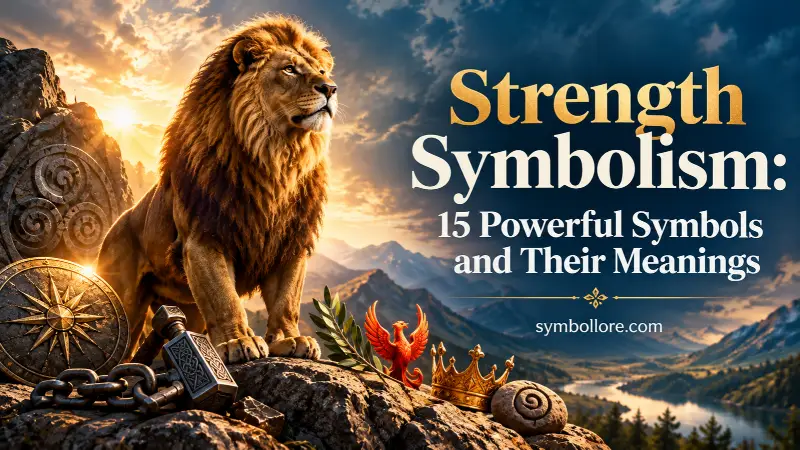
Strength is not always about physical power. Sometimes, it means facing fear, surviving hardship, or finding the courage to begin again. Throughout history, people have used animals, trees, mythical figures, and everyday objects to express these qualities.
Strength symbolism helps turn an invisible human quality into something people can recognize and remember. A lion may represent courage, while an oak tree suggests lasting endurance. A lotus flower can express resilience through difficult conditions.
But which symbols carry the deepest meaning, and what makes them different? This guide explores 15 powerful symbols of strength, their cultural backgrounds, and their meanings in modern life.
Quick Answer: What Does Strength Symbolize?
Strength symbolism represents courage, physical power, emotional resilience, endurance, protection, and the ability to overcome adversity. Common symbols include the lion for bravery, the oak tree for endurance, the phoenix for renewal, and the lotus for resilience. Their meanings depend on cultural traditions and personal interpretations. No single symbol represents every form of strength.
Key Takeaways
- Different kinds of strength: Physical power, emotional resilience, and spiritual endurance are not the same qualities.
- Nature-based symbols: Oaks, mountains, and flowers often express stability, persistence, or renewal.
- Cultural traditions: Some strength symbols have documented meanings rooted in specific societies and artistic traditions.
- Personal significance: Tattoos, jewelry, and artwork may represent individual experiences of courage or recovery.
- Historical accuracy: Not every symbol described online as ancient has a verified ancient meaning.
What Is Strength Symbolism?
Strength symbolism is the use of images, animals, plants, objects, or patterns to represent power and the ability to face challenges.
The meaning can be physical, emotional, mental, or spiritual.
A roaring lion may represent visible power. A tree surviving decades of storms may suggest endurance. Meanwhile, a repaired ceramic bowl can express recovery after damage.
These symbols appear in mythology, religious art, cultural traditions, heraldry, literature, and modern design.
They help communicate complex ideas without lengthy explanations.
However, their meaning is not always universal. A symbol associated with courage in one tradition may represent authority, protection, or something entirely different in another.
Meaning and Importance of Strength Symbolism
Strength symbols matter because people understand courage and resilience in different ways.
A person recovering from a difficult experience may connect with a phoenix. Someone who values patience and stability may prefer an oak tree.
In cultural traditions, symbols can also communicate shared values.
They may appear on clothing, shields, monuments, religious objects, and ceremonial items.
For example, the Akan Adinkra symbol called Dwennimmen combines strength with humility. This reminds viewers that true strength does not always involve dominance.
The deeper meaning depends on the story behind the symbol.
Some represent the power to fight. Others express the wisdom to remain calm, endure hardship, or begin again.
15 Powerful Symbols of Strength and Their Meanings
Meanings are explained in their cultural or artistic context. Modern associations are identified where appropriate.
1. Lion — Courage and Leadership
The lion is among the most recognizable symbols of strength.
Its powerful body, commanding appearance, and reputation as a predator have made it an important figure in art and mythology.
Lions appear in European heraldry, ancient Mediterranean imagery, and religious traditions.
In coats of arms, they often communicate courage, nobility, or authority.
The lion may also represent confidence and leadership.
Symbolic meaning: Physical strength, bravery, power, and authority.
A lion is especially meaningful for someone who associates strength with facing challenges directly.
2. Oak Tree — Endurance and Stability
The oak tree represents strength through its size, long life, and sturdy wood.
Its roots support a broad trunk and spreading branches.
Oaks have carried symbolic importance in several European traditions, including ancient Greek and Roman cultures.
Their association with endurance also appears in military and civic imagery.
Unlike the lion, which suggests immediate power, the oak represents strength developed over time.
Symbolic meaning: Stability, patience, endurance, and lasting resilience.
The oak is a fitting symbol for someone who values steady growth and perseverance.
3. Bear — Protective Strength
Bears are powerful animals capable of defending themselves and their young.
Because of these qualities, they can represent physical strength, independence, and protection.
Bear imagery has appeared in many cultural traditions, although its exact meaning varies.
In modern symbolism, a bear protecting its cubs may represent parental courage.
A solitary bear can also suggest self-reliance.
Symbolic meaning: Power, protection, independence, and determination.
However, it is inaccurate to assign one universal spiritual meaning to bears across all Indigenous or other cultural traditions.
4. Phoenix — Renewal After Hardship
The phoenix is a legendary bird associated with death and renewed life.
Accounts of the bird developed through ancient Mediterranean traditions and later literature.
In popular versions, it rises again from fire or ashes.
This story makes the phoenix a powerful modern symbol of resilience.
It represents the ability to rebuild after loss, failure, or major change.
Symbolic meaning: Renewal, transformation, hope, and overcoming adversity.
A phoenix tattoo or drawing may express an important personal turning point.
5. Lotus Flower — Resilience and Spiritual Growth
The lotus grows in muddy water while producing beautiful flowers above the surface.
Its natural appearance has inspired religious and cultural meanings across Asia.
In Buddhist and Hindu traditions, lotus imagery can represent purity, spiritual development, or enlightenment, depending on the context.
Modern readers also associate the plant with resilience.
Its growth through muddy water creates a meaningful image of rising above difficult circumstances.
Symbolic meaning: Spiritual strength, renewal, purity, and perseverance.
The lotus is especially meaningful when strength involves personal or spiritual growth.
6. Mountain — Stability and Perseverance
Mountains suggest strength through their enormous size and lasting presence.
They withstand changing weather and dominate the surrounding landscape.
In modern symbolism, a mountain can represent a difficult goal or challenge.
Reaching its summit may suggest achievement through persistence.
A mountain can also represent stability and the ability to remain grounded during uncertainty.
Symbolic meaning: Endurance, determination, stability, and overcoming obstacles.
These meanings are often metaphorical rather than tied to one specific ancient tradition.
7. Bull — Physical Power and Determination
Bulls are known for their muscular bodies and forceful behavior.
They have appeared in ancient Mediterranean and Near Eastern art, ritual, and mythology.
Their meanings vary by society.
In many modern interpretations, the bull represents force, confidence, and determination.
It may also suggest stubbornness when strength becomes inflexibility.
Symbolic meaning: Physical power, energy, determination, and confidence.
The bull works well as a symbol of strength that is active and forceful.
8. Eagle — Courage and Authority
Eagles are powerful birds of prey with strong wings and sharp vision.
They appear in the emblems of nations, military organizations, and historic ruling powers.
In the United States, the bald eagle is the national emblem.
Its symbolic associations include strength, independence, and freedom.
In personal artwork, an eagle may suggest confidence or the ability to rise above challenges.
Symbolic meaning: Authority, courage, freedom, and determination.
The eagle differs from the lion because it often emphasizes vision and independence rather than physical dominance alone.
9. Anchor — Stability During Hardship
An anchor holds a vessel in place and helps prevent unwanted movement.
This practical function makes it a natural symbol of stability.
In Christian symbolism, the anchor has also represented hope.
Modern designs may connect an anchor with emotional strength or remaining grounded during difficult times.
Unlike aggressive symbols, the anchor suggests quiet endurance.
Symbolic meaning: Stability, hope, commitment, and emotional steadiness.
It can express the strength to remain secure when circumstances change.
10. Hercules — Extraordinary Strength
Hercules, known as Heracles in Greek mythology, is famous for his immense physical power.
His legendary labors required him to confront dangerous creatures and complete difficult tasks.
One famous story involves the Nemean lion.
Hercules defeated the creature and later wore its skin.
Artists have used his figure to represent strength, courage, and heroic achievement.
Symbolic meaning: Extraordinary power, heroic effort, and determination.
However, Hercules is also a complex mythological figure. His stories include suffering, mistakes, and moral struggles.
11. Ram’s Horns — Strength With Humility
The Akan Adinkra symbol Dwennimmen represents a ram’s horns.
Its traditional meaning combines strength with humility.
The ram is powerful, but the symbol teaches that force should exist alongside modesty and restraint.
This interpretation appears in documented Ghanaian Adinkra traditions.
It offers a different view of strength from symbols focused on dominance.
Symbolic meaning: Humility, controlled power, wisdom, and balanced strength.
Dwennimmen is particularly meaningful because its interpretation has a clear cultural background.
12. Sword — Courage and Resolve
A sword can symbolize strength because of its historic role in combat.
In heraldry and art, it may represent military courage, authority, justice, or defense.
However, the meaning changes with context.
A sword held by a warrior differs from one appearing in a religious or judicial image.
In modern personal symbolism, a sword may suggest the courage to protect personal values.
Symbolic meaning: Courage, resolve, defense, and authority.
The sword can also represent violence, so its meaning should not automatically be described as positive.
13. Wolf — Endurance and Cooperation
Wolves are social animals known for cooperative hunting and strong pack relationships.
Their behavior inspires modern interpretations of teamwork and survival.
In personal symbolism, a wolf may represent loyalty, independence, or persistence.
However, historic wolf meanings vary widely.
Some traditions portray wolves as dangerous. Others emphasize protection or important mythological roles.
Symbolic meaning: Endurance, cooperation, instinct, and loyalty.
A wolf is often chosen to express strength through relationships rather than individual power alone.
14. Bamboo — Flexibility and Resilience
Bamboo is known for its rapid growth and flexible stems.
Certain bamboo species can bend under pressure without breaking.
In East Asian art and literature, bamboo often carries associations with integrity, upright character, and perseverance.
These qualities make it a meaningful example of strength through adaptability.
Rather than resisting every force, bamboo responds to changing conditions.
Symbolic meaning: Flexibility, resilience, integrity, and steady growth.
It suggests that adapting to circumstances can be a form of strength.
15. Kintsugi — Strength Through Recovery
Kintsugi is a Japanese technique for repairing broken ceramics.
Traditional methods use lacquer and may highlight the repaired areas with powdered gold or other metals.
The repairs remain visible rather than being completely hidden.
Today, people often interpret kintsugi as a metaphor for healing and resilience.
Its message is not that damage is desirable. Instead, repair can become part of an object’s continuing story.
Symbolic meaning: Recovery, acceptance, renewal, and resilience.
Kintsugi is a repair tradition rather than an ancient emblem created solely to symbolize emotional strength.
Types of Strength Symbolism
Different symbols communicate different kinds of strength.
| Type of Strength | Core Meaning | Relevant Symbols |
|---|---|---|
| Physical strength | Power and force | Lion, bull, Hercules |
| Emotional strength | Stability through difficult feelings | Anchor, oak |
| Mental strength | Determination and perseverance | Mountain, bamboo |
| Spiritual strength | Growth and inner development | Lotus |
| Protective strength | Defending others or personal values | Bear, sword |
| Resilience | Recovery after hardship | Phoenix, kintsugi |
| Strength with humility | Power balanced with restraint | Dwennimmen |
Physical Strength vs. Inner Strength
Physical strength involves the ability to exert force.
Inner strength involves responding to challenges with determination, patience, or emotional steadiness.
A lion may communicate physical power immediately.
An anchor or bamboo plant can suggest a quieter form of strength.
Neither meaning is more important in every situation.
Strength vs. Courage vs. Resilience
These terms overlap, but they describe different qualities.
Strength is the ability or capacity to face demands. Courage involves acting despite fear. Resilience refers to adapting or recovering after difficulty.
A sword may represent courage. An oak tree may emphasize enduring strength. A phoenix commonly expresses recovery and renewal.
Understanding these differences helps people choose more meaningful symbols.
Examples of Strength Symbolism in Everyday Life
Strength symbols appear in artwork, tattoos, clothing, literature, and personal keepsakes.
Example 1: An Oak Tree Tattoo
Imagine someone choosing an oak tree tattoo after years of overcoming personal challenges.
The roots might represent a strong foundation.
The branches could symbolize continued growth.
This is a personal interpretation supported by the oak’s traditional association with endurance.
Example 2: A Phoenix in a Novel
A writer describes a phoenix appearing after the main character rebuilds their life.
The bird symbolizes renewal following a painful experience.
The meaning comes from the phoenix’s legendary connection with rebirth.
Example 3: A Ram’s Horns Design
A designer uses the Akan Dwennimmen symbol to communicate strength balanced with humility.
The symbol has an established cultural meaning.
An accurate explanation should identify its Ghanaian origins rather than treating it as a generic decorative shape.
Example 4: An Anchor Necklace
Someone wears an anchor necklace as a reminder to stay grounded during uncertainty.
The anchor represents stability and hope.
Here, its practical function supports the personal interpretation.
How to Choose a Meaningful Symbol of Strength
Choosing a strength symbol becomes easier when you identify the quality you want to express.
First, consider whether you value courage, endurance, recovery, protection, or spiritual growth.
Next, explore the traditional meanings of symbols connected to that quality.
A lion may suit someone who values bravery. Bamboo may better represent adaptability.
Then, examine the symbol’s cultural background.
If a design comes from a specific tradition, learn what it means to the people who created and used it.
Finally, consider its personal relevance.
A symbol may carry historical meaning while also reminding you of a particular experience.
The strongest choice is one that connects the documented symbolism with your intended message.
Strength Symbolism in Tattoos, Art, and Jewelry
Strength symbols remain popular in personal design because they communicate meaning through recognizable images.
Tattoos often feature lions, phoenixes, mountains, lotus flowers, or oak trees.
Jewelry may use anchors, trees, or meaningful geometric motifs.
Artists sometimes combine several symbols into one design.
For example, a mountain beneath a rising sun could suggest perseverance followed by hope.
These combinations create personal meanings. They should not automatically be presented as traditional symbols with ancient origins.
When using cultural designs, accuracy and respectful context matter.
Common Misconceptions About Strength Symbols
Every Strength Symbol Means the Same Thing
A lion, an oak, and a phoenix can all represent strength.
However, they emphasize different qualities.
The lion suggests power, the oak represents endurance, and the phoenix expresses renewal.
Ignoring these differences makes interpretations less useful.
All Popular Symbols Have Ancient Origins
Some modern designs are incorrectly described as ancient symbols.
For example, the familiar eight-armed Helm of Awe design belongs to later Icelandic magical traditions. It should not automatically be presented as a verified Viking Age emblem.
Historical evidence matters when explaining a symbol’s origin.
Strength Always Means Aggression
Strength can involve force, but it can also involve patience, humility, and self-control.
The Akan Dwennimmen symbol provides a clear example of strength balanced with humility.
An anchor or bamboo plant may also express steadiness rather than aggression.
A Symbol Guarantees Protection or Success
A tattoo, necklace, or decorative symbol can remind someone of important values.
However, there is no reliable basis for claiming that wearing a particular image guarantees protection, courage, or success.
Symbolic meaning should not be confused with proven supernatural power.
Important Historical and Cultural Insights
Symbols of Strength Are Not Universal
The same animal or object can have different meanings across societies.
For example, wolves may represent danger in one story and cooperation in another.
The meaning depends on the artistic, religious, and historical setting.
Some Symbols Combine Opposing Qualities
Dwennimmen combines humility and strength.
Bamboo can suggest both flexibility and firmness.
These examples show that strength does not always mean remaining rigid or overpowering others.
Modern Interpretations Can Differ From Traditional Meanings
Kintsugi is a Japanese craft tradition, not originally a motivational symbol.
Its modern association with emotional recovery draws on the appearance of repaired ceramics.
Likewise, a mountain tattoo may represent overcoming hardship without belonging to a particular ancient symbolic system.
Understanding this distinction makes symbolism more accurate and meaningful.
People Also Ask About Strength Symbolism
What Is the Most Recognizable Symbol of Strength?
The lion is among the most recognizable symbols of strength, especially in Western heraldry and popular art. It commonly represents courage, leadership, and physical power. However, no single image serves as the universal symbol of strength across every culture.
Which Animal Symbolizes Inner Strength?
A bear, wolf, or lion may symbolize inner strength, depending on the intended meaning. Bears can suggest protection, wolves may represent persistence and cooperation, and lions often communicate courage. Their meanings vary across traditions and personal interpretations.
What Is a Symbol of Strength and Resilience?
The phoenix is a widely used modern symbol of strength and resilience. Its legendary rebirth makes it an image of recovery after hardship. The lotus and oak tree also suggest different forms of resilience through growth or endurance.
What Is an African Symbol of Strength?
Dwennimmen is an Akan Adinkra symbol from Ghana that combines strength with humility. Its design represents ram’s horns. Rather than presenting force alone, it emphasizes the importance of balancing power with modesty.
Frequently Asked Questions
1. What Flower Symbolizes Strength?
The lotus is a meaningful flower associated with resilience and spiritual growth. It rises through muddy water and blooms above the surface, inspiring interpretations of perseverance. In Buddhist and Hindu traditions, it also carries important religious meanings. Other flowers may represent strength in modern personal symbolism, but those associations depend on the cultural or artistic context.
2. What Tree Symbolizes Strength and Endurance?
The oak tree is a well-established symbol of strength and endurance. Its long life, sturdy wood, and historical role in European cultures contribute to this association. Oak leaves also appear in military and civic designs. A personal oak tree symbol may emphasize patience, stability, family roots, or the ability to withstand challenging circumstances.
3. What Symbol Represents Female Strength?
There is no single universal symbol of female strength. A lioness may suggest protective courage, while a lotus can express spiritual growth. Some people choose a phoenix to represent recovery or transformation. The most appropriate symbol depends on the quality being celebrated and its cultural context. Personal meaning is often more useful than assigning gender to a symbol without historical evidence.
4. What Symbol Represents Mental Strength?
Mountains, bamboo, and oak trees can represent mental strength in modern symbolism. A mountain may suggest determination, while bamboo emphasizes flexibility during pressure. An oak can express steadiness and patience. These symbols work as metaphors rather than scientific descriptions of mental health. Their significance depends on the message a person wants to communicate.
5. What Is a Symbol of Strength in Christianity?
In Christianity, the cross can represent faith, sacrifice, and the belief in Christ’s victory over death. The lion may also symbolize courage or royal authority, depending on the biblical context. However, Christian symbols have broader theological meanings than personal strength alone. Their interpretation should consider Scripture and the religious tradition in which they appear.
6. What Is the Best Strength Symbol for a Tattoo?
The best strength tattoo depends on what the wearer wants to express. A lion can suggest courage, an oak tree endurance, and a phoenix renewal after hardship. A lotus may represent spiritual growth, while an anchor communicates stability. Before choosing a culturally specific design, it is useful to understand its background and traditional meaning.
7. Which Symbol Represents Strength Without Violence?
The oak tree, bamboo, anchor, and lotus can all express strength without emphasizing violence. Oaks represent lasting endurance, while bamboo suggests flexibility. Anchors communicate stability, and lotus flowers can symbolize growth through difficult conditions. These designs are especially meaningful for people who view strength as patience, self-control, adaptability, or quiet perseverance.
Conclusion: What Does Strength Ultimately Symbolize?
Strength symbolism represents much more than physical power. It can express courage, endurance, humility, protection, hope, and the ability to recover from hardship.
The lion symbolizes bravery, the oak represents lasting strength, and the phoenix suggests renewal. Meanwhile, Dwennimmen reminds us that power can exist alongside humility.
The most meaningful symbol is one whose history, cultural context, and personal significance reflect the kind of strength you value.