
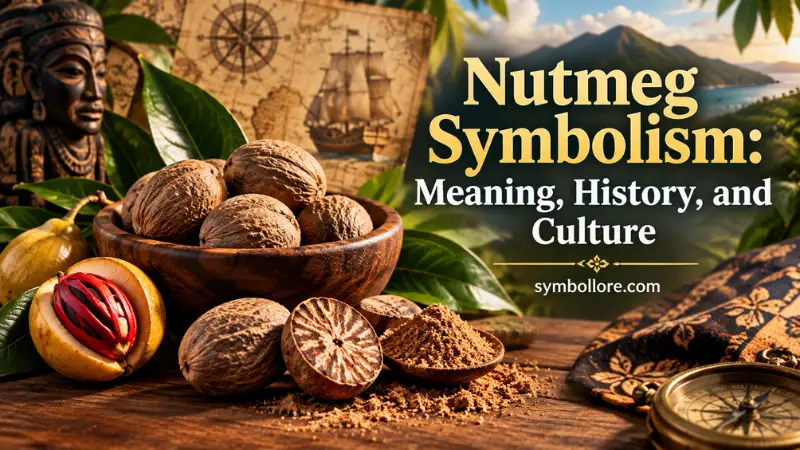
Nutmeg symbolism often centers on wealth, status, prosperity, luck, warmth, and valued abundance. These meanings did not come from one ancient symbolic system. They developed through nutmeg’s rarity, high trade value, medicinal reputation, rich fragrance, and long history in food and ritual.
Nutmeg comes from the seed of Myristica fragrans, a tree native to the Banda Islands of present-day Indonesia. For centuries, the spice traveled across Asian and Middle Eastern trade networks before becoming a prized European commodity. Its history also includes colonial violence and the struggle to control the Spice Islands.
Because of this complicated history, nutmeg can symbolize both luxury and the human cost of luxury. Modern interpretations may also connect it with comfort, good fortune, romance, protection, or personal ritual. However, those meanings should be tied to their specific traditions rather than treated as universal facts.
Quick Answer
Nutmeg symbolism most strongly suggests wealth, status, prosperity, luck, warmth, and valued abundance. Its expensive history made it a visible sign of social privilege, while folk traditions later connected whole nutmegs with luck and prosperity. The meaning changes by culture and setting, so modern magical or spiritual interpretations should not be presented as universal historical beliefs.
TL;DR
- Nutmeg became associated with wealth because it was once rare, costly, and difficult to obtain.
- Its warm fragrance and culinary use support modern meanings of comfort, hospitality, and abundance.
- Indonesian history gives nutmeg an important connection with trade, cultural heritage, status, and colonial power.
- European luxury culture turned nutmeg into a visible marker of refinement and social position.
- Folk-magic traditions associate whole nutmeg with luck, money, and fidelity, but these are specific folkloric practices.
- Modern Americans usually encounter nutmeg through food, holidays, fragrance, and culinary tradition rather than formal symbolism.
Nutmeg Meanings at a Glance
| Context or Feature | Possible Meaning | Why the Association Exists | Important Limit |
|---|---|---|---|
| Rare historical spice | Wealth and status | Nutmeg was costly and difficult to obtain | Strongest in historical European contexts |
| Spice trade | Power and prosperity | Control of nutmeg created enormous commercial value | Its history also includes colonial violence |
| Whole nutmeg | Luck and fortune | Folk traditions used it as a carried charm | This is folklore, not a universal belief |
| Warm fragrance | Comfort and hospitality | Nutmeg flavors foods and perfumes them | Mostly a sensory or modern association |
| Culinary use | Abundance and celebration | Spices enriched meals and festive dishes | Meaning depends on the meal and culture |
| Indonesian heritage | Cultural and economic importance | Nutmeg originated in Maluku and shaped regional history | Indonesian communities are diverse |
| Nutmeg in art or objects | Luxury and refinement | Decorative graters and containers displayed access to costly spices | Context determines the intended message |
What Does Nutmeg Symbolism Mean?
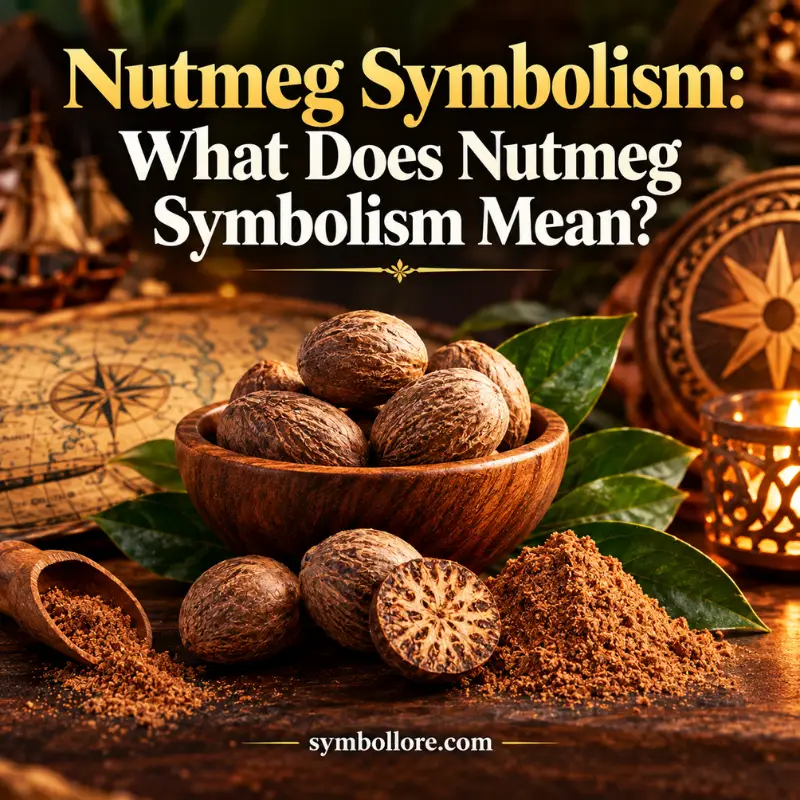
Nutmeg symbolism is best understood through the spice’s material history rather than through a single ancient definition.
The clearest association is wealth. Nutmeg grew naturally in a very limited region, especially the Banda Islands, and European demand eventually made the spice extraordinarily valuable. Its rarity meant that possessing or serving it could signal access to distant trade networks and expensive goods. A 2024 study of nutmeg’s history in Indonesia likewise describes it as a symbol of status and wealth alongside its culinary and medicinal roles.
A second meaning is prosperity. Nutmeg was not valuable because people simply decided it was symbolic. It was valuable because a small, aromatic seed could command a high price in long-distance trade.
A third association comes from folklore. In some European and American folk-magic traditions, whole nutmegs became luck charms and were connected with money, fidelity, or good fortune. These traditions are real examples of folk practice, but they should remain separate from documented economic history.
This distinction makes nutmeg especially interesting. Its symbolism developed from several overlapping experiences: scarcity, fragrance, food, medicine, trade, luxury, and folklore.
Why Does Nutmeg Symbolize Wealth and Status?
Nutmeg became associated with wealth because it was once an expensive imported commodity.
Before modern global agriculture made spices widely available, Europeans could not simply buy a jar of nutmeg at an ordinary grocery store. The spice came from distant islands, crossed complex trade routes, and could command high prices.
Historical evidence shows how strongly nutmeg entered elite European culture. In the eighteenth century, specialized nutmeg graters and ornate spice boxes were objects associated with refined dining. The Metropolitan Museum of Art notes that objects made for consuming imported commodities such as nutmeg could function as symbols of British prosperity.
the Metropolitan Museum of Art’s discussion of nutmeg and luxury
That makes “wealth” more than a modern guess. The object, its container, and the ritual of using it could all display purchasing power.
Nutmeg therefore represents a particular kind of wealth: access to rare goods.
The symbolism differs from that of gold or diamonds. Gold is valuable as a material. Nutmeg became valuable because geography, trade, demand, and political control made the spice scarce.
Nutmeg, the Banda Islands, and the Meaning of Rarity
Nutmeg’s story begins in the Banda Islands of the Maluku region of Indonesia.
The seeds of Myristica fragrans grow inside the fruit of the nutmeg tree. The red, lacy covering around the seed is called mace. Both products became important trade goods. Historical sources identify the Banda Islands as the original home of nutmeg and mace.
That geographic limitation helped create the spice’s symbolic power.
When a useful commodity grows naturally in only a small region, control over that region can become economically important. Nutmeg demonstrates this clearly. Traders and colonial powers competed for access to the islands because the spice could produce substantial profits.
A 2024 academic article on Indonesian nutmeg history describes the spice as culturally and economically significant in Maluku and notes its role in traditional practices as well as its status symbolism.
the academic study of nutmeg’s Indonesian history
So, rarity became linked with prestige. The symbolism can be summarized as:
limited supply → high value → restricted access → status
That pattern helps explain why nutmeg came to represent luxury in some historical settings.
Nutmeg and the History of the Spice Trade
Nutmeg symbolism cannot be separated from the history of global trade.
Arab merchants helped move nutmeg westward, and the spice eventually reached European markets. By the medieval and early modern periods, European consumers prized nutmeg for food, medicine, and fragrance. Competition for control became especially intense once European maritime powers entered the trade.
The Dutch East India Company eventually sought a monopoly over nutmeg production in the Banda Islands. This pursuit had devastating consequences for the Bandanese population.
That history changes the meaning of “luxury.” A decorative silver grater or an expensive spice could represent refinement to an eighteenth-century European consumer. Yet the same commodity can also represent colonial exploitation when viewed through the history of the people whose homeland produced it.
This is one reason responsible symbolism writing should avoid romantic phrases such as “nutmeg represents exotic adventure” without context. The spice did travel across continents, but that movement involved unequal power, violence, forced control, and economic exploitation.
The symbolism of nutmeg therefore includes an uncomfortable duality:
- luxury for consumers
- economic power for traders
- colonial ambition for empires
- cultural heritage for its place of origin
Nutmeg Symbolism in Indonesian Contexts
Indonesia requires special attention because nutmeg is not simply an imported symbol there. It is part of the plant’s geographic and cultural history.
Nutmeg originated in Maluku, and local communities used it for food, medicine, trade, and other cultural purposes. The historical record also connects nutmeg with traditional ceremonies and rituals in Indonesia.
In this setting, nutmeg can be understood through heritage, livelihood, value, and regional identity.
However, it would be inaccurate to claim that every Indonesian community assigns the same symbolic meaning to nutmeg. Indonesia contains many cultures and local traditions. A statement about Maluku should not automatically become a statement about the entire country.
The history of nutmeg also demonstrates why “wealth” can mean different things.
For European merchants, nutmeg represented commercial profit. For communities in its homeland, it was also a cultivated resource tied to local knowledge, food, medicine, and economic life.
The same plant can therefore carry different meanings depending on who is looking at it.
Why Nutmeg Became a European Symbol of Luxury
In medieval and early modern Europe, spices often carried social meaning because they were expensive imports.
Nutmeg was used in food and drink, and wealthy households could display specialized objects for preparing it. Ornate nutmeg graters are especially revealing because they turned an ordinary culinary action into a visible social ritual.
The Metropolitan Museum holds eighteenth-century spice boxes that included central graters for freshly grinding nutmeg at the table. Such objects show that nutmeg was not merely hidden in a kitchen cupboard. It could become part of an elegant dining environment.
an eighteenth-century nutmeg spice box at The Met
This supports the association between nutmeg and refinement.
The symbolism developed through use:
rare spice → expensive ingredient → elite dining → decorative objects → visible status
By contrast, modern Americans usually experience nutmeg as an inexpensive pantry spice. The price has changed dramatically, so the old status symbolism has weakened.
The historical association remains useful, however, when nutmeg appears in period art, literature, decorative arts, or historical fiction.
Nutmeg, Warmth, Comfort, and Hospitality
Nutmeg can also symbolize warmth and comfort, although these meanings are more sensory than formally historical.
Its aroma is strong, sweet, woody, and warm. In modern American culture, people often encounter nutmeg in pies, custards, baked goods, eggnog, spice blends, and other foods associated with colder months.
That creates a powerful connection with home and seasonal comfort.
This association is different from the historical symbolism of wealth. A holiday pie does not necessarily represent luxury. Instead, the spice may evoke family traditions, cooking, hospitality, childhood memories, or seasonal celebration.
Food symbolism often develops through repetition. An ingredient used year after year in a familiar family dish can become emotionally meaningful even without a formal cultural symbol system.
Therefore, a bowl of nutmeg beside cinnamon and cloves in a modern American kitchen may communicate warmth and seasonal abundance more strongly than social status.
Nutmeg and Luck in Folk Traditions
Luck is one of the best-known folkloric associations attached to whole nutmeg.
Some European and American folk-magic traditions describe carrying a whole nutmeg as a charm for good fortune, money, health, or protection. Later occult traditions expanded these associations to include prosperity and fidelity.
A modern magical reference, for example, lists money, luck, and fidelity among nutmeg’s traditional correspondences. These claims belong to folk-magic systems rather than scientific evidence.
That distinction matters.
Saying “some folk traditions use nutmeg as a luck charm” is historically responsible. Saying “nutmeg brings luck” turns a cultural belief into a factual claim.
The whole form also matters. A complete nutmeg is easy to carry in a pocket or pouch. Its small size and durability made it practical as a charm.
This may help explain why whole nutmeg became more strongly associated with portable luck than ground nutmeg.
Nutmeg and Love, Fidelity, and Attraction
Nutmeg is also associated with romantic themes in some folk-magic traditions.
Folk practices have connected the spice with fidelity, attraction, and relationship luck. These associations appear in later magical literature and should be treated as examples of esoteric or folkloric symbolism, not as universal historical meanings.
The association with fidelity is especially interesting because a whole nutmeg could be carried as a personal charm. The spice therefore became part of a symbolic system in which a small, portable object represented a desired relationship outcome.
There is no reliable basis for saying that all historical cultures considered nutmeg a love symbol.
A nutmeg appearing in a modern romantic design may suggest warmth, sensuality, or domestic intimacy because of its scent and culinary associations. That is a contextual interpretation rather than proof of an ancient universal meaning.
Nutmeg, Medicine, and the Meaning of Healing
Nutmeg also has a long history of medicinal use.
Historical sources describe nutmeg in Indian, Chinese, Arabic, and European medical traditions. Medieval and early modern writers attributed various medicinal properties to the spice, while traditional systems incorporated it into different preparations.
This history can support a symbolic association with healing, care, and well-being.
However, medicinal use should not automatically be treated as symbolic use.
A plant can be used as medicine without becoming a formal emblem of healing. Therefore, “nutmeg has a history of medicinal use” is a historical statement, while “nutmeg symbolizes healing” is an interpretation built from that history.
That distinction is especially important today because traditional remedies should not be presented as proven medical treatments.
Nutmeg also has safety concerns at high doses, so folklore about its effects should never be used as encouragement to consume large amounts.
Nutmeg in Art and Material Culture
Nutmeg becomes especially meaningful when it appears in historical objects.
A nutmeg grater may symbolize wealth even when the spice itself is absent. The object communicates that its owner could afford specialized equipment for an expensive imported ingredient.
The Met’s collection contains several eighteenth-century French spice boxes designed to hold ingredients such as pepper, cloves, salt, and nutmeg. Their elaborate construction shows how dining tools could become part of decorative social culture.
The Met’s French spice box with a nutmeg grater
Nutmeg also appears in modern American art in more personal and culturally specific ways. Artist Renée Stout discussed the symbolic significance of nutmeg oil among the materials used in her work, demonstrating that the spice can take on meaning within an individual artistic language.
the Smithsonian’s archival interview with Renée Stout
This is an important lesson about symbolism.
An artist’s use of nutmeg does not prove that nutmeg has one universal artistic meaning. Instead, it shows how a creator can give a familiar material a specific role within a larger symbolic system.
Nutmeg and Modern American Culture
Modern American nutmeg symbolism is usually less formal than its historical European symbolism.
Most Americans encounter nutmeg as a cooking ingredient. It appears in holiday foods, baked goods, creamy dishes, spice blends, and seasonal drinks. Because of that, it can suggest:
- warmth
- home
- family traditions
- celebration
- hospitality
- nostalgia
- seasonal abundance
The spice also has an interesting place in American history because colonial cooking adopted many European spice traditions.
Today, however, nutmeg is no longer an obvious marker of elite status. Supermarkets have made it easy for ordinary households to buy ground nutmeg at a low cost.
That change illustrates how symbolism can weaken when the social conditions behind it disappear.
Nutmeg once communicated “I can afford this rare imported spice.” Today it may communicate “This is a familiar holiday flavor.”
Both readings can be correct, but they belong to different historical settings.
Nutmeg and the American “Nutmeg State”
Nutmeg also has a distinctive connection with American language and regional identity.
Connecticut is famously nicknamed the Nutmeg State. The nickname became associated with an old story that Connecticut merchants were said to sell wooden nutmegs or that buyers could be deceived by imitation spices.
The story itself is generally treated as folklore rather than reliable evidence that Connecticut merchants actually manufactured wooden nutmegs on a large scale. The phrase nevertheless became part of American cultural history.
This gives nutmeg another symbolic layer: cleverness, Yankee identity, commerce, and reputation.
The expression “wooden nutmeg” later became associated with something false or fraudulent. That meaning is quite different from prosperity or luck.
It also shows how a symbol can move from material culture into language. Once an object becomes part of a memorable story, people may continue using its name even after the original economic context has faded.
What Nutmeg Symbolism Does Not Prove
Nutmeg symbolism should not be used to make supernatural claims.
There is no scientific evidence that carrying nutmeg guarantees money, attracts a particular person, predicts future events, or protects someone from harm.
Likewise, not every historical use of nutmeg was symbolic. People used the spice because it tasted good, smelled pleasant, served practical purposes, or had value as a commodity.
Modern spiritual websites sometimes present long lists of meanings such as psychic power, manifestation, protection, love, luck, and abundance. These can be meaningful within particular modern spiritual practices. They should not be confused with universally documented ancient traditions.
The strongest historical evidence instead supports a more grounded picture: nutmeg was rare, valuable, fragrant, medicinally important in several traditions, culturally significant in its homeland, and deeply involved in global trade.
Those facts provide a much stronger foundation for understanding its symbolism.
How Form and Setting Change Nutmeg’s Meaning
The form of nutmeg can change its symbolic message.
A whole nutmeg can suggest rarity, luck, or a tangible charm because whole spices were historically portable and visually distinctive.
Ground nutmeg feels more domestic. In a kitchen or recipe, it is more likely to represent warmth, food, hospitality, or seasonal memory.
Nutmeg with an ornate grater can suggest wealth and refined dining because the object points to historical luxury.
Nutmeg with other spices may represent abundance, culinary richness, trade, or cultural exchange.
Nutmeg in a magical setting may represent prosperity, luck, fidelity, or protection if the tradition explicitly assigns those meanings.
Nutmeg in historical art should be interpreted according to the artwork’s date, culture, neighboring objects, and intended audience.
This contextual approach is more reliable than memorizing one list of meanings.
How to Interpret Nutmeg Symbolism Responsibly
Start with the historical or visual context.
If nutmeg appears in an eighteenth-century European still life, consider luxury, imported goods, social status, and global trade. If it appears in an Indonesian cultural context, investigate Maluku’s own history rather than imposing European interpretations.
If it appears in a modern American kitchen, warmth and family memory may be more useful. If it appears in a folk-magic practice, identify that tradition and label the interpretation as folklore or spiritual belief.
A simple six-question method helps:
- Where does the nutmeg appear?
- Which culture or community is involved?
- What period does the image or practice belong to?
- Is the nutmeg whole, ground, decorative, or mixed with other ingredients?
- What other objects appear beside it?
- Does the creator or tradition explain its intended meaning?
This method prevents the most common symbolism mistake: taking a meaning from one context and presenting it as universal.
For example, the historical status symbolism of nutmeg does not automatically apply to every modern kitchen. Likewise, a modern prosperity charm does not prove that ancient Indonesians universally treated nutmeg as a money symbol.
Nutmeg Symbolism Compared With Other Plant and Food Symbols
Nutmeg belongs to a wider world of food and plant symbolism.
Food symbolism often grows from practical experience. Ingredients can represent nourishment, hospitality, prosperity, identity, or memory because people repeatedly use them in meaningful social settings.
SymbolLore’s guide to food symbolism
Plant symbols can work in a similar way. A seed may suggest potential because it visibly contains the possibility of future growth. Grain can represent abundance because successful harvests produce food and new seed.
SymbolLore’s guide to grain symbolism
Nutmeg is different because its symbolic history is unusually tied to global trade and rarity.
That makes it closer to a historical luxury symbol than to a simple nature metaphor.
Its strongest meanings come from a chain of human experiences:
place → rarity → trade → wealth → status → cultural memory
That chain explains more than a simple list of “nutmeg meanings.”
FAQs
Nutmeg most commonly symbolizes wealth, status, prosperity, luck, warmth, and abundance. Wealth and status have strong historical roots because nutmeg was once a rare and expensive imported spice. Luck and prosperity come more strongly from later folk-magic traditions.
Nutmeg became associated with wealth because it was difficult to obtain and highly valuable in historical trade. European elites used expensive spices and specialized serving objects to display refinement and purchasing power. The association weakened once modern trade made nutmeg inexpensive and widely available.
Nutmeg can symbolize good luck in some European and American folk-magic traditions. Whole nutmegs were sometimes carried as charms for fortune or prosperity. However, this is a folkloric belief, not evidence that nutmeg objectively creates luck.
Nutmeg can represent love, attraction, or fidelity in some folk-magic traditions. These meanings belong to particular magical systems rather than to a universal cultural tradition. In modern cooking, nutmeg may also suggest warmth and intimacy because it appears in comforting foods.
In modern spiritual and magical practices, nutmeg may represent prosperity, luck, protection, fidelity, or abundance. These are belief-based interpretations. They should be separated from the documented historical meanings created by trade, food, medicine, and social status.
Nutmeg is important because Myristica fragrans originated in the Maluku region, especially the Banda Islands. The spice supported local cultivation and trade while attracting international commercial and colonial competition. Its history is therefore connected with Indonesian heritage, economic value, and the difficult history of the global spice trade.
A whole nutmeg can suggest rarity, luck, value, or a portable charm because of its historical use as a complete spice. Ground nutmeg usually feels more domestic and culinary. The setting matters more than the physical form alone.
Conclusion
Nutmeg symbolism grew from real historical experiences rather than one universal symbolic code. Its rarity and high value made it a sign of wealth and status, while its fragrance and culinary use later supported associations with warmth, comfort, and abundance. Folk traditions added meanings connected with luck, prosperity, and fidelity.
The story is also more complicated than a simple list of positive meanings. Nutmeg connects Indonesian heritage with global commerce, colonial power, and the human cost of controlling valuable resources. Understanding those layers makes the symbol richer and more accurate. Today, nutmeg may represent luxury, luck, comfort, or seasonal memory, but its meaning always depends on culture, history, and context.
Five Related Articles from symbollore.com
- Licorice Symbolism: Meaning, History, and Cultural Roots — https://symbollore.com/licorice-symbolism/
- Food Symbolism: Meaning, History, and Cultural Uses — https://symbollore.com/food-symbolism-meaning/
- Grain Symbolism: Meaning, History, and Cultural Significance — https://symbollore.com/grain-symbolism/
- Maple Seed Symbolism: Meaning, Growth, and Change — https://symbollore.com/maple-seed-symbolism/
- Fertility Symbolism and Its Cultural Meanings — https://symbollore.com/fertility-symbolism/


