

Manticore symbolism centers on predatory power, concealed danger, uncontrolled appetite, and the fear of something that looks partly human but behaves without humanity. The legendary creature traditionally combines a human face, a lion’s body, sharp teeth, and a deadly tail.
Its meaning developed across several stages. A Persian-derived name entered Greek writing through stories about India. Roman authors repeated the description, while medieval European bestiaries turned the creature into a moral warning. Modern fantasy later added wings, magical powers, and more complex personalities. Therefore, the manticore does not carry one fixed meaning across every period or fictional setting.
Quick Answer
Manticore symbolism most often represents destructive appetite, deceptive appearances, predatory violence, and danger that cannot easily be escaped. Its human face contrasts with its animal body and deadly tail, making it a useful symbol of intelligence separated from mercy. However, medieval allegory, heraldry, modern fantasy, tattoos, and personal art may give it different meanings.
TL;DR
- The manticore traditionally combines a human face, lion’s body, and deadly tail.
- Its human appearance can symbolize deceptive or corrupted intelligence.
- Its appetite for human flesh supports meanings of greed and uncontrolled desire.
- Medieval bestiaries treated it as a dangerous creature with moral lessons.
- Wings belong mainly to later art and modern fantasy, not the earliest accounts.
- Today, the creature may represent fear, survival, aggression, or untamed power.
Manticore Meanings at a Glance
| Feature or context | Common symbolic meaning | Why the association developed | Important limit |
|---|---|---|---|
| Human face | Deception or corrupted reason | Human appearance hides a predatory nature | Early texts do not always give a formal moral lesson |
| Lion’s body | Strength, speed, and domination | Lions represented dangerous physical power | Lion imagery can also represent courage or royalty |
| Deadly tail | Hidden or far-reaching danger | The creature can attack from behind or at a distance | Tail designs vary by period |
| Three rows of teeth | Excessive appetite and destruction | The mouth appears built for relentless consumption | Medieval artists did not always show this feature |
| Red coloring | Blood, violence, and alarm | Early descriptions call the creature red or blood-colored | Some manuscripts use other colors |
| Medieval bestiary | Sin, cruelty, or threatening appetite | Bestiaries often turned animal lore into moral instruction | Not every manuscript gives the same allegory |
| Heraldic manticore | Fierce identity, intimidation, or authority | Noble badges used extraordinary beasts to project power | Heraldic forms differ from classical descriptions |
| Modern fantasy monster | Powerful enemy or untamed force | Games and novels emphasize combat and magical danger | Each fictional world creates its own rules |
What Does Manticore Symbolism Mean?
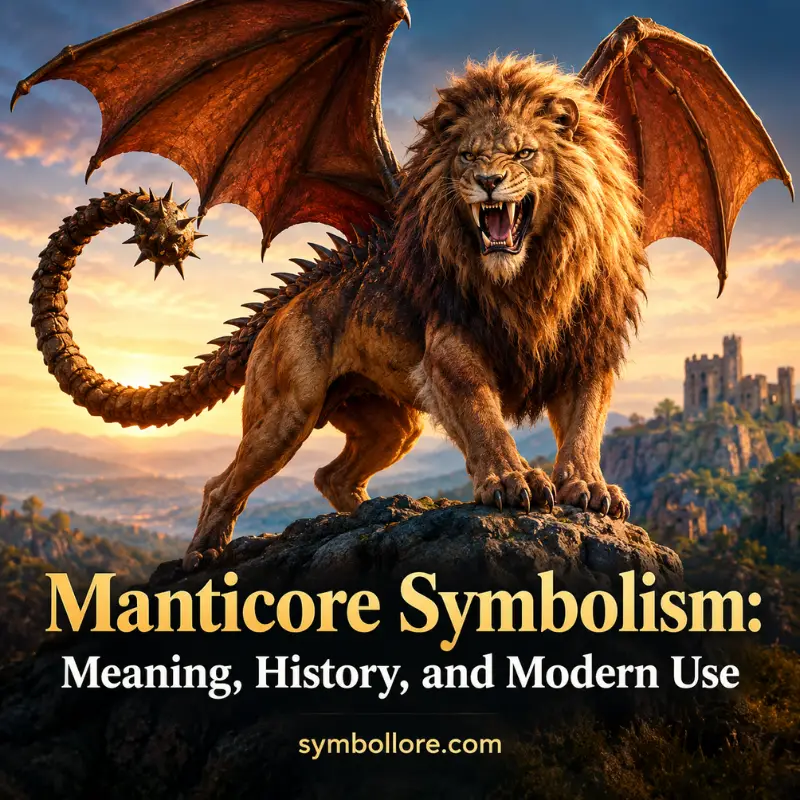
The manticore most strongly represents a predator whose danger comes from several directions at once. A lion-like body gives it speed and physical force. Its teeth express relentless consumption, while its tail adds poison or a ranged attack. Most importantly, its human face gives the monster an unsettling appearance of intelligence.
This combination can suggest power without conscience. The creature does not merely attack from instinct in the way a real animal might. Its partly human form encourages readers to imagine awareness, strategy, or intention behind its violence.
As a result, the manticore can symbolize:
- Intelligence used for cruel purposes
- Desire that consumes everything around it
- A threat hidden behind a familiar appearance
- Authority maintained through fear
- Violence that defeats ordinary defenses
- Human behavior stripped of empathy
- Anxiety about the strange or unknown
These meanings are interpretations built from the creature’s form and history. They are not a universal ancient code. Early authors often described the manticore as if it were an exotic animal rather than presenting it as a formal spiritual emblem.
Where Did the Manticore Come From?
The manticore reached European tradition through a mixture of Persian language, Greek storytelling, and reports about India. Its history should not be reduced to the simple claim that it was “a Persian god” or a universally recognized figure of Persian religion.
Ctesias of Cnidus, a Greek physician who served at the Persian court around the late fifth and early fourth centuries BCE, included the creature in his lost work Indica. Later authors preserved parts of his account. Ctesias placed the beast in India and claimed that one had reached the Persian king.
The name is usually connected with an Old Iranian or Persian expression meaning “man-eater.” Therefore, the word reflects Persian linguistic transmission even though the surviving literary tradition comes mainly through Greek and Roman writers.
This mixed origin matters. Greek audiences often imagined distant countries through stories that combined observation, rumor, wonder, and exaggeration. The manticore consequently became both a monster and an example of how ancient writers pictured lands beyond their direct experience.
The Manticore’s Body and What Each Part Suggests
The creature’s hybrid anatomy creates most of its symbolic power. Each part carries a recognizable function, but their combination produces something unnatural.
The human face
A human face promises reason, recognition, and possible communication. On a predator’s body, however, it becomes disturbing. The face may suggest that civilization, intelligence, or polite appearance cannot guarantee moral behavior.
In later interpretation, this feature supports themes of fraud and concealed cruelty. A person may look familiar or trustworthy while pursuing harmful aims. Still, early descriptions do not clearly say that the face always symbolized deception. That meaning grew more strongly through later art and allegory.
The lion’s body
The lion supplies physical dominance. Ancient and medieval audiences associated lions with courage, kingship, ferocity, and dangerous strength. The manticore turns those qualities toward hunting people.
Unlike the protective courage discussed in
the manticore’s leonine power does not preserve a family or community. It consumes. This contrast shows how action changes the meaning of a shared animal feature.
The teeth and mouth
Accounts commonly give the creature three rows of teeth fitted together like a comb. This exaggerated mouth makes consumption its defining purpose. Symbolically, it can represent greed, hunger, or desire that recognizes no natural limit.
The monster was also said to leave little or no trace of its victims. Therefore, its appetite implies erasure as well as death. It consumes the person and the evidence that the person existed.
The tail
Descriptions vary between a scorpion-like sting and a tail covered with deadly spines. Some accounts say the creature could launch the spines like arrows. Either version makes the tail a symbol of concealed or unexpected attack.
A lion attacks mainly with its jaws and claws. The added tail means that escaping the mouth may not provide safety. Thus, the manticore represents danger that defeats normal expectations.
The Manticore in Greek and Roman Accounts
The earliest accounts did not treat the manticore as pure fantasy in the modern sense. Ancient natural-history writing often placed real animals, misunderstood creatures, travelers’ reports, and marvelous beings within the same broad category.
Ctesias’s original Indica no longer survives as a complete work. However, later writers preserved its most famous details. Claudius Aelian, writing in the Roman imperial period, described the creature as a swift man-eater with a dangerous tail and trumpet-like voice.
His account of the beast attributed to Ctesias
also retains some skepticism about the reliability of the report.
Pliny the Elder included the mantichora in Natural History during the first century CE. His influential work helped move the story into later European natural history. Repetition gave the creature authority, even though nobody had produced verifiable physical evidence.
Some ancient readers doubted the tale. Pausanias suggested that a real tiger may have inspired an exaggerated report. That idea remains a historical attempt at explanation rather than a proven solution. The story could have developed from several sources, including unfamiliar wildlife, translation, rumor, and the appeal of marvels.
The manticore’s ancient meaning therefore includes fear of distant nature and incomplete knowledge. It shows how people fill gaps in geographic understanding with familiar parts arranged into unfamiliar forms.
Manticore Symbolism in Medieval Bestiaries
Medieval bestiaries combined animal descriptions with religious instruction, moral allegory, and imaginative illustration. They included real creatures beside legendary ones because symbolic usefulness did not depend on modern scientific classification.
The manticore fit these books well. Its extreme cruelty could warn against destructive desire, while its mixed form made moral disorder visible. Its partly human appearance also supported the idea that evil might imitate reason or familiarity.
A British Library discussion of
manticores in medieval bestiaries
identifies recurring features such as the blood-red lion’s body, human face, triple teeth, scorpion tail, extraordinary speed, and appetite for human flesh. Surviving illustrations show that artists did not follow one exact model.
The Rochester Bestiary, created in England around 1230, contains another notable example. A history of its
manticore illustration and moral associations
connects the creature with cruelty, tyranny, envy, sinful appetite, and moral confusion.
However, these meanings should remain tied to specific medieval interpretations. It would be inaccurate to claim that every European Christian understood the manticore in precisely the same way.
A Short Timeline of the Manticore
The creature changed as writers, artists, and communities passed it between languages and media.
- Late fifth to early fourth century BCE: Ctesias describes an Indian man-eating beast in Indica, drawing on knowledge gathered around the Persian court.
- First century CE: Pliny includes the mantichora in his influential Natural History.
- Second to third century CE: Aelian preserves a detailed account attributed to Ctesias.
- Twelfth and thirteenth centuries: European bestiaries illustrate the creature and place it among morally meaningful beasts.
- Around 1150–1175: A manticore appears among other creatures on a carved French architectural arch.
- Late Middle Ages and Tudor period: Manticore-like figures enter English heraldic badges under names such as mantyger.
- Seventeenth century: Natural-history writers continue repeating older accounts even as approaches to evidence begin to change.
- Twentieth and twenty-first centuries: Fantasy novels, games, television, and digital art remake the manticore as a winged combat monster or intelligent magical species.
This timeline reveals a movement from reported animal to moral monster, heraldic figure, and fantasy character.
The Manticore in Medieval Art and Architecture
Medieval artists often worked from written descriptions rather than direct observation. As a result, their manticores differ widely. Some have bearded male faces, while others appear younger or more feminine. A few wear unusual head coverings. Bodies may be red, brown, blue, or another color.
The Getty Museum preserves a thirteenth-century manuscript leaf titled
Such manuscript images helped readers identify the creature while turning a written marvel into a memorable visual form.
Manticores also appeared outside books. The Metropolitan Museum of Art holds a French marble
arch carved with a manticore and other beasts,
dated about 1150–1175. The creature appears with a basilisk, harpy, griffin, centaur, dragon, and several animals.
On such objects, the surrounding creatures matter. A manticore placed among dangerous hybrids may represent the threatening edges of creation, moral danger, or the disorder that sacred teaching seeks to identify and control. Yet a viewer should consult the object’s specific program before assigning one allegory to every figure.
Manticore Symbolism in Heraldry
Heraldry changed the manticore from a distant predator into an emblem worn or displayed by human families. In English heraldic traditions, related creatures appear under names such as manticore, mantyger, man-tiger, or mantiger.
These figures do not always match ancient descriptions. A heraldic mantyger may have horns, a human face, an animal body, unusual feet, or features added by a particular artist. Therefore, the heraldic creature should not be treated as a perfectly preserved classical manticore.
As a badge, the monster could project ferocity, courage, intimidation, noble identity, or power over enemies. A ruler or warrior who adopted it did not necessarily admit to greed or evil. Heraldry often transforms feared animals into claims of strength.
This creates an important symbolic reversal. In a bestiary, the monster can warn the reader about dangerous appetite. On a badge, its ability to terrify becomes useful. The owner effectively says that the creature’s power now serves their house or cause.
Deception, Tyranny, and Uncontrolled Appetite
Three darker meanings appear often in later interpretations: deception, tyranny, and excessive appetite.
Deception grows from the conflict between face and body. The manticore looks partly human, but its behavior offers no human sympathy. Therefore, it can represent a pleasant surface hiding destructive intent.
Tyranny comes from power used only to consume and dominate. The monster cannot be reasoned with, ordinary barriers cannot stop it, and its appetite threatens everyone. These features make it a fitting image for authority without restraint.
Uncontrolled appetite may refer to more than food. In allegorical reading, it can represent greed for wealth, territory, pleasure, praise, or control. The manticore does not take what it needs and stop. It destroys the boundary between need and endless desire.
Still, these meanings did not remain constant across every period. The strongest evidence for them belongs to particular medieval and later European settings rather than to a single ancient Persian doctrine.
The Manticore and the Fear of the Foreign
Ancient descriptions often placed marvelous creatures in distant lands. Such stories gave audiences exciting images of places they had never visited. However, they also encouraged the belief that unfamiliar regions contained unnatural dangers.
The manticore’s story reflects this pattern. Greek and Roman writers associated it with India while transmitting a Persian-derived name. Later European readers inherited the creature without direct access to the cultures or landscapes described.
Consequently, the manticore can symbolize the imagined danger of the unknown. Yet modern readers should avoid turning that historical fear into a claim about Asian cultures. The monster tells us as much about Greek and European ways of imagining distant places as it does about Persian or Indian storytelling.
This distinction also prevents cultural flattening. Persia and India were not interchangeable, and neither region had one shared mythology. The surviving literary record passed through outsiders who wrote for their own audiences.
How Modern Fantasy Changed the Manticore
Modern fantasy preserves the manticore’s basic role as a dangerous hybrid, but it often changes its body and behavior. Many recent versions have batlike or dragonlike wings. Earlier classical descriptions usually do not include wings.
Fantasy games commonly present the creature as a powerful combat enemy. A ranged tail attack makes it dangerous from a distance, while wings allow it to control the air. These additions strengthen its symbolism as a threat that cannot be escaped through ordinary movement.
Other stories give manticores language, intelligence, social groups, or individual motives. In those worlds, a manticore may become:
- A guardian of forbidden territory
- A weapon created or controlled by a ruler
- A symbol of magical experimentation
- An intelligent species judged unfairly by humans
- A test that exposes a hero’s fear or pride
- A representation of nature altered into something unstable
Modern fantasy can therefore question the older idea that physical monstrosity proves moral evil. A frightening body may hide a thoughtful mind, just as a human face once hid a predator.
This flexibility resembles modern treatments of
where one fictional creature can appear as a guardian, destroyer, natural force, or complex character.
Red Color and Wings in Manticore Imagery
Red is one of the creature’s oldest repeated visual traits. Ancient and medieval descriptions sometimes call its body cinnabar-colored, blood-colored, or red. The hue naturally strengthens themes of violence, flesh, alarm, anger, and predatory energy.
However, red should not become a universal code. It may also make the monster visually distinct from an ordinary lion. Furthermore, manuscript artists used available pigments and followed local conventions. Some surviving manticores appear brown, blue, or multicolored.
Ancient Greek and medieval color language does not always match modern digital color labels. Symbollore’s guide to
explains why material, brightness, and context matter alongside hue.
Wings require even more caution. They dominate many modern designs, yet they do not define the traditional creature. Adding wings can represent freedom, greater reach, supernatural mobility, or a link with dragons. It also turns an already difficult predator into an enemy that can strike from above.
Manticore Tattoo Meaning
A manticore tattoo can express dangerous strength, survival, defiance, controlled aggression, or acceptance of one’s darker emotions. Some wearers may choose it simply because they enjoy mythology, medieval art, or fantasy games.
Design details shape the message:
- A roaring manticore emphasizes confrontation and fearlessness.
- A watchful pose suggests guarded power or readiness.
- An attacking tail represents hidden defenses or retaliation.
- A medieval style honors bestiaries, manuscripts, and historical monster art.
- A winged version draws more strongly from modern fantasy.
- Broken chains can turn the creature into a symbol of released or uncontrollable power.
- Armor or a shield may frame it as a guardian rather than a predator.
A tattoo does not need to preserve every historical detail. However, the wearer should know which elements come from ancient descriptions and which belong to recent fantasy. The same principle applies when comparing the creature with
Spiritual and Dream Interpretations
No widely documented ancient tradition establishes the manticore as a personal spirit guide. Modern “spirit animal” claims usually come from recent individual interpretation rather than Persian religion, Greek worship, or medieval Christian practice.
As a personal spiritual image, the creature may represent confronting destructive desires, recognizing disguised danger, or learning to control intense power. Such meanings can support reflection, but they should not be presented as supernatural facts.
A manticore dream may reflect fear, conflict, mistrust, or an overwhelming problem. The creature’s particular behavior offers the best clues.
A pursuing manticore might express pressure that seems impossible to escape. A caged one could represent controlled anger or contained danger. Defeating the creature may suggest confidence, while becoming the creature could reflect concern about one’s own aggression, appetite, or behavior.
Dreams do not predict attacks, betrayal, or disaster. They combine memory, emotion, imagination, and recent experiences. Personal context provides a stronger interpretation than a universal dream dictionary.
How to Interpret a Manticore Symbol
Start by identifying the source. A medieval manuscript, heraldic badge, fantasy-game illustration, tattoo, and dream use different symbolic systems.
Next, examine the creature’s features and actions:
- Is the face calm or deceptive? A friendly expression on a threatening body may emphasize false appearances.
- What is the creature attacking or guarding? Predation and protection create opposite meanings.
- Which tail does it have? A scorpion sting emphasizes poison, while projectile spines suggest distant danger.
- Does it have wings? Wings usually point toward modern fantasy rather than the earliest tradition.
- What surrounds it? A royal court, desert, dungeon, shield, or ruined city changes the story.
- Is the creature controlled? Chains, riders, cages, and commands raise questions about power and responsibility.
- Who created the image? Historical period and cultural background matter more than a generic symbol list.
The strongest interpretation connects visible details with documented context. It should also allow a fictional work to create meanings that older sources never used.
Common Myths and Misconceptions
The manticore is not simply a Persian god. The name has Persian linguistic roots, but the best-known surviving accounts come through Greek and Roman authors describing a creature associated with India.
It is also not identical to a sphinx. Both can combine a human head with a lion’s body, yet their stories, features, and roles differ. The manticore traditionally has an especially dangerous tail and an appetite for human flesh.
Wings are not an essential ancient feature. They became common through later illustration and modern fantasy. A wingless manticore may therefore follow older descriptions more closely.
The creature does not have one official spiritual meaning. Claims about awakening, good luck, cosmic messages, or guaranteed protection usually reflect recent personal belief.
Finally, the human face does not prove that every historical artist intended deception. That reading is reasonable in many later contexts, but the earliest accounts focused more strongly on physical description and danger.
FAQs
The manticore has a Persian-derived name but reached surviving literature mainly through Greek and Roman writers. Ctesias described it as an Indian creature reportedly seen at the Persian court. Therefore, “Persian-named creature transmitted through Greek accounts” is more precise than assigning it to only one culture.
In medieval settings, the manticore can symbolize cruelty, sinful appetite, tyranny, envy, moral disorder, or dangerous deception. However, meanings vary by manuscript and setting. Some images may primarily illustrate a beast’s description rather than communicate one independent allegory.
No, the manticore is not named in the Bible. Medieval Christian writers and artists sometimes placed it within moralized bestiaries, but that later use does not make it a biblical creature. Claims about its biblical meaning need clear evidence from a specific commentary or artwork.
The human face comes from early descriptions preserved by classical writers. Symbolically, later viewers may interpret it as reason corrupted by cruelty or a familiar appearance hiding danger. However, the original report does not clearly establish one official explanation for the feature.
The earliest well-known descriptions do not give the manticore wings. They focus on its human face, lion-like body, teeth, speed, red coloring, and deadly tail. Wings became more common in later art and modern fantasy games.
A manticore traditionally has a human face, lion’s body, and dangerous tail. The Greek Chimera combines a lion, goat, and serpent. Both are hybrids, but they belong to different stories and have distinct physical features.
A manticore tattoo may symbolize fierce independence, controlled aggression, survival, hidden defenses, or fascination with myth and fantasy. Its meaning depends on posture, style, tail, wings, color, and the wearer’s personal reason for choosing it.
Conclusion
Manticore symbolism grew from a frightening hybrid whose human face, lion’s body, consuming mouth, and deadly tail combine intelligence with merciless power. Ancient writers treated it as a marvelous foreign animal, while medieval bestiaries connected it with cruelty, moral disorder, tyranny, and excessive desire. Heraldry reclaimed its ferocity as strength, and modern fantasy expanded it into a winged and sometimes complex creature. Context remains essential. A manticore may represent concealed danger, uncontrolled appetite, survival, or untamed power, but its period, design, behavior, and creator determine which meaning fits.
Five Related Articles from symbollore.com
- Green Dragon Symbolism: Culture, Dreams, and Tattoos — https://symbollore.com/green-dragon-symbolism/
- Dragon Tattoo Symbolism: Cultural Meanings and Design Ideas — https://symbollore.com/dragon-tattoo-symbolism/
- Greek Mythology Color Symbolism: Meaning and Context — https://symbollore.com/greek-mythology-color-symbolism/
- Hannya Mask Symbolism: Meaning, Colors, and Tattoos — https://symbollore.com/hannya-mask-symbolism/
- Female Lion Symbolism: Strength, Protection, and Pride — https://symbollore.com/female-lion-symbolism/


