

Loneliness symbolism gives visible form to an emotion that people cannot always explain in words. Artists, writers, filmmakers, and designers often express it through empty chairs, isolated figures, closed windows, distant lights, silent rooms, and wide spaces. These images suggest absence, separation, exclusion, or a desire for connection.
However, being alone does not always mean being lonely. A solitary person may represent peace, independence, grief, rejection, or reflection. Therefore, the surrounding details matter. Color, posture, distance, weather, lighting, and cultural setting help determine whether an image expresses painful isolation or chosen solitude.
Quick Answer
Loneliness symbolism commonly appears through empty seats, solitary figures, barriers, abandoned places, darkness, and large areas of unused space. These images represent missing connection because they emphasize physical or emotional distance. However, the same symbols can express peaceful solitude, independence, grief, or reflection, depending on the artistic and cultural context.
TL;DR
- Empty chairs and unused spaces make a person’s absence visible.
- Windows, walls, water, and distance can symbolize barriers to connection.
- A lone figure may suggest loneliness, but it can also represent independence.
- Blue, gray, darkness, rain, and winter often strengthen a lonely mood.
- Art and literature communicate isolation through setting, scale, silence, and contrast.
- Context matters more than any universal list of symbols.
Loneliness Symbols at a Glance
| Symbol or setting | Possible meaning | Why the association exists | Important limit |
|---|---|---|---|
| Empty chair | Absence, grief, exclusion, or waiting | A place meant for someone remains unused | It may also honor or welcome someone |
| Window | Emotional separation or longing | The glass allows sight but prevents contact | It can also symbolize hope or opportunity |
| Lone figure | Isolation, independence, or reflection | One person appears separated from a group | Solitude may be voluntary |
| Island | Separation, exile, or self-reliance | Water creates a visible boundary | Island cultures may view water as connection |
| Empty house | Abandonment or lost belonging | A home appears without its human relationships | It may also suggest freedom or renewal |
| Night and rain | Sadness, invisibility, or withdrawal | Darkness and bad weather reduce activity and contact | They can create peace, mystery, or romance |
| Distant light | Hope, unreachable connection, or home | Light suggests life that remains far away | The meaning depends on who sees it |
| Crowd around one figure | Emotional alienation | Physical company contrasts with inner separation | The person may simply be observing |
What Does Loneliness Symbolism Mean?
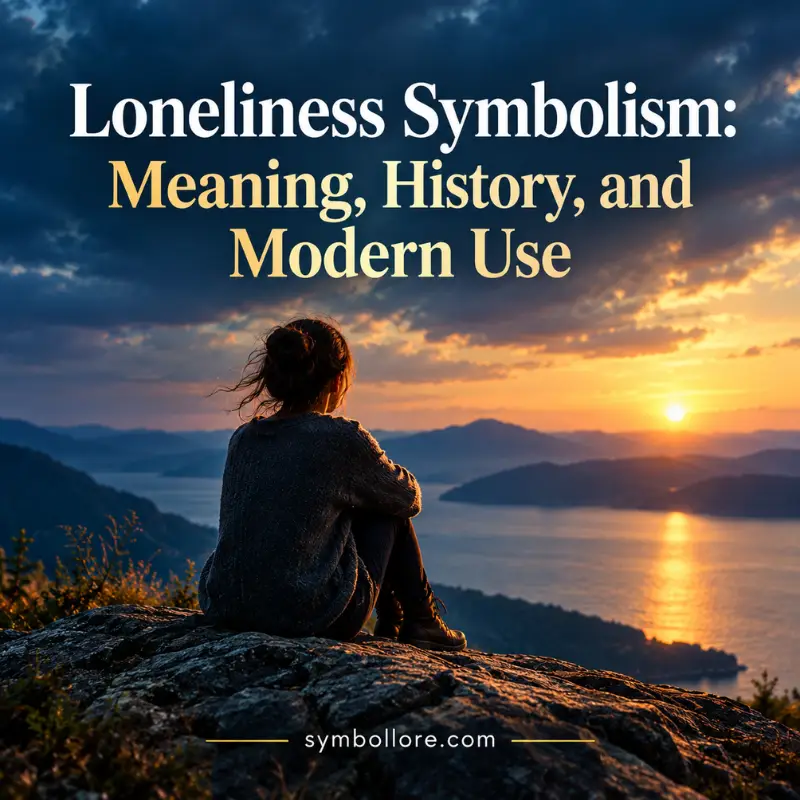
Loneliness symbols express a gap between the connection a person wants and the connection they experience. For that reason, these symbols rarely depend on complete physical isolation. A character may feel lonely at a crowded party, inside a family home, or beside a partner.
The central meaning is emotional distance. An image may show this distance literally through walls, water, empty roads, or separated bodies. It may also communicate it indirectly through silence, lowered posture, unanswered messages, or a figure looking away from others.
Loneliness can include several related experiences:
- Missing a particular person
- Feeling excluded from a group
- Losing a sense of home or belonging
- Being misunderstood despite having company
- Wanting emotional closeness but fearing rejection
- Living apart from one’s family, culture, or community
- Feeling unseen within a busy social environment
These meanings overlap, but they are not identical. A memorial image, for example, may center on grief. A school scene may focus on exclusion. Meanwhile, a city scene can show alienation among strangers.
Why Absence Becomes a Symbol of Loneliness
Absence becomes powerful when a scene contains evidence that someone should be present. An unused cup, an untouched side of a bed, or an empty place at a table creates an implied person. Viewers mentally fill the gap and notice that the expected relationship has been interrupted.
An empty chair is one of the clearest examples. A chair takes the shape and position of a human place, even when nobody occupies it. As a result, it may represent someone who died, departed, was excluded, or has not yet arrived. The meaning becomes more personal when the chair appears beside a second occupied seat.
However, an empty seat does not always express sorrow. It might invite the viewer to sit down. It can also preserve a place for someone in a memorial or family tradition. Symbollore’s guide to
the meanings of an empty chair
explains how setting and ownership change the message.
Other objects work in a similar way. An unworn coat suggests a missing owner, while an unmade bed can imply a recent departure. Therefore, the strongest symbol is often not emptiness alone but emptiness surrounded by signs of former or expected life.
Loneliness Versus Solitude
Loneliness and solitude are not interchangeable. Loneliness usually describes unwanted disconnection, while solitude means spending time alone. Solitude can feel restful, productive, spiritual, or freeing.
A person reading beside a quiet lake may represent calm reflection. By contrast, someone watching a celebration through a window may appear excluded. Both figures stand alone, yet the emotional stories differ.
Body language often helps separate the two meanings. Relaxed shoulders, open surroundings, warm light, and purposeful activity can suggest chosen privacy. Closed posture, barriers, darkness, or attention directed toward unreachable people more strongly imply loneliness.
Edvard Munch explored both sides of being alone. The MUNCH museum’s discussion of
melancholy and solitude in his work
explains that isolation could appear painful in one image and creatively valuable in another.
Nature imagery also carries this distinction. A heron standing alone can represent patience and self-direction rather than sadness.
The meaning of a solitary heron
comes partly from the bird’s quiet, observant posture. Thus, “alone” should serve as the beginning of interpretation, not the final answer.
Common Visual Symbols of Loneliness
Visual art communicates loneliness through relationships among people, objects, and space. The following devices appear often because viewers can recognize their emotional logic quickly.
Empty spaces
A nearly vacant room, road, field, or street makes human absence feel unusually large. The unused space may appear to press around a small figure. Artists often call attention to this imbalance by placing the person near an edge rather than at the center.
Windows and glass
Windows allow people to see one another without touching. Therefore, they can represent longing, observation, confinement, or emotional separation. A person looking outside may want access to another life, while someone viewed from the street may seem trapped in a private world.
An Art UK examination of
windows as symbols of loneliness
shows how British artists used panes, reflections, and interior scenes to create separation even when a figure remained visible.
Roads and paths
A long road can suggest departure, exile, or a difficult journey without companionship. If no destination appears, the road may emphasize uncertainty. In a more hopeful image, however, the same path can represent independence or movement toward a new community.
Water and shorelines
Rivers, oceans, and lakes create physical distance. A figure standing on one shore while watching something across the water may symbolize an unreachable person, home, or future. Still water can add reflection, whereas rough water may make separation feel dangerous.
Doors, walls, and fences
Physical boundaries often represent emotional barriers. A closed door may signal rejection or privacy. A locked gate can suggest exclusion, while a partly open door may preserve the possibility of reconnection.
Colors, Weather, and Light
Color affects emotional tone, but no color has one permanent meaning. Blue commonly supports sadness, distance, silence, and longing in modern Western imagery. Its association with sky and water can also make a scene feel vast or unreachable.
Gray often removes warmth and visual energy. It may suggest routine, numbness, uncertainty, or an environment drained of social life. Black can communicate grief, secrecy, fear, or complete separation. Meanwhile, white may create sterile emptiness when it fills a bare room.
Cold colors are not automatically lonely. Blue may also represent peace, trust, spirituality, or imagination. In The Great Gatsby, for instance, blue helps create both beauty and emotional distance. A detailed discussion of
shows how crowded parties can still feel emotionally empty.
Weather strengthens these associations. Rain hides faces, reduces movement, and places individuals beneath separate umbrellas. Snow can silence a landscape and erase familiar details. Fog limits visibility, while winter strips trees and shortens daylight. Yet all these conditions can also suggest renewal, privacy, mystery, or natural beauty.
Lighting adds another layer. One bright window in a dark building may represent a distant human presence. A lamp beside an empty chair can imply waiting. In contrast, harsh artificial light may expose a person without making them feel understood.
Loneliness Symbolism in Art
Artists often show loneliness through scale, position, and blocked connection rather than through obvious sadness. A small figure against a large setting can appear vulnerable. Two people facing different directions may feel more separated than one person alone.
Nineteenth-century Romantic landscapes frequently include a Rückenfigur, or “back-figure,” who faces the landscape instead of the viewer. This device invites the audience to share the person’s view. However, it does not always mean loneliness. The Metropolitan Museum of Art explains that Caspar David Friedrich used
to encourage reflection and connection with nature.
Later artists gave solitary interiors and urban spaces a more uneasy quality. Edvard Munch used rooms, withdrawn poses, and unfocused expressions to suggest that emotional isolation can exist inside apparently safe spaces.
Edward Hopper became especially important to American images of urban loneliness. His 1942 painting Nighthawks shows four people inside a brightly lit diner surrounded by deserted streets. Although several people share the space, the glass exterior, late hour, and limited interaction make connection seem uncertain. The Art Institute of Chicago notes Hopper’s own comment that he was probably painting
the loneliness of a large city.
These examples reveal an important pattern: loneliness in art often appears through failed relationships between elements. A window should connect inside and outside, but it becomes a barrier. A diner should support conversation, yet its customers appear distant. A home should offer belonging, but an empty room provides no companionship.
Loneliness Symbolism in Literature
Writers turn places, sounds, objects, and repeated images into emotional evidence. Instead of directly stating that a character feels lonely, an author may show unopened letters, an empty hallway, a silent telephone, or a meal prepared for one.
Night is a common literary setting because normal social activity slows after dark. Streets empty, windows close, and familiar places become less welcoming. Robert Frost’s poem
combines nighttime walking, rain, distance, and limited human contact. Together, these elements create a speaker who moves through the city without joining its social life.
Writers also use contrast. A character alone in a desert presents visible isolation. However, a lonely character surrounded by music and conversation reveals a deeper emotional problem. The contrast shows that social presence cannot guarantee understanding or intimacy.
Common literary symbols include:
- An unanswered letter or phone call
- A room separated from the rest of a house
- A train or ship leaving home
- A distant star, lamp, or window
- A meal eaten alone
- Repeated silence after a question
- A forgotten name or fading photograph
- A crowded event where one person remains unnoticed
Repetition matters. One appearance of rain may simply establish weather. If rain returns whenever a character experiences rejection, it can become part of the story’s symbolic pattern.
Islands, Houses, and Other Lonely Places
Certain settings naturally create boundaries. Islands, towers, attics, remote cabins, hospital rooms, and empty apartments can all separate characters from ordinary social life.
An island carries especially flexible meanings. Water can protect a person from danger, offer escape, or create a private world. However, it can also prevent return and rescue.
Therefore, island imagery and isolation
may express refuge, exile, captivity, independence, or loneliness.
Cultural context can challenge the outsider’s interpretation. People from continental societies may imagine water mainly as a barrier. In many island communities, however, the ocean has historically connected families, trade routes, and neighboring islands. Calling every island a symbol of loneliness can erase that lived perspective.
Houses carry a similar tension. A home normally represents security, family, memory, and belonging. Consequently, an abandoned or oversized empty house can make lost connection more noticeable. Symbollore’s overview of
explains how locked rooms, distant homes, and neglected buildings may represent confinement, separation, or lost safety.
Loneliness in Film, Photography, and Design
Film can combine visual separation with sound and time. A director may place one character at the far edge of a wide frame or film them through a doorway. Long pauses, background noise, and unanswered speech can make the audience feel the absence of connection.
Framing often creates invisible barriers. Shelves, window frames, mirrors, and doorways divide characters even when they share a room. A shallow focus may blur everyone except one person. Conversely, an overhead shot can reduce a character to a small shape within a large city or landscape.
Sound also carries symbolic weight. A ticking clock emphasizes waiting. A distant train may suggest departure. Traffic heard from an otherwise silent apartment reminds viewers that life continues outside, while the character remains apart from it.
Photography uses many of the same techniques. Empty public spaces, lone figures at bus stops, and reflections in glass can suggest anonymity. However, captions and context remain essential. A photograph of one person alone does not prove that the person feels lonely.
Modern graphic design often relies on simple forms. One differently colored dot outside a cluster can communicate exclusion immediately. A broken line between two icons may represent lost communication. These symbols work quickly, but they can also oversimplify a complex emotional experience.
Cultural and Historical Context Changes the Meaning
No single culture owns a universal symbol for loneliness. Communities develop meanings through their own stories, artistic traditions, social structures, and historical experiences.
Western modern art often connects loneliness with the individual in an industrial city. Empty streets, rented rooms, cafés, train stations, and apartment windows reflect environments where many strangers live close together without necessarily forming relationships.
Religious traditions may treat withdrawal differently. A hermit, monk, or pilgrim can represent discipline, devotion, or freedom from distraction. Such figures should not automatically be described as lonely because their separation may be voluntary and supported by a spiritual community.
Historical circumstances also matter. An empty place in a wartime family portrait can point to military absence. A vacant home in migration literature may express displacement. Meanwhile, an isolated figure in a work about racial, disability, or social exclusion may represent barriers created by institutions rather than a personal failure to connect.
Therefore, good interpretation asks who produced the image, when it appeared, and what form of separation it addresses.
Modern American Understandings of Loneliness
Contemporary American imagery often places loneliness inside crowded, connected environments. A person may sit among commuters while looking down at a phone. Another may scroll through social media while surrounded by images of other people’s friendships.
Phones have become especially complex symbols. A glowing screen can represent access to community, but it can also suggest waiting for a reply or replacing direct contact with observation. An unread notification may mean neglect, while a silent group chat may reflect exclusion.
Suburban and urban settings create different visual languages. A distant suburban house can suggest privacy, safety, or isolation from community. A high-rise window may show a person physically close to thousands of neighbors yet emotionally unknown.
Public conversation also uses loneliness imagery to discuss aging, remote work, relocation, grief, and changing family patterns. Still, symbolic interpretation should not become a diagnosis. A solitary person in a photograph may feel content. Likewise, a socially active person may experience intense loneliness that no outward image reveals.
Personal, Spiritual, and Dream Interpretations
People may use loneliness symbols to process private experiences. An empty chair could recall a deceased relative. A distant lighthouse might represent hope during separation. A locked room may express difficulty trusting others.
These personal meanings can be genuine without becoming universal rules. The strongest interpretation usually comes from the person’s memory of the image. Someone who grew up near a lighthouse may connect it with home rather than isolation.
Dreams work in a similar way. A lonely house, deserted station, or empty classroom may reflect recent stress, grief, social worry, or memories. However, dreams do not use a scientifically proven symbol dictionary. They also do not predict abandonment or future loss.
Spiritual interpretations sometimes describe isolation as a period of inner growth. That reading may comfort some people, but it should not romanticize suffering. Painful loneliness does not automatically carry a hidden lesson, and seeking connection or professional support does not represent spiritual weakness.
How to Interpret a Loneliness Symbol
Begin with the complete scene instead of selecting one object from a list. Then consider how the elements relate to one another.
- Identify what is missing. Is the image missing a particular person, any human presence, communication, or a sense of belonging?
- Notice whether the separation is chosen. A closed door may protect privacy or enforce exclusion.
- Study posture and direction. A figure looking toward others suggests longing. Someone focused on a task may represent concentration.
- Examine barriers. Glass, walls, water, distance, darkness, and silence can prevent physical or emotional contact.
- Look for contrast. A lonely person within a crowd often communicates alienation more strongly than an empty landscape.
- Consider cultural and historical context. A monk in a religious painting and a neglected child in a social-realist work do not represent the same form of aloneness.
- Check for changes. If a door opens, light appears, or another person enters, the symbol may move from isolation toward hope.
The best interpretation connects visible evidence with the work’s larger purpose. It should remain open to reasonable alternatives.
Common Misconceptions About Loneliness Symbolism
The first misconception is that blue always means loneliness. Blue can support a sad mood, but it may also represent calm, trust, water, distance, imagination, or sacred meaning.
Another mistake treats every solitary person as unhappy. Artists often use lone figures to show independence, contemplation, courage, or privacy. Facial expression, posture, setting, and narrative context must support a loneliness interpretation.
Similarly, empty objects do not always represent abandonment. An empty chair can invite someone to join. An empty room may suggest freedom, simplicity, or a beginning rather than loss.
Finally, loneliness is not a moral weakness. Symbolic stories sometimes present isolated characters as responsible for their condition. Yet exclusion can result from grief, prejudice, illness, migration, inaccessible environments, or damaged relationships. A careful interpretation considers both personal emotion and social cause.
FAQs
An empty chair is one of the clearest objects because it represents a human place without the expected person. However, its meaning can change to grief, remembrance, waiting, exclusion, or invitation. Nearby objects and the chair’s location reveal which interpretation fits.
Solitary animals such as wolves, herons, or bears may represent loneliness in some modern images. Still, living or hunting alone can be normal animal behavior. Therefore, these animals may more accurately symbolize independence, patience, survival, or chosen solitude.
No flower carries a universal meaning of loneliness. A single wilted flower, an isolated bloom, or a flower separated from a bouquet can communicate neglect or disconnection through its condition and placement. Cultural flower traditions may give the same species very different meanings.
An empty house may symbolize loneliness, abandonment, lost family life, displacement, or forgotten memories. The association grows stronger when the building contains signs of former residents. However, a vacant house can also represent freedom, transition, renovation, or a fresh start.
A single figure shown apart from a tightly grouped crowd commonly represents social alienation. Different color, direction, lighting, or focus can strengthen the separation. This image suggests that loneliness concerns emotional connection, not simply the number of nearby people.
Yes. An open door, approaching figure, distant light, growing plant, or bridge can suggest that separation may end. Hope feels strongest when the image acknowledges loneliness while providing a believable path toward renewed connection.
Conclusion
Loneliness symbolism makes emotional separation visible through absence, distance, barriers, silence, and contrast. Empty chairs, windows, isolated figures, dark streets, and abandoned homes work because they show a gap where connection might exist. Still, none of these images has one fixed meaning. A solitary person may be grieving, excluded, independent, peaceful, or deep in thought. Cultural background, historical setting, composition, and personal experience shape the final interpretation. The most grounded reading examines the entire scene and asks whether aloneness appears painful, chosen, temporary, or open to change.
Five Related Articles from symbollore.com
- Island Symbolism: Meanings of Isolation, Refuge, and Change — https://symbollore.com/island-symbolism/
- Chair Symbolism: Meaning, History, and Cultural Use — https://symbollore.com/chair-symbolism/
- House Symbolism: Meanings, History, and Modern Use — https://symbollore.com/house-symbolism/
- Blue Symbolism in The Great Gatsby: Meaning and Key Examples — https://symbollore.com/blue-symbolism-great-gatsby/
- Heron Symbolism: Meaning, History, and Cultural Roots — https://symbollore.com/heron-symbolism/