
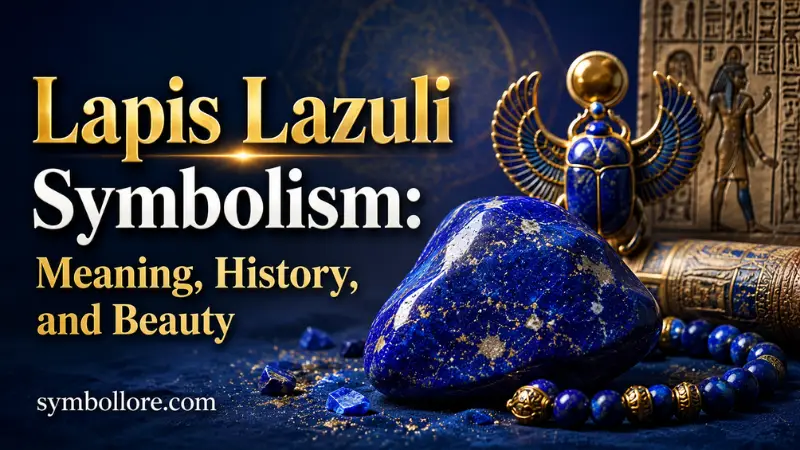
Lapis lazuli symbolism is closely associated with the heavens, sacred beauty, status, protection, and spiritual significance. Its deep blue color and glittering golden flecks made the stone visually distinctive, while its rarity and long-distance trade gave it exceptional value in ancient societies. Yet its meaning was never identical everywhere. Ancient Mesopotamians, Egyptians, medieval European artists, and modern spiritual communities have approached lapis lazuli in different ways.
The stone is especially important because its symbolism developed from real historical uses. Lapis lazuli traveled great distances from sources in the region of present-day Afghanistan, appeared in elite jewelry and ritual objects, and was eventually ground into the precious blue pigment ultramarine. Those practical and artistic roles helped turn its physical beauty into a powerful cultural symbol.
Quick Answer
Lapis lazuli symbolism commonly represents heavenly beauty, sacredness, prestige, protection, and spiritual depth. These associations grew from its intense blue color, rarity, use in elite objects, and connection with religious art. However, lapis lazuli has no single universal meaning. Its significance depends on the culture, period, object, and tradition in which it appears.
TL;DR
- Lapis lazuli often symbolizes the heavens, sacred beauty, prestige, and spiritual depth.
- Its deep blue appearance helped connect the stone with celestial imagery in some ancient contexts.
- Long-distance trade made lapis a rare and valuable material in ancient Mesopotamia and Egypt.
- Medieval European artists used lapis-derived ultramarine for important religious imagery, especially the Virgin Mary’s blue robes.
- Ancient uses do not prove that every culture believed lapis lazuli possessed magical powers.
- Today, people often use the stone as a symbol of wisdom, calm, authenticity, and spiritual reflection.
Lapis Lazuli Meanings at a Glance
| Context | Possible Meaning | Why the Association Exists | Important Limit |
|---|---|---|---|
| Ancient Mesopotamia | Prestige, wealth, sacred value | Lapis was imported from distant regions and used in elite objects | Specific symbolic meanings are not always documented |
| Ancient Egypt | Heavenly beauty, divine association, status | Its blue color and rarity suited elite jewelry, amulets, and divine imagery | Not every Egyptian lapis object had the same meaning |
| Religious art | Sacred beauty and honor | Lapis-derived ultramarine was extremely expensive and used for important figures | This is especially strong in certain periods of European art |
| Royal or elite objects | Wealth and status | The stone required long-distance trade and skilled craftsmanship | Value does not automatically equal a religious meaning |
| Modern jewelry | Wisdom, calm, authenticity | Modern symbolism builds on the stone’s appearance and historical reputation | These meanings are contemporary interpretations |
| Spiritual practice | Inner awareness or protection | Modern traditions often assign metaphysical qualities to stones | Such claims are matters of belief, not established scientific facts |
What Does Lapis Lazuli Symbolism Mean?

The strongest broad interpretation of lapis lazuli is preciousness connected with the sky or sacred realm. That idea comes from several features working together rather than from a single ancient definition.
The stone’s saturated blue surface naturally resembles a clear night sky or deep celestial space. Small golden pyrite inclusions can look like stars scattered across that blue field. In artistic settings, this combination makes lapis particularly suited to images of grandeur and transcendence.
Its rarity strengthened that impression. Ancient Mesopotamia did not have a local source of lapis lazuli. The Metropolitan Museum of Art notes that lapis used in Sumerian objects from Ur originated in the Badakhshan region of present-day Afghanistan.
Consequently, lapis was not merely attractive stone. It represented access to distant resources, complex trade networks, skilled craftsmanship, and considerable wealth.
Why Did Lapis Lazuli Become a Symbol of the Heavens?
Lapis lazuli became linked with heavenly imagery partly because its appearance resembles the night sky. Its intense blue color creates a visual connection with vastness, mystery, and celestial space.
Evidence from ancient Egyptian art provides a particularly useful example. The Metropolitan Museum of Art describes an Egyptian face of a goddess made partly from lapis lazuli and explains that the choice of lapis likely reflected the goddesses’ associations with the heavens.
This is stronger evidence than a generic claim that “ancient Egyptians believed lapis meant heaven.” The object shows how the material itself could reinforce an existing divine association.
That distinction matters. A symbolic material can support the meaning of an image without possessing one fixed dictionary definition. The goddess, object, period, and religious context all help determine what the stone communicates.
Lapis Lazuli Symbolism in Ancient Mesopotamia
Ancient Mesopotamia provides some of the earliest and clearest evidence for the importance of lapis lazuli. Sumerian objects from Ur contain the stone alongside gold and carnelian, showing that it belonged to a world of luxury materials and long-distance exchange.
A Sumerian necklace dated to about 2600–2500 BCE contains gold, lapis lazuli, and carnelian. The Metropolitan Museum explains that these materials were not native to southern Mesopotamia and that their presence demonstrates the importance of long-distance connections.
The symbolism here is partly social. A material that had to travel hundreds or thousands of miles could signal access to wealth and powerful trade networks.
Lapis also appeared in cylinder seals and other objects. A Sumerian cylinder seal made entirely from lapis lazuli survives from roughly the same period.
However, surviving objects do not always tell us exactly what their makers believed the stone represented. It is safer to say that lapis participated in elite, artistic, and potentially sacred visual culture than to assign one universal Sumerian meaning.
Lapis Lazuli and Ancient Egyptian Culture
Ancient Egyptians valued lapis lazuli even though the stone was imported from far beyond Egypt. It appeared in jewelry, amulets, small sculptures, and other high-status objects.
A Middle Kingdom Egyptian bracelet containing lapis illustrates the material’s elite role. The Metropolitan Museum records lapis among the stones used in valuable Egyptian jewelry and notes that Egyptian lapis came from Afghanistan.
Lapis could also appear in religious objects. The Met holds a small Egyptian child-god amulet carved from lapis lazuli and dated to 664–30 BCE. The object shows how the stone could be incorporated directly into sacred imagery.
Another important example is a falcon amulet made from lapis lazuli. The material’s dark blue color provides a striking surface for the carved form associated with Egyptian deities such as Horus or Re-Harakhty.
These objects support associations with divinity, elite status, beauty, and sacred craftsmanship. They do not, however, establish a single Egyptian rule saying that lapis always meant protection or always meant heaven.
How Rarity Shaped Lapis Lazuli Symbolism
Rarity is one of the most important reasons lapis acquired symbolic weight.
Ancient Egyptians could obtain many decorative stones from their own territory or nearby regions. Lapis was different. Its distant source meant that acquiring it required established trade routes and relationships across large geographic areas.
The same pattern appears in Mesopotamia. Lapis in the royal cemetery at Ur was combined with gold and other precious materials. The Metropolitan Museum describes the resulting objects as evidence of wealth and extensive trade connections.
This history helps explain why lapis can symbolize prestige and distinction. The meaning did not necessarily arise because people decided that blue represented wealth. Instead, the physical history of obtaining the material made it valuable.
Its symbolism therefore emerged from both appearance and economics.
Lapis Lazuli and Sacred Blue in European Art
One of the most influential later developments in lapis symbolism came through painting.
Artists could grind lapis lazuli into ultramarine, a rich blue pigment. The National Gallery of Art explains that ultramarine was made from lapis lazuli mined in what is now Afghanistan and that the pigment was exceptionally costly. In Western art, it was famously used for the Virgin Mary’s cloak.
The symbolism of blue in this setting combines color with material value.
Mary’s blue robe could communicate dignity and sacred importance, while the expensive pigment demonstrated the importance of the subject and the resources devoted to the artwork. The stone therefore moved from being a luxury material in ancient objects to becoming part of the visual language of Christian art.
A National Gallery example of a fourteenth-century Madonna shows Mary wearing a lapis-blue mantle.
This is one reason modern discussions often connect lapis lazuli with divine beauty, holiness, dignity, and spiritual depth. Yet those meanings belong especially to particular artistic and Christian contexts. They should not be projected backward onto every ancient culture.
Why Blue and Gold Make Lapis So Symbolic
Lapis lazuli has an unusual visual combination: deep blue with natural golden or metallic-looking inclusions.
That appearance can suggest a star-filled sky. Blue creates depth, while the gold-like flecks provide contrast and visual points of light.
Artists and craftspeople could therefore use the stone to create an impression of luxury without adding another material. In ancient jewelry, lapis worked especially well beside gold and carnelian. In later art, lapis-derived blue pigment could create intense fields of color.
The symbolism is partly visual rather than textual. People do not need a written statement saying “this represents the heavens” for an image to evoke the sky. Color, texture, rarity, and placement can create associations through visual experience.
Still, visual resemblance should be described as an interpretive factor, not proof of a universal belief.
Lapis Lazuli Symbolism in Religion and Spirituality
Lapis lazuli appears in modern spiritual practices as a symbol of wisdom, inner awareness, truth, calm, protection, and spiritual connection.
These ideas are widespread in contemporary crystal and wellness culture, but they should be separated from documented ancient history. There is no scientific evidence that wearing lapis lazuli produces supernatural protection, healing, psychic abilities, or guaranteed spiritual outcomes.
Historical objects can demonstrate that people valued lapis and sometimes used it in sacred settings. They cannot automatically prove modern metaphysical claims.
For a symbolism-focused interpretation, it is more accurate to say that lapis may represent spiritual depth or inner reflection for a modern person. That meaning comes from contemporary belief and personal symbolism rather than an experimentally established property of the mineral.
Lapis Lazuli Meaning in Jewelry and Personal Objects
Today, lapis lazuli is commonly worn as jewelry or displayed as a decorative stone. Its symbolism often centers on individuality, wisdom, confidence, beauty, and connection with the past.
A pendant may carry a personal meaning because of its color or because the wearer associates it with an important person or event. A ring may symbolize a commitment to authenticity. A polished stone may simply be appreciated for its natural appearance.
The historical background adds another layer. Someone familiar with lapis’s ancient use may see the stone as a link to Mesopotamian and Egyptian history or to the history of art.
Modern symbolism is therefore flexible. The same necklace can represent luxury to one person, spirituality to another, and historical appreciation to someone else.
How Color Changes the Meaning of Lapis Lazuli
The dominant blue color strongly influences how people interpret lapis, but the exact shade can change the emotional effect.
Deep, saturated blue often feels serious, mysterious, calm, or majestic. Lighter blue may appear more peaceful or airy. Dense golden inclusions can emphasize luxury and celestial imagery.
However, the stone’s natural appearance should not be treated as a strict symbolic code.
This is especially clear when comparing lapis with broader blue symbolism. In literature and art, blue can suggest calmness, distance, sadness, mystery, spirituality, or even artificiality. Meaning depends on context rather than color alone.
That principle is useful when interpreting lapis: start with the object and setting, then consider the color.
Lapis Lazuli vs. Other Blue Gemstones
Lapis lazuli can be confused symbolically with sapphire and other blue stones, but their histories are different.
Sapphire has its own long religious and cultural associations, especially in traditions that valued the gemstone for its hardness, brilliance, and rarity. Lapis, by contrast, is an opaque rock valued for its rich blue body color and characteristic inclusions.
The difference matters because symbolism develops from material history. A transparent blue sapphire and an opaque blue lapis lazuli may share associations with the sky or prestige, but they did not acquire those associations through exactly the same traditions.
For that reason, it is better to discuss blue gemstones individually rather than treating every blue mineral as interchangeable.
What Lapis Lazuli Can Symbolize Today
In modern American culture, lapis lazuli can reasonably symbolize several ideas:
- Wisdom: its long historical use can make it a natural emblem of learning and accumulated knowledge.
- Authenticity: its distinctive natural appearance resists the idea that beauty must be uniform.
- Spiritual reflection: deep blue can evoke quiet thought, contemplation, or a sense of the transcendent.
- Prestige: its history as an imported luxury material supports associations with refinement and status.
- Historical continuity: ancient jewelry and later artworks connect the stone with thousands of years of human craftsmanship.
- Celestial beauty: its blue-and-gold appearance can resemble a night sky filled with stars.
These are useful modern interpretations, but they are not universal rules. A person’s reason for choosing lapis may be entirely personal.
Common Misconceptions About Lapis Lazuli
One common misconception is that all ancient cultures assigned exactly the same meaning to lapis lazuli. Historical evidence does not support that conclusion. Mesopotamian, Egyptian, and European uses occurred in different periods and cultural systems.
Another claim is that lapis lazuli was always used as a magical protection stone. Some amulets and sacred objects certainly demonstrate that lapis participated in religious settings, but that does not prove a universal belief in supernatural protection.
A third misconception is that the blue pigment ultramarine was simply “blue paint made from a gemstone” with no special social meaning. Its extraordinary cost made it significant in European art. The National Gallery of Art notes that ultramarine could be more valuable than other pigments and was used for important areas of paintings.
Finally, lapis should not be treated as a scientifically proven healing material. Modern spiritual interpretations belong to personal or cultural belief rather than established mineral science.
How to Interpret Lapis Lazuli Symbolism Respectfully
A good interpretation begins with context.
First, identify the culture and historical period. A Sumerian necklace should not be interpreted using modern crystal symbolism. An Egyptian amulet should not automatically be given the same meaning as a contemporary pendant.
Next, identify the object. Jewelry, a religious figure, a seal, a painting, and a loose polished stone can communicate very different ideas.
Then consider the material itself. Ask why the maker selected lapis instead of another blue material. Was the stone rare? Was its color important? Did its cost matter? Did it complement gold or another material?
Finally, distinguish documented evidence from interpretation. If a museum record explicitly connects lapis with a heavenly deity, that is stronger evidence than a modern claim that every lapis stone represents celestial protection.
This approach produces a richer interpretation because it allows the stone to have different meanings in different settings.
FAQs
Lapis lazuli is often used in modern spiritual symbolism to represent wisdom, inner awareness, truth, calm, and spiritual reflection. These are contemporary or belief-based interpretations rather than scientifically proven properties. Historical evidence supports the stone’s importance in sacred and elite objects, but not every modern metaphysical claim.
Lapis lazuli was important because it was rare, imported from distant regions, visually striking, and suitable for elite jewelry, amulets, and religious objects. Its deep blue color could also support heavenly or divine imagery. However, Egyptian uses varied by object and period.
Some lapis objects were used as amulets and religious objects, showing that the stone could participate in practices involving protection or sacred symbolism. However, it is too broad to claim that all Egyptians shared one fixed belief about lapis lazuli’s magical powers.
Its intense blue color naturally resembles the sky, especially a deep blue or star-filled night sky. In at least some Egyptian contexts, museum evidence connects the use of lapis with heavenly associations. The stone’s appearance therefore contributed to celestial symbolism, although the exact meaning depended on context.
Lapis lazuli could be processed into ultramarine, an exceptionally rich blue pigment. Because the raw material came from distant sources and was expensive to obtain and prepare, the pigment was highly valuable. European artists used it for important areas of paintings, including the Virgin Mary’s robe.
Protection is a common modern spiritual interpretation, but there is no scientific evidence that lapis lazuli provides supernatural protection. Historical amulets show that people used objects containing lapis in religious contexts, but historical use should not be presented as scientific proof of a supernatural effect.
As a gift, lapis lazuli can represent wisdom, appreciation, beauty, authenticity, or lasting connection. The meaning depends mostly on the giver, recipient, and occasion. A person familiar with the stone’s history may also choose it as a symbol of ancient culture, artistic heritage, or spiritual reflection.
Conclusion
Lapis lazuli symbolism grew from an unusual combination of color, rarity, trade, craftsmanship, religion, and art. Ancient Mesopotamian and Egyptian objects show its importance as a valuable imported material, while later European painting transformed lapis-derived blue into a major visual language of sacred art.
Today, lapis lazuli may suggest wisdom, heavenly beauty, prestige, spirituality, or historical continuity. Yet no single interpretation applies everywhere. The most reliable reading considers the culture, period, object, and purpose before assigning meaning. Lapis is powerful as a symbol precisely because its history is layered: a rare blue stone became a material of luxury, sacred imagery, artistic achievement, and personal expression.


