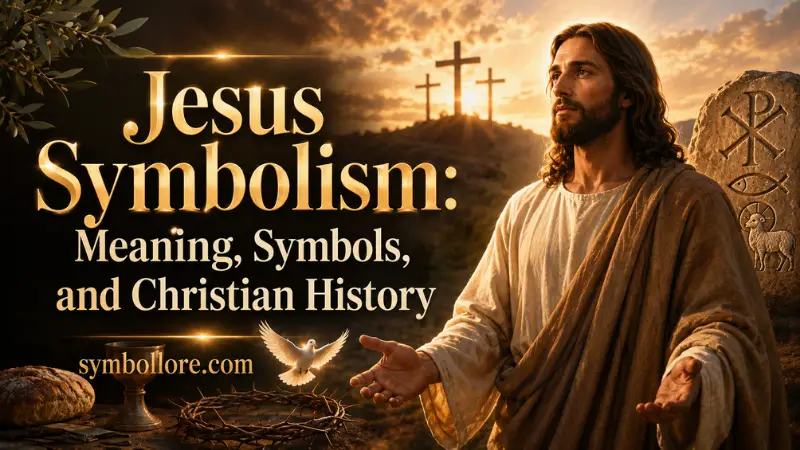
Jesus symbolism centers on sacrifice, salvation, love, resurrection, divine authority, guidance, and hope. Christian communities have expressed these ideas through a wide visual language that includes the cross, crucifix, lamb, Good Shepherd, fish, Chi-Rho, crown of thorns, vine, bread, light, and other images.
These symbols did not all develop at the same time or carry identical meanings. Some come directly from the New Testament, while others emerged through early Christian art, liturgy, theology, and later devotional traditions. Early Christians also adapted familiar visual forms from the Roman and Greek world and gave them new Christian meanings.
For that reason, understanding Jesus symbolism requires more than memorizing a list of meanings. The cross, for example, can communicate both Christ’s suffering and his victory over death. The lamb can emphasize sacrifice, while the shepherd emphasizes care and guidance. Context determines which aspect of Jesus is being expressed.
Quick Answer
Jesus symbolism most strongly represents sacrifice, salvation, resurrection, love, kingship, and guidance. The cross is the central Christian symbol of Jesus because it represents his crucifixion and the salvation Christians associate with it. Other symbols, including the fish, lamb, Good Shepherd, Chi-Rho, vine, light, and crown of thorns, express different aspects of his identity, teachings, suffering, and victory.
TL;DR
- The cross is the strongest single symbol associated with Jesus and represents crucifixion, sacrifice, salvation, and Christian faith.
- The lamb represents Christ as the sacrificial Lamb of God.
- The Good Shepherd emphasizes Jesus’ care, guidance, and willingness to give his life for his followers.
- The Ichthys fish became an early Christian symbol identifying Jesus Christ as Son of God and Savior.
- The Chi-Rho is a Christogram formed from Greek letters associated with Christ’s name.
- The crown of thorns combines suffering, mockery, and Jesus’ kingship.
- Modern Christian art continues to use these symbols, but their meanings depend on denomination, period, artwork, and devotional setting.
Jesus Symbols and Their Meanings at a Glance
| Symbol | Main Meaning | Why It Represents Jesus | Important Context |
|---|---|---|---|
| Cross | Sacrifice, salvation, victory | Directly connected with the Crucifixion | Central across Christianity |
| Crucifix | Christ’s suffering and death | Shows Jesus’ body on the cross | Especially prominent in Catholic and some other traditions |
| Lamb | Sacrifice, redemption | Connects Jesus with the Lamb of God | Rooted in biblical imagery |
| Good Shepherd | Care, guidance, self-giving | Based on Jesus’ shepherd teaching | Important in early Christian art |
| Fish / Ichthys | Jesus Christ, Son of God, Savior | Greek letters form a Christian confession | Especially important in early Christianity |
| Chi-Rho | Christ’s identity | Combines Greek letters chi and rho | Common in late antique Christian art |
| Crown of Thorns | Suffering and kingship | Connected with Jesus’ Passion | Often shown in Crucifixion imagery |
| Vine | Union and spiritual life | Jesus describes himself as the true vine | Based on John 15 |
What Does Jesus Symbolism Mean?
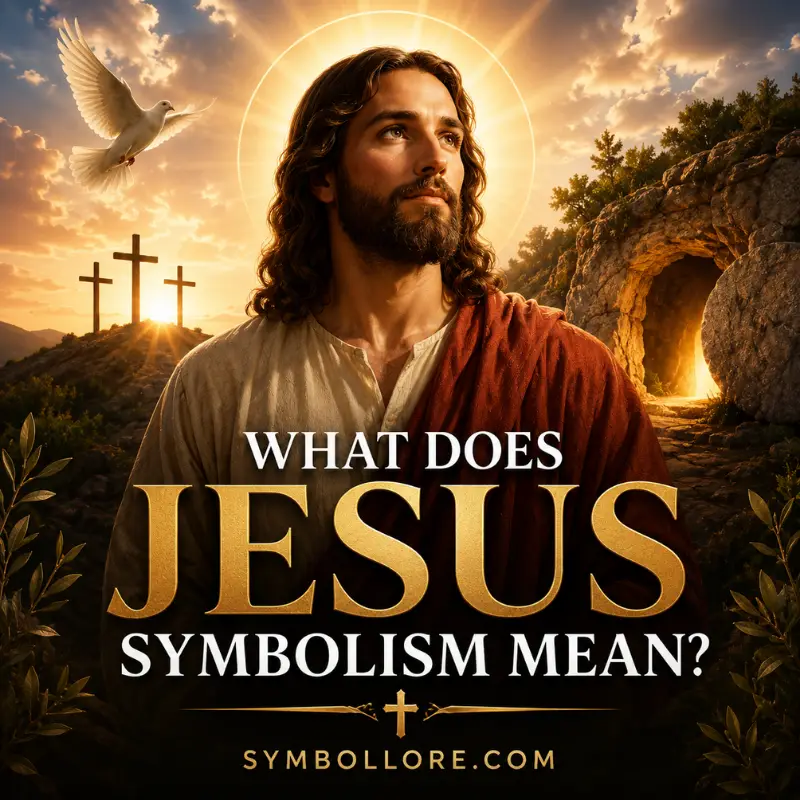
Jesus symbolism is the visual language Christians have used to express beliefs about Jesus’ identity, ministry, death, resurrection, and relationship with believers.
The most important symbols do not simply stand for “Jesus” as a name. They often highlight one particular aspect of his story or Christian theology.
The cross points toward the Crucifixion and its meaning within Christian faith. The lamb emphasizes sacrifice. The shepherd highlights care and leadership. The fish can function as a compact confession of Christian belief. The Chi-Rho identifies Christ through his name.
This distinction matters because Christian symbolism is not a single codebook. The same image can carry several connected meanings, and different Christian traditions may emphasize different aspects.
The Warburg Institute’s religious-iconography collection, for example, separately catalogs Christ as lamb, Christ as Good Shepherd, Crucifixion imagery, the Sacred Heart, the instruments of the Passion, and other forms of Christ imagery.
Why the Cross Became the Central Symbol of Jesus
The cross became the central symbol of Jesus because it directly recalls the Crucifixion, one of the defining events of the Christian Gospel narratives.
The Metropolitan Museum of Art describes the cross as the central image of Christian iconography through its association with Jesus’ Crucifixion. It connects the cross with Christ’s sacrifice, spiritual salvation, and the Christian Church.
The symbol also developed beyond a simple image of execution. In Christian theology and art, the cross can communicate suffering and victory at the same time.
A Byzantine ivory icon from the tenth century makes this double meaning especially clear. The Metropolitan Museum explains that the cross in the image represents both the instrument of Christ’s Crucifixion and a sign of victory over death and sin.
That is why a cross can appear solemn in one setting and triumphant in another.
A bare cross may emphasize Christ’s death and resurrection together. A crucifix, by contrast, visibly includes Christ’s body and therefore places stronger emphasis on suffering and the Passion.
Jesus Symbolism and the Lamb of God
The lamb is one of the oldest animal images associated specifically with Jesus.
Christian use of the lamb draws on biblical sacrifice imagery and the New Testament identification of Jesus as the Lamb of God. The Metropolitan Museum notes that Christians adopted the lamb as a symbol of Christ and emphasized his sacrifice for humanity.
The image therefore represents sacrifice, redemption, innocence, and salvation within Christian iconography.
A lamb carrying a cross or banner can add another layer. The image may connect Christ’s sacrificial death with victory and resurrection rather than leaving the viewer only with an image of suffering.
The lamb also provides an important bridge between two major Jesus symbols: sacrifice and shepherding. Jesus can appear as the lamb who gives his life and as the shepherd who cares for his flock.
These images are not contradictory. They express different parts of Christian interpretation of Christ.
The Good Shepherd as a Symbol of Jesus
The Good Shepherd represents Jesus as a figure of care, protection, guidance, and self-giving love.
The image comes directly from the Gospel of John, where Jesus describes himself as the Good Shepherd who lays down his life for the sheep. Early Christian artists found this imagery especially useful.
The Byzantine Museum explains that early Christians used the figure of a shepherd carrying a lamb to portray Christ as the Good Shepherd. It also notes that the visual form drew on earlier Greek and Roman representations of a figure carrying an animal, while Christians gave the familiar form new meaning.
The Good Shepherd became especially common in early Christian art. It appears in catacomb paintings, sculpture, lamps, and other objects.
The symbolism is powerful because the shepherd’s work provides a visual metaphor for a relationship. Jesus is not merely presented as a distant ruler. He is shown as someone who knows, guides, protects, and sacrifices for his flock.
The Fish and Ichthys Symbolism
The fish is one of the earliest recognizable symbols of Jesus.
The Greek word for fish is ichthys. Early Christians connected its letters with the phrase “Jesus Christ, Son of God, Savior.” The Byzantine Museum describes the fish as one of the earliest and most popular Christian symbols and notes its use in catacombs and funerary inscriptions as a symbol of salvation.
The fish also fits the Gospel stories surrounding Jesus. Fishing, fishermen, miraculous catches, and the feeding of crowds all appear in Christian narratives.
The symbol therefore operates on several levels. It can identify Christ directly through the Greek wordplay while also recalling stories from his ministry.
Early Christian fish imagery was especially useful because it was compact and visually simple. A small fish could communicate Christian identity without requiring a full portrait of Jesus.
The fish should not, however, be treated as a universal symbol of every Christian belief. Its strongest historical function is specifically Christological: it identifies Jesus and expresses Christian confession.
The Chi-Rho and the Name of Christ
The Chi-Rho is a Christogram, or monogram representing Christ.
It combines the Greek letters chi (Χ) and rho (Ρ), the first two letters of Christos, the Greek word from which “Christ” comes.
The Metropolitan Museum identifies the Chi-Rho as the first letters of Christ’s name in Greek. Museum objects from late antiquity show the monogram used on lamps, metalwork, and architectural decoration.
The symbol sometimes appears with Alpha and Omega, the first and last letters of the Greek alphabet. In Christian interpretation, these letters refer to God’s eternal nature and the biblical language of beginning and end.
This makes the Chi-Rho different from the cross. The cross primarily evokes Christ’s Crucifixion, while the Chi-Rho functions more directly as a written emblem of Christ’s identity.
It became particularly important in late antique Christian art and objects.
The Crown of Thorns: Suffering and Kingship
The crown of thorns represents one of the most striking combinations in Jesus symbolism: humiliation and kingship.
According to the Gospel Passion narratives, Roman soldiers placed a crown of thorns on Jesus while mocking him as a king. Christian art later used the crown to recall the suffering and humiliation associated with the Passion.
A sixteenth-century German breastplate in the Metropolitan Museum’s collection depicts Christ crucified with a crown of thorns and a halo. The museum identifies the crown as a symbol of the Passion, while the halo communicates divinity.
The crown therefore carries an intentional tension.
A crown normally suggests authority and honor. The crown of thorns instead shows authority being mocked and suffering being endured. In Christian interpretation, that reversal can become part of the meaning: Christ’s kingship is expressed through suffering rather than conventional worldly power.
Jesus as Light
Light is another important image associated with Jesus, especially in Christian scripture and art.
In the Gospel of John, Jesus describes himself as the light of the world. Christian artists have consequently used radiance, halos, golden backgrounds, candles, stars, and luminous surroundings to communicate holiness, revelation, divine presence, or spiritual understanding.
The halo is especially important in Christian visual language. The Metropolitan Museum explains that the radiant nimbus surrounding Christ’s head in devotional Crucifixion imagery signifies divinity.
However, not every use of light in Christian art automatically means Jesus. Light can symbolize God, revelation, holiness, resurrection, or other theological ideas.
The distinction becomes clearer when the image contains a recognizable Christ figure or another specifically Christological symbol. Otherwise, “light equals Jesus” is too broad.
Jesus as the True Vine
The vine is a less obvious but historically important Jesus symbol.
In the Gospel of John, Jesus describes himself as the true vine, with his followers as branches. This image expresses dependence, connection, growth, and spiritual life.
Christian visual art adopted vine imagery because the plant offered a useful metaphor for an interconnected community. A branch cannot remain alive apart from the vine, just as the Gospel image describes the relationship between Christ and his followers.
The St Andrews Encyclopaedia of Theology notes that early Christian artists adapted familiar visual forms, including vine leaves associated with the classical world, and gave them Christian meanings connected with Christ and Eucharistic wine.
This is an important example of how Christian symbolism developed. A symbol did not always begin as an exclusively Christian object. Existing visual language could acquire new meaning when placed within Christian teaching.
Bread and Wine in Jesus Symbolism
Bread and wine are closely connected with Jesus through the Last Supper and Christian Eucharistic or Communion traditions.
Bread can represent life, nourishment, sharing, and Christ as the Bread of Life. Wine can represent the covenant and, in Christian sacramental traditions, Christ’s blood.
The meaning varies among denominations because Christians do not all understand Communion in exactly the same theological way.
The symbols also work together. Bread provides nourishment, while wine participates in the sacramental remembrance or celebration of Christ’s death and covenant according to different Christian traditions.
This is a good example of why religious symbolism requires precision. Saying that bread simply “means Jesus” loses the theological relationship between the object, the Gospel narrative, worship, and the particular Christian community using it.
For a broader comparison of religious food imagery, Symbol Lore’s discussion of
examines how bread, fish, wine, and other foods acquire different meanings through cultural and religious contexts.
Jesus Symbolism in Early Christian Art
Early Christian art did not immediately settle on one standard visual appearance of Jesus.
Christians used symbols, biblical scenes, allegorical figures, and adapted classical forms. The Good Shepherd is one clear example. Another is the fish.
The St Andrews Encyclopaedia of Theology explains that early Christian artists adapted familiar pagan visual forms and gave them Christian meanings. It identifies the fish, Good Shepherd, and other images among the visual language of early Christianity.
The Byzantine Museum similarly describes the Good Shepherd as a Christian reinterpretation of an older shepherd-with-animal artistic type.
This does not mean early Christians simply copied pagan religion. Rather, artists worked within the visual vocabulary available in the late Roman world. Familiar forms could be transformed through new stories and theological meanings.
This process helps explain why Christian art contains both distinctly biblical imagery and visual forms that existed before Christianity.
How Jesus Symbolism Changed Through Christian Art
Jesus imagery changed significantly as Christian art developed.
Early Christian artists often relied on symbolic shorthand. Later Byzantine and medieval traditions developed more standardized images of Christ, including the Pantocrator, Crucifixion, Nativity, Last Judgment, and other scenes.
The Passion became particularly important in medieval and later European art. The Metropolitan Museum notes that the Crucifixion and related Passion scenes became a constant focus in Italian painting, with artists using them to evoke grief, pity, guilt, and devotion.
Later devotional art could therefore make Jesus more emotionally immediate. A suffering Christ could invite compassion, while an enthroned Christ could emphasize divine authority.
The symbol changed because the purpose of the image changed. A burial object, church mosaic, private devotional icon, processional cross, painting, and modern pendant do not necessarily communicate the same emotional or theological emphasis.
Jesus Symbolism Across Christian Traditions
Christianity contains many denominations and traditions, so Jesus symbolism is not visually identical everywhere.
Catholic art often makes extensive use of the crucifix, Sacred Heart, Eucharistic imagery, and Passion scenes. Eastern Orthodox traditions emphasize icons and established Christological forms. Protestant communities vary widely, with some favoring a plain cross and others using figurative or symbolic imagery.
Ethiopian Christian art offers another distinct example. The Metropolitan Museum describes an Ethiopian hand cross whose designs reflect the country’s unique Orthodox Christian heritage. Its imagery includes Christ’s Crucifixion alongside distinctive geometric patterns.
These differences matter because a symbol can carry both a shared Christian meaning and a tradition-specific emphasis.
The cross, for instance, can be recognized across Christian communities while appearing in very different artistic styles and devotional settings.
Jesus Symbolism in Modern American Culture
In the United States, Jesus symbolism appears in churches, homes, jewelry, paintings, tattoos, music, literature, memorials, public art, and popular culture.
The cross remains the most recognizable symbol. It may communicate Christian faith, remembrance, devotion, sacrifice, identity, or hope.
A fish pendant or bumper sticker can similarly identify Christian belief through the Ichthys tradition. A crown of thorns may emphasize the Passion, while a shepherd image can express care and pastoral guidance.
Modern American use also introduces personal meanings. Someone may wear a cross because of family heritage, religious conviction, remembrance of a loved one, or a personal experience of faith.
These uses should not automatically be treated as ancient traditions. Modern Christian symbolism often combines inherited imagery with contemporary personal identity.
Symbol Lore’s article on
provides a related example: the cross, water, bread, wine, and dove can all participate in Christian ideas of divine grace, but they do not have identical theological roles.
Jesus Symbolism and the Difference Between Fact and Tradition
Religious symbolism needs careful language because different kinds of evidence often become mixed together online.
Some associations are directly supported by Christian scripture. Others are documented in early Christian art. Still others developed through medieval devotion, denominational teaching, popular tradition, or modern spirituality.
For example, the Bible provides the foundation for the Good Shepherd, Lamb of God, true vine, Bread of Life, light, and Passion imagery. Museums can then document how artists represented those ideas in particular historical periods.
A later devotional claim should not be presented as though it were a direct biblical command.
The same principle applies to legends. Symbol Lore’s discussion of
notes the popular Christian legend connecting dogwood with the Crucifixion while distinguishing that folklore from biblical evidence. That distinction is essential whenever a symbol becomes surrounded by later stories.
Common Misconceptions About Jesus Symbols
Several popular claims become misleading when they turn a specific tradition into a universal rule.
“Every Christian symbol is a symbol of Jesus.”
Not necessarily. The dove, for example, is strongly associated with the Holy Spirit, while the anchor can symbolize hope. They may appear in Christian art without functioning specifically as symbols of Jesus.
“The fish was created as a secret code Christians always used during persecution.”
The Ichthys clearly became an early Christian symbol, but explanations of its use should avoid turning a complex historical practice into one simple persecution story. The Byzantine Museum documents its use in catacombs and funerary contexts.
“The cross has only one meaning.”
The cross can signify Crucifixion, sacrifice, salvation, the Church, suffering, resurrection, and victory. Its meaning depends partly on how it is depicted.
“The Chi-Rho is the same thing as the cross.”
They can appear together, but they function differently. The Chi-Rho is specifically a monogram for Christ’s name, while the cross is directly associated with the Crucifixion.
“Every modern spiritual interpretation is an ancient Christian teaching.”
No. Contemporary spiritual meanings can be personally meaningful without having a documented historical or biblical origin.
How to Interpret Jesus Symbolism in Art
The most reliable interpretation begins with the complete image rather than one isolated object.
Ask five questions:
- Which symbol is most prominent?
A cross, lamb, shepherd, crown, or fish may point toward a different aspect of Christ. - What is Jesus doing?
A suffering Christ creates a different emphasis from an enthroned Christ or Good Shepherd. - Which historical period produced the artwork?
Early Christian, Byzantine, medieval, Renaissance, modern, and contemporary art use different visual conventions. - Which Christian tradition created it?
Catholic, Orthodox, Protestant, Ethiopian Orthodox, and other communities have distinctive artistic practices. - What symbols appear alongside Jesus?
A lamb with a banner, a Chi-Rho with Alpha and Omega, or Christ with a crown of thorns creates different layers of meaning.
This approach prevents the common mistake of assigning one fixed definition to every Christian image.
FAQs
The cross is generally the strongest single symbol of Jesus because it directly represents his Crucifixion and has become central to Christian iconography. It can express sacrifice, salvation, suffering, resurrection, victory, and Christian identity depending on the setting.
The lamb is the animal most directly associated with Jesus as the Lamb of God. The Good Shepherd image also represents Christ through a shepherd caring for sheep. The fish is another major early Christian symbol associated directly with Jesus Christ.
The fish, or Ichthys, became an early Christian symbol because the Greek word for fish could be read through its letters as a confession identifying Jesus Christ as Son of God and Savior. Fish imagery also connects with Gospel stories involving fishermen and Jesus’ ministry.
The Chi-Rho symbolizes Christ through the Greek letters chi and rho, associated with the beginning of the Greek word Christos. It is therefore a Christogram, or visual monogram of Christ’s name. It became widely used in late antique Christian art.
The crown of thorns represents Jesus’ suffering and humiliation during the Passion while also creating an image of kingship. The contrast between a crown and an instrument of suffering is central to its Christian visual meaning.
No. Biblical images have particular meanings within their passages, while Christian artists and communities have developed additional visual traditions over time. A responsible interpretation should distinguish scripture, historical Christian art, later tradition, and modern personal symbolism.
Jesus can symbolize faith, salvation, love, sacrifice, forgiveness, hope, moral guidance, resurrection, and Christian identity. The meaning varies according to denomination, personal belief, artwork, ceremony, and cultural setting. A cross worn as jewelry, for example, may have a personal meaning beyond its historical iconographic associations.
Conclusion
Jesus symbolism is best understood as a network of related images rather than one fixed visual code. The cross emphasizes Crucifixion, sacrifice, salvation, and victory; the lamb highlights self-giving sacrifice; the Good Shepherd represents care and guidance; the fish identifies Christ through early Christian language; and the Chi-Rho names Christ through a compact Greek monogram.
These symbols developed across scripture, early Christian communities, theology, worship, and centuries of art. Their meanings can overlap, but context remains essential. The most accurate interpretation distinguishes biblical teaching from later tradition and personal belief, allowing Christian symbols to retain both their historical depth and their continuing significance.