Stained glass transforms ordinary sunlight into glowing colors, patterns, and stories. For centuries, artists have used it to express religious beliefs, human emotions, and ideas about beauty and hope. Its shifting light can make a simple room feel peaceful, mysterious, or sacred.
But what does stained glass actually symbolize?
Stained glass symbolism often centers on divine light, faith, spiritual renewal, unity, and transformation. Yet its meaning depends on the colors, images, and setting. This guide explores seven important interpretations, their historical roots, and the meanings behind stained-glass windows in churches, art, and modern culture.
Quick Answer: What Does Stained Glass Symbolize?
Stained glass commonly symbolizes divine light, spiritual transformation, hope, faith, and unity. In Christian churches, colored windows often portray biblical stories and express ideas about God’s presence. Different colors and images can add further meaning. However, stained glass has no single universal interpretation. Its symbolism changes with the artwork, religious tradition, and cultural setting.
Key Takeaways
- Sacred light: Light passing through colored glass can suggest divine presence, spiritual understanding, and hope.
- Religious storytelling: Historic church windows depict biblical figures, saints, and important Christian events.
- Color symbolism: Red, blue, green, and purple can carry symbolic associations, but their meanings are not fixed.
- Unity and transformation: Many separate glass pieces form one complete design, inspiring modern interpretations of harmony and change.
- Cultural context: Stained glass also appears in secular buildings, homes, and art without a religious meaning.
What Is Stained Glass Symbolism?
Stained glass symbolism is the use of colored glass, light, and visual designs to communicate deeper meanings.
The symbolism may come from religion, cultural tradition, artistic choices, or personal experience.
Stained glass is an art form made from colored or painted glass. Traditional windows often use narrow lead strips, called cames, to hold individual pieces together.
When light passes through the glass, it creates colored patterns that change with the sun’s position.
In churches, these effects can make the interior feel separate from everyday life. The windows may also depict Jesus, Mary, saints, angels, or biblical events.
Historical Background
Stained-glass art existed before the medieval period. However, it became especially important in European churches between the 12th and 16th centuries.
Gothic architecture allowed builders to create taller windows and larger openings in stone walls.
As a result, churches could fill their interiors with colorful light.
Medieval artists used these windows to communicate Christian teachings and decorate sacred spaces.
During the 19th-century Gothic Revival, stained glass became popular again. Artists also explored new subjects and techniques.
Today, the medium appears in religious buildings, museums, private homes, and public spaces.
7 Powerful Meanings of Stained Glass Symbolism
The meaning of stained glass often depends on its setting. Still, several themes appear frequently in religious art and modern interpretations.
1. Divine Light and God’s Presence
Light is one of the most important elements of Christian stained-glass symbolism.
In Christianity, light often represents God’s presence, truth, and spiritual understanding.
When sunlight enters a church through colored glass, it transforms the interior. This visual experience can suggest a connection between the physical world and spiritual reality.
Medieval religious thinkers also explored the relationship between light, beauty, and the divine.
The windows themselves were not believed to contain God. Instead, their glowing appearance could direct people’s attention toward spiritual ideas.
Central meaning: Light passing through glass can represent the experience of divine presence and spiritual understanding.
2. Faith and Religious Devotion
Many traditional stained-glass windows depict scenes from the Bible.
Artists portrayed events such as the birth of Jesus, the Crucifixion, the Resurrection, and the lives of saints.
These images helped communicate Christian beliefs to people who could not easily read religious texts.
The windows also gave worshippers familiar images for prayer and reflection.
In this context, stained glass symbolizes faith through the stories it presents.
A window showing Christ’s Resurrection, for example, expresses Christian beliefs about victory over death and eternal life.
Central meaning: Biblical stained-glass scenes can express faith, devotion, and religious teaching.
3. Hope and Spiritual Renewal
Stained glass can also suggest hope and renewal.
The connection comes partly from the way light changes a dark interior.
When sunlight enters through a colorful window, it can create a sense of warmth and brightness.
In Christian art, this effect may complement religious themes of salvation, forgiveness, or new life.
For modern viewers, the changing light may also represent a fresh beginning.
However, these meanings depend on the artwork and the viewer. They are not universal rules for every stained-glass window.
Central meaning: Stained glass may express hope, renewed faith, or the possibility of positive change.
4. Unity in Diversity
A traditional stained-glass window contains many separate pieces.
Each piece has its own color and shape, yet the pieces work together to create one design.
This arrangement often inspires a modern symbolic interpretation of unity.
Different colors may suggest different personalities, cultures, or experiences. Together, they form something complete.
The idea can be meaningful in discussions about communities, families, and cooperation.
However, unity in diversity is best understood as a contemporary interpretation unless a particular historical artwork clearly expresses that theme.
Central meaning: Separate pieces forming one design can symbolize harmony, cooperation, and belonging.
5. Transformation and Personal Growth
Stained glass changes the appearance of ordinary light.
That physical transformation can inspire symbolic ideas about personal growth.
Someone may interpret the glass as a reminder that difficult experiences can change how people see the world.
In art or literature, a stained-glass window might therefore represent emotional development or a new perspective.
Broken pieces assembled into a beautiful design can also suggest recovery after hardship.
These meanings are especially common in personal or creative interpretation rather than established medieval religious teaching.
Central meaning: Stained glass can represent change, growth, and finding new meaning through experience.
6. Beauty, Wonder, and the Sacred
Stained glass can create a strong emotional response through color, scale, and detail.
A large cathedral window may make visitors feel small compared with the surrounding architecture.
Its glowing colors may encourage quiet reflection.
In religious settings, this beauty can direct attention toward worship and sacred ideas.
In secular spaces, the same visual qualities may inspire wonder without suggesting a specific religious belief.
Central meaning: Stained glass can symbolize the human search for beauty, wonder, and experiences beyond ordinary life.
7. Memory and Remembrance
Many stained-glass windows honor people, events, or communities.
Churches sometimes commission memorial windows to remember loved ones, donors, or important figures.
Such windows often include names, dates, portraits, or meaningful symbols.
The glass becomes a lasting expression of remembrance.
Its symbolic meaning may include gratitude, grief, love, and the hope that someone will not be forgotten.
Central meaning: Memorial stained glass represents remembrance, lasting connections, and respect for the past.
Stained Glass Color Meanings and Symbolism
Colors can influence how viewers interpret a stained-glass window.
However, there is no single historical color code that applies to all stained glass.
The meaning of a color depends on the image, artistic period, culture, and religious setting.
The following table summarizes common symbolic associations.
| Color | Common Symbolic Associations | Important Context |
|---|---|---|
| Red | Love, sacrifice, passion, courage | Often associated with Christ’s blood or martyrdom in Christian imagery |
| Blue | Heaven, peace, faithfulness, purity | Frequently appears in images of the Virgin Mary |
| Green | Life, growth, renewal, hope | Often reflects nature or spiritual renewal |
| Purple | Royalty, dignity, reflection, penitence | Meanings vary across historical and liturgical settings |
| Yellow or Gold | Light, glory, wisdom, holiness | May emphasize divine radiance or importance |
| White or Clear | Purity, innocence, light | Meaning depends on the scene and artistic design |
| Orange | Warmth, energy, change | Often a modern personal association rather than a fixed historical meaning |
Red Stained Glass Symbolism
Red commonly suggests love, passion, sacrifice, and courage.
In Christian artwork, red may refer to the blood of Christ or the suffering of martyrs.
An artist might use red clothing to emphasize a religious figure’s sacrifice.
However, red also serves decorative purposes and creates visual contrast.
A red glass panel does not automatically symbolize martyrdom.
Blue Stained Glass Symbolism
Blue often suggests heaven, peace, calmness, and devotion.
In Western Christian art, blue is strongly associated with the Virgin Mary.
It can also create a peaceful atmosphere when sunlight passes through a large window.
Still, the specific meaning depends on the figures and scenes surrounding the color.
Blue might simply be part of an artist’s overall design.
Green Stained Glass Symbolism
Green commonly represents life, growth, nature, and renewal.
These associations come from the color’s connection with plants and living landscapes.
In modern spiritual interpretations, green stained glass may suggest healing or a fresh beginning.
However, a medieval artist could have selected green for practical or decorative reasons.
Context remains essential.
Purple Stained Glass Symbolism
Purple can represent royalty, dignity, and spiritual reflection.
In Christian liturgical traditions, violet or purple is commonly associated with Advent and Lent.
Yet historical purple colors did not always carry the same meaning.
Their interpretation could depend on the period, the artist’s materials, and the status of the person depicted.
Yellow and Gold Stained Glass Symbolism
Yellow and gold often suggest sunlight, glory, wisdom, and radiance.
In Christian artwork, golden tones can help emphasize heavenly scenes or important religious figures.
Artists also used yellow to create highlights and details.
Therefore, its appearance may result from both symbolic intention and artistic technique.
Religious and Spiritual Stained Glass Symbolism
Stained glass has a particularly rich history in Christianity.
Many churches use windows to express biblical teachings, honor saints, and create an atmosphere suited to worship.
Stained Glass Symbolism in Christianity
Christian stained-glass windows often combine several forms of meaning.
A single window might communicate through:
- A biblical scene or religious figure.
- Colors that support the main subject.
- Light that creates a sacred atmosphere.
- Flowers, animals, or objects connected to Christian traditions.
For example, a window featuring a lamb may refer to Jesus as the Lamb of God.
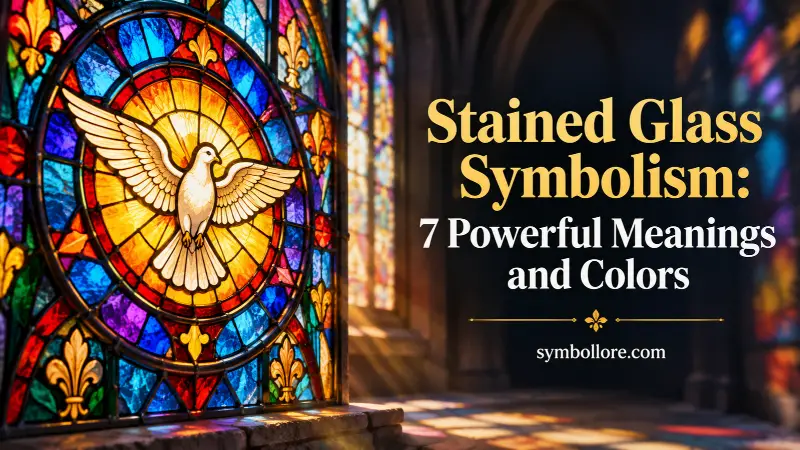
A dove can symbolize the Holy Spirit.
A cross can represent Christ’s Crucifixion and the Christian belief in salvation.
These images are usually more reliable indicators of meaning than color alone.
What Do Rose Windows Symbolize?
A rose window is a large circular window often found in Gothic churches.
Its design usually features radiating patterns arranged around a central point.
Rose windows can contain images of Christ, Mary, saints, angels, or biblical stories.
Their symbolic meaning depends on the complete design.
The circular arrangement may inspire ideas of divine order, completeness, or eternity. However, not every rose window was created to express all these concepts.
Some primarily organize religious narratives through a striking geometric design.
Why Is Light So Important?
Light gives stained glass its distinctive appearance.
Unlike an ordinary wall painting, a stained-glass window changes as daylight moves.
This creates a visual experience that connects the artwork with its surroundings.
In medieval Christian thought, light could also carry theological meaning.
For worshippers, the combination of architecture, colored glass, and sunlight could reinforce the spiritual purpose of a church.
Examples of Stained Glass Symbolism in Famous Art
Historic buildings and surviving artworks show how symbolism changes with time and artistic purpose.
1. Chartres Cathedral, France
Chartres Cathedral is famous for its medieval stained-glass windows.
Its windows portray biblical figures, religious narratives, and Christian themes.
The cathedral’s deep blue glass is especially celebrated.
Symbolic significance: The windows combine sacred storytelling with an atmosphere of light and devotion.
2. Canterbury Cathedral, England
Canterbury Cathedral contains important medieval stained-glass traditions.
Its historic windows include religious figures, biblical ancestry, and stories connected to Christian history.
These works reveal how stained glass helped communicate identity, devotion, and religious memory.
Symbolic significance: Religious images can preserve beliefs and historical traditions across generations.
3. The Tree of Jesse Windows
The Tree of Jesse is a Christian artistic design based on the ancestry of Jesus.
Its imagery often shows figures connected through branches or a tree-like structure.
In stained glass, this pattern can illustrate the relationship between biblical history and Christian teachings about Christ.
Symbolic significance: The tree represents lineage, continuity, and the fulfillment of religious history.
4. Louis Comfort Tiffany’s Stained Glass
American designer Louis Comfort Tiffany helped transform stained-glass art during the late 19th and early 20th centuries.
His studios developed richly colored glass and innovative layered effects.
Tiffany windows appeared in churches as well as homes and other buildings.
Some feature religious subjects, while others portray flowers, landscapes, and decorative patterns.
Symbolic significance: Tiffany’s work shows that stained glass can express both religious devotion and an appreciation for natural beauty.
How to Interpret Stained Glass Symbolism
Understanding a stained-glass window requires looking beyond its colors.
A practical interpretation begins with the subject and setting.
Step 1: Identify the main image. Look for figures, animals, plants, religious objects, or geometric shapes. A recognizable biblical scene often provides the clearest meaning.
Step 2: Consider the location. A window in a cathedral may have a different purpose from one in a private home or public library.
Step 3: Examine the colors. Notice which colors draw attention. Consider their possible meanings without assuming every shade has a fixed message.
Step 4: Study the historical background. Learn when the window was made and who commissioned it. An artist’s purpose may differ from modern interpretations.
Step 5: Observe the role of light. Notice how sunlight changes the appearance of the design throughout the day.
This method helps separate documented meanings from personal impressions.
Stained Glass Symbolism in Modern Art and Culture
Stained glass continues to inspire artists beyond traditional church architecture.
Homes and Interior Design
Decorative stained glass can create privacy while allowing light into a room.
Its colors may suggest warmth, individuality, or an appreciation for craftsmanship.
In this setting, the meaning is usually personal or aesthetic rather than religious.
Literature and Storytelling
Writers may use stained glass to represent beauty, memory, faith, or a changing perspective.
A colorful church window might reinforce a story’s religious setting.
A damaged window could suggest loss or a broken tradition.
These meanings depend on the narrative. They are not automatic properties of the glass itself.
Memorials and Public Buildings
Stained-glass installations can commemorate important people or events.
A memorial design may include symbols tied to the person being honored.
Here, the window can represent shared memory, gratitude, and continuity.
Religious vs. Secular Stained Glass Symbolism
Although stained glass often appears in churches, it is not exclusively religious.
| Feature | Religious Stained Glass | Secular Stained Glass |
|---|---|---|
| Main Purpose | Worship, teaching, remembrance | Decoration, artistic expression, identity |
| Common Subjects | Christ, saints, biblical stories | Landscapes, flowers, abstract designs |
| Role of Light | May support sacred symbolism | Often emphasizes atmosphere and beauty |
| Symbolic Meaning | Based on religious traditions and imagery | Often depends on artist or viewer |
| Typical Locations | Churches, chapels, religious institutions | Homes, museums, libraries, public buildings |
A floral Tiffany-style window, for example, does not necessarily carry a Christian message simply because it uses stained glass.
The material is the same, but the intended meaning may be entirely different.
Common Misconceptions About Stained Glass Symbolism
Every Stained-Glass Color Has One Fixed Meaning
Color associations vary across cultures and historical periods.
Red can suggest sacrifice in one Christian image and royal clothing in another.
Artists also select colors for contrast, beauty, and available materials.
Therefore, fixed color charts should be treated as interpretive guides rather than universal historical rules.
All Stained-Glass Windows Are Religious
Stained glass appears in homes, civic buildings, commercial spaces, and modern installations.
Many designs contain no religious subject.
Its use in churches is historically important, but the medium itself is not limited to worship.
Every Medieval Window Was Made to Teach People Who Could Not Read
Religious teaching was an important purpose of medieval windows.
However, stained glass also expressed devotion, honored donors, displayed artistic skill, and enhanced architecture.
Reducing every window to a teaching tool overlooks these other functions.
Broken Stained Glass Always Symbolizes Healing
Broken stained glass may suggest loss, damage, change, or recovery in a story.
The meaning depends on the surrounding context.
A shattered church window could represent destruction rather than healing. Another artist might use repaired glass to suggest resilience.
Neither interpretation applies automatically.
Stained Glass Has Supernatural Powers
Stained glass can hold deep religious or personal significance.
However, its beauty and symbolic meaning do not establish that the material itself possesses supernatural powers.
Religious meanings come from beliefs, traditions, and the images represented.
Important Historical Facts About Stained Glass
Medieval Windows Were Complex Works of Art
Traditional stained-glass windows required several specialized skills.
Artists planned the design, selected colors, cut glass, painted details, and assembled the pieces.
Lead strips joined the sections together.
The finished window depended on careful coordination between design and craftsmanship.
The Colors Came From Materials and Techniques
Historic glassmakers used metallic compounds to create different colors.
Some windows also included painted details and silver stain, which could produce yellow tones.
These methods influenced the final appearance.
As a result, the meaning of a color cannot always be separated from the technology used to create it.
Medieval Color Choices Were Not Always Symbolic
Scientific research on historic cathedral windows has shown that color choices did not consistently follow a universal religious code.
Artists also responded to visual balance, tradition, fashion, and available materials.
This is an important distinction when interpreting historic stained glass.
Stained Glass Changes With Its Environment
The same window can appear bright in direct sunlight and darker on a cloudy day.
This changing quality is central to its visual appeal.
In religious settings, viewers may connect the shifting light with reflection and spiritual experience.
In other spaces, it may simply create an engaging artistic atmosphere.
People Also Ask About Stained Glass Symbolism
What Does Stained Glass Represent Spiritually?
Stained glass can represent divine light, faith, hope, and spiritual transformation. Its religious meaning often comes from the images shown and the role of light in sacred spaces. However, spiritual interpretations vary between traditions and individuals.
What Do Stained-Glass Windows Mean in Churches?
Church stained-glass windows often illustrate biblical stories, portray saints, and express Christian beliefs. Their colored light may also contribute to an atmosphere of worship and reflection. The subject of each window usually provides the strongest clue to its meaning.
Why Are Church Stained-Glass Windows Colorful?
Church windows use color to create visual interest, distinguish figures, support storytelling, and transform natural light. Certain colors may also reinforce religious associations. However, historical artists did not always use colors according to one fixed symbolic system.
What Does a Circle Mean in Stained-Glass Art?
A circle may suggest wholeness, continuity, or eternity in a modern interpretation. In Gothic rose windows, circular patterns also organize biblical scenes and decorative elements. The complete design matters more than the circular shape alone.
Frequently Asked Questions
Yes, stained glass can symbolize hope, especially when light and religious imagery support that interpretation. Sunlight shining through colorful glass may suggest renewal or a brighter future. In Christian artwork, scenes about salvation or resurrection can reinforce this meaning. However, hope is not the intended message of every stained-glass design.
Blue often carries associations with heaven, peace, devotion, and the Virgin Mary in Western Christian art. These meanings may appear in stained-glass windows featuring religious figures. However, the precise interpretation depends on the scene and artistic tradition. Blue was also used for backgrounds and decorative purposes, so its presence alone does not prove a specific message.
Red may represent love, sacrifice, courage, or martyrdom in Christian imagery. It can be especially meaningful in scenes showing Christ’s suffering or saints who died for their faith. Yet red also has a strong visual effect and may serve a decorative purpose. The surrounding images offer better evidence of its intended symbolism.
Broken stained glass may symbolize loss, damaged beliefs, disrupted traditions, or emotional pain. In some modern artworks, repaired glass can suggest recovery and resilience. These meanings depend on the story or artwork. There is no universal religious teaching that broken stained glass always represents healing, forgiveness, or spiritual transformation.
No. Christianity has a major historical connection with stained glass, especially in medieval European churches. However, the art form also appears in other religious settings and secular architecture. Modern artists use it for landscapes, abstract designs, personal expression, and decorative installations. Its meaning comes from context rather than the material alone.
Gothic architecture developed structural methods that supported taller walls and larger window openings. Builders used these spaces for colorful glass designs that illuminated church interiors. The windows could portray religious stories and enhance the spiritual atmosphere. Their size also demonstrated architectural skill and the resources devoted to important religious buildings.
Stained glass in a dream may personally suggest faith, beauty, memory, or a changing perspective. Someone might associate its colors with emotional experiences or spiritual reflection. However, no universal dream meaning can be established from the image alone. Personal circumstances and the dream’s wider context are more useful than fixed interpretations or claims about certain predictions.
Conclusion: What Does Stained Glass Ultimately Symbolize?
Stained glass symbolism centers on light, faith, hope, beauty, memory, and transformation.
In Christian churches, stained-glass windows communicate biblical stories and religious beliefs. In modern art, they can also represent personal growth, unity, or remembrance.
Their deeper meaning comes from the relationship between color, imagery, light, and context. Understanding those elements helps reveal why stained glass has inspired people for centuries.