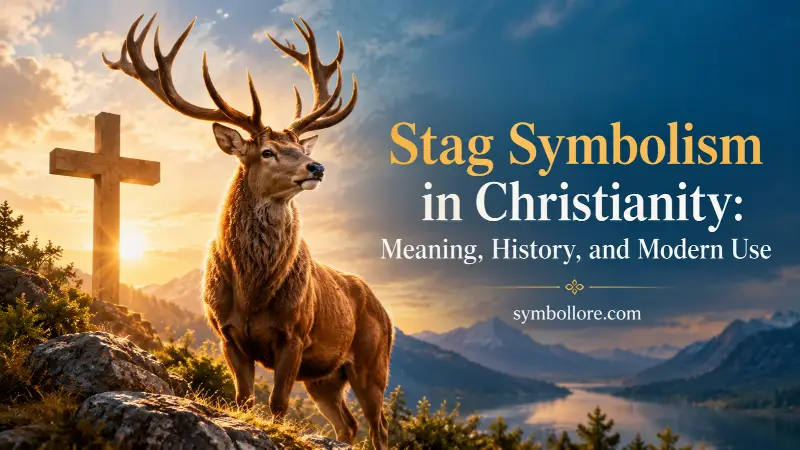
A stag is more than a beautiful woodland animal in Christian symbolism. It represents a soul searching for God, the strength that comes from faith, and the hope of spiritual renewal. For centuries, Christians have used images of deer to express devotion, trust, and the desire for a closer relationship with God.
But what does stag symbolism in Christianity actually mean? Does the animal represent Jesus Christ, or does it symbolize the faithful believer?
The answer comes from biblical poetry, early Christian art, and religious traditions. Each gives the stag a special meaning that continues to inspire Christians today.
Quick Answer: What Does a Stag Symbolize in Christianity?
In Christianity, a stag commonly symbolizes spiritual longing, faith, divine strength, renewal, and conversion. Psalm 42 compares a soul seeking God to a thirsty deer searching for water. Other biblical passages connect deer with sure footing and strength. In Christian art, a stag bearing a cross between its antlers also represents an encounter with Christ.
Key Takeaways
- Spiritual longing: The thirsty deer in Psalm 42 represents a soul seeking God’s presence.
- Strength through faith: Psalm 18:33 and Habakkuk 3:19 compare God-given strength to a deer’s sure footing.
- Renewal and baptism: Deer drinking water appear in historic Christian artwork linked to spiritual rebirth.
- Divine encounter: A stag bearing a crucifix recalls the conversion legends of Saints Eustace and Hubert.
- Different interpretations: A stag can represent a believer, spiritual transformation, or Christ’s presence, depending on the context.
What Is Stag Symbolism in Christianity?
Stag symbolism in Christianity refers to the religious meanings associated with a male deer, particularly one with prominent antlers.
A stag is an adult male deer. In older English writing, the word hart often refers to a male deer as well. This explains why some traditional Bible translations mention a hart, while newer versions simply use the word deer.
Christian symbolism uses natural objects and animals to communicate spiritual ideas. A dove, for example, may represent the Holy Spirit. Similarly, a deer seeking water can express a person’s deep desire for God.
However, the Bible does not give every animal one fixed symbolic meaning. Readers must consider each passage and its context.
The stag became important in Christianity through three major traditions: biblical poetry, baptismal imagery, and stories about religious conversion.
The Meaning and Importance of the Stag in Christianity
The stag carries several connected meanings. Most involve the relationship between human weakness and God’s strength.
1. Spiritual Thirst and Longing for God
Psalm 42:1 provides one of Christianity’s most recognized deer images.
The psalm compares a thirsty deer searching for flowing water with a soul longing for God.
Water is essential for the animal’s survival. In the same way, the psalmist expresses a deep need for God’s presence.
This image is especially meaningful during difficult times. A person experiencing grief, loneliness, or spiritual uncertainty may find comfort in the psalm.
The deer represents an honest search for God rather than perfect or unquestioning faith.
2. Spiritual Strength and Confidence
Deer can move across steep and rocky landscapes with remarkable agility.
Psalm 18:33 uses this ability to describe the strength God gives.
The verse compares God-given stability with the sure footing of a deer on high ground.
This does not mean believers will never face danger. Instead, the image communicates confidence in God’s support during difficult circumstances.
For Christians, the stag can therefore become a reminder of courage, endurance, and trust.
3. Faith During Difficult Times
Habakkuk 3:19 also compares the prophet’s strength to the feet of a deer.
The surrounding passage describes hardship and a lack of food. Even so, the prophet chooses to rejoice in God.
The animal’s steady movement across difficult ground becomes a picture of perseverance.
This meaning can speak to believers facing uncertain circumstances. Faith does not always remove the obstacle, but it can provide strength to continue.
4. Renewal and New Spiritual Life
In early Christian artwork, deer often appear beside flowing water.
These images sometimes connect Psalm 42 with baptism, spiritual cleansing, and eternal life.
Baptism marks entry into Christian life in many traditions. The movement of a deer toward water became a fitting image for a person seeking spiritual renewal.
The symbolism developed through Christian worship and artistic interpretation. It is not a separate biblical command about deer.
5. Religious Conversion and Divine Guidance
The cross-bearing stag became especially important in medieval Christian traditions.
According to the legend of Saint Eustace, a Roman hunter encountered a stag with an image of the crucified Christ between its antlers.
The extraordinary encounter led him to embrace Christianity.
A similar story later became associated with Saint Hubert.
These legends present the stag as a sign of spiritual awakening. They also show how an unexpected moment can lead someone to reconsider the direction of life.
6. Hope and Perseverance
The stag’s connection with faith and renewal also makes it a possible symbol of hope.
This interpretation draws on the biblical image of a deer finding secure footing and the Christian tradition of water as a sign of new life.
A person might choose stag artwork to remember a difficult period they survived through faith.
However, hope is an interpretation drawn from related Christian themes, not a single meaning assigned to the stag throughout Scripture.
7. Christ’s Presence and Spiritual Transformation
In certain Christian artworks, a stag bearing a crucifix represents the appearance of Christ to a future saint.
The meaning comes from the Eustace and Hubert legends.
The stag itself is not universally recognized as a symbol of Jesus in every Christian tradition. Instead, the cross, the surrounding story, and the artwork determine its meaning.
This distinction matters because a stag drinking water usually symbolizes spiritual thirst, while a stag carrying a crucifix points toward an encounter with Christ.
Biblical References to Deer and Stag Symbolism
Several Old Testament passages provide the foundation for Christian interpretations of the stag.
| Bible Passage | Deer Imagery | Spiritual Meaning |
|---|---|---|
| Psalm 42:1–2 | A deer thirsting for water | Longing for God’s presence |
| Psalm 18:33 | Deer moving securely on high ground | Strength and stability from God |
| Habakkuk 3:18–19 | Deer-like footing during hardship | Trust and perseverance |
| 2 Samuel 22:34 | Feet like those of a deer | God-given ability and confidence |
| Song of Songs 2:9 | A beloved compared to a gazelle or young stag | Love, beauty, and admiration |
Does Psalm 42 Refer to a Stag?
Psalm 42 uses the image of a deer longing for water.
Older English versions may use hart, meaning a male deer. Many modern translations use the broader word deer.
The main point is not the animal’s gender. It is the intensity of the animal’s thirst.
The psalm expresses the writer’s longing for God, making it one of the strongest biblical foundations for Christian deer symbolism.
What Does a Stag Represent in Song of Songs?
Song of Songs uses deer-like animals to describe beauty, speed, affection, and the beloved.
The book is primarily love poetry. In some Christian traditions, readers also understand its imagery as an allegory of Christ’s love for the Church.
That spiritual reading belongs to a long history of interpretation. It should not replace the poem’s original romantic setting.
Key Features of the Stag in Christian Symbolism
Different parts of a stag’s appearance can suggest different spiritual ideas.
Antlers: Strength and Personal Renewal
Antlers make a mature stag easy to recognize.
Many deer species shed and regrow their antlers. Because of this natural cycle, modern readers may associate antlers with growth, renewal, and resilience.
These are reasonable personal interpretations. However, the Bible does not directly teach that deer antlers symbolize resurrection or spiritual rebirth.
In historic Christian images, antlers also provide the setting for the crucifix in the legends of Saints Eustace and Hubert.
Water: Spiritual Thirst and Baptism
A deer drinking from a stream strongly recalls Psalm 42.
Christian artists developed this image further by connecting flowing water to baptism and spiritual life.
A stag near a fountain may therefore represent a soul approaching God or a believer receiving new life through faith.
The surrounding artwork helps identify the intended meaning.
High Ground: Confidence in God
Deer are known for moving across challenging terrain.
Biblical poets use their sure footing to describe security and strength.
The image offers a lesson about trusting God during unstable circumstances.
It does not promise that every challenge will end quickly or easily.
The Cross Between Antlers: Conversion
A stag carrying a crucifix is a distinctive Christian symbol.
It most often points to the traditions of Saints Eustace and Hubert.
In these stories, the cross reveals Christ’s presence and leads the hunter toward spiritual change.
Unlike general deer imagery, this specific design has a clear connection to medieval Christian legend.
Examples of Stag Symbolism in Christianity
Christian history includes several recognizable uses of stag imagery.
Example 1: Saint Eustace and the Miraculous Stag
Saint Eustace’s traditional story describes a Roman soldier named Placidus who was hunting when he encountered an unusual stag.
A crucifix appeared between the animal’s antlers, and Christ spoke to the hunter.
The experience led Placidus to become a Christian and take the name Eustace.
This legend became a popular subject in European religious art.
A well-known example is Pisanello’s The Vision of Saint Eustace, painted around 1438–1442.
The artwork portrays the encounter as a moment of revelation.
Symbolic lesson: A life-changing spiritual experience can challenge a person’s beliefs and redirect their choices.
The account belongs to Christian hagiography, the tradition of writing about saints’ lives. Its miraculous details should not be presented as independently verified historical events.
Example 2: Saint Hubert and the Cross-Bearing Stag
Saint Hubert is traditionally associated with hunting and the forests of the Ardennes.
According to a later legend, he encountered a stag bearing a crucifix while hunting.
The experience inspired him to turn toward a religious life.
In Christian art, Saint Hubert may appear beside a stag, sometimes with hunting dogs or woodland scenery.
Symbolic lesson: Spiritual transformation may begin when a person recognizes a need to change.
The legend is important to Christian tradition, but its miraculous encounter cannot be established as historical fact.
Example 3: Deer Drinking from a Baptismal Fountain
Historic Christian mosaics sometimes depict deer drinking from streams or fountains.
The Musée de Valence preserves baptistery mosaics showing deer near the rivers of Paradise.
The imagery connects water with baptism, resurrection, and eternal life.
Symbolic lesson: A believer seeks spiritual renewal as naturally as a thirsty animal seeks water.
This example demonstrates that deer symbolism was part of Christian visual culture, not merely a modern interpretation.
Example 4: A Stag in Personal Devotional Artwork
Imagine a Christian choosing a painting of a stag standing beside a quiet stream.
The person may associate the scene with Psalm 42 and a renewed commitment to prayer.
The image could serve as a personal reminder to seek God’s presence.
Symbolic lesson: Religious symbols can connect biblical passages with personal devotion.
This is an illustrative modern example, not a claim about an established ritual.
How Stag Symbolism Appears in Christian Life Today
The stag’s traditional meanings can still have a place in modern Christian reflection.
Personal Prayer and Meditation
A deer seeking water can help someone remember Psalm 42.
A believer might reflect on whether daily worries have distracted them from prayer or spiritual growth.
The image does not have supernatural power. Its value comes from the biblical idea it recalls.
Christian Art and Decoration
Stag imagery can appear in paintings, stained-glass designs, illustrations, and other religious objects.
A deer drinking water may emphasize devotion or baptism.
A cross-bearing stag may refer to Saint Eustace or Saint Hubert.
However, a decorative deer is not automatically a religious symbol. The artist’s purpose and the design’s context matter.
Religious Tattoos and Personal Symbols
Some Christians may choose a stag tattoo to express spiritual strength or a connection to Psalm 42.
Others may prefer a design featuring a cross between the antlers.
Such meanings are personal unless the design clearly refers to established Christian iconography.
Christian views on tattoos also differ across denominations and individual communities.
Stag Symbolism Compared With Other Christian Animals
Christian art uses many animals, but their meanings are not interchangeable.
| Animal | Common Christian Association | Important Distinction |
|---|---|---|
| Stag or deer | Spiritual longing, strength, renewal | Draws heavily on Psalms and later Christian art |
| Lamb | Jesus Christ, sacrifice, innocence | Has direct New Testament connections to Christ |
| Dove | Holy Spirit, peace | Appears in accounts of Jesus’ baptism |
| Lion | Kingship, courage, Christ | Can have different meanings depending on the biblical passage |
| Eagle | Strength, renewal, heavenly imagery | Often connects to biblical images of soaring and endurance |
Does a Stag Symbolize Jesus Christ?
Sometimes, but not in every setting.
A stag carrying a crucifix can represent a miraculous appearance of Christ in the legends of Saints Eustace and Hubert.
However, a deer seeking water in Psalm 42 represents a soul longing for God.
The stag does not have the same clear and widespread identification with Jesus as the Lamb of God.
Common Misconceptions About Stag Symbolism
Misconception 1: Every Stag Represents Jesus
Not every stag is a symbol of Christ.
In Psalm 42, the deer represents spiritual longing. In the legends of Saints Eustace and Hubert, the cross-bearing stag is connected to Christ’s appearance.
The intended meaning changes with the context.
Misconception 2: Deer Antlers Always Mean Resurrection
Deer antlers may inspire thoughts of renewal because they grow again after being shed.
However, this does not establish antlers as a universal biblical symbol of resurrection.
The association works better as a modern personal interpretation than as a direct statement from Scripture.
Misconception 3: Seeing a Stag Guarantees a Divine Message
The Bible does not teach that every encounter with a deer carries a special message from God.
Some people may find such an experience personally meaningful.
Still, an ordinary wildlife encounter is not proof of a supernatural sign.
Misconception 4: Saint Hubert and Saint Eustace Were the Same Person
Christian tradition recognizes them as different figures.
Their stories share the image of a hunter encountering a stag with a crucifix.
This similarity can make their artworks difficult to distinguish without additional details.
Misconception 5: All Christian Churches Interpret Stags Identically
Christians share many biblical texts, but their approaches to images and saints differ.
Catholic and Orthodox traditions have extensive histories of religious iconography.
Many Protestant communities focus more directly on Scripture and may give less attention to saints’ legends.
Therefore, stag symbolism does not carry one required interpretation across Christianity.
Expert Insights and Important Historical Facts
Biblical Meaning and Medieval Tradition Are Different Sources
One of the most important distinctions is between biblical deer imagery and the later stories of Christian saints.
Psalm 42 and Habakkuk provide scriptural images that Christians can study directly.
The miraculous stag encounters belong to religious legends preserved and illustrated over many centuries.
Both influenced Christian culture, but they carry different kinds of historical and religious authority.
Christian Deer Symbolism Is Older Than the Famous Hunting Legends
Images of deer near water appeared in early Christian decorative and baptismal contexts.
This means the relationship between deer, spiritual thirst, and Christian renewal did not begin with the medieval stories of Eustace and Hubert.
The baptismal imagery developed from biblical poetry and early Christian interpretations of water and new life.
The Same Stag Can Have Different Meanings
A stag’s meaning depends on what surrounds it.
Consider three examples:
- A deer beside flowing water may suggest spiritual longing or baptism.
- A deer standing on rocky heights may recall God-given strength.
- A stag with a crucifix between its antlers usually connects to a conversion legend.
The setting is often more important than the animal alone.
This provides a reliable way to interpret Christian artwork without assigning unsupported meanings.
People Also Ask About Stag Symbolism in Christianity
Deer represent spiritual longing, strength, and secure footing in several biblical passages. Psalm 42 uses a thirsty deer to describe the desire for God. Psalm 18 and Habakkuk 3 compare a deer’s agility with strength received from God.
The image comes from Christian traditions about Saints Eustace and Hubert. Both are associated with stories in which a hunter encounters a stag bearing a crucifix. The scene represents a divine encounter and a turning point in religious life.
In a Christian setting, a stag can suggest faith, spiritual longing, perseverance, and renewal. These meanings depend on biblical references and artistic traditions. Other spiritual systems may interpret the same animal differently.
Early Christian artists depicted deer drinking from streams or fountains. These images drew on Psalm 42 and the religious importance of water. In baptismal settings, they could symbolize spiritual cleansing, new life, and a soul seeking God.
Frequently Asked Questions
The stag is a recognized symbol in parts of Christian art and tradition, but it is not a universal emblem of Christianity. Its meanings come from biblical poetry, baptismal imagery, and legends about saints. The cross and the fish are more widely recognized Christian symbols. A stag’s religious meaning usually becomes clearer when it appears with water, a crucifix, or another Christian element.
Antlers are especially important in artwork about Saints Eustace and Hubert because the crucifix appears between them. Modern Christians may also associate antlers with strength or renewal. However, these broader meanings should not be mistaken for direct biblical teachings. Scripture does not assign a fixed theological meaning to the annual growth of deer antlers.
A white stag may appear in Christian artwork about Saint Hubert, whose legendary encounter is sometimes depicted with a white deer. The animal’s unusual appearance can emphasize the miraculous nature of the scene. However, Christianity does not have a universal doctrine that every white stag represents purity, salvation, or divine guidance. Such meanings depend on the specific story or artwork.
A stag in a dream may remind someone of biblical themes such as spiritual longing or trust in God. However, the Bible does not provide a fixed Christian interpretation for every dream involving deer. Dream details and personal circumstances can influence how someone understands the experience. It is best to treat such interpretations as personal reflection rather than certain predictions or divine instructions.
A hart is an older English term for a male deer, while stag is the more familiar modern term for an adult male deer. Bible translations may also use the broader word deer. In passages such as Psalm 42, the animal represents spiritual thirst. The central message remains the same despite differences in English vocabulary.
Yes. In Catholic tradition, Saint Hubert is widely recognized as a patron saint of hunters. His association with hunting comes partly from the famous story of his encounter with a crucifix-bearing stag. This tradition connects his life with spiritual conversion and a change in personal priorities. However, the miraculous details belong to legend rather than established historical evidence.
Christians can use stag imagery as a personal reminder of biblical teachings, depending on their beliefs about religious decoration. A painting of a deer near water, for example, may recall Psalm 42. The image itself does not guarantee spiritual protection or blessings. Its meaning comes from the beliefs, Scripture, and intentions associated with it.
Conclusion: What Does the Stag Ultimately Symbolize?
Stag symbolism in Christianity centers on spiritual longing, faith, divine strength, renewal, and transformation.
The Bible presents the deer as a powerful image of a soul seeking God and receiving strength during hardship. Christian art adds further meaning through baptismal imagery and the conversion legends of Saints Eustace and Hubert.
Above all, the stag reminds believers of a simple spiritual truth: just as a thirsty deer seeks water, the human soul can seek strength, hope, and fulfillment in God.