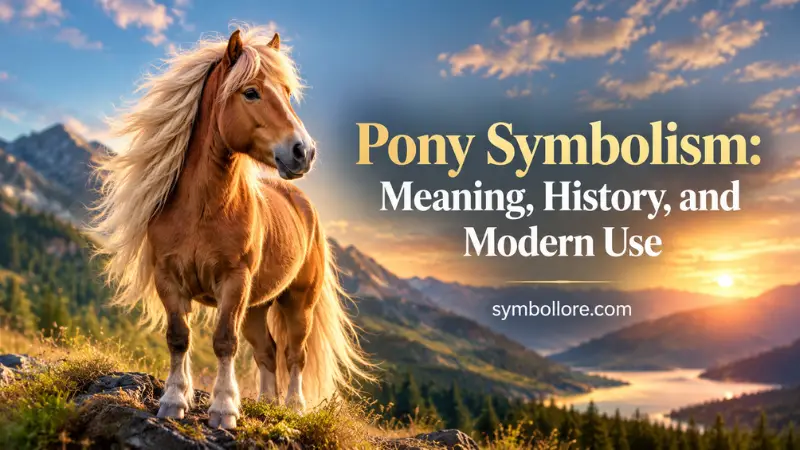
Pony symbolism most often represents quiet strength, resilience, freedom, loyalty, playfulness, and the confidence to move at one’s own pace. These meanings come from the animal’s compact build, sure footing, social nature, long working history, and strong place in childhood stories.
Yet a pony is not simply a smaller symbol of the horse. Horse imagery often emphasizes speed, grandeur, conquest, or unrestrained power. Pony imagery feels more grounded. It can suggest strength that others underestimate, independence without isolation, and gentleness that still has clear limits. The meaning also changes with the setting, from a wild island pony to a pit pony, a child’s companion, or a fictional character.
Quick Answer
Pony symbolism represents resilient strength, freedom, loyalty, humility, and youthful joy. A pony’s small but sturdy body supports meanings of endurance and underestimated ability, while its social behavior suggests trust and companionship. However, history, literature, dreams, and personal art use pony imagery differently, so no meaning applies in every context.
TL;DR
- Ponies often symbolize strength that does not need to look large or imposing.
- Wild pony imagery emphasizes freedom, self-direction, and survival.
- Working ponies can represent service, endurance, and overlooked labor.
- Children’s stories connect ponies with wonder, care, growth, and responsibility.
- A calm pony may suggest trust; a resisting pony can represent firm boundaries.
- Dream and spiritual meanings are personal interpretations, not proven messages.
Pony Meanings at a Glance
| Context | Possible Meaning | Why the Association Exists | Important Limit |
|---|---|---|---|
| Small, sturdy pony | Quiet strength and resilience | Compact ponies can work and travel in demanding conditions | Small size does not mean weakness or youth |
| Pony on open land | Freedom and independence | Open movement contrasts with fences, reins, and control | Many “wild” U.S. herds are technically feral |
| Pony carrying a load | Service, patience, and endurance | Ponies have worked in farming, transport, and mining | The image can also reveal exploitation |
| Pony with a child | Trust, care, and growing confidence | Pony stories and riding experiences often center on learning | Real ponies still require skilled, respectful handling |
| Herd or pair of ponies | Belonging and loyalty | Equines form social groups and communicate closely | Loyalty should not be confused with obedience |
| Resting pony | Contentment and grounded energy | The scene suggests safety, routine, and enoughness | In another setting, stillness may suggest confinement |
| Dream or tattoo | Personal freedom, memory, or resilience | The viewer connects the image with lived experience | Personal meaning outweighs generic symbol lists |
What Does Pony Symbolism Mean?
Pony symbolism describes capability without display. Ponies may look approachable, compact, or even cute, yet many breeds developed in rough landscapes where they needed stamina, balance, and efficient use of energy. That contrast creates the symbol’s central message: power does not always arrive in a dramatic form.
The pony can therefore represent a person who is underestimated but dependable. It suits stories about steady recovery, patient learning, practical courage, or doing difficult work without public praise. This meaning is close
which also links hard terrain with balance and perseverance. However, the pony adds a stronger history of partnership with people.
The symbol also carries warmth. Ponies appear in family farms, riding schools, fairs, picture books, and treasured childhood memories. As a result, they can express joy and affection without losing their connection to real strength.
Why Ponies Represent Quiet Strength
A pony is a mature small horse type, not a baby horse. A young horse is a foal. This difference matters because pony symbolism should not rest only on ideas of youth or innocence.
Many pony breeds have thick coats, strong bodies, and sure feet. Breeders valued those traits in places with cold weather, poor grazing, steep ground, or narrow working spaces. Their strength often looks economical rather than explosive. They conserve energy, test uncertain ground, and continue steadily.
That pattern supports several symbolic ideas:
- Resilience: continuing under hard conditions;
- Resourcefulness: doing more with limited space or supplies;
- Humility: possessing strength without needing to appear grand;
- Self-trust: choosing a safe pace rather than following pressure;
- Boundaries: refusing when a path or demand feels unsafe.
Calling a pony stubborn can miss the point. In symbolic use, refusal may represent fear, judgment, self-protection, or a limit that deserves attention.
Pony Symbolism Compared With Horse Symbolism
Ponies and horses share meanings because both belong to the same species and have long lived beside people. Both can represent travel, vitality, loyalty, freedom, and the bond between instinct and guidance. Still, their images create different emotional effects.
A large running horse often suggests speed, majesty, ambition, battle, or power that breaks restraint. A pony usually feels closer to the ground. It may suggest practical endurance, companionship, childhood, rural life, or strength hidden by modest size.
The difference becomes clear in a story. A warrior on a tall horse may signal status and command. A child caring for a pony may signal trust, responsibility, and growing independence. A pack pony crossing a difficult trail emphasizes service and persistence rather than spectacle.
Neither image has a fixed meaning. Pose, rider, equipment, landscape, and cultural source still control the interpretation.
Pit Ponies and the Symbolism of Work
Pit ponies give the symbol a serious historical layer. Mines used compact, heavy-bodied equines because they could move through low passages and pull loaded carts.
The National Coal Mining Museum’s pit-pony history
explains that British mines used Welsh and Shetland ponies in smaller tunnels. It also records harsh conditions, injuries, and the long decline of pony labor as machinery took over.
This history supports meanings of endurance, duty, and partnership. However, it also warns against romanticizing service. An animal praised for loyalty may still have lacked freedom. Therefore, a pit pony can symbolize both dependable labor and the moral cost of treating a living being mainly as a tool.
The same tension appears in other working-animal symbols.
For example, llama symbolism
also connects endurance and transport with a long human-animal relationship. In both cases, respect requires attention to care, burden, and cultural history.
Wild Ponies, Freedom, and the American Imagination
In the United States, island ponies create a powerful image of freedom. The horses of Assateague live among beaches, marshes, storms, insects, and limited food. Their ability to survive there supports modern themes of adaptability, independence, and belonging to a place.
However, “wild” needs qualification.
The National Park Service’s Assateague horse history
describes the herds as feral descendants of domestic horses. It also separates popular shipwreck folklore from the more likely explanation that mainland owners placed livestock on barrier islands during the colonial period.
The ponies still hold deep cultural value. Chincoteague’s annual Pony Penning tradition and Marguerite Henry’s 1947 novel Misty of Chincoteague helped turn them into national symbols. In this setting, the pony represents freedom, local identity, survival, family tradition, and the difficult balance between human care and animal wildness.
Childhood, Wonder, and Growing Responsibility
Modern pony imagery often represents childhood joy, but its meaning goes beyond cuteness. A pony gives a young character something real to care for. Feeding, grooming, riding, and earning an animal’s trust require patience and responsibility.
Children’s pony stories therefore create a bridge between imagination and maturity. The animal may symbolize a dream, yet that dream demands steady work. A child who learns to guide without cruelty also learns that confidence and control are not the same thing.
Popular toys and animated ponies strengthen associations with color, friendship, imagination, and self-expression. Those modern meanings come from media and play rather than ancient folklore. They remain culturally important because they shape how many Americans first encounter pony imagery.
A pony can also recall a safer or simpler time. In adult art, that nostalgia may feel comforting. It may also express grief for childhood freedom or a desire to recover curiosity.
Loyalty, Trust, and Healthy Boundaries
Pony symbolism often joins loyalty with independence. A pony can form a close bond with people and other equines, yet closeness does not erase its will. It may cooperate, hesitate, resist, or leave when given space.
That balance makes the pony a useful symbol for healthy trust. Genuine loyalty grows through repeated care, clear signals, and safety. It is not blind obedience. A gentle animal that plants its feet can represent the right to say no.
This meaning differs from the protective duty often associated with
The dog image commonly stresses guarding and trained service. The pony more often suggests cooperation between two beings who must learn each other’s movements.
In relationships, pony imagery can therefore mean: stay warm, remain loyal, and keep your boundaries.
Ponies in Literature: Freedom, Care, and Loss
Literature often uses ponies to test the relationship between love and possession. In Misty of Chincoteague, Assateague represents wildness, while nearby human society offers care, work, and belonging. The story’s ponies allow readers to ask whether loving an animal means keeping it or respecting its freedom.
John Steinbeck’s The Red Pony uses a different emotional path. The pony becomes part of a child’s encounter with hope, responsibility, illness, death, and the limits of adult promises. Here, pony symbolism is not mainly cheerful. It marks the painful movement from childhood confidence toward a more complicated understanding of life.
These works show why no short list can define every pony in fiction. A literary symbol gains meaning through plot, repeated images, relationships, and change. Readers should ask what happens to the pony, who controls it, and how the human characters respond.
Spiritual Meaning of a Pony
In modern spiritual interpretation, a pony may represent grounded freedom, modest strength, trustworthy companionship, or progress at a sustainable pace. Someone drawn to the image may use it as a reminder that gentleness and courage can exist together.
The pony can also symbolize a “smaller path” that remains worthwhile. Not every goal needs dramatic speed, public status, or heroic scale. A modest life can still contain movement, loyalty, pleasure, and purpose.
These readings are personal or community-based beliefs. There is no single ancient “pony spirit animal” tradition shared across cultures. In addition, specific Indigenous relationships with horses should not be reduced to generic online spirit-animal claims.
A grounded spiritual reflection might ask:
- Where am I stronger than others assume?
- Which responsibility requires patience rather than force?
- Do I need freedom, belonging, or a better balance between them?
- Is my resistance protecting a real boundary, or keeping me stuck?
Pony Dreams and Personal Encounters
A pony dream does not predict a fixed future event. Dreams combine memory, emotion, recent experience, and personal associations. The most useful interpretation begins with the animal’s action and the dreamer’s feelings.
A free-running pony may reflect a desire for space or self-direction. A pony carrying too much could mirror pressure, duty, or unequal work. Caring for one may suggest growing responsibility, while an injured pony could express concern about vulnerability or neglected needs.
Color adds mood, not a guaranteed code. A white pony might feel peaceful in one dream and ghostly in another. A dark pony can feel protective, mysterious, or frightening depending on the scene.
For a real-life encounter, begin with the ordinary explanation. The moment may still become personally meaningful, but that meaning comes from reflection rather than proof of an omen.
Pony Tattoo Meaning
A pony tattoo can represent freedom, resilience, childhood memory, rural heritage, or a bond with a real animal. The design changes the message.
- A running pony suggests freedom, energy, or escape from limits.
- A sturdy moorland pony can represent endurance and self-reliance.
- A pony with a child may honor trust, care, or a formative memory.
- A pit pony can memorialize labor history, sacrifice, or family mining roots.
- A colorful cartoon pony may express playfulness, fandom, friendship, or identity.
- A herd can symbolize belonging without the loss of individuality.
The wearer’s story matters more than a generic definition. Cultural patterns, tribal designs, or ceremonial imagery require special care and should not be copied without understanding their source and ownership.
How to Interpret Pony Imagery Accurately
Start with visible evidence instead of choosing a meaning from a list.
- Identify the pony’s condition. A healthy, burdened, frightened, decorated, or injured pony creates a different message.
- Notice its action. Running, carrying, resting, resisting, and following all suggest different relationships with freedom and control.
- Study the setting. A mine, island, farm, fair, battlefield, or child’s bedroom changes the image’s cultural frame.
- Look at human contact. A rider, handler, child, or empty saddle may shift the meaning toward trust, authority, care, absence, or loss.
- Check the source. A novel, dream, logo, historical photograph, and tattoo do not use symbolism in the same way.
This method prevents a flexible symbol from becoming a false universal rule.
Common Misconceptions About Pony Symbolism
Several popular claims need correction.
First, a pony is not automatically a young horse. Ponies can be fully mature, and their small size often comes with strength and hardiness. Therefore, innocence is only one possible meaning.
Second, pony and horse symbolism overlap but are not identical. The pony’s scale and social history add themes of underestimated strength, childhood, and practical service.
Third, “stubbornness” is not always negative. In a story, refusal can represent wisdom, fear, independence, or resistance to control.
Finally, no color or dream scene carries a guaranteed message. White does not always mean purity, and a black pony does not automatically signal danger. Tone, action, and personal experience matter more.
FAQs
Yes, a pony can symbolize freedom, especially when shown running on open land or living with a feral herd. However, working, saddled, fenced, or tethered ponies may instead highlight the tension between freedom and control.
Spiritually, a pony may represent quiet strength, grounded independence, loyal companionship, and progress at a manageable pace. These are modern personal interpretations rather than a single belief shared by every religion or culture.
A white pony may suggest peace, innocence, hope, memory, or a fresh start in modern Western imagery. Yet white can also create a ghostly or distant mood. The scene and cultural setting determine which reading fits.
A black pony can represent mystery, independence, hidden strength, elegance, or fear. It is not automatically a bad omen. Its behavior and the viewer’s emotional response provide better clues than color alone.
A wild or feral pony commonly symbolizes freedom, resilience, self-direction, and life shaped by the landscape. Assateague imagery adds American themes of island survival, community tradition, and respect for animals that remain outside ordinary domestic control.
Seeing a pony is not a proven sign of future luck. If the encounter feels meaningful, it may remind you of patience, joy, freedom, or underestimated ability. Treat that response as personal reflection rather than a prediction.
Sources and Further Reading
- Assateague’s Wild Horses — National Park Service
- Chincoteague Ponies — U.S. Fish & Wildlife Service
- Pit Ponies — National Coal Mining Museum for England
- Misty of Chincoteague Symbols and Motifs
Conclusion
Pony symbolism centers on quiet strength, resilience, freedom, loyalty, and the courage to move at a sustainable pace. Those meanings grow from real contrasts: a small body with surprising power, a gentle presence with firm boundaries, and a social animal that still values movement. Yet context remains essential. A pit pony, an Assateague herd, a child’s companion, and a literary pony do not tell the same story. The clearest interpretation begins with the animal’s action, setting, and relationship to people. The pony’s grounded lesson is simple: strength can be modest, warm, and steady without being weak.


