
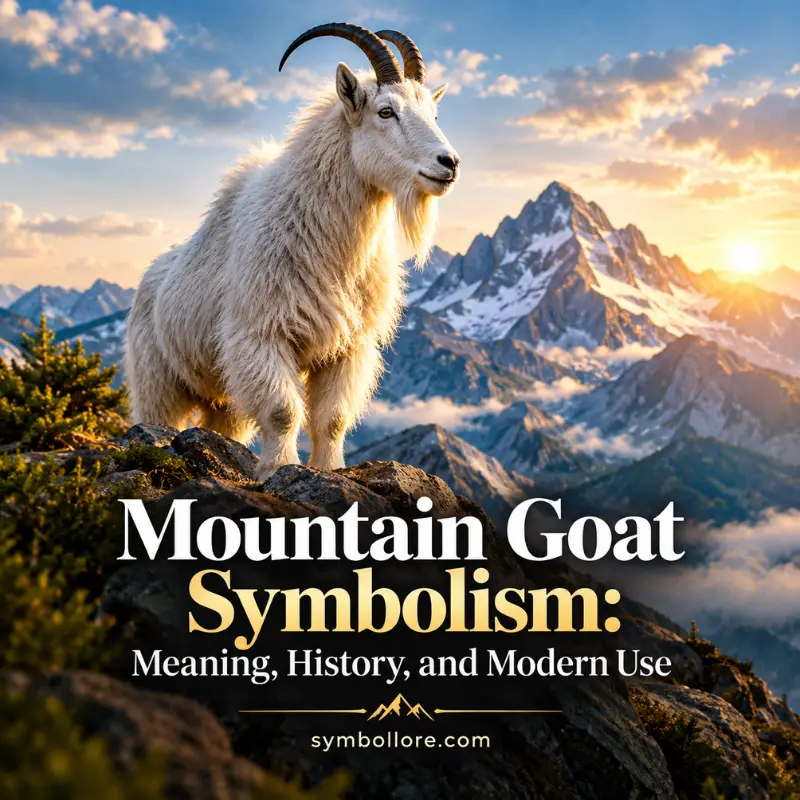
Mountain goat symbolism commonly represents endurance, balance, ambition, independence, and the ability to move through difficult situations. These meanings come largely from the animal’s life on steep cliffs, rocky slopes, and high mountain ridges.
However, the mountain goat does not carry one universal meaning. Northwest Coast Indigenous communities have deep cultural relationships with the animal, while ancient artists often portrayed other wild goats, such as ibexes. Modern Americans may use the mountain goat as a personal symbol of determination, outdoor freedom, or steady progress. Each meaning depends on the animal, culture, period, and setting involved.
Quick Answer
Mountain goat symbolism represents perseverance, careful progress, balance, ambition, and confidence in difficult conditions. These meanings reflect the animal’s ability to climb steep terrain and remain secure where few creatures can travel. However, traditional Indigenous meanings, ancient ibex imagery, and modern personal interpretations should remain separate rather than being treated as one universal belief.
TL;DR
- Mountain goats often represent endurance and steady progress.
- Their climbing skill links them with balance, focus, and adaptability.
- High mountain habitats can suggest ambition, freedom, or perspective.
- Northwest Coast cultures have distinct material and cultural relationships with the animal.
- Ancient ibex and wild-goat images do not automatically carry modern mountain-goat meanings.
- Dream and spiritual interpretations remain personal rather than proven messages.
Mountain Goat Meanings at a Glance
| Context | Possible Meaning | Why the Association Exists | Important Limit |
|---|---|---|---|
| Climbing steep cliffs | Perseverance and progress | The animal advances across difficult terrain | This is mainly a modern visual interpretation |
| Standing on a narrow ledge | Balance and self-control | Secure footing prevents dangerous falls | Balance does not mean the animal never struggles |
| Living at high elevations | Ambition and perspective | Mountains suggest height, goals, and distance from ordinary life | Cultural meanings of mountains vary |
| Moving independently | Confidence and freedom | Mountain goats travel through remote environments | Females and young may also form social groups |
| Horns and strong build | Defense and resilience | Horns provide protection and social power | Horn meanings differ from those of antlers |
| Northwest Coast traditions | Relationship, livelihood, art, and responsibility | Hair, hide, bone, and horn have long held practical and ceremonial value | Meanings differ among individual nations |
| Modern tattoos and logos | Achievement and toughness | The climbing animal creates a clear image of overcoming difficulty | The intended meaning belongs to the wearer or organization |
What Does Mountain Goat Symbolism Mean?
The mountain goat most often symbolizes the ability to continue despite difficult conditions. Its symbolic power comes from visible actions rather than a single old legend. The animal climbs narrow ledges, crosses broken rock, and survives in exposed alpine environments. As a result, people connect it with patience, skill, and resilience.
Its meaning differs slightly from simple strength. A mountain goat does not overcome a cliff by charging forward. Instead, it tests its footing and chooses a workable path. Therefore, the animal can represent controlled effort rather than reckless force.
The symbolism also connects with personal ambition. A mountain goat moving upward resembles a person working toward a demanding goal. Yet the image carries an important lesson: reaching a higher position requires balance as well as desire.
Why Climbing Creates Meanings of Progress and Perseverance
Climbing gives the mountain goat its strongest modern symbolic meaning. Every step appears deliberate because one poor foothold could lead to danger. Consequently, the animal has become a useful image for gradual improvement.
This symbolism applies to goals that require time. A student completing a degree, a business recovering from a setback, or a person rebuilding confidence may identify with the animal’s slow upward movement. The mountain goat suggests that progress does not need to look fast or dramatic to matter.
Its movement also connects with
Physical balance allows the animal to remain stable, while symbolic balance can mean managing risk, effort, and patience. In both cases, control matters as much as forward motion.
However, this lesson should not become a demand to struggle alone. Mountain goats adapt their routes and respond to changing conditions. Symbolically, perseverance can include pausing, changing direction, and accepting support.
High Places, Ambition, and a Wider Perspective
Mountains often appear distant, difficult, and larger than ordinary human spaces. Therefore, an animal that lives near their peaks can suggest ambition, achievement, and an expanded point of view.
A mountain goat standing above a valley may symbolize seeing a problem from a wider perspective. Distance reveals patterns that remain hidden at ground level. In personal symbolism, this can mean stepping back before making a major decision.
Height can also suggest leadership or status. However, being physically high does not automatically mean moral superiority. In some images, the isolated animal may instead represent solitude, exposure, or the cost of pursuing a demanding goal.
Modern American outdoor brands often use mountain animals to communicate adventure and toughness. These designs usually reflect current marketing language, not an inherited cultural meaning. The image works because viewers quickly recognize cliffs, high elevations, and difficult movement as signs of challenge.
Sure-Footedness as a Symbol of Balance and Judgment
Mountain goats have split hooves with firm outer edges and textured inner pads. This structure helps them grip uneven rock. Their secure movement has inspired meanings related to judgment, stability, and trust in one’s abilities.
Symbolically, sure-footedness does not mean knowing the entire route. It means choosing the next safe step with care. This makes the mountain goat especially relevant to periods of uncertainty. A person may not see the final outcome, yet they can still make a thoughtful next move.
The animal can also represent risk awareness. It lives in dangerous terrain, but it does not treat every direction as equally safe. Therefore, the symbol favors calculated courage over careless behavior.
This distinction makes mountain goat imagery useful in stories about maturity. Early confidence may involve proving bravery. Mature confidence involves understanding limits, preparing carefully, and knowing when to stop.
Horns, Defense, and Personal Boundaries
The horns of a mountain goat can represent protection, readiness, and the ability to defend personal space. Both males and females have horns, although their size and shape may differ. This makes horn symbolism broader than a simple image of male aggression.
Horns grow throughout the animal’s life. Because of this lasting growth, they may also suggest experience, continuity, or strength developed over time. However, that meaning remains an interpretation rather than a fixed scientific fact.
Horns should not be confused with antlers. Horns usually remain attached, while antlers are shed and regrown.
Therefore, deer antler symbolism
often emphasizes renewal and cycles more strongly. Mountain goat horns better support ideas of lasting defense, accumulated experience, and firm boundaries.
Still, horns do not always mean conflict. In a calm portrait, they may simply show alertness and natural strength. The complete image matters more than one physical feature.
White Coat Symbolism
The mountain goat’s pale coat can suggest clarity, endurance through winter, or adaptation to harsh surroundings. Against snowy peaks, its color also creates a strong visual connection with the alpine landscape.
White carries many meanings in American culture. It can represent peace, cleanliness, simplicity, mourning, emptiness, or a new beginning. Therefore, a white mountain goat does not have one automatic interpretation.
The coat may also symbolize protection because thick hair helps the animal survive cold and wind. In this context, softness and strength appear together. The animal looks bright and almost delicate from a distance, yet it can endure severe conditions.
Artists should consider the background as well. A white goat against dark rock may represent hope during hardship. Against snow, it may suggest belonging, concealment, or harmony with the environment. In a lonely scene, the same color could create a feeling of silence or emotional distance.
Mountain Goats in Northwest Coast Indigenous Cultures
Mountain goats hold important relationships with several Indigenous peoples of the Northwest Coast. However, there is no single “Native American mountain goat meaning.” Each nation has its own laws, stories, artistic practices, names, and responsibilities.
The Tulalip Tribes describe mountain goats as prominent in tribal culture and as a symbol of Pacific Northwest alpine wilderness. Their account also notes the historical use of wool, horn, bone, and other materials for clothing, blankets, tools, trade, and ceremonial objects. These relationships connect the animal with livelihood, skill, land, and community rather than a short list of abstract traits.
The Tulalip Natural Resources mountain goat program
provides this community-specific context.
Mountain goat hair has long supported remarkable weaving traditions. The Alaska Department of Fish and Game describes the use of hair in Chilkat and Ravenstail blankets and the carving of horns into ceremonial spoons. These works require detailed knowledge and great skill, giving mountain goat materials
deep cultural significance in Native weaving and carving.
A 2025 study by Gitga’at scholar Spencer Greening offers another important perspective. It explains mountain goat hunting through relationships among education, hereditary governance, identity, stewardship, and responsibility to place.
This Gitga’at account of mountain goat relationships
shows why outsiders should avoid reducing Indigenous traditions to phrases such as “spirit animal of ambition.”
Material culture also preserves specific artistic connections. For example, the Smithsonian’s National Museum of the American Indian records a 1963
by Lincoln Wallace. The object confirms the animal’s place in Tlingit artistic production, although the museum record does not assign it one universal symbolic definition.
Ancient Wild-Goat and Ibex Imagery
Ancient artists across West Asia frequently portrayed wild goats and ibexes. Yet these animals should not automatically be identified with the North American mountain goat. They belong to different species, landscapes, and cultural histories.
Ibexes attracted attention because of their sweeping horns and ability to live in rocky mountains. Their images appeared on pottery, vessels, seals, and other objects. Depending on the object, setting, and period, wild-goat imagery could relate to landscape, ritual life, abundance, high status, or animal power.
For example, the Metropolitan Museum of Art holds a fifth-century BCE Achaemenid silver drinking vessel shaped like a ram or ibex. The museum explains that such vessels served at royal banquets and acted as signs of elite status. It also identifies the ibex as a distinctly Iranian motif connected with the Zagros Mountains.
shows how an animal image gains meaning from its use and cultural setting.
Therefore, ancient ibex art does not prove that all mountain goats represented ambition or perseverance. Some modern meanings fit the animal’s appearance, but historians must examine each object separately.
Biblical Meaning of Mountain Goats
Mountain goats and wild goats appear in the Bible mainly as creatures suited to remote, rocky habitats. They can illustrate the order, variety, and reach of creation. However, the Bible does not give them a single formal meaning such as ambition, financial success, or spiritual awakening.
states that the high mountains provide a home for wild goats. Within the larger psalm, this image praises a world in which different creatures have suitable places to live. Therefore, the verse can support themes of provision, belonging, and an ordered natural world.
Job 39 also refers to mountain goats giving birth in the wild. The passage emphasizes the limits of human knowledge and control. Humans do not manage every hidden event in nature.
A Christian reader may personally see the animal as a reminder of divine care or trust during difficulty. Still, that devotional reading should remain separate from the direct meaning of the biblical text.
Mountain Goat Symbolism in Modern American Culture
In the United States, mountain goat imagery commonly appears in outdoor recreation, sports, conservation, clothing, and personal art. It communicates toughness because Americans associate rugged mountains with physical tests and self-reliance.
The animal can also symbolize the wilderness of the Pacific Northwest and Alaska. In this setting, it represents a living part of a particular ecosystem rather than only a motivational idea. Conservation images may use the mountain goat to express the fragility and importance of alpine habitats.
Athletic teams and adventure companies often choose mountain animals to suggest stamina, confidence, and high performance. The popular acronym “GOAT,” meaning “greatest of all time,” can add another layer. However, that expression refers to a domestic goat as a word-based symbol, not specifically to the mountain goat’s cultural history.
The mountain goat may also join other North American animals in modern symbolic art.
While brown bear imagery
often emphasizes physical power and protection, the mountain goat usually communicates controlled movement, altitude, and endurance.
Mountain Goat Tattoo Meaning
A mountain goat tattoo commonly represents perseverance, achievement, freedom, or the ability to remain steady under pressure. A climber may choose it to honor time spent in the mountains. Someone else may use it to mark recovery from a difficult period.
The pose can change the meaning:
- A goat climbing upward may represent progress or ambition.
- A goat standing at a summit can mark an achieved goal.
- A goat looking across a valley may suggest perspective or independence.
- A mother with a young goat may represent protection and family.
- A skull or horn design can suggest mortality, toughness, or survival.
- A goat beside native alpine plants may express respect for a specific landscape.
A tattoo does not inherit every meaning ever connected with goats. The wearer’s story, visual details, and cultural context matter most. People should also avoid copying Indigenous crest designs or ceremonial patterns without understanding their ownership and significance.
Dreams and Personal Encounters
A mountain goat in a dream has no scientifically proven or universal meaning. Dreams combine memories, concerns, emotions, and recent experiences in highly personal ways. Therefore, a fixed dream dictionary cannot determine what the animal means for every person.
Still, the dreamer can use the image as a reflection tool. A goat climbing calmly may resemble steady progress. A slipping goat could reflect fear about risk or lost control. A blocked path may relate to frustration, while a summit scene may express relief or hope.
The emotion inside the dream often offers a better clue than the animal alone. Calmness, fear, pride, and loneliness can produce very different interpretations.
A real-life sighting also does not guarantee a supernatural message. It may still feel meaningful, especially during a personal transition. In that case, the meaning comes from the observer’s circumstances rather than a proven omen.
Mountain Goat, Goat, Ram, Ibex, and Capricorn Differences
These images overlap, but they are not interchangeable.
A domestic goat often represents fertility, appetite, stubbornness, sacrifice, or rural life. Those meanings grew from thousands of years of human contact with domesticated animals.
A ram is an adult male sheep. Its curled horns and forceful behavior often connect it with leadership, masculinity, conflict, or determination. Meanwhile, an ibex is a wild goat known for long, curved horns and mountain habitats. Ancient West Asian and European art contains many ibex images.
The North American mountain goat belongs to a different genus from domestic goats. Its modern symbolism relies strongly on alpine survival and climbing ability.
offers another useful comparison because llamas also connect with mountain landscapes, endurance, transport, and community life, yet their Andean history remains distinct.
Capricorn adds another layer. Western astrology represents Capricorn as a sea-goat. It may share themes of ambition and persistence, but an astrological sea-goat should not be treated as the same symbol as a real North American mountain goat.
Common Misconceptions
Several popular claims about mountain goats need qualification.
First, mountain goats do not have one universal spiritual meaning. Perseverance and ambition are reasonable modern interpretations, but they are not laws shared by every culture.
Second, “Native American symbolism” is not a single tradition. Northwest Coast nations hold specific relationships with mountain goats, while many other Indigenous peoples live outside the animal’s natural range or have different traditions.
Third, ancient ibex images do not prove that modern mountain goat symbolism existed thousands of years ago. Similar-looking animals can carry different meanings in different societies.
Fourth, living high on a mountain does not make the animal a scientific sign of enlightenment or divine approval. Height becomes symbolic because humans associate upward movement with goals, status, heaven, or perspective.
Finally, mountain goats are not completely solitary models of independence. Females and young may form groups. Therefore, the animal can support meanings of both self-reliance and social protection, depending on the scene.
How to Interpret Mountain Goat Imagery
Begin with the visible details rather than choosing a meaning from a list. Ask what the animal is doing, where it stands, and how the scene feels.
A climbing goat points toward effort, movement, and risk. A resting goat may suggest patience or earned security. Two competing goats can represent conflict, rank, or determination. A group may emphasize community and protection.
Next, consider the setting. Snow can add meanings of hardship, purity, silence, or adaptation. A summit suggests completion, while a narrow ledge highlights balance. Dark clouds may create tension, whereas morning light may suggest hope.
Finally, identify the cultural source. A personal tattoo, an Indigenous carving, an ancient ibex vessel, and an outdoor-company logo require different forms of interpretation. Context prevents a meaningful image from becoming a vague universal claim.
FAQs
A mountain goat can represent good luck in personal or modern spiritual art, but no universal tradition makes it a guaranteed luck symbol. It more commonly represents the skills that help create favorable outcomes, including preparation, patience, balance, and persistence.
Spiritually, some people interpret the mountain goat as a sign of steady growth, faith during difficulty, or movement toward a higher purpose. These are personal or community-based interpretations rather than scientifically proven messages. Specific religious and Indigenous traditions should be described on their own terms.
Seeing a mountain goat means that you encountered an animal adapted to alpine terrain. If the moment feels personally important, it may remind you to move carefully, remain balanced, or continue toward a difficult goal. However, the sighting does not predict a future event.
Yes, modern mountain goat imagery can symbolize independence because the animal survives in remote and demanding environments. However, mountain goats are not always alone. Females and young may gather in social groups, so the image can also suggest protection and cooperation.
A mountain goat on a cliff usually symbolizes balance, courage, controlled risk, and perseverance. The narrow ledge makes the challenge visible, while the animal’s stable position suggests skill. If the scene feels threatening, it may instead represent vulnerability or pressure.
No. Capricorn is an astrological sea-goat with its own history, myths, and personality traits. A real mountain goat may share modern themes of ambition and persistence, but the two symbols should not be treated as historically identical.
Yes, especially when an image shows a mother and her young. That scene may symbolize protection, teaching, and guiding someone through danger. A single adult mountain goat, however, more often suggests personal endurance, independence, or careful progress.
Conclusion
Mountain goat symbolism centers on endurance, balance, careful ambition, and the ability to move through challenging conditions. These meanings developed mainly from the animal’s secure movement across steep alpine terrain. However, its significance extends beyond modern motivational imagery. Northwest Coast communities hold distinct cultural relationships with mountain goats, while ancient ibex art and biblical wild-goat references belong to separate traditions. The most accurate interpretation considers the animal’s pose, setting, historical source, and cultural context. Rather than promising effortless victory, the mountain goat offers a grounded lesson: difficult progress becomes possible through patience, preparation, and one secure step at a time.
Five Related Articles from symbollore.com
- Deer Antler Symbolism: Renewal, Strength, and Meaning — https://symbollore.com/deer-antler-symbolism/
- Llama Symbolism: Meaning, History, and Cultural Roots — https://symbollore.com/llama-symbolism/
- Balance Symbolism: Meaning, History, and Key Symbols — https://symbollore.com/balance-symbolism-meaning/
- Brown Bear Symbolism: Strength, Protection, and Renewal — https://symbollore.com/brown-bear-symbolism/
- Black Wolf Symbolism


