
Lavender rose symbolism centers on enchantment, wonder, fascination, and the early stages of romantic attraction. Unlike the familiar red rose, which has a long association with established romantic love, the lavender rose often suggests something more unusual: being captivated by someone or feeling that a new relationship is special. Modern flower guides frequently connect lavender roses with love at first sight.
Yet the history is more complicated than a simple Victorian color chart. The language of flowers used many different dictionaries, and meanings varied between books. More importantly, the lavender roses familiar today are largely products of modern rose breeding. That means some claims about “ancient lavender rose symbolism” go further than the evidence allows.
The best interpretation combines the rose’s older symbolism of love with the unusual visual character of lavender and the modern traditions surrounding purple-toned roses.
Quick Answer
Lavender rose symbolism commonly represents enchantment, fascination, wonder, and love at first sight. The meaning grew from the rose’s established connection with love combined with the unusual, mysterious quality often attached to purple and lavender shades. However, lavender roses are largely modern cultivars, so claims that their exact meaning comes unchanged from ancient or Victorian tradition should be treated cautiously.
TL;DR
- Lavender roses commonly suggest enchantment, fascination, wonder, and new romantic attraction.
- The rose itself has a much older symbolic connection with love and beauty.
- Victorian flower dictionaries did not use one universal code, and their meanings sometimes differed.
- Modern lavender roses became prominent through 20th-century rose breeding, rather than existing as a standard ancient flower.
- A lavender rose can express romance without carrying the same intensity as a traditional red rose.
- Context matters more than any fixed flower-language definition.
Lavender Rose Meanings at a Glance
| Context | Possible Meaning | Why the Association Exists | Important Limit |
|---|---|---|---|
| Modern romance | Enchantment and fascination | Lavender combines romantic rose symbolism with an unusual color | Not a universal romantic code |
| New relationship | Love at first sight | Modern flower-language traditions use lavender and purple roses for sudden attraction | Historical sources vary |
| Admiration | Wonder and appreciation | The unusual color can emphasize rarity and beauty | Personal intention may differ |
| Victorian floriography | Enchantment in some sources | Purple rose entries appear in historical flower-language traditions | Different dictionaries disagree |
| Weddings | Romantic elegance and individuality | Lavender creates a softer alternative to red | This is mainly a modern design interpretation |
| Gifts | Special affection or fascination | The rose remains strongly connected with emotional expression | The recipient may not know the flower-language tradition |
What Does Lavender Rose Symbolism Mean?
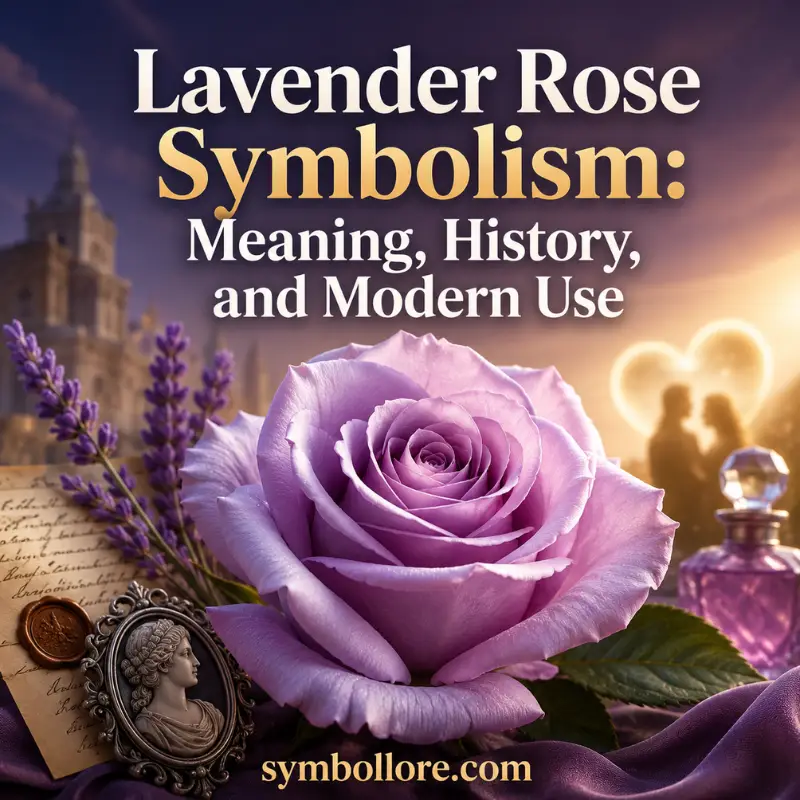
The strongest modern meaning is enchantment. A lavender rose can suggest that someone has captured your attention in an unusual or almost magical way. That does not necessarily mean a long-established relationship. Instead, it can fit the emotional stage when admiration is becoming romantic interest.
The meaning also overlaps with wonder and fascination. A lavender-colored rose stands apart from the conventional red, white, pink, and yellow palette. Its unusual appearance can therefore communicate that the recipient is unusual or especially captivating.
Modern educational flower guides commonly associate lavender roses with love at first sight. PBS, for example, lists lavender roses under this interpretation while distinguishing them from red roses, which represent love and passion.
That distinction is useful. A red rose tends to make a direct declaration. A lavender rose is more suggestive. It can communicate, “I am captivated by you,” without necessarily making the same claim of enduring romantic devotion.
Why Do Lavender Roses Symbolize Enchantment?
The meaning makes more sense when the symbolism of the rose and the symbolism of the color are considered separately.
Roses have carried associations with love and beauty for centuries. The New York Botanical Garden notes their roles in Greek and Roman mythology, Christian imagery, political history, and Victorian floriography. It also explains that different rose colors developed different symbolic messages.
Lavender and purple add another layer. Purple has often been associated with rarity, rank, mystery, and spiritual or imaginative qualities. Modern color symbolism similarly connects purple with ideas such as royalty, creativity, mystery, and spirituality, although these associations change across cultures and settings.
Put together, the symbolism becomes fairly intuitive:
rose + lavender color = love or beauty + unusual fascination.
That combination helps explain why lavender roses are commonly used to represent enchantment rather than simply ordinary affection.
Still, this is an interpretation of how the two symbolic traditions interact. It should not be presented as proof that every society consciously created the meaning in exactly this way.
Lavender Rose Symbolism and Love at First Sight
Love at first sight is probably the most recognizable romantic meaning attached to lavender roses today.
The idea works because the color suggests something different from the established red-rose message. Red roses are deeply associated with passionate romantic love. Lavender roses can instead emphasize the moment of discovery: the sudden feeling that another person is fascinating, beautiful, or extraordinary.
This makes them especially suitable for:
- a new romantic relationship;
- an early anniversary;
- a first date or meaningful first meeting;
- a romantic confession;
- an admirer who wants to express fascination;
- a bouquet celebrating a relationship’s beginning.
The phrase “love at first sight” should still be treated as a flower-language convention, not an objective translation. A lavender rose does not prove that a giver has fallen in love. The accompanying message, relationship, and occasion remain more reliable evidence of intent.
What Does Victorian Floriography Say About Lavender Roses?
Victorian flower language gives us an important historical warning: there was never one perfectly standardized flower dictionary.
During the 19th century, floriography became popular in Britain, North America, and elsewhere. Books assigned meanings to flowers and sometimes to specific colors or forms. However, different books could give different definitions. The Smithsonian notes that Victorian flower meanings came from several sources, including visual analogies, religion, literature, folklore, and botanical characteristics.
The New York Botanical Garden likewise explains that flower dictionaries became fashionable in 19th-century America and that meanings could come from legends, mythology, appearance, and plant attributes.
The historical record therefore supports the existence of purple-rose enchantment symbolism, but it does not justify claiming that every Victorian reader understood a lavender rose in precisely the same way.
The RHS comparison of historical flower-language books
is particularly useful because it compares meanings across multiple historical sources rather than pretending that one dictionary represented the entire tradition.
Purple Rose and Lavender Rose: Are They the Same Symbol?
They are closely related, but they should not automatically be treated as identical.
Historical and modern flower guides frequently group lavender, lilac, mauve, and purple roses together. Yet these colors can look quite different. A pale lavender rose has a softer emotional effect than a deep violet rose.
That difference can support slightly different interpretations:
- Lavender: gentle enchantment, wonder, romantic fascination.
- Lilac: softness, elegance, youthful romance.
- Deep purple: mystery, majesty, stronger enchantment.
- Mauve: nostalgia, refinement, and understated romance.
These distinctions are best treated as modern interpretive conventions rather than fixed historical rules.
For comparison, the modern color symbolism guide on Symbollore notes that purple can suggest royalty, creativity, mystery, and spirituality while warning that color meanings change according to culture and context.
When Did Lavender Roses Become Common?
This is where popular online explanations often become misleading.
Lavender-colored roses are not an ancient rose type with an uninterrupted symbolic history. Modern lavender roses emerged through rose breeding in the 20th century.
One important milestone was Sterling Silver, introduced in 1957 and recognized for its unusual lavender-silver coloration. The later Blue Moon, introduced by Mathias Tantau Jr. in 1964, became another famous lavender or lilac Hybrid Tea rose. Contemporary horticultural records identify Blue Moon as a lavender-lilac rose and trace its parentage to Sterling Silver.
This matters because it separates two ideas:
- Purple rose symbolism existed in flower-language traditions.
- The familiar modern lavender Hybrid Tea rose is comparatively recent.
Therefore, it is safer to say that modern lavender roses inherited symbolic ideas from older rose and color traditions than to claim that a specific lavender rose meaning has existed unchanged since antiquity.
A Short History of Rose Symbolism
The rose itself has a much deeper symbolic history than the lavender cultivar.
In Greek and Roman traditions, roses were connected with love and beauty. The New York Botanical Garden describes associations with Venus and later explains how roses entered mythology, storytelling, political emblems, and Victorian flower language.
Roses also developed meanings through their cultural uses. In Roman settings, roses could be connected with secrecy through the expression sub rosa, or “under the rose.” Later, different colors became associated with different emotional messages.
By the 19th century, flower dictionaries gave these associations a more systematic form. The Smithsonian describes floriography as a popular Victorian practice in which flowers communicated feelings that could be difficult to express openly.
The important point is that lavender rose symbolism sits on top of this older rose tradition. The lavender color adds the ideas of rarity, fascination, and enchantment, while the rose supplies the deeper language of love and beauty.
What Does a Lavender Rose Mean in a Relationship?
In a relationship, a lavender rose usually works best as a symbol of fascination and romantic appreciation.
For a new relationship, it can represent the excitement of discovering someone who feels different from other people. For an established couple, it can express continued admiration rather than simply repeating the familiar message of passion.
The meaning can also change according to the rest of the bouquet.
A lavender-and-white arrangement may feel gentle, elegant, and sincere. Lavender with pink roses can emphasize tenderness and admiration. Lavender combined with red roses creates a stronger romantic message because the red rose brings established passion into the arrangement.
There is no universal rule requiring these combinations. The symbolism emerges from the interaction of the flowers, colors, setting, and giver’s intention.
What Does Giving a Lavender Rose Mean?
Giving a lavender rose can communicate “I am fascinated by you” or “You are special to me.”
It is particularly effective when the giver wants romance without using the strongest possible declaration. A dozen red roses can feel unmistakably passionate. A lavender rose can feel more personal, unusual, and exploratory.
For that reason, lavender roses can suit:
- a romantic surprise;
- a first serious expression of attraction;
- an engagement or wedding arrangement;
- an anniversary;
- Valentine’s Day;
- a birthday for a romantic partner;
- a bouquet celebrating a new relationship.
The safest approach is to pair the flowers with a short note. That removes ambiguity and allows the personal meaning to matter more than any flower dictionary.
Lavender Roses in Weddings and Modern Design
Modern weddings often use lavender roses because their color creates a romantic atmosphere without relying on traditional red.
In this setting, they can suggest elegance, individuality, tenderness, and romantic wonder. Lavender also works naturally with white, cream, blush, dusty blue, and other soft colors.
The wedding symbolism is largely contextual. There is no universal historical rule saying that every lavender wedding rose means a particular emotion.
Instead, the color can become part of the couple’s chosen visual language. A bride or groom might select lavender because it recalls a favorite garden, a shared memory, or a particular season. In such cases, the personal association is more important than traditional floriography.
This reflects a broader pattern in modern flower symbolism: people still use flowers to express feelings, but they rarely follow a strict Victorian dictionary. The Smithsonian describes how flower symbolism has changed over time and across cultures.
Lavender Rose Tattoos and Personal Symbolism
A lavender rose tattoo can represent romantic fascination, beauty, individuality, new love, or a person who feels extraordinary.
Unlike a gift, however, a tattoo usually has a highly personal meaning. The wearer may choose lavender because it represents a favorite color or because the flower reminds them of a particular person.
Other design elements can sharpen the interpretation:
- Lavender rose with a name: personal love or remembrance.
- Lavender rose with a date: an important relationship or milestone.
- Lavender rose with thorns: beauty combined with difficulty or emotional boundaries.
- Lavender and red roses: new fascination joined with established passion.
- Lavender rose with butterflies: transformation, beauty, or romantic change.
- Lavender rose with a moon: mystery, imagination, or personal reflection.
These are possible readings, not universal tattoo codes. A viewer should not assume that a lavender rose tattoo has one predetermined message.
Does Lavender Rose Symbolism Have a Spiritual Meaning?
There is no single universal spiritual meaning for a lavender rose.
Some modern spiritual interpretations connect purple or lavender colors with intuition, mystery, higher awareness, or transformation. Those ideas belong to particular spiritual systems and modern interpretive traditions. They should not be presented as an ancient universal belief.
The same caution applies to claims that a lavender rose is a guaranteed sign from a deceased person, an angel, or a supernatural force. Symbolism can support personal reflection, but it cannot establish that an external spiritual message has been received.
A person might reasonably choose a lavender rose as a private symbol of hope, spiritual reflection, or emotional growth. That is a meaningful personal interpretation without needing to claim that everyone must understand the flower in the same way.
Common Misconceptions About Lavender Rose Symbolism
“Lavender roses have always meant love at first sight.”
Not exactly. Modern flower guides commonly give lavender roses this meaning, but historical flower language was inconsistent. Some sources assign related meanings to purple roses, while other dictionaries use different wording.
“Ancient people gave lavender roses romantic meanings.”
This claim is too strong. The rose has an ancient symbolic history, but modern lavender rose cultivars are comparatively recent. It is more accurate to connect today’s meaning with older rose symbolism and later color traditions.
“Every purple rose means royalty.”
Not necessarily. Purple has historical associations with rank and luxury, but a purple rose can also represent enchantment, mystery, fascination, or personal affection.
“A lavender rose always means romantic love.”
No. It can express admiration, beauty, appreciation, or personal significance. The relationship and occasion determine how strongly romance should be read.
“Victorian flower language was one universal code.”
It was not. Multiple dictionaries circulated, and their meanings sometimes conflicted. The Smithsonian and New York Botanical Garden both emphasize the variety and changing nature of flower-language traditions.
How to Interpret a Lavender Rose Correctly
Start with the occasion, then consider the color and the relationship.
If someone gives a lavender rose on a first date, romantic fascination is a reasonable interpretation. If the same flower appears in a wedding bouquet, elegance and romantic wonder may be more relevant. In a memorial arrangement, the flower could simply reflect the deceased person’s favorite color or a personal memory.
Next, consider whether the symbolism is historical or modern. A Victorian literary scene should use period-specific flower dictionaries rather than modern florist meanings. For historical research, Kate Greenaway’s Language of Flowers is useful because it records specific entries rather than a generalized modern chart. Her book gives different meanings to many rose varieties and colors.
Finally, remember that flowers communicate through combinations. The rose, its color, surrounding flowers, arrangement, occasion, and accompanying words all contribute to the message.
That approach produces a much stronger interpretation than simply looking up one keyword and assigning it as a permanent definition.
FAQs
The main modern meaning is enchantment or fascination, especially romantic fascination. Lavender roses are also commonly associated with love at first sight, wonder, and the feeling that someone is unusually captivating. These are flower-language conventions rather than universal rules.
Yes, it can symbolize love, particularly new or fascinated romantic love. However, red roses have a stronger traditional association with established romantic passion. Lavender tends to make the message softer and more unusual.
Yes. Modern flower-language guides commonly associate lavender roses with love at first sight. PBS lists lavender rose as a symbol of this idea. The association should still be understood as a cultural convention rather than a fixed botanical meaning.
Lavender-colored roses exist as cultivated rose varieties, but the famous modern lavender roses are products of breeding. Sterling Silver, introduced in 1957, and Blue Moon, introduced in 1964, were important examples of lavender or lilac Hybrid Tea roses.
The two overlap considerably. Lavender usually creates a softer impression of enchantment, wonder, and romantic fascination, while deeper purple can suggest stronger mystery, majesty, or enchantment. These distinctions are mainly interpretive and can vary between flower-language sources.
It can, but friendship is not its strongest traditional modern association. A lavender rose is more naturally suited to admiration, fascination, romance, or appreciation. If friendship is the main message, another flower with a stronger friendship tradition may communicate that intention more clearly.
There is no established biblical meaning specifically assigned to the modern lavender rose. The Bible contains important floral imagery, but connecting a particular lavender rose meaning directly to biblical teaching would require evidence that is generally absent. Modern spiritual interpretations should therefore be kept separate from biblical claims.
Conclusion
Lavender rose symbolism combines the enduring symbolism of the rose with the unusual visual character of lavender. The result is a flower commonly associated with enchantment, fascination, wonder, and love at first sight. Its modern meaning is especially suited to new attraction and romantic admiration rather than only established passion.
The history also calls for caution. Roses have ancient symbolic roots, while familiar lavender cultivars emerged much later through modern breeding. Victorian flower dictionaries provide useful evidence for rose and purple symbolism, but they were never a single universal code. The most reliable interpretation considers the flower’s color, historical period, relationship, occasion, and personal meaning together.