
Hera symbolism centers on marriage, queenship, fertility, family, female authority, and the social power of a wife and queen. In ancient Greek religion, Hera was not simply the jealous wife of Zeus. She was a major goddess with her own cults, sanctuaries, rituals, and visual language. Ancient artists identified her through features such as a crown, scepter, veil, throne, and, in later traditions, the peacock.
Her meanings also changed across time and place. The symbolism found at Argos was not necessarily identical to later Roman or Renaissance imagery. Some associations are strongly documented, while others come from later mythology or modern interpretation. Understanding that difference makes Hera a far richer symbol than a simple list of “goddess meanings.”
Quick Answer
Hera symbolism most strongly represents marriage, queenship, female authority, family, fertility, and childbirth. These meanings grew from Hera’s religious role as queen of the gods and divine patron of marriage and women. Her crown and scepter emphasize authority, while the peacock became a major later artistic attribute. Her darker myths add themes of betrayal, jealousy, anger, and protection of marital boundaries.
TL;DR
- Hera primarily symbolizes marriage, queenship, family, and female authority.
- Her crown, throne, and scepter communicate royal status and divine power.
- The peacock became one of her best-known visual symbols, especially in later art.
- The pomegranate has a documented connection with Hera’s Argive cult, but its exact meaning was treated as mysterious.
- Hera’s associations with women and childbirth extend her symbolism beyond marriage alone.
- Modern interpretations can emphasize confidence, boundaries, leadership, or commitment, but these should not be mistaken for universal ancient meanings.
Hera Meanings at a Glance
| Symbol or context | Possible meaning | Why the association exists | Important limit |
|---|---|---|---|
| Marriage | Commitment, marital union, legitimacy | Hera’s central religious role | Not the same as romantic love |
| Crown or polos | Queenship, dignity, authority | Hera was queen of the gods | Meaning depends on artistic context |
| Scepter | Sovereignty and power | Royal attribute in ancient representations | Also used by other divine figures |
| Peacock | Beauty, status, divine identity | Strong association in later Greek and Roman art | The familiar Argus-eye story is later |
| Pomegranate | Fertility, abundance, mystery | Appears in Hera’s Argive cult statue | Ancient source does not reveal its exact meaning |
| Cow | Ancient sacred association | Hera’s “cow-eyed” epithet and sacred-animal tradition | Modern fertility readings can overreach |
| Bridal veil | Marriage and womanhood | Hera’s role as divine bride | Not unique to Hera |
| Jealousy and anger | Betrayal, violated marriage, retaliation | Repeated mythological conflicts with Zeus | Not Hera’s complete meaning |
What Does Hera Symbolism Mean?
The central meaning of Hera is marital and royal authority.
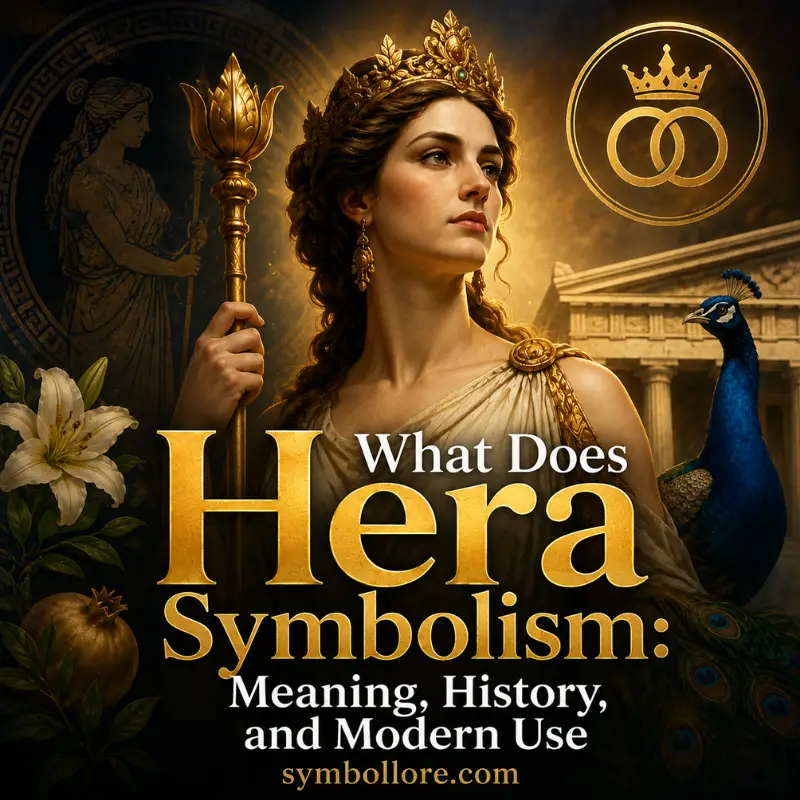
Hera was the sister and wife of Zeus and queen of the Olympian gods. Ancient Greek art commonly represented her as a dignified woman wearing a tall crown called a polos. She could also appear with a royal scepter, veil, or throne. These attributes helped viewers recognize her and communicated her elevated position.
Her symbolism therefore has two closely connected sides.
The first is marriage. Hera represented the institution of marriage and the status of the married woman.
The second is queenship. She was not merely identified as someone’s wife. Her royal imagery presented her as a powerful divine figure with authority of her own.
That combination explains why Hera can symbolize commitment and sovereignty at the same time.
For modern readers, this makes Hera useful as a symbol of marital commitment, self-respect, leadership, family responsibility, or feminine authority. Those modern readings can be meaningful, but they should remain distinct from documented ancient Greek religion.
Why Hera Became a Symbol of Marriage
Marriage is the strongest foundation for Hera’s symbolism.
Ancient Greek wedding traditions differed between communities, but Hera was widely connected with marriage. Evidence from ancient Greek literature and descriptions of wedding customs shows that sacrifices to Hera formed part of some marriage preparations. She could serve as a divine model for the bride.
This association explains several aspects of her iconography.
A veil could emphasize her identity as a married woman. A scepter could express the authority of a queen. Her dignified posture could reinforce the social importance of marriage rather than romantic passion.
This distinction matters because Hera is sometimes confused with Aphrodite.
Aphrodite is more strongly associated with sexual attraction, desire, and erotic beauty. Hera’s symbolic territory is different. Her mythology focuses more heavily on marriage, legitimate union, family, status, and the obligations created by marriage.
The difference can be summarized simply:
Aphrodite represents desire; Hera represents marriage and its social and sacred authority.
That distinction is particularly useful when interpreting classical artwork or modern wedding imagery.
Hera as Queen: Crown, Throne, and Scepter
Hera’s royal imagery is one of the clearest expressions of her symbolic power.
The Metropolitan Museum of Art notes that Hera is frequently depicted wearing a tall crown or polos. Ancient artistic traditions also show her seated on a throne or holding a royal scepter.
These objects communicate status before a viewer even knows the story.
The Crown
The crown represents rank, dignity, queenship, and elevated authority.
Because Hera was queen of the gods, the crown is not merely decorative. It identifies her social position within the divine hierarchy.
The Throne
A throne reinforces stability, sovereignty, and legitimate status.
An enthroned Hera looks different from a youthful goddess shown in motion. The seated pose emphasizes permanence and authority.
The Scepter
The scepter represents royal power and command.
Ancient depictions of Hera holding a scepter make her status visually unmistakable. Her authority is therefore part of her iconography, not simply a modern interpretation.
Together, these attributes support a modern symbolic reading of Hera as a figure of leadership, dignity, confidence, and feminine power.
The Peacock and Hera Symbolism
The peacock is probably Hera’s most recognizable symbol today.
The association became especially important in later Greek and Roman art. The Metropolitan Museum identifies peacock feathers as attributes of Hera, while its collection includes a Renaissance representation of Juno—the Roman counterpart of Hera—with a peacock.
The bird’s appearance naturally supports several modern symbolic readings:
- beauty
- grandeur
- visibility
- royal status
- pride
- magnificence
However, one popular detail requires caution.
Many modern explanations say that the eyes on the peacock’s tail represent the eyes of Argus, a many-eyed guardian associated with Hera. The story became firmly connected with the peacock in later literary tradition. It should not be projected backward onto every early Greek representation of Hera.
This is an important example of how mythology develops. A symbol can become strongly associated with a deity through a later story without that story explaining the symbol’s earliest history.
The peacock can therefore be confidently described as a major Hera attribute while its specific Argus-eye explanation should be treated as a later development.
Hera and the Pomegranate
The pomegranate is another important Hera symbol, but it requires more careful interpretation than many modern articles suggest.
The ancient traveler Pausanias described the great cult statue of Hera at Argos as holding a pomegranate in one hand and a scepter in the other. His account is especially valuable because it connects the object with a specific ancient sanctuary rather than a modern symbolic list.
Yet Pausanias did not provide a simple definition of the fruit. Instead, he treated its story as a sacred mystery.
That uncertainty matters.
The pomegranate can reasonably invite modern interpretations involving:
- fertility
- abundance
- family continuity
- marriage
- life and reproduction
The fruit’s many seeds make fertility an intuitive symbolic association. Pomegranates also had broader ritual and funerary associations in Greek culture. The Metropolitan Museum, for example, notes the fruit’s connection with funerary beliefs and ritual in Greek art.
Still, it would be inaccurate to claim that the pomegranate definitively meant fertility in Hera’s Argive cult. The surviving ancient evidence does not give us that certainty.
This is one of the clearest cases where historical honesty improves symbolic interpretation.
The Cow and Hera’s Older Imagery
The cow has a deeper connection with Hera than many modern readers realize.
Ancient Greek poetry repeatedly uses the epithet boôpis, commonly translated as “ox-eyed” or “cow-eyed,” for Hera. The phrase describes her striking eyes, but the repeated cattle imagery also belongs to the older religious tradition surrounding the goddess. Hera is associated with the cow among her sacred animals.
Modern symbolic interpretations sometimes connect the cow with:
- fertility
- nourishment
- motherhood
- abundance
- femininity
These readings can make sense as modern interpretations, particularly because cattle were valuable sources of food, milk, wealth, and agricultural support.
However, there is a difference between saying “the cow can evoke fertility today” and claiming that ancient Greek worshippers universally understood every cow image of Hera as a fertility symbol.
The safest historical interpretation is that the cow belongs to Hera’s established sacred imagery, while the exact development of that association is more complicated.
Hera, Fertility, and Childbirth
Hera’s symbolism includes fertility and childbirth, but her role should not be reduced to that alone.
Ancient sources connect Hera with women and childbirth, while Eileithyia—the goddess associated specifically with childbirth—is also connected with Hera in Greek tradition.
Hera’s reproductive symbolism is therefore closely connected with marriage and family continuity.
That relationship helps explain why fertility fits naturally within her symbolic sphere. Marriage in ancient Greek society was closely connected with household formation and legitimate descendants.
For a modern reader, Hera may therefore symbolize:
- family formation
- motherhood
- childbirth
- continuity between generations
- commitment to a household
- protection of women
A broader fertility article on Symbollore also explains why fertility symbols often extend beyond pregnancy to ideas such as family continuity, prosperity, agricultural abundance, and renewal.
That wider context helps explain why Hera’s fertility associations should not be treated as a single, narrow definition.
Hera and the Cuckoo
The cuckoo is a less familiar Hera symbol, yet it has an interesting mythological connection.
In an ancient tradition associated with Hera and Zeus, Zeus approached Hera in the form of a cuckoo. The story links the bird with their courtship and marriage.
This makes the cuckoo different from the peacock.
The peacock became a broad visual identifier of Hera. The cuckoo has a more specific mythological connection with courtship, transformation, deception, and the beginning of Zeus and Hera’s relationship.
That distinction illustrates why symbols should not be treated as interchangeable.
A bird may be associated with the same goddess for completely different reasons: one through visual art, another through a particular myth.
Hera’s Darker Symbolism: Jealousy and Betrayal
Hera’s mythology has a darker side that cannot be separated from her symbolic identity.
Zeus repeatedly violates the expectations of their marriage through relationships with other women. Hera often responds with anger, jealousy, punishment, or revenge toward people connected with Zeus.
These myths have made jealousy one of Hera’s most recognizable modern associations.
Yet “Hera means jealousy” is far too narrow.
Her anger makes more sense when viewed against her central role as a goddess of marriage. Betrayal is especially significant because it violates the very institution with which Hera is associated.
Her darker symbolism can therefore include:
- marital betrayal
- wounded dignity
- anger
- jealousy
- boundary protection
- retaliation
- conflict within relationships
This complexity is part of what makes Hera compelling. She represents the idealized institution of marriage while also appearing in myths that expose its tensions and contradictions.
Hera’s Symbolism in Ancient Greek Art
Ancient Greek art used recognizable attributes to identify the gods.
Hera could appear as a mature, dignified woman with a crown, scepter, veil, or throne. Her position beside Zeus could also reinforce her identity as queen and wife. Ancient pottery and sculpture frequently used these visual conventions to communicate divine identity.
This is important because a symbol does not exist independently of its artistic setting.
For example:
- A crown emphasizes rank.
- A scepter emphasizes authority.
- A veil emphasizes marriage.
- A throne emphasizes sovereignty.
- A pomegranate may connect the image to a particular cult tradition.
- A peacock can identify Hera or her Roman counterpart Juno in later art.
The meaning comes from the combination.
This approach is more reliable than assigning one fixed definition to each object.
Hera, Juno, and the Roman Tradition
Hera’s Roman counterpart is Juno, and their imagery overlaps strongly.
The peacock is especially important in later representations of Juno. The Metropolitan Museum’s Juno and the Peacock identifies the bird as a clear attribute of the Roman goddess and connects her with marriage.
This overlap explains why many later Western artworks use Hera-like imagery without clearly separating Greek and Roman traditions.
Still, Hera and Juno should not automatically be treated as identical in every religious context.
Greek and Roman religions developed within different social and political systems. Roman artists and worshippers adapted Greek mythology while giving Roman deities their own roles and traditions.
For symbolism, the safest distinction is:
Hera belongs to ancient Greek religion; Juno belongs to Roman religion, even though their identities and imagery overlap substantially.
Hera Symbolism in Modern American Culture
Hera does not have one fixed meaning in modern American culture. Instead, people encounter her through mythology courses, classical art, literature, museums, jewelry, tattoos, fantasy media, and modern discussions of feminine power.
Her imagery can now communicate:
- commitment
- leadership
- confidence
- marital loyalty
- independence
- family
- feminine authority
- beauty
- resilience
The meaning depends heavily on the context.
A peacock tattoo may emphasize beauty or pride. A crown may represent personal authority. A pomegranate may symbolize fertility or family. A Hera figure used in an academic setting may simply represent ancient Greek religion.
Modern use should therefore be interpreted by asking what the person, artist, or designer intended, rather than assuming one universal spiritual message.
Hera Symbolism in Weddings
Hera is a natural reference for modern wedding imagery because marriage is at the center of her ancient identity.
A Hera-inspired design might use:
- a peacock feather for regal beauty
- a crown for dignity and commitment
- a pomegranate for abundance or family continuity
- Greek architectural motifs for a classical atmosphere
- a veiled goddess figure to reference marriage
These choices can work well in invitations, jewelry, artwork, or decorative themes.
However, a modern wedding using Hera imagery should not automatically be described as an authentic ancient Greek ritual. Ancient Greek marriage customs varied by place and period, and modern symbolic design is a separate practice.
A related example appears in hawthorn symbolism, where marriage and love associations also developed through specific cultural traditions rather than through one universal rule.
Hawthorn Symbolism: Hope, Protection, and Folklore
Hera Symbolism in Tattoos and Jewelry
Hera imagery can work especially well in tattoos and jewelry because her attributes are visually distinctive.
Peacock
A peacock can emphasize beauty, confidence, dignity, or divine status.
Crown
A crown can represent self-respect, leadership, sovereignty, or personal strength.
Pomegranate
A pomegranate can suggest fertility, family, abundance, or continuity, although its ancient Hera-specific meaning remains uncertain.
Scepter
A scepter can emphasize authority and leadership.
Combined imagery
A design combining a peacock with a crown can create a strong modern message about regal feminine power. A pomegranate combined with a wedding motif may emphasize family or commitment.
These are modern interpretations. They should not be presented as fixed ancient rules.
Hera Symbolism and Female Authority
One of the most useful modern interpretations of Hera is female authority.
Her status as queen gives her a visual language of leadership. Unlike a symbol based only on beauty or fertility, Hera’s crown and scepter communicate institutional power.
That makes her relevant to modern discussions of:
- leadership
- dignity
- confidence
- boundaries
- self-respect
- responsibility
- feminine strength
At the same time, modern empowerment language should not be projected backward onto ancient Greece without qualification.
Ancient Greek gender roles were different from modern American ideas about equality, independence, marriage, and leadership. Hera can inspire modern interpretations of female authority, but that does not mean ancient Greeks understood her through today’s political or social categories.
Historical Meaning vs. Modern Interpretation
One of the easiest ways to misunderstand Hera is to combine every interpretation into one timeless definition.
A better approach is to separate the layers.
| Period or setting | Stronger symbolic emphasis |
| Ancient Greek religion | Marriage, women, queenship, family, childbirth |
| Ancient Greek art | Crown, throne, scepter, veil, divine status |
| Argive cult tradition | Specific sacred attributes including the pomegranate |
| Later Greek and Roman imagery | Peacock and expanded visual identification |
| Renaissance and later European art | Juno/Hera as regal wife and goddess |
| Modern American symbolism | Leadership, commitment, feminine power, family, personal identity |
This historical distinction prevents a modern tattoo meaning from being mistaken for an ancient religious doctrine.
It also explains why different sources can give apparently different meanings without one necessarily being completely wrong.
Common Misconceptions About Hera Symbolism
Hera only symbolizes jealousy
No. Jealousy is a major theme in her mythology, but marriage, queenship, women, family, and childbirth are much broader parts of her religious identity.
The peacock was always Hera’s main ancient symbol
That is too simple. The peacock became a major attribute, especially in later artistic traditions, but Hera’s ancient visual identity also included the crown, scepter, throne, veil, cow, cuckoo, and pomegranate.
Hera represents romantic love
Not primarily. Hera is more strongly associated with marriage and marital status, while Aphrodite occupies a different symbolic sphere centered on erotic desire.
The pomegranate definitely means fertility
Not with complete historical certainty. The fruit is documented in Hera’s Argive cult imagery, but the ancient explanation of its meaning was deliberately left mysterious.
Hera and Juno are exactly the same goddess
They are closely related counterparts, but Greek and Roman religious traditions developed separately. Their overlapping symbolism should not erase those cultural differences.
Hera is simply a “goddess of women”
That description is incomplete. Her symbolism includes women and childbirth, but also marriage, queenship, family, and divine authority.
FAQs
Hera is chiefly associated with marriage, women, queenship, and family, with important connections to childbirth and fertility. Her role as Zeus’s wife and queen of the gods strongly shaped her religious identity.
The peacock is probably Hera’s most recognizable symbol in later Western art. However, ancient representations also use the crown, scepter, throne, veil, cow, cuckoo, and pomegranate to identify or characterize her.
The peacock can suggest beauty, grandeur, royal status, and divine identity. Its connection with Hera became especially prominent in later Greek and Roman artistic traditions. The familiar story connecting its tail “eyes” with Argus belongs to later literary development rather than explaining every early Hera image.
The pomegranate may be interpreted through fertility, abundance, marriage, or family continuity, but its precise ancient meaning is uncertain. Pausanias describes the fruit in Hera’s Argive cult statue while treating its story as a sacred mystery.
Yes, as a modern interpretation. Hera’s status as queen and her royal attributes make her a strong contemporary symbol of authority, dignity, leadership, and feminine strength. Those modern meanings should be distinguished from the gender concepts of ancient Greek society.
Hera has genuine associations with fertility, women, and childbirth, especially through her connection with marriage and family continuity. However, fertility was not her only domain, and she should not be treated as interchangeable with every fertility deity in Greek religion.
Hera can symbolize marriage, commitment, family continuity, dignity, and the responsibilities of a marital union. A modern wedding may use her imagery as a classical reference, but that does not make the ceremony an authentic reconstruction of ancient Greek ritual.
Conclusion
Hera symbolism brings together marriage, queenship, family, fertility, childbirth, authority, and the complicated emotions surrounding betrayal. Her crown and scepter communicate sovereignty, while the peacock became a powerful later emblem of her identity. The pomegranate and cow connect her with older and more localized traditions that deserve careful interpretation rather than simple modern definitions.
The most useful way to understand Hera is to keep history and modern symbolism separate. Ancient Greek religion gives us the foundation, while later art and contemporary culture continue to reshape her image. In that context, Hera can remain both a historical goddess and a modern symbol of commitment, dignity, and power.


