
Harp symbolism often brings together harmony, memory, identity, storytelling, and sacred music. These associations come from the instrument’s sound, its long use in courts and ceremonies, its place in mythology and religious art, and its powerful role in Irish history.
Yet the harp does not have one universal meaning. A harp on an Irish state emblem communicates national identity, while one held by an angel in religious art suggests heavenly music. A harp in poetry may represent inspiration or memory instead. Its setting, culture, period, and surrounding imagery determine the strongest interpretation.
Quick Answer
Harp symbolism commonly represents harmony, beauty, memory, storytelling, identity, and spiritual or heavenly music. These meanings developed from the instrument’s musical qualities, religious imagery, literary traditions, and cultural history. Ireland gives the harp an especially strong national meaning, while other traditions use it differently.
TL;DR
- Harps commonly suggest harmony, beauty, memory, and creative expression.
- Ireland uses the harp as an official national emblem.
- Irish mythology connects the instrument with powerful emotional music.
- Christian art often places harps with angels and heavenly worship.
- Persian traditions show the harp also had royal and literary associations.
- Modern meaning depends strongly on setting, design, and personal intention.
Harp Meanings at a Glance
| Context or Tradition | Possible Meaning | Why the Association Exists | Important Limit |
|---|---|---|---|
| General musical imagery | Harmony and serenity | Flowing, layered sound encourages these readings | Aesthetic interpretation is not a universal rule |
| Irish national identity | Ireland, heritage, sovereignty | Centuries of heraldic and political use | Refers specifically to Irish historical identity |
| Irish mythology | Emotional power and transformation | Stories give the instrument extraordinary musical abilities | Mythological tradition is not historical proof |
| Christian art | Heavenly worship | Angels and sacred music became recurring artistic motifs | The familiar angel-with-harp image is largely iconographic |
| Persian court culture | Royal music and refinement | Historical sources connect harps with courtly settings | Meanings vary by period |
| Literature and poetry | Inspiration, memory, storytelling | Harpists accompanied poets and narratives | Literary meaning depends on the individual work |
| Modern personal symbolism | Peace, creativity, remembrance | Contemporary users adapt established associations | Personal symbolism is not an ancient tradition |
What Does Harp Symbolism Mean?
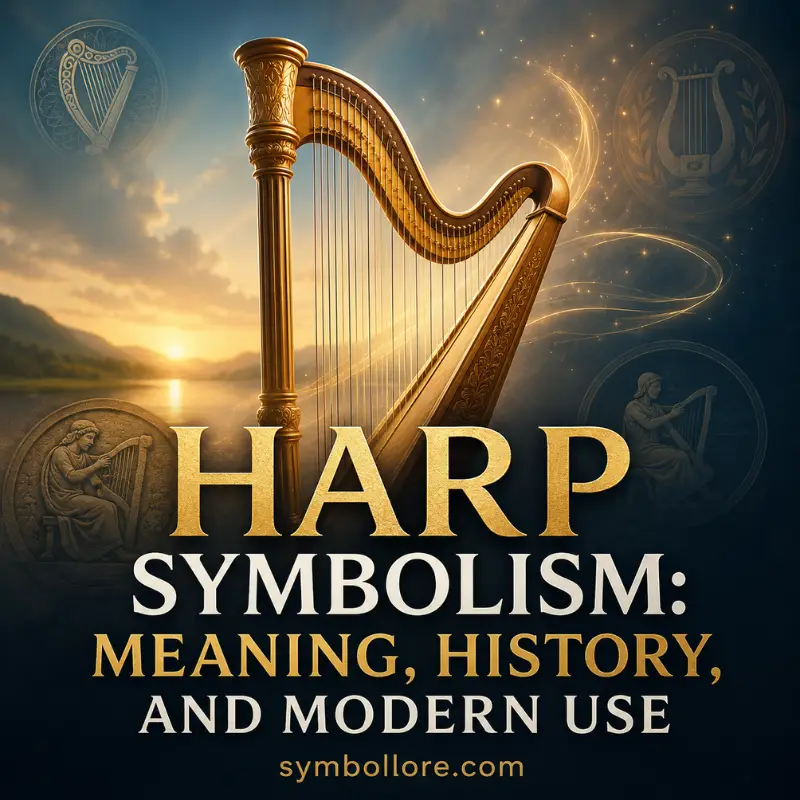
At its broadest, harp symbolism represents harmony, beauty, memory, creative expression, and connection through music. These meanings are not arbitrary. The harp produces layered tones that can sound continuous and flowing, which makes harmony an intuitive metaphor for emotional or social balance.
The instrument also has a long relationship with storytelling. The Metropolitan Museum of Art notes that Irish harps accompanied epic tales and helped communicate history, news, songs, and stories. That role makes the harp more than a musical object: it can symbolize the preservation and transmission of cultural memory.
The idea of serenity is more interpretive. Modern writers often connect the harp’s gentle sound with calmness and reflection. Such a reading is reasonable as a modern aesthetic association, but it should not be presented as a universal ancient belief.
For related ideas about equilibrium and harmony, see
Balance Symbolism: What It Means Across Cultures and Life.
Why the Harp Represents Harmony and Serenity
The connection between the harp and harmony begins with the instrument itself. Multiple strings can sound together, creating layered tones rather than a single sustained note. As a result, writers and artists can use the harp as a metaphor for different elements working together.
This helps explain why harmony and serenity appear so often in modern symbolism. A harp can visually communicate delicacy and musical order even when no sound is actually being produced.
However, the meaning changes with context. A harp shown beside a grieving figure may suggest memory or mourning rather than happiness. A harp in a wedding design may emphasize love and harmony. In a fantasy setting, it may represent enchantment or magical music.
The safest approach is therefore to treat harmony as a recurring association rather than a fixed definition.
The Harp in Irish Identity and National History
The harp has an unusually strong connection with Irish identity. Ireland’s government identifies it as the official emblem of the state, while medieval evidence already shows a harp associated with Ireland. The Wijnbergen roll of arms, compiled around 1270, depicts a harp among the arms associated with Ireland.
The symbol later became deeply political. The harp appeared on Irish coinage and was used by competing political movements. During the eighteenth and nineteenth centuries, its meaning could support royal authority, Irish nationalism, cultural revival, or resistance to British rule. The Irish Georgian Society’s historical study emphasizes that the symbol’s political history was contested rather than simple.
This history explains an important distinction: the harp is not merely a symbol of “Irish music.” It can also represent national sovereignty, cultural memory, political identity, and the continuing construction of Irishness.
The modern state harp is carefully standardized. Government guidance specifies features including its left-facing orientation and a particular official design.
That official use gives the harp a meaning that is more specific than general musical symbolism.
Irish Mythology and the Dagda’s Harp
Irish mythology adds another layer through Dagda’s harp, a legendary instrument associated with the Dagda of the Tuatha Dé Danann. In traditional stories, the harp possesses extraordinary musical power and can produce different emotional responses.
One Irish account describes the instrument as capable of expressing sorrow, gladness, and rest. The story therefore presents music as something that can shape human emotion rather than merely entertain.
This tradition helps explain why harp symbolism can include emotional transformation, memory, joy, grief, and restoration. Yet the story belongs to mythology. It should not be used as evidence that historical Irish harps literally possessed supernatural powers.
The distinction matters because folklore often survives precisely because it gives ordinary objects extraordinary narrative roles. The harp’s symbolic power can be historically meaningful even when the supernatural events in a story are not historical facts.
Harp Symbolism in Religion and Heavenly Worship
In Christian and European religious art, the harp became strongly associated with heavenly worship. Angels playing harps are a familiar artistic image, and the instrument can therefore suggest praise, sacred music, paradise, or divine order.
The Bible itself contains references to harps and music, but the popular image of every angel playing a harp should not be treated as a direct biblical rule. It developed through a much longer history of Christian artistic representation.
Medieval and later artworks repeatedly use musical instruments to create an atmosphere of celestial praise. Smithsonian collections, for example, document American religious artworks in which angels are depicted with harps. One Smithsonian record describes an angel holding a harp in a religious sculpture, while another records an angel playing a harp in a Christian-themed painting.
King David also appears frequently with a harp in Jewish and Christian artistic traditions. The association connects the instrument with psalmody, kingship, devotion, and sacred music.
Thus, King David and angelic imagery belong to related but distinct symbolic traditions. One should not collapse biblical figures, medieval iconography, and modern spirituality into a single meaning.
Harps in Persian and African Traditions
Harp symbolism is much broader than Celtic or Christian traditions. Historical evidence from Persia shows that harps existed there in several forms and were used across long periods of cultural change.
Encyclopaedia Iranica documents Persian harps from the third millennium BCE onward. It also describes royal contexts in which harps accompanied courtly scenes and notes their appearance in epic poetry and illustrated manuscripts.
This evidence supports an association with royal music, refinement, storytelling, and elite cultural life in particular Persian settings. It also demonstrates why “the harp symbolizes Ireland” is too narrow as a general definition.
African traditions offer another important example. A Fang harp in the Smithsonian’s National Museum of African Art collection is described as a sacred object in Bwiti practice. The instrument is connected with ancestral communication and is understood within that religious tradition as a means of expressing spiritual teachings and relationships between the living and the dead.
That example is especially useful because it shows how dramatically symbolic meaning can change across cultures. The Irish harp may represent national identity, while a specific Fang harp can participate in a living ritual system with its own religious meanings.
These traditions should remain separate rather than being combined into a vague claim that “harps connect heaven and earth” everywhere.
Harp Symbolism in Art, Literature, and Storytelling
The harp has long been useful to artists because it combines a recognizable shape with strong associations of music, poetry, memory, and emotion. In literary symbolism, it can represent the voice of a poet, the survival of cultural memory, or the difficulty of recovering a lost past.
The relationship with storytelling is especially important in Irish history. Harpers worked alongside poets and helped preserve cultural material through performance. Ireland’s National Inventory of Intangible Cultural Heritage describes Irish harping as a tradition extending for more than a thousand years and connects it with mythology, folklore, literature, oral tradition, and traditional craftsmanship.
The harp can therefore symbolize storytelling because it historically participated in the transmission of stories.
It can also suggest poetic inspiration. Modern literary scholarship continues to examine the harp as a metaphor for artistic expression, emotion, and the relationship between music and poetry.
In visual art, a harp may also identify a bard, musician, angel, king, poet, or personification of a nation. The surrounding figure often tells the viewer which meaning is intended.
For example, a harp held by an angel usually points toward sacred or heavenly music. A harp beside a national personification can communicate political identity. A harp beside a poet may emphasize creativity and artistic voice.
Harp Symbolism in Modern American Culture
In the United States, the harp does not have one official symbolic meaning. Americans encounter it in orchestral music, Celtic heritage events, wedding ceremonies, religious art, fantasy imagery, memorial designs, jewelry, tattoos, and decorative objects.
Irish-American culture gives the harp an especially recognizable heritage meaning. It can appear alongside shamrocks, Celtic designs, Irish names, family histories, or national colors. In this setting, the symbol may communicate ancestry, cultural pride, belonging, or connection to Ireland.
The Met notes that Irish harps have also been used in commercial identity, including famous Irish-associated branding.
Outside Irish contexts, modern users may select a harp simply because they associate it with music, elegance, peace, creativity, or memory. These are valid personal readings, but they should be identified as modern interpretations rather than ancient universal meanings.
A memorial harp, for instance, may express the continuing “voice” or memory of someone who has died. A wedding harp may emphasize harmony and partnership. A tattoo may combine the instrument with flowers, names, dates, or Celtic patterns to create a highly personal message.
How Context Changes a Harp’s Meaning
A useful way to interpret harp symbolism is to examine five questions:
- Where does the harp appear?
A government emblem, church artwork, concert setting, and tattoo each create different expectations. - Who is holding it?
An angel suggests a different tradition from a king, poet, musician, or mythological figure. - What is around it?
Crowns may emphasize authority. Celtic motifs can suggest Irish heritage. Wings may create a heavenly association. - What is the occasion?
Weddings may favor harmony and love. Memorials may emphasize memory. National ceremonies may communicate identity. - Is the meaning historical or personal?
A documented national emblem has a different evidentiary status from someone’s private spiritual interpretation.
This method prevents the most common mistake in symbolism writing: assuming that every appearance of the same object carries exactly the same message.
A harp can symbolize memory without representing grief. It can suggest spirituality without belonging to a particular religion. It can communicate Ireland without referring to every aspect of Irish culture.
Context turns the object into a meaningful visual statement.
FAQs
Spiritually, a harp may symbolize harmony, sacred music, peace, contemplation, or connection with the divine. These meanings vary by tradition. Christian art often associates harps with angels and heavenly praise, while modern spiritual interpretations may extend the image into personal ideas about healing or inner peace.
The harp became associated with Ireland through centuries of musical, heraldic, political, and cultural use. Medieval heraldry provides early evidence, while later coinage, flags, nationalist movements, and state emblems strengthened the association. Ireland’s government continues to use the harp as the official state emblem.
In Irish mythology, the Dagda’s harp is portrayed as an extraordinary instrument capable of producing powerful emotional responses. The story connects music with sorrow, happiness, rest, and supernatural power. These are mythological meanings rather than evidence about the physical abilities of historical harps.
Angels with harps became a familiar convention in Christian and European art because musical instruments could represent heavenly praise and worship. The image is therefore strongly iconographic. It should not be simplified into the claim that the Bible requires all angels to play harps.
A harp can symbolize love when it appears in romantic, wedding, or personal settings. Its association with harmony and emotional expression makes it suitable for this interpretation. However, love is not the harp’s universal historical meaning, so the surrounding imagery and occasion should guide the reading.
In literature, a harp can represent poetry, artistic inspiration, memory, cultural heritage, emotional expression, or the power of music. Its meaning depends on the author and work. Because harpers historically accompanied poets and storytellers, the instrument can also stand for the preservation of cultural memory.
A harp tattoo may represent music, creativity, Irish heritage, harmony, remembrance, spirituality, or a personal connection to someone who played music. Celtic patterns may strengthen an Irish interpretation, while wings can suggest a religious or memorial meaning. The wearer’s intended story remains more important than any fixed symbolism list.
Conclusion
Harp symbolism brings together several powerful ideas: harmony, memory, identity, storytelling, creativity, and sacred music. Its meanings developed through actual musical practice, mythology, religious art, political history, literature, and cultural identity rather than from one universal symbolic code.
Ireland gives the harp one of its strongest national meanings, but Persian, African, Christian, and literary traditions demonstrate how flexible the instrument can be. The best interpretation therefore begins with context: identify the culture, period, setting, surrounding imagery, and purpose before assigning a meaning.


