
Freemason symbolism uses builders’ tools, geometric forms, clothing, and temple imagery to teach lessons about conduct. A square can represent fairness, while compasses can suggest self-control. These emblems are teaching aids within ritual, not a single secret code.
Meanings also depend on place and setting. A symbol common in an American lodge may be absent in England, while an emblem of the Scottish Rite may not belong to basic Craft Masonry at all.
Quick Answer
Freemason symbolism turns objects associated with building into reminders about character, duty, equality, restraint, and self-improvement. The square and compasses form the best-known emblem. However, no worldwide authority fixes every meaning, so the symbol’s lodge, jurisdiction, degree, date, and object must guide any interpretation.
TL;DR
- Builders’ tools become visual lessons about ethical conduct.
- The square and compasses form the main Masonic emblem.
- American use of the letter G is not universal.
- Different degrees and organizations add their own imagery.
- The dollar-bill pyramid is not a standard Craft symbol.
Common Masonic Symbols at a Glance
| Symbol | Common Lesson | Important Context |
|---|---|---|
| Square and compasses | Fairness and self-restraint | Core emblem; wording varies by jurisdiction |
| Letter G | Geometry; sometimes God | Especially common in the United States |
| Eye of Providence | Divine awareness and moral accountability | Older and broader than Freemasonry |
| Plumb and level | Upright conduct and equality | Working-tool imagery in Craft degrees |
| Rough and perfect ashlars | Growth through discipline and education | A process, not a claim of perfection |
| Apron | Work, honorable service, and upright conduct | Design can indicate office, degree, or body |
| Two pillars | Strength, establishment, and temple tradition | Drawn from the account of Solomon’s Temple |
| Acacia | Endurance, remembrance, and immortality | Often connected with Master Mason teaching |
How Freemason Symbolism Turns Tools Into Moral Lessons
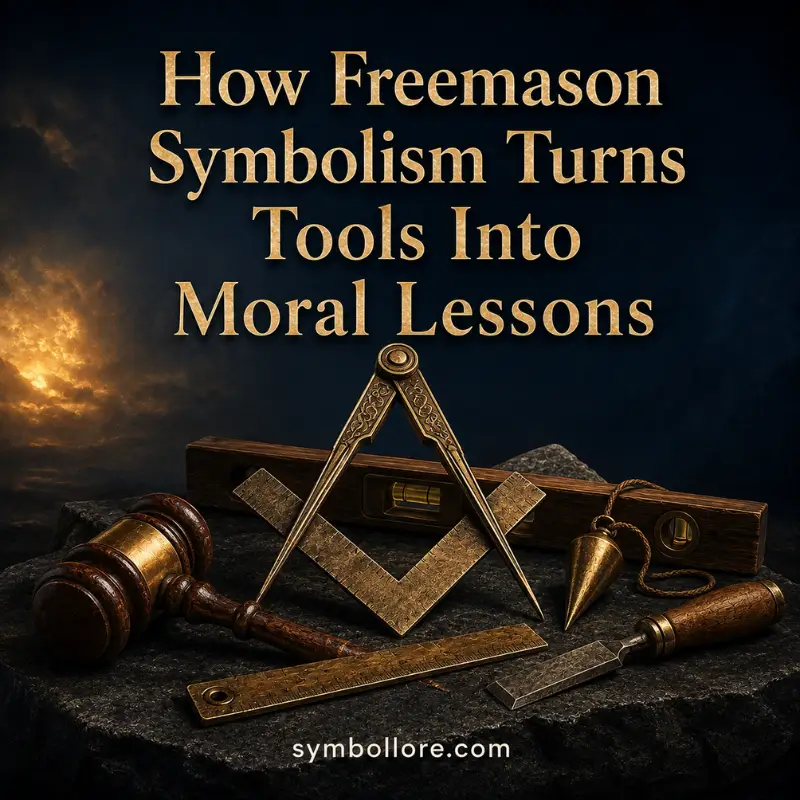
Masonic symbols work through analogy. A craftsperson uses a square to test a right angle, so a Mason can use the same object as a mental test for fair behavior. Compasses draw a boundary, so they become a reminder to keep desires and actions within proper limits.
This method helps explain why the imagery appears in lodge rooms, ceremonies, lectures, jewelry, architecture, and tracing boards. The object is not believed to possess magical power. Instead, ritual and instruction connect a visible form to an ethical idea. The symbol then serves as a compact memory aid long after the lesson ends.
It also explains why a one-line “secret meaning” is often misleading. Material use, ritual setting, and personal reflection can add different layers without making every interpretation equally historical.
From Stonemasons to Organized Freemasonry
Modern Masonic imagery grew from the language and tools of stone building, but claims of an unbroken institution from ancient Egypt are not established history.
The United Grand Lodge of England’s history
places the accepted roots among medieval stonemasons and records speculative members in the 1600s. It also identifies 1717, when four London lodges formed the first Grand Lodge, as a major organizational turning point.
As non-operative members joined, practical equipment gained philosophical meaning. The builder’s task became a model for shaping character, and a finished structure became a model for an ordered life. Biblical, geometric, moral, and Enlightenment ideas later expanded that vocabulary. Therefore, an emblem can predate Freemasonry even when Masons gave it a distinct use.
The Square and Compasses as the Central Emblem
The square and compasses are the most reliable public sign of Freemasonry. The square commonly represents fair, upright dealings. The compasses commonly represent restraint and the limits a person should place on harmful impulses. Together, they picture disciplined freedom rather than secrecy for its own sake.
The Museum of Freemasonry’s explanation
connects both tools to their real building functions. It also notes that their combined form is recognized worldwide, even though each tool existed long before organized Freemasonry. That distinction matters: ownership of an old shape is not required for a group to develop a recognizable emblem from it.
Orientation, ornament, and wording can vary. A ring may also reflect membership or remembrance, but its position on a finger does not create one universal message.
The Eye of Providence and Letter G
The Eye of Providence and letter G have different histories, even though both may appear near the central emblem. The eye usually expresses divine watchfulness and moral accountability. Because Christian artists and other institutions used it before Masons did, an eye inside a triangle is not automatically Masonic.
The letter G is especially important in American imagery.
The Museum of Freemasonry’s study of the G
identifies geometry as its original Masonic meaning and says U.S. use became more common in the 1800s. Many American explanations also connect it with God or the Grand Architect of the Universe. England largely stopped placing it within the emblem, while Irish and Scottish practice retained it.
Context resolves the ambiguity. A G inside the square and compasses is a strong Masonic clue; a freestanding eye or letter is not.
Working Tools, Ashlars, and the Work of Character
Working tools expand the building metaphor into a practical moral vocabulary. The plumb suggests upright conduct because it tests vertical truth. The level suggests equality because it establishes a common horizontal plane. The trowel joins separate stones, so it can represent fellowship and the bonds that hold a community together.
The common gavel and chisel turn correction into an image of deliberate effort. They remove unwanted material rather than hiding it. In the same way, the rough ashlar represents an unfinished person, while the perfect ashlar represents character shaped through education, discipline, and reflection. “Perfect” describes the model and direction of the work; it does not mean that a Mason claims personal flawlessness.
These meanings are strongest when the actual tool and its real function remain clear. Decorative speculation becomes less reliable when it ignores how builders used the object.
King Solomon’s Temple, Tracing Boards, and Lodge Imagery
King Solomon’s Temple supplies a narrative setting for much Masonic teaching. Representations of the pillars Jachin and Boaz, a winding staircase, a pavement, and sources of light help turn a lodge room into a symbolic place of learning. The building is a moral framework, not evidence that the modern fraternity constructed the biblical temple.
Tracing boards gather several emblems into one teaching picture. Instructors use them to connect a degree’s story, objects, and lessons. Light commonly suggests knowledge or moral understanding, while darkness can mark ignorance or a state before instruction. The sun and moon may also express order, regularity, and the rhythm of lodge work.
Because the images operate together, isolating one detail can distort its role. The degree and surrounding emblems often matter more than visual resemblance to an unrelated symbol.
The Masonic Apron, Acacia, and Mortality
The Masonic apron turns protective workwear into regalia associated with labor, honor, and conduct. A simple white apron often stresses innocence or upright behavior, while added colors and decorations can identify a degree, office, jurisdiction, or affiliated body. Design details should therefore be read as evidence of context, not as a universal rank chart.
The acacia is commonly linked with endurance, remembrance, and hope beyond death. Coffins, skulls, sprigs, and broken-column scenes may also invite reflection on mortality, especially in memorial art. Yet a skull alone is too widespread to prove Masonic identity.
On a grave, the strongest reading comes from several clues together: a clear emblem, lodge initials or number, dates, and local records. One familiar motif is rarely enough.
Blue Lodge, Scottish Rite, and York Rite Differences
Blue Lodge, or Craft Masonry, contains the three foundational degrees: Entered Apprentice, Fellow Craft, and Master Mason. Its central vocabulary includes builders’ tools, ashlars, pillars, light, and temple allegory. This is the safest starting point when someone asks what a general Masonic emblem means.
The Scottish Rite and York Rite are appendant systems that a Master Mason may choose to join. They add degrees, stories, offices, and emblems. A double-headed eagle, for example, strongly suggests a Scottish Rite setting, while a triple tau or certain cross-and-crown forms may point toward York Rite bodies.
These are not extra symbols shared identically by every Mason. Even within one branch, designs and explanations can differ by country, state Grand Lodge, ritual tradition, and historical period.
Freemason Symbolism in American Public Life
In the United States, Masonic emblems appear on lodge buildings, rings, pins, cornerstones, certificates, monuments, and gravestones. The square and compasses, especially with a G, provide the clearest identification. Shared religious or civic imagery needs more caution.
The reverse of the Great Seal of the United States shows a 13-step unfinished pyramid beneath the Eye of Providence.
The National Archives’ account of the Great Seal
documents a six-year, three-committee design process and identifies William Barton’s 1782 reverse design. It does not present the seal as a Masonic emblem.
The eye was already a wider symbol of Providence, and the pyramid is not a standard feature of regular Craft ritual. Similarity shows a shared visual culture, not proof of secret authorship. Historical claims should follow documents, not coincidence.
How to Interpret an Unfamiliar Masonic Emblem
A responsible reading starts with identification, then moves to interpretation. Use this five-part check:
- Name the object. Is it a ring, apron, grave marker, certificate, lodge furnishing, or modern graphic?
- Find the strongest identifier. Look for the square and compasses, lodge name, number, initials, or governing body.
- Separate core and appendant imagery. Check whether it belongs to Craft, Scottish Rite, York Rite, or another organization.
- Date and locate it. American, English, and Continental designs can use different forms and explanations.
- Confirm with a reliable collection. Museum catalogs, Grand Lodge archives, and documented monitors are stronger than unsourced symbol lists.
This method protects against two opposite errors. It avoids dismissing a real ritual emblem as decoration, and it avoids labeling every eye, triangle, star, or skull as Masonic.
FAQs
The main emblem is the square and compasses. The square commonly teaches fairness and upright conduct, while the compasses represent restraint and proper limits. A letter G often appears in the center in the United States, but the emblem can appear without it elsewhere.
The G most securely refers to geometry, which connects operative stonework with Masonic moral teaching. Many American Masons also understand it as God. Its absence does not make an emblem non-Masonic, because English and other regional practices do not use it in the same way.
No. The radiant eye has a longer history in Christian and European art and appears in non-Masonic settings. Freemasons use it for divine awareness and accountability, but identification requires context such as a lodge object, documented source, or nearby Masonic emblem.
The unfinished pyramid belongs to the reverse of the Great Seal, where its 13 levels refer to the original states and its unfinished form suggests future growth. It is not a standard symbol in regular Craft ritual, so the dollar bill does not prove a secret Masonic design.
No single Masonic authority governs the whole world. Core lessons often overlap, but wording, artwork, ritual use, and emphasis can differ among Grand Lodges, countries, degrees, and appendant bodies. Date and jurisdiction are essential when interpreting a specific object.
Start with the square and compasses, then look for a letter G, lodge name, lodge number, or a documented emblem of an affiliated body. Confirm the reading through cemetery records, obituaries, or Grand Lodge archives. A lone eye, star, skull, or plant is not enough.
Conclusion
Freemason symbolism is a visual method of moral instruction built from tools, geometry, temple stories, regalia, and memorial imagery. Its clearest emblem is the square and compasses, while other forms gain meaning from their ritual and historical setting.
Good interpretation requires context. Identify the object, organization, degree, place, and date before assigning a meaning. That approach preserves the genuine depth of Masonic teaching while avoiding claims based only on visual coincidence, commercial lists, or conspiracy stories.