Deer antler symbolism most often represents renewal, strength, protection, growth, and a close relationship with nature. These meanings come partly from what antlers do: they grow rapidly, serve in displays and contests, fall off, and return in another annual cycle.
However, antlers do not have one universal meaning. A prehistoric headdress, modern tattoo, hunting lodge display, religious image, and dream may use the same branching form for very different purposes. Cultural origin and personal context therefore matter as much as appearance.
Quick Answer
Deer antlers mainly symbolize renewal, strength, protection, maturity, and connection with the natural world. Their annual shedding and regrowth make them an especially clear image of recovery and transformation. Depending on the culture or setting, they can also suggest leadership, fertility, spiritual authority, rivalry, sacrifice, or the boundary between civilization and wilderness.
Key Takeaways
- Annual regrowth makes antlers natural symbols of renewal.
- Their size and use in contests suggest strength and status.
- Branching tines can resemble trees, crowns, or reaching arms.
- Cultural meanings vary and should not be blended carelessly.
- Modern uses include tattoos, jewelry, logos, dreams, and décor.
- Antlers may also represent pride, rivalry, mortality, or loss.
Deer Antler Meanings at a Glance
| Context or Feature | Likely Meaning | Why It Fits | Important Limitation |
|---|---|---|---|
| Shedding and regrowth | Renewal, recovery, transformation | A new set develops after the old one falls | Renewal is an interpretation, not a prediction |
| Large branching rack | Strength, maturity, authority | Mature males use antlers in display and competition | Antler size does not always indicate age |
| Tree-like shape | Nature, growth, interconnected life | Tines visually resemble branches | This association varies by artist and culture |
| Crown-like position | Leadership, dignity, spiritual authority | Antlers rise prominently above the head | Meanings depend on the tradition |
| Locked or fighting antlers | Rivalry, courage, conflict | Males may use antlers during breeding contests | It can symbolize danger as well as bravery |
| Shed antler | Release, transition, mortality | The former structure lies separated from the animal | It may also be a simple natural object |
| Tattoo or jewelry | Resilience, independence, wilderness | Wearers choose a lasting personal emblem | Ask the wearer rather than assuming |
| Dream image | Growth, pressure, identity, change | Dreams combine memory and personal associations | No universal dream dictionary can prove its meaning |
Why Antlers Symbolize Renewal and Regeneration
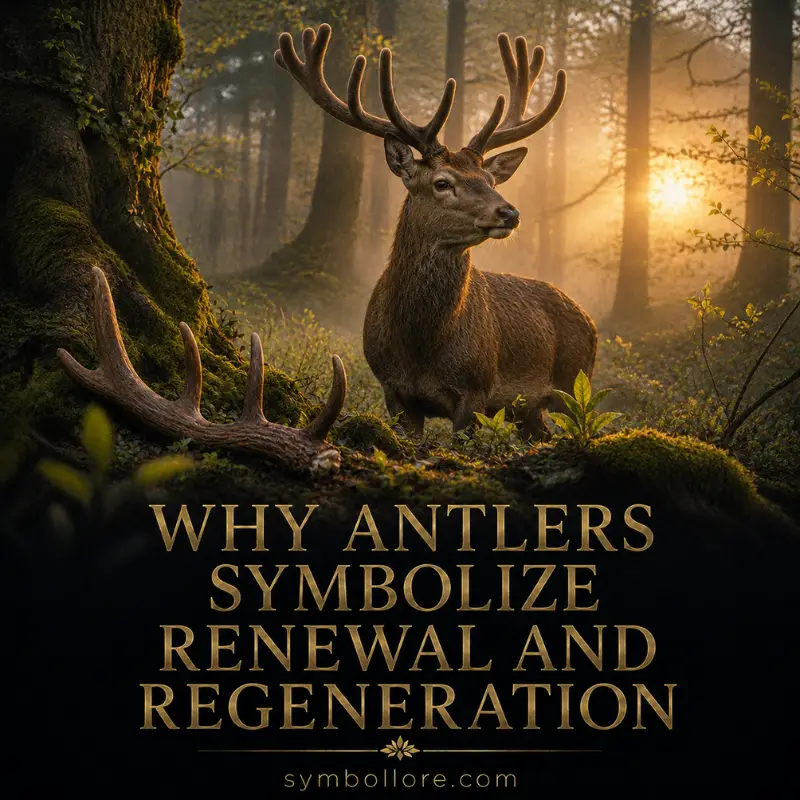
The renewal meaning begins with an unusual biological fact. Antlers are extensions of the skull made of bone, and members of the deer family generally shed and regrow them each year. Horns usually remain attached and continue growing, which makes antlers biologically distinct.
The National Park Service’s comparison of horns and antlers
explains this difference and confirms the annual cycle.
New antlers grow under a living, blood-rich covering called velvet. Hormonal and seasonal changes later end growth, after which the hardened antlers serve in display and competition. Scientific researchers describe antlers as the only known mammalian organ capable of complete natural regeneration after being cast off. That remarkable process has also made them valuable in
research on mammalian tissue regeneration.
Symbolically, this cycle offers a vivid pattern: growth, maturity, release, rest, and return. It can represent rebuilding after loss without suggesting that recovery restores life exactly as it was before.
Strength, Protection, and Leadership
Antlers signify strength because they are both prominent displays and practical structures. During the breeding season, male deer, elk, and related animals may use them to test rivals and establish access to mates. A branching rack can therefore communicate physical power, confidence, competitive ability, and maturity.
Yet deer antler symbolism is not limited to aggression. Antlers can prevent some contests from becoming direct attacks with hooves or teeth.
The National Park Service’s account of elk behavior
notes that bulls wrestle with their antlers and that weaker animals often withdraw. In symbolic art, this controlled contest can stand for setting boundaries, defending one’s position, or using power with restraint.
Their elevated, crown-like appearance also supports meanings of leadership and dignity. A stag design may suggest someone who stands visibly and accepts responsibility. In a negative context, however, the same image can communicate dominance, vanity, or an obsession with status.
Antlers, Horns, and Whole-Deer Symbolism
Antlers and horns are not the same. Antlers occur in the deer family, or Cervidae, and consist primarily of bone. They normally grow in branching forms and are shed. Horns have a bony core with a keratin sheath and usually remain for life.
The distinction changes symbolic interpretation:
- Antlers strongly support renewal, transformation, maturity, and cyclical loss.
- Horns more often suggest lasting defense, force, abundance, or enduring power.
- A stag may emphasize majesty, competition, virility, and leadership.
- A doe commonly emphasizes watchfulness, gentleness, care, and grace.
- A whole deer can represent sensitivity, alertness, speed, or peaceful movement.
- A shed antler focuses more directly on release, transition, remains, or renewal.
There are exceptions in nature. Both male and female reindeer, called caribou in North America, can grow antlers. Therefore, antlers should not automatically be treated as exclusively masculine symbols.
Ancient Evidence and European Traditions
People have worked with deer antlers for thousands of years, but an ancient object’s exact meaning is not always recoverable. One important example comes from Star Carr, a Mesolithic site in North Yorkshire. Archaeologists found modified red-deer skulls with attached antlers, often described as frontlets or headdresses.
The British Museum’s Star Carr antler frontlet
dates to roughly 8000 BC. Its design suggests that someone deliberately reduced and worked the skull, possibly so it could be worn. Scholars have proposed hunting, disguise, ceremony, transformation, or social identity as possible uses, but the object cannot confirm one interpretation by itself.
Later European imagery also connects stags with the forest, the hunt, sovereignty, sexuality, and encounters with an Otherworld. Antlered figures such as Cernunnos appear in ancient Celtic religious art. Modern writers sometimes treat Cernunnos as a simple “stag god,” but surviving evidence does not provide a complete theology. It is safer to say the antlered figure has associations with animals, abundance, nature, and sacred power.
Indigenous Traditions Require Specific Context
There is no single “Native American meaning” for deer antlers. Hundreds of distinct Indigenous nations have their own languages, histories, ceremonies, artistic systems, and relationships with deer. A claim about one community should not be presented as a belief shared by all Indigenous peoples.
In particular settings, deer may be connected with food, clothing, tools, hunting responsibility, kinship, ceremony, storytelling, or respectful exchange with the land. Antlers may function as materials, regalia, clan-related images, or signs associated with a particular narrative. These roles cannot be reduced to a generic label such as “spiritual antenna.”
When interpreting an Indigenous object, identify its nation, maker, date, location, and original use whenever possible. Museum records, tribal cultural centers, and information published by the relevant nation provide a stronger foundation than generalized spirituality websites. Appreciation begins with specificity and respect for living communities.
Christian and Modern Spiritual Meanings
Christian symbolism more commonly uses the deer than isolated antlers. Biblical poetry describes a deer longing for flowing water, which Christian art and teaching have linked with the soul’s desire for God. Medieval stories also sometimes present a stag as a guide, a sign of conversion, or an animal that leads a hunter toward a sacred encounter.
Antlers add themes of elevation, branching growth, sacrifice, and renewal, but those associations are interpretive rather than a fixed biblical definition. A Christian antler design may represent spiritual growth, restored faith, endurance, or the search for divine guidance.
In modern personal spirituality, people sometimes view antlers as a crown of awareness or a bridge between earth and sky. That reading comes largely from their position above the head and their tree-like form. It can be a meaningful metaphor, but it should be described as a contemporary spiritual interpretation rather than a scientifically demonstrated power.
Challenging Meanings: Conflict, Pride, and Mortality
Antlers can carry difficult meanings as well as hopeful ones. Their use in breeding contests makes them suitable symbols of rivalry, territorial tension, ambition, and the cost of competition. Locked antlers may represent two people trapped in a conflict neither is willing to release.
A mounted rack can evoke achievement and wilderness heritage for one viewer. For another, it may signify death, conquest, hunting pressure, or human control over nature. Horror stories and films often use antlers to make a human figure seem wild, predatory, distorted, or caught between species.
Shed antlers create another contrast. They may stand for healthy release because shedding is part of the animal’s cycle. Yet when separated from the living deer, they can also suggest absence, aging, vulnerability, or what remains after a former identity has passed.
Meaning therefore depends on tone. Bright foliage around growing antlers creates a different message from a damaged skull in a dark forest.
Deer Antler Tattoos, Jewelry, Art, and Home Décor
A deer-antler tattoo commonly expresses resilience, independence, growth, protection, or attachment to wilderness. A full stag may emphasize leadership and confidence, while a single shed antler may focus on surviving change. Flowers can soften the design toward healing; arrows may add direction or hunting associations; a skull can introduce mortality.
Antler jewelry often works as a private reminder of strength or renewal. An actual-antler piece may also express outdoor heritage, hunting identity, craftsmanship, or the desire to use a naturally shed material. Antler-shaped metal jewelry carries similar visual meaning without using animal material.
In logos, branching antlers create a strong silhouette. Outdoor brands may use them to suggest ruggedness, while wellness businesses may emphasize organic growth. Home décor ranges from traditional hunting displays to sculptural, nature-inspired forms. Because the same design can communicate conservation or conquest, its surrounding imagery matters.
Before using culturally specific patterns, research their origin. Avoid labeling a generic antler design “tribal” or copying ceremonial imagery without understanding its source.
Dreams and Personal Encounters
Dreams about antlers do not have one proven supernatural meaning. They draw from memory, emotion, culture, recent experiences, and personal associations. The most useful interpretation begins with what the antlers were doing and how the dream felt.
Consider four questions:
- Were the antlers growing, complete, damaged, or falling? Growth may suggest development, while damage may reflect vulnerability.
- Did they protect or threaten? Defensive antlers can represent boundaries; charging antlers may reflect pressure or conflict.
- Who carried them? A deer, another person, or the dreamer creates a different identity question.
- What did you feel? Awe, fear, pride, grief, and calm point toward different interpretations.
Seeing a real deer can likewise inspire reflection without being treated as a guaranteed message. The encounter might remind someone to stay alert, move gently, protect a boundary, or accept a season of change.
Ethical Use and Shed-Antler Collection
Naturally shed antlers may appear harmless to collect, but they still play a role in an ecosystem. Rodents and other animals gnaw them for minerals, and the objects become part of the forest floor. Searching for them can also disturb wildlife during a season when animals need to conserve energy.
Collection rules vary by state, park, refuge, season, and property owner. Many protected lands prohibit removing natural objects, while some jurisdictions temporarily close areas to shed hunting. Check the responsible wildlife agency and land manager before taking anything.
Use these basic safeguards:
- Never chase, approach, or pressure an animal to make it drop an antler.
- Respect seasonal closures and private-property boundaries.
- Leave antlers attached to skulls or remains unless removal is clearly lawful.
- Clean found material carefully and keep it away from untreated food surfaces.
- Consider photography or cast replicas when collection could cause harm.
Ethical use strengthens the symbol’s connection with respect for nature.
FAQs
Spiritually, deer antlers commonly represent renewal, personal growth, protection, heightened awareness, and connection with nature. These meanings come from annual regrowth and the antlers’ branching, elevated shape. They are modern or culture-specific interpretations rather than one universal spiritual doctrine.
Deer antlers can represent good fortune when they are associated with abundance, protection, successful growth, or a fresh start. However, good luck is not their universal meaning. In hunting, religious, artistic, and family settings, the same form may carry very different associations.
A deer-antler tattoo often represents resilience, strength, independence, maturity, or love of the wilderness. Its exact meaning depends on the wearer and accompanying elements. Flowers may suggest healing, a skull may emphasize mortality, and a full stag may communicate leadership or pride.
Antlers are associated with rebirth because deer shed and replace them in a recurring biological cycle. The old structure falls away, and a new one develops. This makes antlers a strong visual metaphor for recovery, transformation, and growth after a period of loss.
Antlers can symbolize masculinity because males grow them in most deer species and use them in display and competition. Still, that interpretation is not absolute. Female reindeer also grow antlers, and modern designs may use them as gender-neutral symbols of resilience, nature, or personal authority.
Finding a shed antler may personally suggest release, transition, renewal, or the discovery of strength after change. Biologically, however, it means a deer completed a normal stage of its annual cycle. No single spiritual message can be proven from the event alone.
Yes. Antlers alone usually emphasize growth, strength, status, and renewal. A deer skull introduces death, memory, sacrifice, survival, or the relationship between life and decay. Combining the skull with intact antlers creates a stronger contrast between mortality and regeneration.
Conclusion
Deer antler symbolism draws its strongest meanings from a real natural cycle. Antlers grow, mature, fall, and return, making them powerful emblems of renewal, resilience, strength, and change. Their branching form can also suggest leadership, protection, nature, or spiritual reach.
Still, no meaning applies everywhere. A tattoo, ancient headdress, religious image, dream, and hunting display require different interpretations. Start with the object’s cultural source and setting, then consider its condition, surrounding imagery, and personal significance. That approach keeps the symbolism meaningful without turning interpretation into unsupported certainty.


