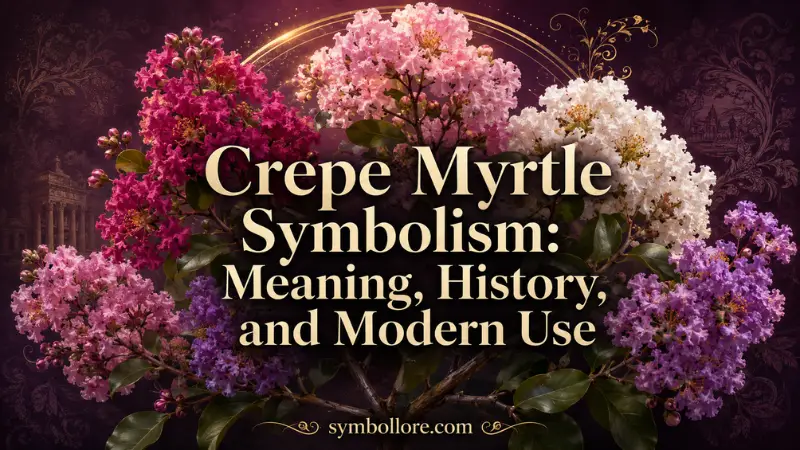
Crepe myrtle symbolism commonly centers on resilience, lasting beauty, renewal, devotion, and summer abundance. These meanings grow partly from the tree’s behavior: it flowers during intense heat, blooms for an extended period, sheds its bark, and returns with color each year.
However, the flowering tree is not the true myrtle associated with Aphrodite or biblical passages. Crepe myrtle belongs to the genus Lagerstroemia, so its meanings come from Asian cultural contexts, its strong presence in Southern landscapes, modern flower symbolism, and personal interpretation.
Quick Answer
Crepe myrtle symbolism represents resilience, enduring beauty, renewal, devotion, and hope. Its long summer flowering suggests perseverance, while its peeling bark can represent growth and leaving the past behind. Specific meanings vary by culture and color, and many popular spiritual interpretations are modern rather than ancient or universal traditions.
Key Takeaways
- Long summer blooms commonly represent perseverance and lasting affection.
- Peeling bark can suggest renewal, growth, and personal transformation.
- Flower colors add flexible emotional meanings rather than fixed rules.
- Chinese and Korean traditions provide distinct cultural associations.
- Crepe myrtle is not the true myrtle of Greek mythology.
- American gardens often connect the tree with Southern resilience.
Crepe Myrtle Meanings at a Glance
| Feature or context | Common symbolic meaning | Why the association developed | Important distinction |
|---|---|---|---|
| Long flowering season | Endurance and devotion | Flower clusters continue through much of summer | Bloom length varies by climate and cultivar |
| Hot-weather flowering | Resilience and hope | The tree produces vivid color during summer heat | Symbolism interprets a real trait |
| Exfoliating bark | Renewal and transformation | Old bark falls away and reveals a smooth surface | This is a metaphor, not a spiritual event |
| Pink flowers | Affection, joy, gratitude | Pink commonly carries warm emotional associations | Modern and flexible, not universal |
| White flowers | Peace, remembrance, new beginnings | White is widely linked with simplicity and ceremony | Meanings differ among communities |
| Red flowers | Passion, courage, vitality | Strong red color creates an energetic impression | True red cultivars are horticultural selections |
| Purple flowers | Dignity, creativity, distinction | Purple often conveys refinement or status | Chinese ziwei history is more specific |
| Southern landscapes | Regional endurance and summer beauty | The tree is highly visible across warm U.S. communities | It is not native to North America |
What Crepe Myrtle Symbolism Means
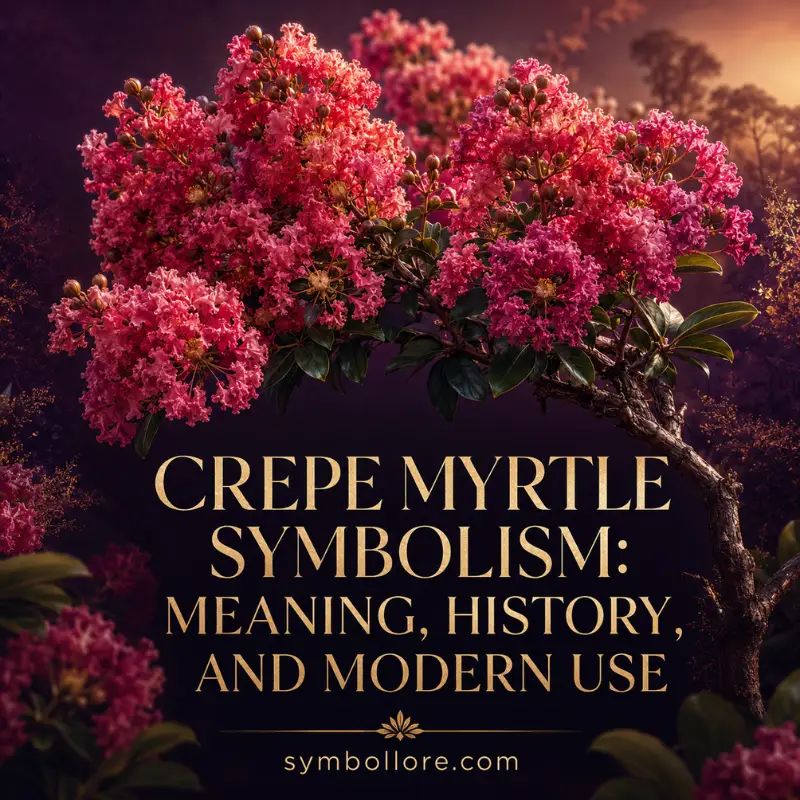
The central meaning of crepe myrtle is beauty that persists under pressure. The tree’s flower clusters appear during the hottest part of the year, when many spring-flowering plants have finished. Therefore, people often read it as an emblem of perseverance, confidence, and hope during difficult periods.
Long-lasting flowers also support meanings such as devotion and enduring affection. The connection is symbolic rather than scientific: people observe a visible quality and turn it into a human metaphor. A flowering tree that holds its color through summer can naturally suggest a relationship, memory, or purpose that survives hardship.
Renewal is another common interpretation. Mature trees shed sections of bark, revealing smooth, differently colored layers beneath. This natural process provides a strong image for releasing an old identity and continuing to grow.
Why Its Natural Features Shape Its Meaning
Crepe myrtle’s meanings make more sense when connected to its biology. North Carolina State University identifies Lagerstroemia indica as a deciduous shrub or small tree with showy flower panicles and exfoliating bark. Its cultivars may produce white, pink, red, lavender, or purple blooms. These observable features provide the foundation for later symbolic interpretations.
The NC State Extension Plant Toolbox
also documents considerable variation among cultivars. Some remain compact, while others become substantial landscape trees. This matters because “crepe myrtle” does not describe one identical-looking plant.
Three features inspire most modern meanings:
- Extended flowering: Sustained color suggests patience, commitment, and endurance.
- Bark renewal: The shedding surface suggests change without loss of identity.
- Seasonal return: New foliage and flowers suggest hope after dormancy.
These interpretations do not prove that the tree possesses spiritual power. Instead, its natural life cycle supplies useful metaphors for human experience.
Crepe Myrtle Flower Colors and Their Meanings
Flower color can refine crepe myrtle symbolism, but it does not create a universal code. Most color associations used in memorials, weddings, tattoos, and gifts are modern conventions. Personal and cultural context should guide the final choice.
White crepe myrtle
White flowers commonly suggest peace, sincerity, remembrance, and a fresh beginning. A white-flowering tree can suit a quiet memorial garden because its appearance is calm and highly visible against green foliage.
Pink crepe myrtle
Pink often conveys gentle love, appreciation, friendship, and happiness. It may suit a celebratory gift, family garden, or memorial for someone remembered for warmth and kindness.
Red crepe myrtle
Red commonly represents passion, vitality, confidence, or courage. Because the color is visually intense, it can communicate an active and spirited form of remembrance.
Purple or lavender crepe myrtle
Purple and lavender may suggest dignity, creativity, admiration, or spiritual reflection. In a Chinese context, however, purple-flowering ziwei carries cultural associations that cannot be reduced to a general Western color chart.
These meanings are starting points. A person might select white because it was a loved one’s favorite color or choose red to recall a shared summer garden. That personal connection can be more meaningful than a standard flower-language definition.
Crepe Myrtle Symbolism in Chinese Culture
Crepe myrtle has a deeper historical identity in China than generic online claims about luck suggest. Lagerstroemia indica is commonly known as ziwei in Chinese. The name also carries associations with Ziwei, the Purple Star, and with historic ideas about imperial order, distinction, and cultivated elegance.
The tree’s long bloom period also influenced its identity. It is sometimes associated with the idea of “hundred-day red,” a poetic description of flowers continuing across a large part of summer. That feature supports themes of continuity, vitality, prosperity, and lasting distinction.
Still, Chinese symbolism is not one unchanging system. Meanings can differ by historical period, region, literary source, and garden setting. It is safer to say that ziwei has acquired associations with longevity of bloom, elegance, status, and auspicious beauty than to claim every Chinese person interprets it identically.
Botanically, Lagerstroemia belongs to the loosestrife family, Lythraceae.
The U.S. National Arboretum’s Lagerstroemia checklist
documents the genus and its many cultivated forms, helping separate plant identity from unsupported folklore.
Korean Meanings of Devotion and Integrity
In Korea, crepe myrtle is known as baerongnamu, a name associated with its extended flowering. The tree appears in traditional garden contexts and is sometimes linked with constancy, loyalty, integrity, and the disciplined character expected of Confucian scholars.
One Korean legend tells of a maiden who waited for a returning hero. After tragedy, red flowers appeared and continued blooming for a hundred days. This story supports interpretations of patience, faithful love, and devotion that survives separation.
A legend should not be treated as a scientific history or the only Korean explanation. It is a narrative tradition that helps people express values through the tree. Its emotional force comes from the relationship between prolonged waiting and prolonged flowering.
The cultural setting also matters. In a memorial, the tree might represent faithful remembrance. Near a historic academy or formal garden, it can carry stronger associations with integrity, learning, and constancy.
Symbolism in the American South
In the United States, crepe myrtle frequently represents Southern summer beauty and resilience. The association developed because the tree became highly visible along streets, in yards, around public buildings, and across warm landscapes.
Crepe myrtles are not native to North America. The Smithsonian reports that no member of the genus Lagerstroemia originated here, although introduced trees became widely established in cultivation.
Its account of crepe myrtle in the United States
also explains how birds use the seeds, adding ecological nuance to the tree’s American presence.
The Southern association is therefore cultural and horticultural, not evidence of native origin. Its ability to produce bright midsummer flowers in heat and humidity helps explain why Americans interpret it as tenacious, dependable, and regionally familiar.
For some families, a mature tree also represents home, continuity, and inherited memory. A specimen planted by a parent or grandparent can become a living marker of family history even when that meaning has no formal cultural definition.
Crepe Myrtle Is Not True Myrtle
Crepe myrtle and true myrtle are different plants. Crepe myrtle belongs to the genus Lagerstroemia and family Lythraceae. True myrtle, Myrtus communis, belongs to the family Myrtaceae.
This distinction prevents a common symbolism error. In Greek and Roman traditions, true myrtle became strongly associated with Aphrodite or Venus, love, marriage, beauty, and fertility. Writers sometimes transfer those meanings to crepe myrtle because the common names sound similar.
The Smithsonian Libraries’ history of
true myrtle and its cultural meanings
identifies Myrtus communis as the classical plant. It is an evergreen Mediterranean shrub with different flowers, leaves, ancestry, and cultural history.
The same warning applies to biblical symbolism. Biblical references to myrtle do not identify modern ornamental Lagerstroemia. A person may still give a crepe myrtle a Christian personal meaning, but that interpretation should not be presented as a direct biblical identification.
Spiritual Meaning and Personal Interpretation
The spiritual meaning of crepe myrtle often centers on renewal, resilience, patient growth, and releasing old burdens. These ideas come from observing the tree’s seasonal cycle rather than from one universal religious doctrine.
Its shedding bark offers a particularly strong transformation metaphor. The tree does not become something entirely different when the outer layer falls away. Instead, the process reveals another surface while growth continues. Someone experiencing recovery or a new life stage might see that as a reminder that change can uncover strength rather than erase identity.
Its flowers can also represent hope during a demanding period. Because they appear in summer heat, they suggest the possibility of beauty amid discomfort.
Such meanings can be emotionally valuable without being treated as predictions. Seeing a blossom does not guarantee luck, romance, or a supernatural message. A grounded spiritual interpretation asks what the tree helps a person notice, remember, or practice.
Memorials, Weddings, Gifts, and Tattoos
Crepe myrtle works as a personal symbol when its meaning matches the occasion and the person involved. Its living form can be especially powerful because it changes through the seasons and may remain in a landscape for years.
Memorial planting
A memorial tree may represent a continuing bond, endurance through grief, and the return of beauty after loss. White can create a peaceful mood, while pink may celebrate warmth and affection. Before planting, check the cultivar’s mature size, local climate, and placement requirements.
Weddings and anniversaries
Long-lasting flowers can represent commitment and affection. However, couples should not mistake crepe myrtle for the classical bridal myrtle associated with European wedding traditions. They can choose it for its own qualities, including summer abundance and resilience.
Meaningful gifts
A potted or landscape-ready plant can communicate encouragement, gratitude, or hope. Include a short note explaining the intended meaning so the recipient does not need to guess.
Tattoos and artwork
A tattoo may combine ruffled blossoms with peeling bark, dates, initials, or another personal element. Pink can emphasize tenderness, red can communicate courage, and purple may convey dignity or creativity. Botanical accuracy helps make the design recognizable.
How to Interpret Crepe Myrtle Symbolism Responsibly
A responsible interpretation considers the plant, the cultural source, and the personal setting. This approach preserves the emotional value of symbolism while avoiding false historical claims.
Use three questions:
- What physical feature supports the meaning?
Long flowering supports endurance, while exfoliating bark supports renewal. - Does the claim belong to a named tradition?
Chinese ziwei history, Korean garden associations, and American Southern identity should remain distinct. - Is the meaning traditional, modern, or personal?
A color chart is usually a modern convention. A family memorial meaning may be entirely personal.
This framework also helps evaluate online claims. Statements such as “the tree always brings wealth” go beyond what symbolism can establish. A more accurate statement is that its abundant flowers may represent prosperity or hope in a chosen setting.
Symbolism remains meaningful because people connect natural forms with human experience. It does not need invented history or supernatural certainty to matter.
FAQs
Both spellings are accepted, although crape myrtle is common in American horticultural sources. “Crape” refers to the flowers’ crinkled, fabric-like appearance. The focus phrase “crepe myrtle symbolism” uses the widely searched alternative spelling without identifying a different plant.
Crepe myrtle can represent good fortune, prosperity, or hopeful change in modern interpretations. However, planting or seeing one does not guarantee luck. The association comes mainly from abundant flowering, positive color meanings, and selected cultural traditions.
Pink crepe myrtle commonly symbolizes affection, gratitude, gentle love, and happiness. These are flexible contemporary associations rather than fixed historical definitions. Personal memories connected with pink flowers may create a more specific meaning.
No clear biblical reference identifies the ornamental Lagerstroemia called crepe myrtle today. Biblical myrtle refers to a different plant, generally associated with true myrtle. Christian meanings assigned to crepe myrtle are therefore modern or personal interpretations.
In a memorial garden, the tree can represent continuing love, resilience during grief, renewal, and beautiful memories that return. Its seasonal changes make it a living remembrance. Choose a flower color and cultivar that suit the person, space, and local climate.
Seeing one may prompt reflection on patience, renewal, or remaining hopeful during a difficult season. That response can be personally meaningful, but it is not a universal omen. The meaning depends on the observer’s beliefs, circumstances, and cultural background.
Conclusion
Crepe myrtle symbolism draws its strongest meanings from visible qualities: long summer flowers suggest perseverance and devotion, while shedding bark evokes renewal and continuing growth. Chinese, Korean, and American settings add distinct ideas such as cultured elegance, integrity, faithful remembrance, and Southern resilience.
Still, no single interpretation applies everywhere. Crepe myrtle is also different from the classical true myrtle associated with Aphrodite and biblical texts. The most meaningful use respects that distinction while connecting the tree’s real characteristics with a specific memory, value, or life experience.