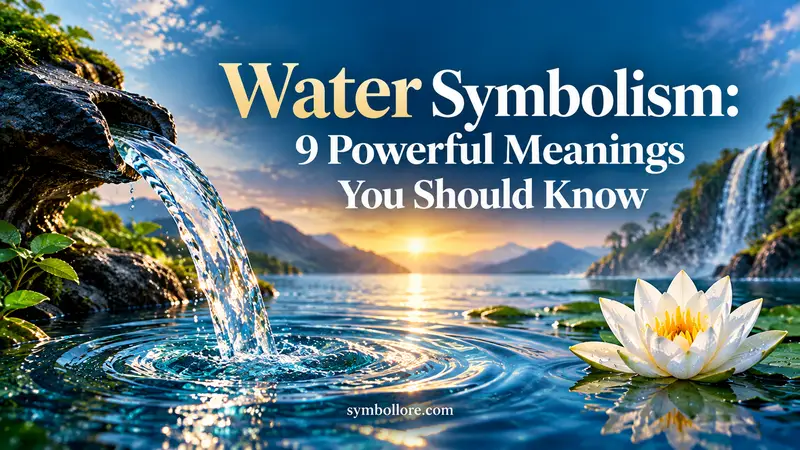
Water symbolism appears in religion, literature, dreams, art, and everyday life. A peaceful lake may suggest calm emotions, while a powerful ocean can represent mystery or danger. Water can give life, wash away dirt, and transform landscapes. Yet it can also cause floods and destruction.
So, what does water symbolize spiritually and culturally?
Its meaning depends on the setting, tradition, and emotions involved. From Christian baptism to ancient mythology, water has carried powerful messages for thousands of years.
This guide explains nine major meanings of water, their historical roots, and how to interpret water imagery thoughtfully.
Quick Answer: What Does Water Symbolize?
Water symbolism commonly represents life, purification, renewal, emotions, transformation, and spiritual growth. Flowing water may suggest change, while still water often represents peace or reflection. In religious traditions, water can symbolize cleansing, creation, and divine blessings. However, storms, floods, and deep oceans may also represent danger, chaos, or uncertainty. Its meaning always depends on context.
Key Takeaways (TL;DR)
- Life and creation: Water supports living things, making it a natural symbol of existence and fertility.
- Purification: Many religious traditions connect water with cleansing and preparation for worship.
- Emotional depth: Water imagery often helps writers and artists express feelings.
- Change and renewal: Rivers, rain, and flowing water can represent transitions and fresh beginnings.
- Dual meanings: Water can symbolize both peace and danger, depending on its setting.
What Is Water Symbolism?
Water symbolism refers to the meanings people assign to water in religion, mythology, art, literature, and personal experiences.
Because water is essential for life, humans have long treated it as more than an ordinary natural substance.
Civilizations developed near rivers, depended on rainfall, and used water for drinking, farming, cleaning, and transportation.
At the same time, people experienced its dangers through floods, storms, and drowning.
These experiences helped shape water’s symbolic meanings.
A clear stream might suggest purity, while a stormy sea could represent uncertainty.
In a religious ceremony, water may signify spiritual cleansing. In a novel, the same image might suggest grief or a major life change.
There is no single meaning that applies to every culture or situation.
The most accurate way to understand water symbolism is to consider what the water does, how it appears, and why it matters within the story or tradition.
The 9 Powerful Spiritual Meanings of Water
Water carries several important meanings across cultures and personal spiritual practices.
Some meanings have deep historical roots. Others are common modern interpretations.
1. Life and Creation
Water is one of the strongest natural symbols of life.
Every known living organism depends on water, and human communities have historically developed around reliable water sources.
This makes water a fitting image of creation, fertility, and survival.
In religious traditions, water sometimes appears at the beginning of creation stories.
For example, Genesis describes waters in its opening account of creation.
Likewise, the Quran connects water with the existence of living things.
In everyday symbolism, a flowing spring may suggest new life or the arrival of an opportunity.
2. Purification and Cleansing
Water removes dirt from the body, so its physical cleaning role naturally supports symbolic ideas about purification.
Many religions use water in sacred practices.
Christian baptism involves water and carries meanings connected with faith, cleansing, and entry into the Christian community.
In Islam, ritual washing prepares worshippers for prayer.
Jewish traditions also include ritual immersion in a mikveh under specific religious circumstances.
These practices differ in purpose and theology.
Still, they show how water can connect physical washing with spiritual preparation.
3. Renewal and New Beginnings
Rain can refresh dry ground, while rivers continually move through changing landscapes.
These natural patterns make water a common symbol of renewal.
In personal reflection, washing your hands or standing beside a stream might inspire thoughts about beginning again.
Writers may use rainfall after a difficult event to suggest hope or recovery.
However, renewal does not always mean forgetting the past.
Sometimes, it represents accepting an experience and moving forward with a new understanding.
4. Emotions and Inner Feelings
Water often represents emotions in modern art, literature, and dream interpretation.
Its changing conditions provide useful images for different feelings.
Calm water may suggest peace, while rough waves can represent distress.
Deep water may symbolize uncertainty or feelings that are difficult to understand.
This comparison works because emotions, like water, can seem gentle one moment and powerful the next.
Nevertheless, there is no scientific rule that a specific water image reveals someone’s exact emotional condition.
The meaning depends on the individual’s experience and the surrounding context.
5. Transformation and Change
Water constantly changes form and location.
It evaporates, becomes clouds, returns as rain, and flows through rivers and oceans.
These natural processes inspire symbolic meanings of transition and transformation.
A river crossing may represent leaving one stage of life and entering another.
In mythology, bodies of water sometimes mark boundaries between familiar and unfamiliar worlds.
The symbolic idea is that change can be unavoidable, but it can also create new possibilities.
6. Peace and Spiritual Calm
Quiet lakes, gentle streams, and soft rainfall often create peaceful settings.
Because of this, water frequently appears in artwork about stillness and reflection.
A person watching ripples spread across a pond may associate the scene with slowing down and finding perspective.
In modern spiritual practices, water imagery may help people focus during meditation.
Still, calm surroundings do not guarantee emotional healing.
Their symbolic value comes from the meaning and comfort someone finds in the experience.
7. Mystery and the Unknown
Deep oceans hide much of what lies beneath their surfaces.
This makes water an effective symbol of mystery, hidden knowledge, and uncertainty.
In stories, a character sailing into an unfamiliar sea may be entering an unpredictable future.
Dark water can also represent fears that have not been fully understood.
The meaning is not always negative.
Mystery may also suggest curiosity, discovery, and the possibility of learning something new.
8. Destruction and Chaos
Water’s power can be dangerous.
Floods, storm surges, and powerful currents can destroy property and threaten lives.
For this reason, water has long represented chaos, judgment, or uncontrollable forces in religious and literary traditions.
The flood narrative in Genesis is one example of water connected with judgment and destruction.
In storytelling, an overwhelming wave may symbolize a crisis that changes everything.
This meaning reminds us that water represents far more than peace and renewal.
9. Healing and Restoration
Water is essential for bodily health, hydration, and hygiene.
These physical benefits help explain its symbolic association with healing.
Springs, baths, and rivers have appeared in different cultural practices involving restoration and well-being.
However, claims that particular waters possess supernatural healing powers belong to specific beliefs and traditions.
Symbolically, water may suggest emotional recovery or the hope of becoming whole again.
It should not be confused with a medical treatment or a guarantee of recovery.
Water Symbolism in Different Forms
Water’s appearance and movement often shape its meaning.
Flowing Water Symbolism
Flowing water commonly represents movement, time, progress, and change.
A river never remains exactly the same from moment to moment.
For that reason, it can symbolize life’s ongoing transitions.
In personal interpretation, flowing water might encourage flexibility and acceptance.
Still Water Symbolism
Still water often suggests peace, patience, and reflection.
A smooth lake can reflect the sky and nearby trees, making it a useful image of self-awareness.
However, still water may also suggest waiting, isolation, or uncertainty in some stories.
Its meaning depends on the atmosphere.
Clear Water Symbolism
Clear water frequently represents honesty, clarity, and purity.
A character seeing the bottom of a stream might symbolize gaining a better understanding of a situation.
In dreams, clear water may feel comforting.
However, clarity is a symbolic association, not a fixed spiritual message.
Dirty or Muddy Water Symbolism
Muddy water can symbolize confusion, uncertainty, or emotional stress.
Its limited visibility provides a natural metaphor for situations that are difficult to understand.
A writer might describe a muddy river when a character faces a complicated decision.
The image does not automatically represent evil or danger.
Rain Symbolism
Rain often symbolizes renewal, fertility, sadness, or release.
Gentle rain after a drought may suggest hope.
Heavy rainfall during a tragic scene might reinforce feelings of grief.
The same weather event can carry opposite meanings depending on the story.
Ocean Symbolism
The ocean commonly represents vastness, freedom, mystery, and overwhelming power.
Its size can make human concerns feel small.
An open sea might symbolize adventure, while dangerous waves may represent uncertainty.
Flood Symbolism
Floods often suggest overwhelming change, danger, or destruction.
In religious narratives, a flood may also carry themes of judgment or a new beginning.
Modern personal interpretations sometimes connect floods with emotional pressure.
However, the symbolic meaning should never overshadow the real danger of flooding.
Water Symbolism in Religion and Spiritual Traditions
Water appears in many religious traditions, but its role differs across communities.
Water Symbolism in Christianity
Christianity frequently connects water with baptism, cleansing, new life, and divine provision.
Baptism uses water as an important sign of Christian faith.
John 4 also uses the image of living water in Jesus’ conversation with the Samaritan woman.
This imagery expresses spiritual life and God’s gift rather than ordinary drinking water alone.
Other biblical passages portray water as dangerous or destructive.
Therefore, Christian water symbolism includes both blessing and judgment.
Water Symbolism in Islam
Islam emphasizes water as a gift from God and an essential part of life.
The Quran discusses water in relation to creation, rainfall, and living things.
Water also plays an important role in ritual purification.
Muslims perform wudu before prayer when required, while ghusl applies in certain circumstances.
These practices involve religious preparation, not simply physical hygiene.
When water cannot be used under qualifying circumstances, Islamic law also provides for tayammum, a form of dry purification.
Water Symbolism in Hinduism
Water has important religious associations in Hindu traditions.
Rivers such as the Ganges, known as Ganga, hold sacred significance for many Hindus.
Ritual bathing can express purification and devotion.
Water is also used in offerings and ceremonies.
However, practices and interpretations differ across Hindu communities.
The sacred meaning of a river should not be reduced to a general claim that all water represents good luck.
Water Symbolism in Buddhism
Water appears in Buddhist art and rituals with meanings that can include purity, generosity, and clarity.
Water offerings are important in some Tibetan Buddhist practices.
Other traditions use water in ceremonies connected with blessings or purification.
Buddhist teachings also use natural images to explore impermanence and change.
Nevertheless, there is no single water interpretation shared by every Buddhist school.
Water in Ancient Greek Mythology
Ancient Greek mythology included rivers, seas, springs, and water deities.
Poseidon was associated with the sea and powerful natural forces.
The River Styx marked an important boundary connected with the underworld.
Other stories involved water in transformation, identity, and the passage between worlds.
These examples show how water could represent both life-giving resources and frightening supernatural boundaries.
Water Symbolism in Literature
Writers use water because it can communicate several ideas without explaining them directly.
Its condition, location, and role in the plot help determine the meaning.
Water as Guilt and Cleansing in Macbeth
In Shakespeare’s Macbeth, washing becomes closely connected with guilt.
Lady Macbeth’s troubled attempts to remove imagined blood reveal her inability to escape what has happened.
Water and washing therefore connect with the desire for cleansing, even when moral guilt remains.
Water as Freedom and Danger in The Adventures of Huckleberry Finn
The Mississippi River plays an important role in Mark Twain’s novel.
For Huck and Jim, traveling by river offers moments of freedom from the restrictions and dangers they face on land.
Yet the river journey also brings uncertainty.
This makes water a useful symbol of both possibility and risk.
Water as Power and Obsession in Moby-Dick
In Herman Melville’s Moby-Dick, the ocean provides the setting for adventure, danger, and Ahab’s destructive obsession.
Its enormous scale reinforces humanity’s limited control over nature.
The sea becomes more than scenery.
It helps create the novel’s atmosphere of mystery and overwhelming power.
Water as Time and Identity in Modern Literature
Virginia Woolf’s The Waves uses recurring sea imagery alongside the changing lives and inner experiences of its characters.
Waves help create patterns of movement, continuity, and change.
The imagery encourages readers to consider how individual lives unfold over time.
Examples of Water Symbolism and Their Meanings
| Water image | Possible symbolic meaning | Common context |
|---|---|---|
| Clear flowing river | Change and clarity | Personal growth stories |
| Quiet lake | Reflection and peace | Art and meditation |
| Heavy rainfall | Grief or renewal | Poetry and fiction |
| Deep ocean | Mystery and uncertainty | Adventure literature |
| Floodwater | Chaos or major change | Myths and religious narratives |
| Spring water | Fresh life and restoration | Cultural and spiritual imagery |
| Water used in washing | Cleansing and purification | Religious rituals |
| Crossing a river | Transition or separation | Literature and mythology |
These examples are interpretive starting points.
The same image may mean something different depending on its cultural setting.
Water Symbolism in Dreams
Dreaming about water may reflect personal memories, emotions, or recent experiences.
However, dream researchers have not established a universal meaning for every water-related dream.
Dreaming of Clear Water
Clear water may suggest calmness or a desire for greater understanding.
If the dream feels peaceful, you might associate it with confidence or emotional balance.
Dreaming of Deep Water
Deep water may reflect uncertainty or curiosity about something unfamiliar.
A frightening dream could relate to stress, while an enjoyable underwater experience might suggest exploration.
Dreaming of Flooding Water
A flood dream may feel connected to emotional pressure or a loss of control.
It does not predict a real flood or future misfortune.
Dreaming of Swimming
Swimming can symbolize effort, independence, or adapting to changing circumstances.
Your feelings during the dream are important.
Swimming comfortably and struggling against a current create very different experiences.
How Water Symbolism Is Used in Everyday Life
Water imagery appears in tattoos, jewelry, artwork, home decoration, and personal reflection.
A wave tattoo may represent resilience, freedom, or a connection with the ocean.
A river painting can suggest movement and the passage of time.
Some people use the image of calm water as a reminder to slow down during stressful days.
Others connect rainfall with hope or starting over.
These meanings can be personally valuable, but they are not universal messages.
For religious water symbols, the tradition and intended use deserve special attention.
Common Misconceptions About Water Symbolism
Misconception 1: Water Always Represents Peace
Water can symbolize peace, but it can also express danger, conflict, or destruction.
A calm lake and a violent storm create very different symbolic meanings.
Misconception 2: Clear Water Always Means Good Luck
Clear water may represent purity or understanding in modern interpretations.
However, it does not predict wealth, success, or favorable events.
Misconception 3: Every Religion Uses Water the Same Way
Religious water practices have different teachings and purposes.
Christian baptism, Islamic wudu, and Hindu ritual bathing should not be treated as identical ceremonies.
Misconception 4: Water Dreams Reveal the Future
There is no reliable scientific evidence that dreaming about water predicts future events.
Dreams may be meaningful for personal reflection without functioning as predictions.
Misconception 5: Water Has One Universal Meaning
Symbolic meanings change across cultures, stories, historical periods, and personal experiences.
Context is more useful than a fixed definition.
Important Historical and Cultural Insights
One of water’s most important symbolic qualities is its ability to express opposites.
It supports life but can also cause death.
It cleanses, yet contaminated water can spread disease.
It creates connections through rivers and travel routes, while oceans can separate communities.
This dual nature explains why water appears so frequently in religion and literature.
Another important distinction involves evidence.
A religious text may establish a specific traditional meaning. A novelist may create a meaning through imagery, while a person may assign private significance to an experience.
These three forms of symbolism can all matter, but they should not be presented as equally established historical facts.
People Also Ask About Water Symbolism
What does water symbolize spiritually?
Water often symbolizes life, renewal, purification, and spiritual growth. Many religious traditions use it in sacred practices, although their teachings differ. In modern personal spirituality, water may also represent emotional awareness and change.
Why is water a symbol of life?
Water is essential for living organisms and has supported farming, settlement, and human survival throughout history. Its physical importance naturally makes it a powerful symbol of creation, fertility, and continued existence.
What does running water symbolize?
Running water commonly symbolizes movement, transition, and the passage of time. Writers may use it to suggest that life continues to change. In some settings, it can also represent cleansing or leaving the past behind.
Frequently Asked Questions
Water may symbolize emotional connection, tenderness, vulnerability, or the changing nature of relationships. Calm water might suggest harmony, while rough waves can represent conflict. These meanings are especially common in poetry and modern personal interpretations. However, the image itself does not predict whether a relationship will succeed.
The Bible uses water to represent several ideas, including life, cleansing, divine provision, and judgment. Baptism has particular importance in Christianity, while stories of floods and dangerous seas reveal water’s destructive side. The meaning depends on the passage rather than one general definition.
Some Christian interpretations connect water imagery with the Holy Spirit, especially in passages such as John 7:37–39. However, not every reference to water in the Bible symbolizes the Spirit. Readers should examine the passage and its theological context before making that connection.
Ocean water often represents freedom, mystery, depth, and powerful natural forces. In literature, a calm sea may offer hope or possibility, while a violent ocean can suggest danger. Its vast size also makes it a useful image of the unknown and humanity’s limited control.
Water tattoos may represent resilience, transformation, freedom, or emotional depth. Waves often suggest strength during change, while flowing rivers can symbolize life’s journey. Religious water designs may carry more specific meanings. The tattoo’s appearance and the wearer’s personal story help determine its significance.
Drinking water in a dream may reflect ordinary sensations, memories, or personal associations with relief and renewal. Some people interpret it as a desire for emotional or spiritual nourishment. However, no universal scientific rule establishes that drinking water in a dream predicts healing or good fortune.
Yes. Water can symbolize both death and rebirth, especially in religious narratives, mythology, and literature. Floods or dangerous crossings may represent endings, while cleansing or emerging from water may suggest renewal. The pairing reflects water’s ability to sustain life and also threaten it.
Conclusion: What Does Water Symbolism Really Mean?
Water symbolism carries powerful meanings of life, purification, renewal, emotions, transformation, and mystery.
Its significance comes partly from water’s essential role in nature and partly from the religious and cultural ideas people have developed around it.
Most importantly, water can represent both creation and destruction.
Whether it appears in a dream, religious ceremony, poem, or painting, the best interpretation considers the context rather than assuming one universal meaning.