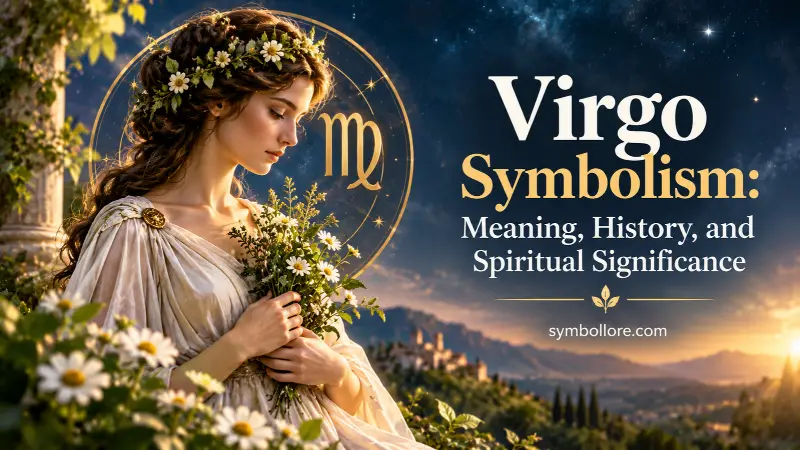
Virgo symbolism combines the image of a maiden with ancient ideas about harvest, wisdom, independence, and responsibility. As the sixth sign of the Western zodiac, Virgo has strong connections to practical thinking, careful work, and helping others.
But why does Virgo appear as a woman holding wheat? And what does its unusual zodiac symbol, ♍, actually mean?
The answers begin with ancient sky stories and farming traditions. Over time, Greek mythology and Western astrology added new layers of meaning.
This guide explores Virgo’s historical origins, spiritual interpretations, important symbols, and modern significance while separating cultural beliefs from scientific facts.
Quick Answer: What Does Virgo Symbolize?
Virgo symbolizes the maiden, harvest, purity, wisdom, service, and careful judgment. Ancient traditions connect its constellation with grain and figures such as Astraea and Demeter. In Western astrology, Virgo represents practicality, attention to detail, and improvement. Its glyph, ♍, identifies the zodiac sign. These meanings come from mythology and astrological tradition rather than scientific evidence about personality.
Key Takeaways
- The maiden: Virgo’s central figure represents independence, integrity, and traditionally, purity.
- Wheat and harvest: Grain connects Virgo with nourishment, fertility, seasonal change, and the rewards of work.
- Ancient mythology: Virgo has associations with several goddesses, including Astraea and Demeter.
- Mercury and earth: Western astrology connects Virgo with analysis, communication, practical thinking, and adaptability.
- Modern symbolism: Virgo often represents personal growth, service, responsibility, and thoughtful self-improvement.
What Is Virgo Symbolism?
Virgo symbolism refers to the meanings attached to the sixth sign of the Western zodiac and its associated constellation.
The word Virgo comes from Latin and means “maiden” or “virgin.”
In traditional images, Virgo appears as a female figure, sometimes with wings, holding a stalk or sheaf of grain.
This image has roots in ancient agricultural and religious traditions.
Today, Virgo is most familiar as an astrological sign associated with people born roughly between August 23 and September 22.
However, the zodiac sign and the constellation are not exactly the same thing.
In tropical Western astrology, Virgo is a 30-degree section of the zodiac defined by the seasons. In astronomy, Virgo is a constellation with boundaries set by astronomers.
The two systems share historical names and imagery but serve different purposes.
Virgo Symbol ♍ and Its Meaning
The Virgo zodiac symbol is ♍.
It is commonly called the Virgo glyph. Its shape resembles a stylized letter M with a curved line turning inward.
The exact origin of the design is not firmly established.
Some traditional interpretations connect the symbol with the maiden, modesty, or the idea of keeping something protected within.
Modern readers sometimes view its inward curve as a symbol of reflection and self-control.
These explanations are interpretations rather than proven accounts of the glyph’s original design.
Virgo Spiritual Meaning and Importance
Virgo’s spiritual meanings center on integrity, careful judgment, service, and personal growth.
These ideas come from astrology and symbolic reflection. They are not universal spiritual laws.
Purity and Personal Integrity
The maiden is Virgo’s most recognizable symbol.
Historically, virginity could represent purity, modesty, independence, or a sacred role, depending on the culture.
In modern symbolism, Virgo’s maiden need not represent sexual experience or the absence of it.
Instead, the figure may express integrity, self-respect, and the ability to make independent choices.
This interpretation makes the symbol more meaningful to a wider audience.
Wisdom and Discernment
Virgo often represents thoughtful decision-making.
In Western astrology, the sign is associated with noticing details, organizing information, and separating useful ideas from distractions.
Symbolically, this becomes the ability to judge a situation carefully.
A Virgo-inspired design might represent someone who values understanding before taking action.
The meaning emphasizes practical wisdom rather than supernatural knowledge.
Service and Compassion
Service is another important Virgo theme.
Astrological tradition connects the sign with helping others through useful work and everyday responsibility.
A person might interpret Virgo as a reminder that caring for others does not always require a grand gesture.
Sometimes compassion appears through small actions, steady effort, and attention to practical needs.
This is a symbolic ideal, not a personality trait shared by everyone born under Virgo.
Growth and Self-Improvement
Virgo also carries a modern association with self-improvement.
Its astrological reputation for careful observation can inspire the idea of examining habits and making useful changes.
In this sense, Virgo represents progress through patience.
The goal is not necessarily perfection. A healthier interpretation emphasizes learning from mistakes and improving with experience.
Connection to Nature and the Harvest
The harvest image gives Virgo a strong connection to the natural world.
Grain symbolizes nourishment, effort, and the results of patient care.
A successful harvest depends on preparation, time, and favorable conditions.
As a metaphor, Virgo can represent the rewards of consistent work.
This meaning grows directly from the agricultural imagery associated with the constellation.
Virgo Symbolism in Ancient Mythology and History
Virgo’s image developed over many centuries.
Its story includes Mesopotamian star traditions, Greek mythology, and later astrological interpretation.
Virgo in Ancient Mesopotamia
Ancient Mesopotamian sky traditions connected part of the sky now identified with Virgo to agricultural imagery.
The goddess Shala, who was associated with grain, appears in discussions of the constellation’s early history.
She could be represented holding an ear of grain.
This helps explain why a female figure and wheat became central features of Virgo imagery.
The symbolism reflects the importance of agriculture in societies where successful harvests supported everyday survival.
Virgo and Astraea in Greek Mythology
Astraea is one of Virgo’s best-known mythological associations.
In Greek and later classical traditions, Astraea represented justice and innocence.
One version of her story describes a golden age when humans lived more peacefully.
As human behavior became increasingly corrupt, Astraea eventually left Earth and took her place among the stars.
This story connects Virgo with moral integrity, justice, and the loss of an ideal world.
The nearby constellation Libra, represented by scales, strengthens the association with justice.
However, this is one of several mythological interpretations of Virgo, not its only historical identity.
Virgo and Demeter: Harvest and Abundance
Demeter, the Greek goddess of agriculture, is another figure associated with Virgo in classical star lore.
Demeter represents cultivated crops, nourishment, and seasonal cycles.
Her connection to grain makes her a natural comparison with the maiden holding wheat.
Through this tradition, Virgo can symbolize abundance, care, patience, and the importance of sustaining life.
The story also emphasizes humanity’s dependence on the natural world.
Not every ancient source identifies Virgo as Demeter, so the connection should be understood as one recognized tradition among several.
Other Mythological Figures Associated With Virgo
Virgo has also been connected with Erigone and other female figures in classical mythology.
The identity varies according to the author and tradition.
Some stories emphasize innocence or justice, while others focus on tragedy, transformation, or a figure’s place among the stars.
These differences show that constellations did not always possess a single fixed meaning.
Ancient cultures used familiar star patterns to preserve stories and explain important ideas.
Virgo Symbol Meanings: Maiden, Wheat, Earth, and Mercury
Several images and astrological features contribute to Virgo’s meaning.
| Virgo Symbol | Traditional Association | Common Modern Interpretation |
|---|---|---|
| Maiden | Virginity, independence, sacredness | Integrity, self-respect, careful judgment |
| Wheat | Harvest, fertility, nourishment | Growth, abundance, rewards of effort |
| Glyph ♍ | Astrological identification | Reflection, modesty, inward focus |
| Earth element | Practicality, material concerns | Stability, responsibility, grounded thinking |
| Mercury | Communication, analysis, intellect | Learning, organization, problem-solving |
| Mutable quality | Seasonal transition, adaptability | Flexibility, improvement, adjustment |
| Spica | Grain held by the maiden | Harvest and abundance in symbolic readings |
The Maiden as a Symbol of Independence
The maiden represents more than a young woman.
Within modern interpretations, she may symbolize a person who acts from personal values rather than outside pressure.
This idea makes independence an important part of Virgo symbolism.
The figure can also suggest responsibility and the desire to live with integrity.
Wheat as a Symbol of Abundance
Wheat is among Virgo’s most historically meaningful symbols.
It represents food, cultivation, and the harvest season.
Unlike symbols based only on abstract ideas, wheat connects the constellation to a practical part of ancient life.
As a modern metaphor, it can represent the results of consistent effort and the value of caring for others.
Virgo’s Earth Element
Western astrology places Virgo among the three earth signs, alongside Taurus and Capricorn.
Earth represents material reality, steady effort, and practical concerns in astrological language.
For Virgo, this is often interpreted as a preference for useful action over vague promises.
Symbolically, the earth element encourages grounding ideas in everyday life.
Mercury as Virgo’s Ruling Planet
Mercury is Virgo’s traditional ruling planet in Western astrology.
Astrologers associate Mercury with communication, reasoning, observation, and the movement of information.
Within Virgo symbolism, Mercury emphasizes sorting details and solving problems.
This does not mean the planet physically determines someone’s intelligence or communication style.
The relationship belongs to the symbolic framework of astrology.
Virgo as a Mutable Sign
Virgo is one of four mutable signs in Western astrology.
Mutable signs mark transitions between seasons within the tropical zodiac.
They are commonly associated with adjustment, change, and flexibility.
Virgo combines this quality with earth symbolism.
The result is an astrological image of practical adaptation: noticing what needs improvement and making useful changes.
How to Interpret Virgo Symbolism in Everyday Life
Virgo imagery can become meaningful through reflection, artwork, gifts, or personal goals.
The first step is to identify which part of the symbol matters most.
A person who values justice might connect with Astraea. Someone building a new career may prefer the harvest image as a reminder that effort takes time.
Next, consider the setting.
A Virgo symbol on a birthday gift usually refers to the zodiac sign. The maiden holding wheat in an artwork may emphasize history, agriculture, or mythology.
Finally, avoid treating symbolism as destiny.
The image may inspire a person to become more thoughtful or organized, but it does not determine their character.
Examples of Virgo Symbolism in Everyday Life
Example 1: A Virgo Tattoo Representing Growth
Someone chooses the Virgo glyph for a small wrist tattoo.
The design marks their zodiac identity while also expressing a personal commitment to thoughtful decisions.
In this example, the meaning comes from both astrology and individual intention.
Example 2: Wheat in a Virgo-Inspired Artwork
An artist draws a maiden holding a bundle of golden wheat.
The image connects ancient harvest symbolism with patience, nourishment, and abundance.
It may also suggest the rewards of work completed over time.
Example 3: Virgo as a Symbol of Service
A person uses Virgo imagery in a journal dedicated to volunteering and community work.
For them, Virgo represents the value of helping through reliable action.
This is a modern personal application of the sign’s traditional association with service.
Example 4: Astraea and the Search for Justice
A writer features a star-filled sky above a character who is struggling with an unfair decision.
The constellation Virgo becomes a reference to Astraea and the ideal of justice.
The meaning depends on the story’s use of classical mythology.
Virgo Symbolism in Tattoos, Jewelry, and Modern Culture
Virgo imagery appears on jewelry, clothing, tattoos, birthday gifts, and digital artwork.
The simple glyph ♍ works well in minimal designs.
The maiden offers a more detailed option, especially when combined with stars, wheat, or floral patterns.
Wheat can emphasize growth, patience, or abundance. A constellation design may reflect an interest in astronomy rather than belief in astrology.
Some people combine the Virgo glyph with Mercury’s planetary symbol to express the sign’s astrological connection with thought and communication.
Others choose Virgo imagery simply because it reflects their birth date.
No single explanation applies to every design.
Modern symbolism is often personal. Two people may wear the same Virgo necklace for entirely different reasons.
Virgo vs. Gemini, Taurus, and Capricorn Symbolism
Virgo shares some astrological features with other zodiac signs.
Comparing them helps clarify what makes its symbolism distinctive.
| Zodiac Sign | Shared Feature With Virgo | Main Symbolic Contrast |
|---|---|---|
| Gemini | Mercury as ruling planet | Gemini emphasizes duality and exchange; Virgo emphasizes analysis and practical application |
| Taurus | Earth element | Taurus is often associated with stability and enjoyment; Virgo with refinement and useful work |
| Capricorn | Earth element | Capricorn commonly represents structure and long-term ambition; Virgo emphasizes details and improvement |
| Pisces | Mutable quality; opposite Virgo in the zodiac | Pisces often represents imagination and emotional openness; Virgo emphasizes discernment and practical care |
These comparisons describe traditional astrological themes.
They should not be treated as scientific descriptions of people born under different signs.
Common Misconceptions About Virgo Symbolism
Misconception 1: Virgo Means Someone Must Be a Virgin
The Latin name means maiden or virgin, but the zodiac sign does not describe a person’s sexual history.
Modern interpretations often emphasize integrity, independence, or symbolic purity.
Misconception 2: Virgo Represents Only One Greek Goddess
Virgo has associations with Astraea, Demeter, Erigone, and other figures.
Its mythological identity varies across traditions.
Claiming that only one goddess represents Virgo oversimplifies its history.
Misconception 3: Virgo People Are Always Perfectionists
Perfectionism is a familiar Virgo stereotype in popular astrology.
However, birth signs do not provide a scientifically reliable way to predict personality.
People born during Virgo season have varied strengths, preferences, and habits.
Misconception 4: The Virgo Constellation and Zodiac Sign Are Identical
They are related but different.
Astronomy studies the actual constellation, while tropical Western astrology uses a fixed seasonal division of the zodiac.
The Sun’s position among the background stars has shifted relative to traditional astrological dates because of Earth’s axial precession.
Misconception 5: Virgo Symbolism Predicts the Future
Virgo symbols do not provide scientifically established predictions about relationships, success, or future events.
People may find astrology personally meaningful, but its symbolic claims should be distinguished from evidence-based forecasting.
Important Facts About Virgo Symbolism
Spica Connects the Constellation to Grain
Spica is the brightest star in the constellation Virgo.
Its name comes from Latin and refers to an ear of grain.
In traditional sky illustrations, Spica marks the grain held by the maiden.
This creates a direct connection between the star’s name, the constellation’s image, and harvest symbolism.
Virgo Is One of the Largest Constellations
Virgo is the second-largest of the 88 officially recognized constellations by area.
Only Hydra covers a larger section of the sky.
This astronomical fact is separate from its symbolic role in astrology.
The Maiden Does Not Have One Universal Identity
Across ancient traditions, Virgo has represented different female figures.
This variety is not necessarily a contradiction. Different cultures and writers attached their own stories to the same region of the sky.
Understanding those differences gives a more accurate picture of Virgo’s history.
Astrology and Astronomy Ask Different Questions
Astronomy examines stars, planets, galaxies, and other physical objects through scientific methods.
Astrology interprets celestial patterns through a traditional symbolic system.
Virgo exists in both contexts, but claims about personality and spiritual destiny belong to astrology rather than established astronomy.
People Also Ask About Virgo Symbolism
What does Virgo symbolize spiritually?
Virgo spiritually symbolizes integrity, thoughtful service, practical wisdom, and personal growth in modern astrological interpretation. Its maiden represents independence, while wheat suggests nourishment and the results of patient effort. These meanings can inspire personal reflection, but they are cultural and spiritual interpretations rather than scientifically established influences.
Why is Virgo represented by a maiden?
Virgo is represented by a maiden because ancient sky traditions associated the constellation with female figures linked to agriculture, justice, and purity. Classical mythology connected Virgo with several figures, including Astraea and Demeter. The maiden’s meaning changed across cultures, so she does not represent only one goddess or quality.
What does the Virgo symbol ♍ mean?
The Virgo glyph, ♍, identifies the sixth sign of the Western zodiac. Its design resembles an M with a line curving inward. Modern symbolic interpretations connect this shape with modesty, reflection, or self-containment. However, there is no firmly established explanation of its original design.
What goddess is associated with Virgo?
Astraea, the goddess associated with justice and innocence, is one of Virgo’s best-known mythological figures. Demeter, the Greek goddess of agriculture, is another important association. Ancient accounts also connect the constellation with Erigone and other female figures. No single goddess represents every historical interpretation of Virgo.
Frequently Asked Questions
The deeper meaning of Virgo symbolism involves integrity, practical wisdom, service, and the rewards of careful effort. The maiden represents independence, while wheat connects the sign to harvest and nourishment. Modern astrology adds themes of thoughtful analysis and self-improvement. Together, these ideas form a symbol of responsibility and purposeful growth.
Virgo traditionally holds wheat because the constellation has ancient connections with agriculture, fertility, and harvest goddesses. Its brightest star, Spica, is associated with an ear of grain. Wheat represents nourishment and the rewards of cultivation. This is one of the strongest historical features of Virgo imagery.
In Western astrology, Virgo’s earth element represents practicality, stability, and attention to everyday life. Astrologers connect this element with reliable effort and an interest in useful results. When combined with Virgo’s mutable quality, earth symbolism suggests adapting to change through practical action rather than resisting it.
Common modern astrological associations include beige, brown, muted green, navy blue, and other earthy colors. These shades can suggest stability, simplicity, reflection, and a connection with nature. However, different astrology guides assign different colors to Virgo. There is no single historical color system accepted across all traditions.
A Virgo tattoo often represents zodiac identity, independence, personal growth, or practical wisdom. The glyph ♍ creates a simple design, while the maiden or wheat can add mythological meaning. Someone might also use the constellation’s stars to express an interest in astronomy. The wearer’s intentions determine the tattoo’s personal significance.
Virgo’s maiden is traditionally a female figure, so femininity forms an important part of its historical imagery. However, its broader meanings include justice, harvest, integrity, service, and independence. These qualities are not limited to any gender. Virgo symbolism can therefore be meaningful to anyone, regardless of identity.
Virgo is commonly associated with precision and improvement in modern astrology. This has created the popular stereotype of Virgo as a perfectionist. However, the historical symbols of the maiden and wheat do not simply mean perfection. They also reflect responsibility, nourishment, and integrity. A constructive modern interpretation focuses on steady improvement rather than flawless results.
Conclusion: What Does Virgo Symbolize?
Virgo symbolism brings together ancient harvest traditions, mythological figures, and modern astrological meanings.
The maiden represents independence and integrity. Wheat connects Virgo with nourishment, abundance, and patient effort. Figures such as Astraea and Demeter add themes of justice and agriculture.
Modern astrology also associates Virgo with practical wisdom, service, adaptability, and self-improvement.
The most meaningful way to understand Virgo is to recognize the difference between its documented cultural history and the personal interpretations people give it today.