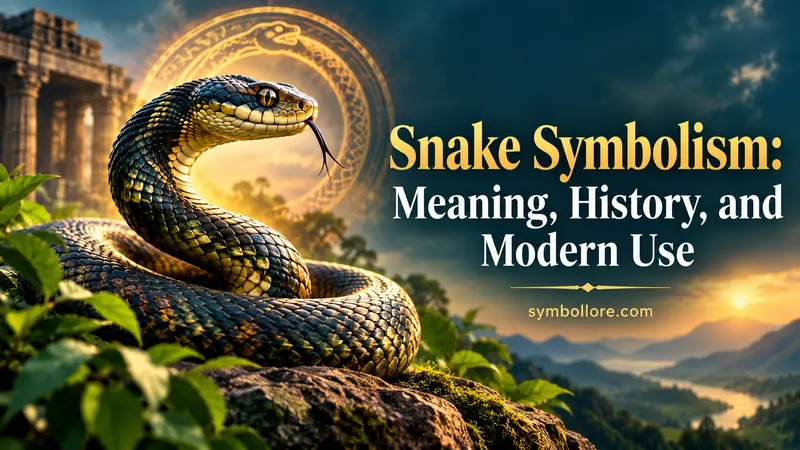
Snake symbolism can represent transformation, healing, danger, protection, temptation, renewal, power, and even political independence. Few animals carry so many opposing meanings.
That complexity comes from both biology and culture. Snakes shed their skin, move close to the earth, can disappear into hidden spaces, and include species capable of delivering dangerous venom. Human societies turned those traits into very different symbols. Egyptian cobras protected kings, Greek serpent imagery became tied to healing, biblical texts used snakes in both threatening and restorative scenes, and Buddhist art could turn a serpent into a guardian.
There is no single worldwide snake meaning. The culture, species, pose, story, and historical setting decide what the image communicates.
Quick Answer
Snake symbolism most often represents transformation, renewal, danger, healing, protection, power, temptation, or hidden knowledge. Skin shedding helps explain modern associations with change, while venom supports meanings of danger and mortality. However, Egyptian, Greek, biblical, Buddhist, Mesoamerican, and American snake symbols developed in different contexts, so no one interpretation applies everywhere.
TL;DR
- Skin shedding gives snakes a strong connection with renewal and transformation.
- Ancient Egyptian cobra imagery could represent royal authority and divine protection.
- The Greek Rod of Asclepius links the serpent with medicine and healing.
- Biblical snakes can signify temptation and danger, but the bronze serpent also appears in a healing story.
- Buddhist naga imagery can represent guardianship, especially in the story of Mucalinda.
- In U.S. history, the rattlesnake became a symbol of colonial unity, warning, and political independence.
Snake Meanings at a Glance
| Context | Main Meaning | Why the Association Developed | Important Limit |
|---|---|---|---|
| Skin shedding | Renewal, transformation | The outer skin is periodically replaced | Biology inspires the metaphor; it does not create one universal spiritual rule |
| Venom and striking | Danger, defense, mortality | Some species can cause serious injury or death | Many snakes are nonvenomous and avoid confrontation |
| Ancient Egypt | Protection, kingship, divine authority | The uraeus cobra appeared on royal and divine imagery | This meaning belongs to specific Egyptian iconography |
| Ancient Greece | Healing, medicine | The serpent became linked with Asclepius | Do not confuse the Rod of Asclepius with the caduceus |
| Biblical texts | Temptation, danger, judgment, healing | Different passages use serpents differently | “Snake = evil” is too simple |
| Buddhism | Protection, sacred guardianship | Mucalinda shelters the Buddha | Naga traditions vary across regions |
| Mesoamerica | Divine and cosmic power | Feathered Serpent deities combined serpent and feather imagery | Not every serpent image represents Quetzalcoatl |
| Colonial America | Unity, warning, resistance | Rattlesnake emblems appeared in Revolutionary-era political imagery | Modern political meanings have continued to change |
Why Snakes Became Symbols of Transformation
Transformation is one of today’s most familiar snake meanings because snakes visibly shed their outer skin.
The process is called ecdysis. Research on snake physiology explains that snakes periodically replace outer epidermal layers as part of normal growth, protection, healing, and other biological functions. PubMed
The Smithsonian National Zoo also explains that snakes shed their skin for several reasons, including growth, repair, and normal adult physiological changes. National Zoo
From a human point of view, the effect is visually powerful. An old outer layer separates, and the snake emerges in fresh skin. That makes the animal an easy metaphor for:
- releasing an old identity;
- recovering after hardship;
- entering a new stage of life;
- adapting without becoming an entirely different person;
- leaving behind something worn or damaged.
Still, this is where symbolism writing often becomes too broad.
The biological process does not prove that every ancient culture interpreted snakes as rebirth symbols. Some traditions did connect serpents with regeneration or cycles, while others emphasized danger, sovereignty, water, healing, or chaos.
The safest general statement is that shedding gives the snake an unusually strong visual basis for renewal.
Readers interested in another animal whose transformation meaning comes from a real biological process can compare it with Butterfly Tattoo Symbolism: Meanings, Colors and Ideas. SymbolLore
Danger, Venom, and the Meaning of Hidden Power
Snakes can symbolize danger because humans have practical reasons to pay attention to them.
Some species are venomous. Others defend themselves by striking, constricting, displaying warning postures, or trying to escape. Even a nonvenomous snake can appear threatening because its movement is quiet and difficult for people to predict.
This creates a second major symbolic family:
- danger;
- defense;
- warning;
- concealed strength;
- vigilance;
- boundaries;
- mortality.
A snake therefore does not need to be attacking to suggest power.
A coiled snake can communicate restraint or readiness. A raised cobra can show an unmistakable defensive presence. A hidden snake may suggest danger that has not yet revealed itself.
That distinction is especially useful in tattoos, emblems, fiction, and political art. The snake’s symbolic force often comes from power held in reserve, not constant aggression.
For a species-specific example, Cobra Symbolism: Power, Protection, and Transformation examines how the cobra’s expanded hood strengthens meanings of warning, authority, and protection. SymbolLore
Snake Symbolism in Ancient Egypt
Ancient Egypt gives us one of the clearest historical examples of positive serpent symbolism.
The uraeus is the upright, hooded cobra seen on royal and divine imagery. The Metropolitan Museum of Art identifies the rearing cobra as a symbol of protection and connects it especially with the goddess Wadjet, patron deity of Lower Egypt. Uraei appeared on royal and divine headdresses and on architectural features protecting sacred space. The Metropolitan Museum of Art
Another Met object describes the uraeus as a major symbol of royalty. The Metropolitan Museum of Art
This creates a meaning very different from the familiar Western idea of the snake as simply deceptive or evil.
In Egyptian royal imagery, the cobra could communicate:
- divine protection;
- legitimate kingship;
- sacred authority;
- readiness to defend;
- destructive power directed against enemies.
The pose is important. A hooded cobra appears alert and dangerous. Egyptian art turned that threat into protective royal power.
That historical example shows why snake symbolism cannot be reduced to one moral label.
Why the Snake Became a Symbol of Medicine
The serpent’s connection with medicine comes most strongly from ancient Greek tradition.
Asclepius, the Greek god associated with medicine and healing, was represented with a staff entwined by a single snake. Medical historians trace the snake-and-staff emblem back more than two thousand years. PubMed
That image became the Rod of Asclepius, one of the best-known medical emblems.
The snake’s medical meaning has encouraged several interpretations. Shedding can suggest renewal, while the animal’s close relationship with life, death, danger, and recovery creates an especially powerful symbol for medicine.
Rod of Asclepius vs. Caduceus
These two images are frequently confused.
The Rod of Asclepius has:
- one serpent;
- one staff;
- no wings;
- a historical connection with Asclepius and medicine.
The caduceus traditionally has:
- two serpents;
- a staff;
- wings;
- a historical connection with Hermes or Mercury.
A medical-history review notes that the caduceus entered some modern medical usage despite its different ancient background. PubMed
So the common statement “two snakes on a winged staff represent ancient medicine” needs qualification.
The single-serpent Rod of Asclepius has the clearer ancient healing connection.
Snake Symbolism in the Bible
Biblical serpent imagery contains both negative and positive or restorative elements.
The most famous example appears in Genesis 3, where the serpent persuades Eve to eat from the forbidden tree. Later Jewish and Christian interpretation gave this scene enormous symbolic importance, and Christian tradition increasingly connected the serpent with temptation, deception, sin, and evil.
That legacy heavily influenced Western art and language.
Yet the Bible itself contains another striking serpent story.
The Bronze Serpent of Moses
In Numbers 21, poisonous serpents attack the Israelites. God then instructs Moses to make a serpent and place it on a pole. Those who look at the bronze serpent after being bitten survive. Bible Gateway
The same broad animal image therefore appears in a completely different role.
Biblical serpent imagery can involve:
- temptation;
- danger;
- judgment;
- human disobedience;
- healing;
- survival;
- divine action.
This is why “the snake always symbolizes Satan in the Bible” is too simplistic.
The meaning changes with the passage.
Buddhist Naga Symbolism and Mucalinda
In Buddhist art, the serpent can become a protector.
The best-known example is Mucalinda, a naga king associated with a story about the Buddha after enlightenment.
The British Museum describes Mucalinda as a serpent who protects the historical Buddha after enlightenment, sheltering him beneath a multi-headed hood. British Museum
The Metropolitan Museum of Art preserves a 12th-century Cambodian sculpture showing the Buddha sheltered by the naga Muchilinda during heavy rain. The Metropolitan Museum of Art
Here the snake-like being does not symbolize deception.
Instead, the image can communicate:
- protection;
- guardianship;
- sacred power;
- shelter;
- devotion;
- the relationship between local serpent traditions and Buddhism.
The motif became especially important in parts of Southeast Asia.
This example also shows why it is risky to say that “Eastern cultures see snakes positively.” Asia contains many religions, cultures, and historical periods. The Mucalinda tradition should be understood on its own terms rather than used to represent an entire continent.
Feathered Serpents in Mesoamerican Art
Mesoamerica produced serpent imagery that is visually and religiously distinct from Egyptian, Greek, or biblical forms.
The Feathered Serpent, often associated with Quetzalcoatl and related traditions, combines a serpent body with feathers.
The Metropolitan Museum of Art documents feathered-serpent imagery in Mesoamerican objects and notes that Quetzalcoatl had many aspects and was worshipped by numerous Mesoamerican peoples. The Metropolitan Museum of Art
At Chichen Itza, serpent imagery connected with Kukulkan appears prominently in ritual and monumental art. The Met identifies Quetzalcoatl or Kukulkan as one of the city’s principal deities. The Metropolitan Museum of Art
It is tempting to translate the Feathered Serpent into one simple word such as “wisdom.”
That loses too much.
Depending on place and period, these serpent traditions can intersect with:
- divinity;
- rulership;
- ritual;
- wind;
- creation;
- cosmic order;
- earth-and-sky imagery;
- political authority.
The specific deity and archaeological context matter more than a generic snake dictionary.
The Rattlesnake in American Symbolism
The snake also has a distinctly American political history.
Benjamin Franklin’s “Join, or Die” woodcut appeared in The Pennsylvania Gazette in 1754. It showed a snake divided into sections representing colonies and argued for political unity. The Library of Congress identifies it as an early image of colonial unification. The Library of Congress
During the Revolutionary era, rattlesnake imagery gained another famous message:
“Don’t Tread on Me.”
The snake now communicated:
- unity;
- resistance;
- warning;
- self-defense;
- independence;
- political identity.
The logic was visual and behavioral. A rattlesnake appears dangerous, but its rattle can function as a warning before a defensive strike.
That made it an effective political metaphor: leave us alone, but expect resistance if attacked.
Modern uses of rattlesnake imagery have continued to change, so a contemporary flag or tattoo should be read within its current political or personal setting rather than assumed to carry only its 18th-century meaning.
For broader context on why one symbol should not be generalized across hundreds of Indigenous nations, see Native American Symbolism: Meanings, History, and Use. SymbolLore
Does a Snake Symbolize Rebirth?
A snake can symbolize rebirth or renewal, but the meaning needs context.
The association usually begins with shedding.
A snake periodically removes its old outer skin, so modern writers, artists, and tattoo wearers often interpret the process as leaving an old phase behind.
This symbolism works especially well for:
- recovery;
- personal growth;
- major life transitions;
- changing identity;
- resilience;
- starting again.
However, the snake does not biologically become a new animal.
It replaces an outer layer.
For that reason, renewal or transformation is often more precise than literal “rebirth.”
A butterfly undergoes complete metamorphosis into a body form very different from the larva. A snake keeps the same basic body while renewing its exterior. Symbolically, those two forms of change can suggest different kinds of transformation.
Snake Symbolism in Tattoos
Snake tattoos are especially flexible because the design can draw on several historical traditions or on purely personal meaning.
Common interpretations include:
- transformation;
- survival;
- danger;
- protection;
- healing;
- independence;
- temptation;
- sexuality;
- resilience;
- controlled power.
The composition changes the meaning.
A shedding snake can emphasize renewal.
A cobra with an expanded hood can communicate defense, authority, or warning.
A snake around a staff may evoke medicine.
A snake with flowers can contrast beauty with danger or life with mortality.
A snake and skull can emphasize death, survival, or impermanence.
A snake and butterfly can combine two different visual languages of transformation.
A design influenced by Egyptian, Hindu, Buddhist, Mesoamerican, or Indigenous imagery deserves more careful research because sacred or culturally specific symbols cannot be reduced to decoration.
In Japanese tattoo or theatrical-inspired imagery, serpent forms may also interact with stories of emotion and transformation. Hannya Mask Symbolism: Meaning, Colors, and Tattoos provides one example where snake imagery can strengthen themes of destructive passion or transformation. SymbolLore
Spiritual Meaning of a Snake Today
Modern spiritual interpretations commonly describe snakes as symbols of change, intuition, healing, hidden knowledge, energy, or awakening.
Those readings can be meaningful as personal reflection.
For example, someone who has recently changed careers may connect a shedding snake with leaving an old identity behind. A person recovering from hardship may see the snake as a symbol of survival.
However, an actual snake encounter does not scientifically prove that transformation is coming.
A real snake may simply be moving through its habitat, seeking food, warmth, shelter, water, or safety.
A grounded spiritual interpretation says:
“This encounter made me think about change.”
A stronger supernatural claim says:
“This snake was sent to guarantee that my life will change.”
The first describes personal meaning. The second claims evidence the encounter cannot provide.
What Does Seeing a Snake Mean?
Seeing a snake has no single symbolic meaning.
Start with the practical context first.
If the snake is real, keep a safe distance and identify the species only if it can be done without approaching or handling it. Symbolism should never replace basic wildlife safety.
After that, someone may personally connect the encounter with:
- alertness;
- change;
- boundaries;
- fear;
- curiosity;
- respect for nature;
- renewal;
- an issue that has been hidden.
Your reaction matters.
Someone afraid of snakes may interpret the sighting as danger. A herpetologist may simply feel excitement. A person familiar with Egyptian art may think of protection, while someone thinking about Genesis may associate it with temptation.
That difference proves the main rule of snake symbolism: context comes before interpretation.
Snake Dreams and Their Limits
Snake dreams are common subjects in modern dream interpretation, but there is no proven dictionary that assigns one fixed meaning to them.
Possible personal interpretations include:
- a hidden fear;
- a threatening relationship;
- change;
- attraction;
- recovery;
- instinct;
- something being avoided;
- fascination with snakes themselves.
The dreamer’s emotions are often more useful than a generic color chart.
A calm snake may feel protective or neutral. A chasing snake may reflect fear or pressure. A shedding snake may naturally invite thoughts about transition.
Still, none of these meanings can reliably predict future events.
Dream interpretation is better used as reflection than prophecy.
Why the Snake Can Mean Opposite Things
Snake symbolism feels contradictory because the real animal itself combines traits humans interpret in opposite ways.
A snake can be dangerous, yet its image became tied to healing.
It sheds its skin, so it suggests renewal, yet venom can associate it with death.
A cobra can threaten, yet Egypt transformed that threat into royal protection.
A serpent can tempt in Genesis, yet another serpent becomes connected with survival in Numbers.
A naga can look formidable while protecting the Buddha.
The contradiction is not a problem to solve. It is one of the reasons snake imagery remained powerful for thousands of years.
The snake works especially well as a symbol when a culture needs to express two truths at once: danger and healing, death and renewal, fear and protection, hiddenness and wisdom.
How to Interpret Snake Symbolism Correctly
Use a context-first method rather than a fixed symbol dictionary.
- Identify the culture. Egyptian, Greek, biblical, Buddhist, Mesoamerican, and American images have different histories.
- Identify the species or form. A cobra, rattlesnake, generic serpent, naga, and Feathered Serpent are not interchangeable.
- Look at the pose. Coiled, striking, shedding, encircling, or protective forms change the message.
- Notice nearby symbols. Staffs, crowns, flowers, skulls, feathers, deities, or flags can completely alter the meaning.
- Separate history from modern spirituality. A personal interpretation can be valid without being ancient.
- Avoid universal claims. “Snakes always mean evil” and “snakes always mean rebirth” are both inaccurate.
This approach preserves what makes snake symbolism so interesting: its meanings are powerful precisely because they developed differently across cultures.
FAQs
Transformation and danger are among the most common modern meanings, but there is no single universal definition. Skin shedding encourages renewal symbolism, while venom and defensive behavior support associations with danger, warning, and power. Historical traditions add healing, kingship, guardianship, temptation, and political resistance.
The strongest historical connection comes from the ancient Greek god Asclepius. His staff with one entwined serpent became the Rod of Asclepius and remains a recognized medical emblem. Medical-history scholarship traces this snake-and-healing relationship back more than two millennia. PubMed
A snake can be positive, negative, or mixed. Egyptian cobras could protect royalty, Greek serpent imagery could signify healing, biblical passages include both dangerous and healing serpents, and Buddhist naga imagery can depict protection. The correct interpretation depends on culture and context.
Christian tradition often connects the serpent with temptation, sin, Satan, and evil because of interpretations of Genesis. Yet biblical serpent symbolism is not exclusively negative. Numbers 21 describes Moses creating a bronze serpent that bitten Israelites could look upon and live. Bible Gateway
A cobra often symbolizes danger, defense, authority, alertness, and controlled power. In ancient Egypt, the rearing cobra or uraeus carried documented meanings of royalty and divine protection. The Metropolitan Museum of Art identifies it as an emblem worn by rulers and deities. The Metropolitan Museum of Art
The association comes largely from ecdysis, the periodic shedding of the outer skin. Biologically, shedding serves normal functions such as growth and maintenance. Symbolically, people often reinterpret that visible process as releasing an old phase and entering a renewed one. PubMed
The rattlesnake became associated with political unity, warning, resistance, and independence during the colonial and Revolutionary periods. The Library of Congress documents the development from Franklin’s “Join, or Die” imagery to Revolutionary-era “Don’t Tread on Me” symbolism.
Conclusion
Snake symbolism is powerful because the serpent can express opposing ideas at the same time. Skin shedding supports transformation and renewal, while venom creates associations with danger and mortality. Egyptian cobras represented protective authority, Greek serpent imagery became tied to healing, biblical texts used snakes in sharply different ways, Buddhist nagas could protect the Buddha, and American rattlesnakes became political symbols of warning and resistance.
No single meaning explains all of these traditions. Culture, species, pose, surrounding imagery, and historical setting matter. The most accurate interpretation starts with those details and treats modern spiritual meanings as personal reflection rather than universal fact.