
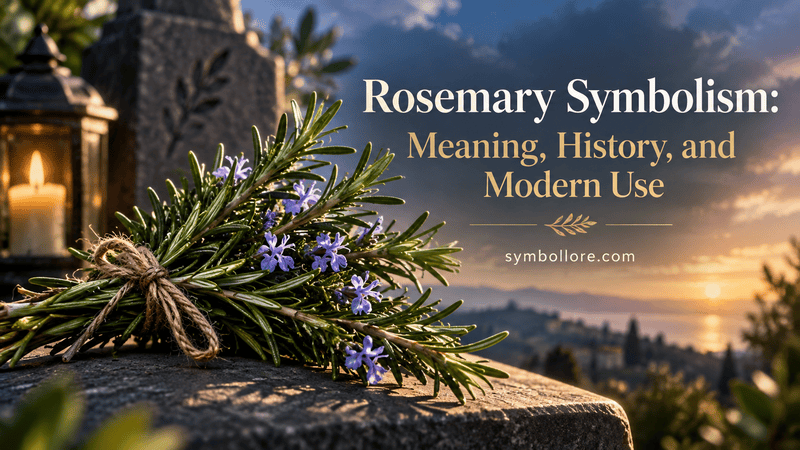
Rosemary symbolism most strongly centers on remembrance and fidelity. Those meanings did not appear from a single legend. They developed through the herb’s long use in European ceremonies, its reputation for memory, its evergreen character, and its appearance in literature such as Shakespeare’s Hamlet. Rosemary could belong at both weddings and funerals, making it a symbol of loyalty in life and remembrance after loss.
Today, rosemary can carry several meanings depending on where it appears. A sprig in a memorial may suggest remembrance, while rosemary at a wedding can suggest faithfulness and lasting connection. Folklore adds ideas of protection and purification, but those traditions should not be confused with universally established meanings.
Quick Answer
Rosemary symbolism commonly represents remembrance, fidelity, loyalty, love, and lasting connection. The strongest historical association is remembrance, reinforced by centuries of ceremonial use and Shakespeare’s famous Hamlet scene. Its meaning still depends on culture and context, so rosemary at a wedding does not communicate exactly the same message as rosemary used in mourning.
TL;DR
- Remembrance is rosemary’s strongest documented symbolic association.
- Fidelity and loyalty developed alongside its use in weddings and relationships.
- Its evergreen nature and persistent fragrance helped make it a fitting metaphor for continuity.
- Shakespeare’s Hamlet strongly reinforced the connection between rosemary and memory.
- Australian Anzac traditions give rosemary a particularly strong commemorative meaning, linked to Gallipoli.
- Protection and spiritual meanings belong mainly to particular folklore and traditions, not to one universal symbolism.
Rosemary Meanings at a Glance
| Context | Possible Meaning | Why the Association Exists | Important Limit |
|---|---|---|---|
| Memorial or funeral | Remembrance | Rosemary became associated with mourning and remembering the dead. | This is a cultural tradition, not an inherent property of the plant. |
| Wedding | Fidelity and loyalty | Historical European customs used rosemary at weddings and gave it to friends or guests. | Wedding practices varied by time and place. |
| Shakespearean literature | Remembrance | Ophelia explicitly gives rosemary “for remembrance” in Hamlet. | Literary symbolism belongs to the work’s context. |
| Australian Anzac commemoration | Memory of service and the fallen | Rosemary grows wild on the Gallipoli Peninsula and became part of Anzac remembrance. | This is especially associated with Australian commemoration. |
| Garden or household | Continuity, care, tradition | Rosemary is an evergreen, useful household herb with a long history of cultivation. | Modern gardeners may attach entirely personal meanings to it. |
| Folklore | Protection or purification | Some European traditions used fragrant herbs in household and ritual practices. | Folklore should not be presented as scientific or universal fact. |
Why Rosemary Became a Symbol of Remembrance
The connection between rosemary and memory is unusually persistent because several traditions reinforced one another.
Rosemary is an aromatic evergreen shrub native to the Mediterranean region. Kew describes it as a drought-tolerant plant of Mediterranean climates, with strongly aromatic foliage. Its current accepted botanical name is Salvia rosmarinus, although Rosmarinus officinalis remains a familiar older name.
An evergreen plant can remain visually present when other vegetation changes with the seasons. Its strong fragrance also survives in dried material. These characteristics made rosemary useful in everyday life and offered people a natural metaphor for things that remain: memory, loyalty, and continuity.
Historical sources then strengthened that metaphor. The Metropolitan Museum of Art notes that rosemary had been prescribed in medieval traditions to “warm the brain” and strengthen memory, and that by the sixteenth century it had become an emblem of remembrance.
That history matters because it shows how symbolism often develops. People first encounter a plant through its physical qualities and practical uses. Literature, ceremony, and folklore can then give those qualities a more lasting cultural meaning.
Rosemary and Shakespeare’s Famous Meaning
The most recognizable literary association comes from William Shakespeare’s Hamlet.
In Act 4, Scene 5, Ophelia distributes flowers and herbs while grieving her father’s death. She gives rosemary to Laertes and says that it is “for remembrance.” The Folger Shakespeare Library’s edition confirms the passage and places the line within Ophelia’s emotionally disturbed flower-giving scene.
The surrounding context is important. Ophelia does not simply present a decorative plant. She is distributing plants with established symbolic associations while confronting death, grief, and memory. Rosemary therefore becomes part of the play’s larger language of loss.
The association was not created by Shakespeare alone. Cambridge’s scholarly discussion of rosemary notes earlier English evidence for the remembrance association and describes its use at weddings, funerals, and among friends.
Shakespeare helped preserve and popularize an association that already existed.
For readers interested in literary symbolism more broadly, SymbolLore’s
guide to red symbolism in literature
provides a useful comparison of how writers use physical objects and colors to carry ideas that depend on context.
From Memory to Fidelity and Loyalty
Rosemary does not symbolize only remembering someone after death. Historically, it could also represent fidelity, friendship, and loyalty.
This becomes especially clear when rosemary appears in wedding customs. The Metropolitan Museum of Art describes rosemary as a common token at weddings and funerals in early modern England. Cambridge’s research similarly notes its established use at weddings and funerals and its association with remembrance and friendship.
The two settings may seem opposite, but the symbolic connection is straightforward:
Wedding → “Remember and keep faith with this bond.”
Funeral → “Remember and honor the person who is gone.”
In both situations, rosemary can represent a relationship that should not be casually forgotten.
That is why calling rosemary simply a “love symbol” misses part of its history. Its older symbolism is closer to lasting attachment and faithful remembrance than to romance alone.
Rosemary in Weddings and Love Traditions
Rosemary’s wedding symbolism developed particularly strongly in European traditions.
Historical accounts describe brides wearing rosemary and wedding participants receiving or carrying sprigs. Some traditions also involved rosemary being treated as a keepsake or planted in connection with marriage.
The plant’s evergreen character made it an appropriate metaphor for a relationship expected to endure. Its fragrance also made it useful in ceremonial settings where herbs and flowers carried both practical and symbolic value.
Modern couples may use rosemary in bouquets, table arrangements, boutonnieres, or favors. However, a modern wedding does not automatically follow an old symbolic code. A couple may choose rosemary simply because they like its appearance, fragrance, culinary connection, or Mediterranean character.
The historical meaning provides context, not a mandatory interpretation.
Rosemary and Funeral Remembrance
Rosemary’s connection with mourning is one of its oldest and strongest symbolic uses in European traditions.
Cambridge’s research on the medieval garden records rosemary’s association with funerals and with remembrance. The Metropolitan Museum likewise describes its use as a token at funerals as well as weddings.
The plant’s evergreen quality helped make it suitable for this role. A sprig could stand for something that continues after a person’s death: memory, affection, or loyalty.
This distinction is useful: rosemary does not necessarily symbolize death itself. More often, its historical role is connected with the human response to death—remembering, honoring, grieving, and maintaining a connection with the deceased.
That distinction is also consistent with SymbolLore’s broader discussion of
flowers associated with death and remembrance,
where mourning, remembrance, farewell, and death are treated as related but different symbolic ideas.
Rosemary in Ancient and Medieval Traditions
Rosemary’s symbolic history reaches back into Mediterranean and European traditions, but popular retellings often make the evidence sound more certain than it is.
Ancient and later writers associated rosemary with memory, fragrance, medicine, ceremony, and the dead. The Australian Department of Veterans’ Affairs notes the longstanding belief that rosemary could improve memory and records traditions linking it with Roman funerary practices.
The familiar story that Greek students wore rosemary in their hair while studying is also widely repeated. However, it is better described as a reported traditional belief rather than as a firmly established fact about every ancient Greek student. Even modern institutional sources use cautious language around this claim.
By the medieval and early modern periods, the documentary record becomes clearer. Rosemary was cultivated in European gardens and used in medicine, domestic life, weddings, funerals, and literature. Cambridge’s scholarship even notes that rosemary had been introduced into England around the fifteenth century and later became widespread in English gardens.
Rosemary in Australian Commemoration
One of the clearest modern examples of rosemary symbolism comes from Australia.
On Anzac Day, Australians traditionally wear sprigs of rosemary to commemorate people who served in wars, conflicts, and peace operations. The Australian Department of Veterans’ Affairs explains that the tradition is connected with rosemary growing wild on the Gallipoli Peninsula in Türkiye, the site of the 1915 Gallipoli Campaign.
The Australian War Memorial likewise describes rosemary as an emblem of fidelity and remembrance and notes its connection with Anzac Day and Remembrance Day.
This example is important because it demonstrates how symbolism can become place-specific. Rosemary’s general association with remembrance existed earlier, but the Gallipoli landscape gave that meaning a particular national commemorative expression in Australia.
It should therefore not be presented as an American tradition or as a universal meaning shared equally across cultures.
Religious and Christian Rosemary Folklore
Rosemary also appears in Christian folklore, particularly stories involving the Virgin Mary.
One popular legend says that Mary placed her cloak over a rosemary bush during the Flight into Egypt, after which the plant’s flowers became blue. Other versions connect rosemary with Mary and the Holy Family in different ways. Such stories help explain why rosemary sometimes appears in discussions of Christian symbolism.
But the status of these stories matters.
They are religious legends or folklore, not historical evidence that rosemary has one officially defined Christian meaning. Rosemary is not equivalent to a central Christian symbol such as the cross.
A careful interpretation can therefore say that rosemary has Christian folkloric associations in some traditions, especially around Mary, remembrance, devotion, and seasonal customs, without claiming that Christianity universally assigns the plant one fixed symbolic message.
Does Rosemary Symbolize Protection?
Protection is another meaning frequently attached to rosemary, especially in folklore.
Historical European traditions sometimes treated fragrant herbs as cleansing or protective materials. Rosemary was used in household practices, ritual settings, and herbal preparations, which helped encourage associations with purification and protection. Some modern folklore sources continue these interpretations.
However, protection is less firmly established as a universal symbolic meaning than remembrance and fidelity.
The safest wording is therefore:
In some folklore, rosemary represents protection or purification.
That is different from saying that rosemary inherently protects a person, removes negative energy, or guarantees spiritual safety. Those latter claims belong to personal belief or modern spiritual practice rather than established historical evidence.
What Rosemary’s Physical Traits Add to Its Symbolism
The plant itself helps explain why certain meanings feel so natural.
Rosemary is evergreen, aromatic, drought-tolerant, and adapted to dry Mediterranean environments. Kew notes that it thrives in dry regions and can tolerate periods of drought.
Those qualities provide several possible symbolic associations:
- Evergreen foliage → continuity and lasting presence
- Persistent fragrance → memory and recognition
- Drought tolerance → endurance
- Long cultivation history → tradition and inheritance
- Useful culinary herb → domestic care and hospitality
These are best understood as explanations for how people may have developed metaphors around rosemary. The physical plant does not scientifically “prove” a symbolic meaning.
This distinction is essential for responsible symbolism writing: botanical characteristics can inspire symbolism, but symbolism is created by people and cultures.
Rosemary Symbolism in Modern American Life
There is no single official American meaning for rosemary.
In contemporary U.S. settings, its symbolism is more likely to depend on the situation. A rosemary sprig in a wedding bouquet may suggest loyalty. A plant grown in a memorial garden may serve as a living reminder of someone. A botanical illustration may simply represent nature, cooking, or Mediterranean style.
Personal experience can also become part of the symbolism. The smell of rosemary may remind someone of a family kitchen, a garden, a particular meal, or a person they knew.
This is one reason rosemary remains useful as a modern symbol: its historical meanings are recognizable, but the plant also leaves room for personal memory.
Modern SymbolLore articles such as
pink rose symbolism and its changing meanings by color
show the same broader principle: plant symbolism becomes clearer when the specific setting, tradition, and historical period are considered rather than treating one definition as universal.
What Rosemary Symbolism Does Not Prove
Several popular claims about rosemary deserve caution.
Rosemary does not have one meaning in every culture. Its strongest associations differ by region and historical setting.
Rosemary is not automatically a Christian symbol. Christian legends exist, but they should be identified as legends or traditions.
Rosemary does not guarantee protection. Protective uses belong to folklore and belief.
The ancient memory story should not be overstated. Historical traditions connect rosemary with memory, but modern retellings can make the evidence sound more precise than it is.
A rosemary tattoo has no universal code. Someone may use it for a deceased relative, family heritage, love, gardening, Mediterranean identity, or simply botanical beauty.
The most reliable interpretation always starts with where the rosemary appears and what the person or community is using it to express.
How to Interpret Rosemary Symbolism by Context
When rosemary appears in an artwork, ceremony, tattoo, story, or gift, consider four questions:
- What is happening around the rosemary?
A wedding, funeral, memorial, garden, meal, or literary scene can change the meaning. - Which culture or historical period is involved?
European wedding customs and Australian Anzac remembrance are not interchangeable traditions. - Is the meaning documented or folkloric?
Shakespeare’s use is documented literary symbolism. A claim about warding off spirits belongs to folklore. - Could the meaning be personal?
A person may use rosemary because it reminds them of someone or something that has no established cultural symbolism.
This approach avoids turning symbolism into a dictionary of fixed answers.
FAQs
The strongest historical meaning of rosemary is remembrance. Fidelity, loyalty, friendship, and lasting connection are closely related associations, particularly in European wedding and funeral traditions. Shakespeare reinforced the remembrance association through Ophelia’s famous speech in Hamlet.
Rosemary became associated with remembrance through a combination of traditional beliefs about memory, its persistent fragrance and evergreen character, and its use in ceremonies involving the dead. Its literary appearance in Hamlet further strengthened the connection in English-speaking culture.
At a wedding, rosemary can symbolize fidelity, loyalty, friendship, and lasting commitment. Historical sources document rosemary being used at European weddings as well as funerals. The exact practice varied by period and location.
At a funeral or memorial, rosemary most often represents remembrance and honoring the dead. Historical European traditions used rosemary in mourning contexts, while modern Australian Anzac ceremonies use it specifically as a symbol of commemoration.
Rosemary is not a major biblical symbol with a universally established biblical meaning. Some Christian folklore connects rosemary with the Virgin Mary and the Flight into Egypt, but these are later traditions rather than biblical statements.
In Australia, rosemary has a particularly strong connection with Anzac remembrance. Sprigs are worn on Anzac Day to commemorate those who served, partly because rosemary grows wild on the Gallipoli Peninsula.
No. Remembrance is its strongest documented association, but rosemary can also represent fidelity, friendship, love, continuity, and particular forms of folklore or personal meaning. The surrounding ceremony, culture, and historical period determine which interpretation fits.
Sources and Further Reading
- Folger Shakespeare Library — Hamlet, Act 4, Scene 5
- Metropolitan Museum of Art — The Virtues of Rosemary
- Cambridge University Press — Rosemary: Not Just for Remembrance
- Australian War Memorial — Rosemary
- Australian Department of Veterans’ Affairs — Rosemary as a Symbol of Commemoration
- Kew — Rosemary, Salvia rosmarinus
Conclusion
Rosemary symbolism is rooted most strongly in remembrance and fidelity, but those meanings developed through different historical paths. European wedding and funeral customs connected the herb with loyalty and memory, while Shakespeare gave the remembrance association an enduring literary form. In Australia, rosemary gained a specific commemorative role through Anzac traditions. Elsewhere, folklore may add ideas of protection or devotion. The clearest interpretation therefore depends on culture, period, and setting. Rosemary is best understood not as a plant with one fixed message, but as a living symbol people have repeatedly used to express what they want to remember and preserve.