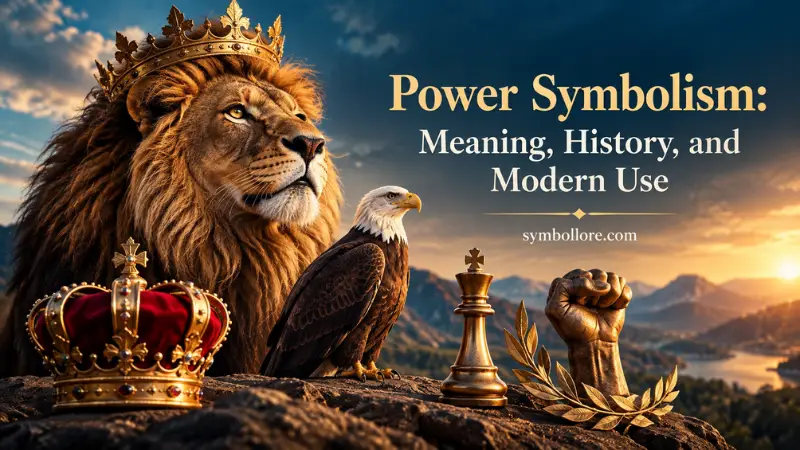
Power symbolism turns an unseen idea into something people can recognize: a crown on a ruler, an eagle on a seal, or a raised fist at a protest. Yet these images do different jobs. A crown can mark an office. A lion can suggest might. A fist can express the strength of people acting together.
Their meanings grew through specific uses in ceremonies, art, and public life. They also change with place and time. An eagle on the U.S. Great Seal, for example, carries a documented national meaning; an eagle in another tradition needs its own explanation. The key is to ask whose power the image shows and how that power works.
Quick Answer
Power symbolism represents the ability to govern, protect, influence, resist, or act with strength. Crowns and staffs often mark recognized authority; lions can evoke physical might; raised fists can express collective action. These associations come from particular histories and uses, so no image means “power” in exactly the same way across every culture or setting.
Power Symbols at a Glance
| Symbol and setting | Kind of power it can show | Why it carries that meaning | Key limit |
|---|---|---|---|
| British coronation crown and orb | Royal office | A public ceremony identifies the monarch | The orb also has a specifically Christian meaning |
| Ancient Egyptian uraeus cobra | Royal protection | The rearing cobra appeared on royal headwear | Its meaning belongs to an Egyptian religious setting |
| Lion in ancient Egyptian royal art | Kingly might | Artists linked the animal to the ruler | A lion elsewhere may have another role |
| Dragon on a Qing imperial robe | Imperial rank | Court clothing used restricted dragon designs | A dragon alone does not identify an emperor |
| Eagle on the U.S. Great Seal | National strength and independence | The official seal pairs it with other national emblems | Those details matter to the reading |
| U.S. House mace | Institutional authority | The House uses it as an emblem of its office | It does not symbolize personal strength |
| Raised fist in Black Power art | Solidarity and resistance | Artists and activists used the gesture in a movement | Other groups may use it differently |
What Does Power Symbolism Actually Represent?
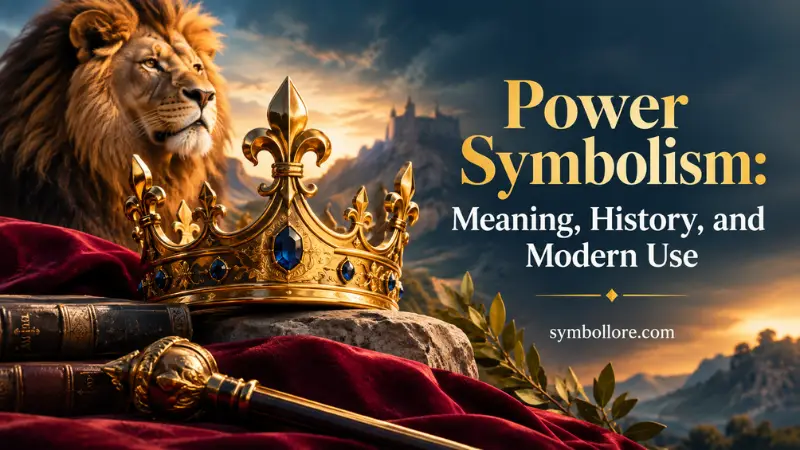
A symbol can show the right to act, the ability to act, or people joining to act. Those are related ideas, but they are not equal. A person may be strong without holding public office. A ruler may hold an office without being physically strong.
That difference helps explain why power symbols take so many forms. Regalia marks a recognized role. Predatory animals can project might. A movement’s shared gesture can show that its members gain influence through unity. Even within one image, several meanings may coexist. The U.S. Great Seal pairs an eagle with an olive branch and arrows, bringing peace and defense into the same design.
The National Museum of American Diplomacy’s account of the Great Seal
explains those elements and their intended national message.
Crowns, Orbs, and Staffs: Power Given a Public Role
Royal objects make an office visible. During a British coronation, a crown, sceptre, and orb do more than decorate the monarch. Their place in the ceremony identifies a person with the role of sovereign.
The Royal Collection Trust’s guide to the coronation regalia
explains that the orb represents the monarch’s power and depicts the Christian world through a cross mounted on a globe. That meaning is specific to this regalia and ceremony.
A staff can signal a different kind of authority in another society. An Asante ɔkyeame serves as a royal spokesperson and counselor. The figure carries a ceremonial staff whose imagery can work alongside formal speech.
A Metropolitan Museum of Art record of an Asante staff
discusses its stool, chain, and crossed swords. The museum also cautions against assigning one definite proverb to that particular object. It is a useful reminder that identifying an object’s role does not settle every detail of its design.
These objects show why authority depends on more than impressive materials. A staff held by a court official gains meaning from the office, the occasion, and the people who recognize both. For a closer look at the ruler as a figure of authority and duty, see
The Lion and Cobra: Might and Protection in Egyptian Art
Animals can make power feel immediate. A lion’s size and presence offer a vivid image of might. But the strongest reading comes from a documented setting, not a guess about what every lion means.
The Met describes a recumbent lion from ancient Egypt
and notes that lions remained symbols of the king’s power in Egyptian history. Artists also joined a lion’s body with a ruler’s head in images later called sphinxes.
The Egyptian uraeus, or rearing cobra, carries a more particular message. Its raised body appeared at the front of royal and divine headwear.
The Met’s account of a uraeus fitting
identifies it as a protective emblem connected with goddesses including Wadjet. In that religious setting, the cobra faced outward to defend the king. This is an account of an ancient belief and artistic convention, not a claim that an image could physically protect someone.
The distinction matters: the lion makes royal might visible, while the cobra on the brow also marks sacred protection. Readers interested in how the animal’s pose shapes other interpretations can explore
The Imperial Dragon: Power That Depends on Dress and Rank
A dragon can seem like an obvious emblem of great power. Yet its exact meaning depends on the object that bears it. On Qing Chinese court clothing, details of dress helped identify the wearer’s rank and place in imperial life.
The Metropolitan Museum of Art describes a
bearing five-clawed dragons and other emblems reserved for imperial robes. Its record also identifies bright yellow as a restricted imperial color in that setting. The dragon mattered as part of a larger system of clothing, symbols, and court rules. A dragon removed from that setting does not automatically carry the robe’s precise meaning.
Modern artwork may use a dragon for an artist’s own purpose. A tattoo, for example, can express strength or identity, but its style and cultural references still matter.
for that separate modern context.
Eagles, Maces, and Fasces in U.S. Public Life
The eagle on the Great Seal of the United States offers a clear case of national power with a recorded design history.
According to the National Museum of American Diplomacy,
the seal adopted in 1782 was intended to express strength, unity, and independence. Its olive branch and arrows point to peace and war. Reading the whole design gives a more precise answer than saying simply that “eagles mean power.”
Inside the U.S. House of Representatives, the mace signals the House’s authority. The House explains that its mace includes 13 ebony rods for the original states, with a silver eagle above them.
The same House guide to chamber art
describes bronze fasces behind the rostrum. It connects their bound rods with unity and the strength of people acting together.
The fasces also shows why history cannot be reduced to one label. It has an ancient Roman background, an official place in the House Chamber, and later political associations. When interpreting one, identify where it appears, when it was used, and who placed it there. A symbol’s past is relevant, but its setting tells you which meaning a particular display claims.
The Raised Fist: Power Built Through Solidarity
Not every power symbol belongs to a ruler or state. A raised fist can show people joining to demand change. In U.S. Black Power history, its meaning is tied to named artists, activists, and events.
The Smithsonian American Art Museum discusses the raised fists in Barbara Jones-Hogu’s print as part of Black Power imagery.
The National Museum of African American History and Culture’s account of the Black Power salute
also connects the gesture with Tommie Smith and John Carlos at the 1968 Olympics. In these cases, the fist communicates collective resolve and public protest.
A raised fist does not identify one movement in every image. The person using it, the surrounding words, and the event determine the more specific message. That makes it distinct from a crown: one commonly identifies an established office, while the other can express a group’s effort to challenge an existing arrangement.
How to Read a Power Symbol Without Guessing
When an image seems to represent power, use these four checks:
- Identify the object exactly. A ceremonial mace, royal sceptre, and ordinary staff may look related but have different uses.
- Find its setting. Look for the culture, institution, artwork, ceremony, or movement in which it appears.
- Ask who holds the power. Is the image about a ruler, an office, a deity, a community, or an individual?
- Check the supporting details. Color, clothing, placement, nearby objects, and written accounts can narrow the meaning.
Consider a chair as an example. A reserved ceremonial seat may mark rank; an empty chair in an artwork may instead draw attention to someone’s absence. The surrounding scene decides which reading fits.
The site’s guide to chair symbolism
develops those different uses.
This method also leaves room for uncertainty. Viewers can explain what an image suggests without claiming to know an artist’s private intention. When a museum record or primary account supplies a specific meaning, use it. When evidence ends, say so.
FAQs
A crown is a familiar sign of royal authority, but there is no single symbol of power for every setting. A crown identifies monarchy more clearly than it identifies physical strength or a protest movement. The strongest answer depends on the kind of power you mean.
Strength often suggests the ability to withstand or exert force. Power can also include the right to govern, access to resources, or the ability to influence a group. A lion in royal art may suggest might; a government mace marks institutional authority. Some images can express both ideas.
No. A lion can carry different meanings in different works. Ancient Egyptian royal art offers documented examples linking lions with kingship, but that evidence does not establish the meaning of every lion in a logo, story, sculpture, or tattoo. Start with the specific image and its setting.
They can show different relationships to power. A crown often identifies an established office through ceremony and tradition. A raised fist may express solidarity or a demand for change. Their meanings become clearer when you know who used each image and why.
Yes. An image of force may suggest protection in one work and intimidation in another. A viewer should check the subject’s actions and the surrounding story before calling the power admirable or harmful. The emblem itself does not settle that judgment.
Sources and Further Reading
- Royal Collection Trust: The Crown Jewels and Coronation Regalia
- The Metropolitan Museum of Art: Uraeus Fitting from a Shrine
- The Metropolitan Museum of Art: Qing Festival Robe
- National Museum of American Diplomacy: The Great Seal
- U.S. House of Representatives: Art and Artifacts in the House Chamber
Conclusion
Power symbolism gives people a way to show authority, might, protection, or shared resolve. Its meaning grows from use: a crown appears in a ceremony, an eagle joins other emblems on a national seal, and a fist gains force within a movement. Those details explain more than a simple list of “powerful symbols” can.
When you meet an unfamiliar image, ask who used it and what kind of power it was meant to show. Culture, period, and setting may change the answer. A careful reading can recognize a symbol’s force without pretending it has one meaning for everyone.


