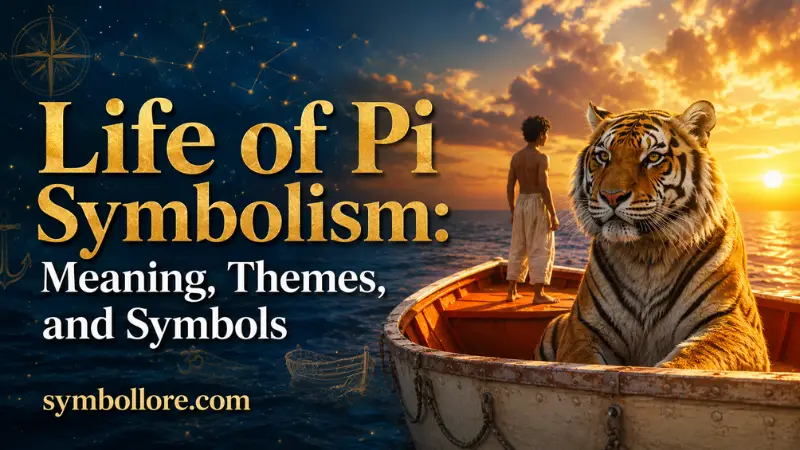
Life of Pi symbolism turns a survival story into a deeper exploration of faith, identity, violence, imagination, and the stories people use to understand suffering. Yann Martel’s novel, first published in 2001, follows Piscine Molitor Patel after a shipwreck leaves him stranded in the Pacific with a Bengal tiger named Richard Parker. The strange pairing is not merely an adventure device. Martel has explained that the boy and tiger form a metaphor for the human condition, bringing together religious aspiration and humanity’s animal nature.
The novel’s symbols work together rather than offering a simple code. Richard Parker can represent Pi’s survival instinct, the lifeboat can represent a fragile boundary between civilization and wilderness, and the ocean can suggest both freedom and terrifying uncertainty. Meanwhile, the two versions of Pi’s story turn symbolism itself into part of the novel’s central question: how do people create meaning when reality is almost impossible to bear?
Quick Answer
Life of Pi symbolism centers on faith, survival, storytelling, identity, and the tension between civilization and human instinct. Richard Parker reflects Pi’s fierce will to live, while the lifeboat becomes a fragile space between order and chaos. The novel’s competing stories also suggest that people sometimes use imagination, religion, and narrative to make unbearable experiences meaningful.
TL;DR
- Richard Parker symbolizes Pi’s survival instinct and the violent side of human nature.
- The lifeboat represents survival, isolation, and the unstable boundary between civilization and wilderness.
- The ocean reflects uncertainty, fear, freedom, and the vast mystery of existence.
- Orange repeatedly appears around moments of hope, survival, and continuity.
- The carnivorous island represents temptation, false safety, and the danger of surrendering to an easy answer.
- Pi’s two stories make storytelling itself a symbol of how humans search for meaning after trauma.
Life of Pi Symbols at a Glance
| Symbol or Element | Possible Meaning | Why It Matters | Important Limit |
|---|---|---|---|
| Richard Parker | Survival instinct, violence, inner self | Pi’s life depends on living alongside the tiger | He is also a literal animal within the story |
| Lifeboat | Survival, isolation, fragile civilization | It becomes Pi’s entire physical world | Its meaning changes as Pi’s relationship with the sea changes |
| Ocean | Mystery, uncertainty, danger, possibility | Pi cannot control or fully understand it | It is also a real survival environment |
| Orange | Hope, survival, continuity | Orange objects recur before and during the ordeal | Color symbolism is contextual, not universal |
| Carnivorous island | Temptation and false security | Its paradise-like appearance hides a deadly reality | Its exact meaning remains deliberately open |
| Pi’s name and π | Infinity, complexity, incomprehensibility | The mathematical constant parallels Pi’s identity and worldview | Mathematical symbolism is layered rather than a single allegory |
| Animal story | Imagination and emotional truth | It transforms unbearable human violence into an animal narrative | The novel never gives an easy final answer about which story is “true” |
What Does Life of Pi Symbolism Mean?
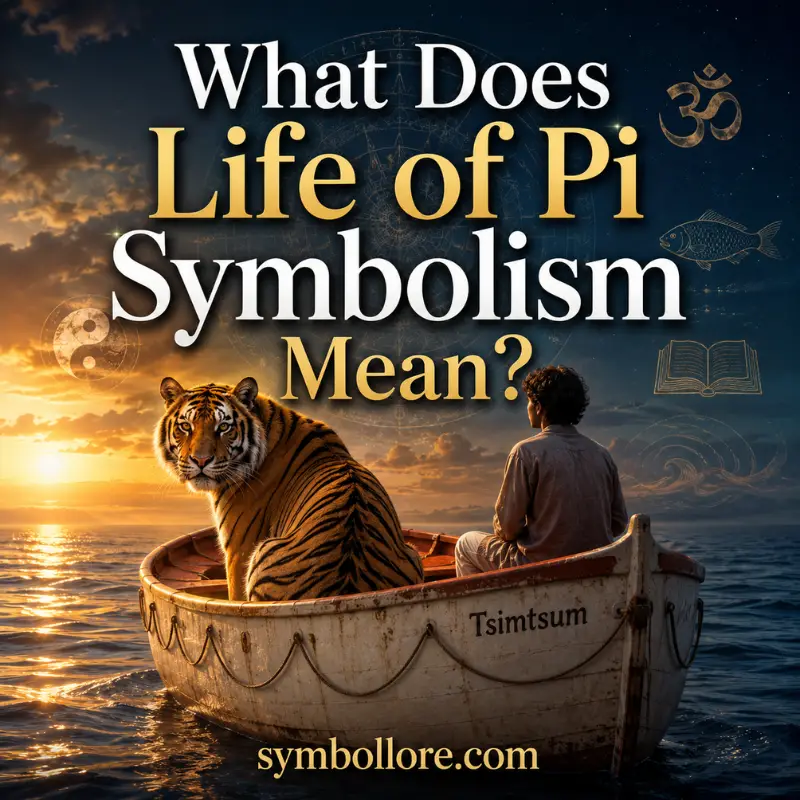
At its broadest level, the symbolism in Life of Pi examines how a human being survives when ordinary structures of life disappear.
Before the shipwreck, Pi lives among family, animals, education, religion, and the routines of a modern community. After the Tsimtsum sinks, nearly all of those structures vanish. He is left with a lifeboat, limited supplies, the ocean, and Richard Parker.
That change creates the novel’s symbolic framework. Pi must reconstruct order from almost nothing.
He develops routines. He studies the tiger. He divides the lifeboat into areas. He gathers food and water. He prays. He observes the natural world. He tells a story.
Each action becomes more than a survival technique. Together, they show Pi rebuilding a form of civilization inside an environment that offers very little stability.
Yann Martel has said that the novel is deeply concerned with religion, faith, storytelling, and the interpretation of reality. In a PBS interview, he described the religious boy and wild animal sharing a lifeboat as a metaphor for the human condition.
That idea helps connect the novel’s many symbols. Pi is not simply fighting nature. He is also negotiating the competing parts of himself.
Richard Parker Symbolism: Survival and the Animal Self
Richard Parker is the most important symbol in the novel because Pi’s relationship with the tiger mirrors his struggle with his own nature.
Martel has directly explained that the animal characters have human counterparts in the alternative account. He identifies Richard Parker with Pi, the zebra with the Taiwanese sailor, the orangutan with Pi’s mother, and the hyena with the French cook. Martel also describes Pi and Richard Parker as sharing a stubborn desire to live and doing what they must to survive.
This makes Richard Parker more complicated than a simple symbol of evil.
The tiger is dangerous. Pi must respect his territory, control his behavior, and constantly consider the possibility of attack. Yet Richard Parker also gives Pi a reason to remain alert. The tiger forces him to maintain routines and focus on practical survival.
Without Richard Parker, Pi might have surrendered to despair more easily.
The relationship therefore contains a paradox. The creature that threatens Pi also helps keep him alive.
Richard Parker can also be read as the part of Pi that civilization normally keeps under control. Pi begins the story as a vegetarian boy with strong religious commitments. The catastrophe forces him to kill animals and consume meat. His survival requires behavior that conflicts with the identity he had previously constructed.
The tiger gives that violence an external form.
Pi can therefore tell a story in which the savage acts belong to Richard Parker rather than directly to himself. This does not make the violence unreal. Instead, it gives Pi psychological distance from actions that would be difficult to accept as part of his own identity.
A scholarly study of the novel’s animal symbolism similarly identifies the animals as vehicles for human virtues, vices, power, trust, survival, and psychological conflict.
The Lifeboat as a Symbol of Civilization
The lifeboat represents a tiny version of civilization surrounded by overwhelming nature.
Before the shipwreck, Pi belongs to a structured society. He has family, school, religion, food systems, and a zoo managed by adults. The lifeboat removes most of those supports.
Yet Pi gradually rebuilds order.
He creates boundaries. He develops a schedule. He manages supplies. He establishes methods for collecting water and food. He learns how to train Richard Parker.
These actions matter because civilization is partly the creation of predictable rules.
The lifeboat is therefore not simply a vehicle. It becomes a miniature world in which Pi tries to restore order.
At the same time, that world is extremely fragile. A storm can overturn it. Supplies can disappear. Richard Parker can cross a boundary. Hunger can undermine Pi’s moral rules.
The lifeboat consequently symbolizes civilization under pressure.
It shows that human order can survive in extreme conditions, but it also reveals how quickly that order depends on material security.
The Ocean as a Symbol of Mystery and Uncertainty
The Pacific Ocean represents the enormous unknown surrounding Pi.
It is beautiful and terrifying at the same time. Pi encounters luminous water, flying fish, storms, predators, and long periods of isolation. The ocean provides food and threatens his life. It separates him from civilization while also carrying him toward rescue.
This double function makes the ocean one of the novel’s most flexible symbols.
It can represent:
- uncertainty, because Pi cannot know what lies ahead;
- freedom, because ordinary social restrictions have disappeared;
- danger, because the sea contains forces beyond his control;
- spiritual mystery, because Pi repeatedly encounters experiences he cannot fully explain;
- isolation, because the horizon seems to place him beyond ordinary human contact.
The ocean also weakens the distinction between control and surrender.
Pi can learn skills, prepare equipment, and make decisions. Yet he cannot command the weather or guarantee rescue. Survival requires both action and acceptance of forces outside his control.
That tension parallels the novel’s treatment of faith. Pi does what he can, but he also learns that complete control is impossible.
The Color Orange as a Symbol of Hope
Orange is one of the most recognizable recurring colors in Life of Pi.
The color appears in objects associated with survival, including the life jacket, whistle, lifebuoy, and Richard Parker. Orange also appears in the framing narrative through Pi’s family life.
Literary analysis commonly interprets the repeated orange imagery as a sign of hope and survival. SparkNotes, for example, notes how the orange objects connect Pi’s present survival with the future life shown in the framing story.
The important point is not that orange universally means hope.
Rather, Martel establishes an internal color pattern within this particular work.
Orange repeatedly appears when survival remains possible.
That pattern makes the color function almost like a visual thread connecting different parts of Pi’s life. The color appears before the disaster, during the struggle, and in images associated with Pi’s eventual continuation.
The effect is subtle. Orange does not remove the tragedy from the story. Instead, it suggests that survival remains possible even when the surrounding world seems to have collapsed.
This is a good example of how literary symbolism works. A color gains meaning through repetition, placement, and narrative association, not because every culture assigns it one permanent definition.
The Carnivorous Island Symbolism: Temptation and False Paradise
The mysterious island is one of the novel’s strangest symbols.
At first, it appears to be exactly what Pi needs. It provides food, fresh water, vegetation, and a place where he can rest without the constant demands of the open sea.
Yet the island contains a hidden danger.
Pi eventually discovers evidence that the island is carnivorous. The discovery changes everything. What seemed like salvation becomes a threat.
The island therefore represents false security.
It offers an easy solution to Pi’s suffering, but accepting that solution would mean remaining trapped in a place that appears comfortable while concealing death.
The island also tests Pi’s faith and judgment. He could remain where his immediate needs are satisfied. Instead, he chooses to leave.
Yann Martel has explained that he deliberately designed the island to stretch the reader’s ability to believe. He described it as the point where spontaneous belief begins to weaken and rationality returns.
That makes the island important not only inside Pi’s story but also in the relationship between author and reader.
It asks whether readers will continue accepting a strange narrative when its logic becomes increasingly difficult to defend.
The island may also recall older literary and religious traditions involving tempting paradises. Literary analysis often connects it with the Lotus Eaters in Homer’s Odyssey and the Garden of Eden.
Yet those parallels should be treated as interpretations rather than as a single officially declared meaning.
Pi’s Name and the Symbolism of π
Pi’s name is itself a carefully constructed symbol.
Piscine Molitor Patel chooses “Pi” as his preferred name because he wants to escape the humiliating associations attached to his full first name. He then associates his chosen identity with the mathematical constant π.
The choice matters because π is irrational and its decimal expansion continues without a simple repeating pattern.
That makes it an effective metaphor for something that resists complete human understanding.
Pi himself contains contradictions.
He is scientific and religious. He values zoology but also believes deeply in God. He is compassionate toward animals but becomes capable of killing them. He wants factual truth but also values stories that provide emotional and spiritual meaning.
The name therefore reflects a character who cannot be reduced to one simple category.
Pi is also associated with the circle. A circle has no obvious beginning or end, which can support interpretations involving infinity, continuity, and the search for meaning.
However, it would be excessive to claim that every mathematical property of π maps neatly onto Pi Patel. The strongest symbolism comes from the novel’s repeated attention to mathematics, infinity, incomprehensibility, and Pi’s complex identity.
The Animals as Human Counterparts
The animals aboard the lifeboat form an important symbolic structure.
The zebra, orangutan, hyena, and tiger initially appear to be separate animals caught in the disaster. Later, Pi’s alternative account creates possible human counterparts for each.
The symbolic pairing is central because it changes the reader’s understanding of the animal story.
The zebra’s suffering can be read as the suffering of the injured sailor. The orangutan’s tenderness can be associated with Pi’s mother. The hyena’s cruelty can correspond to the French cook. Richard Parker then becomes the counterpart to Pi himself.
This structure turns the lifeboat into a symbolic stage for human behavior.
The animals represent different possibilities within extreme circumstances:
- vulnerability;
- compassion;
- brutality;
- self-preservation;
- violence;
- fear;
- attachment.
The animal story may therefore make human behavior easier to look at.
A hyena attacking a zebra feels like a natural-history event. A human being attacking another human being feels morally horrifying. By translating people into animals, Pi’s story creates emotional distance while preserving the underlying horror.
That is one reason storytelling becomes a survival mechanism rather than simple entertainment.
The Tsimtsum and the Symbolism of the Shipwreck
The Tsimtsum is the cargo ship carrying Pi’s family from India toward Canada.
Its name carries an additional layer because it refers to tzimtzum, a concept associated with Lurianic Kabbalah concerning divine contraction or withdrawal in the act of creation. Rachel Wagner’s academic study of Life of Pi examines the importance of this reference and its relationship to the film’s treatment of religious imagination and creation.
The ship’s sinking can therefore be read as more than a plot event.
A world that once contained Pi suddenly disappears.
He is forced into an almost empty space where he must create a new order. In that sense, the disaster resembles a symbolic unmaking followed by reconstruction.
The interpretation should remain cautious because the novel draws from several religious traditions rather than presenting one formal theological system.
Still, the Tsimtsum supports one of the book’s deepest patterns: meaning can emerge after the collapse of an old world.
Pi loses almost everything familiar, yet he develops new ways to understand himself.
Religion as a Symbol of Multiple Ways of Seeing
Religion in Life of Pi is not merely background information about Pi’s childhood.
Pi practices Hinduism, Christianity, and Islam, and his willingness to embrace multiple faiths creates conflict with religious authorities who want him to choose one tradition. His approach is based less on institutional boundaries than on his desire to know and love God.
The symbolism here concerns plural ways of interpreting reality.
Each tradition gives Pi a language for understanding existence. His religious curiosity also prepares him for the later problem of the two stories.
The novel repeatedly places different interpretations beside one another.
Fact and faith.
Science and religion.
Animal story and human story.
Literal truth and emotional truth.
Pi does not necessarily treat these oppositions as mutually exclusive. Instead, he asks readers to consider whether a story can carry meaning even when its literal details are uncertain.
Martel has described the novel as an exploration of the boundary between fiction and fact and has connected religion with interpretation of reality.
For this reason, religious symbolism in the novel is less about promoting one simple doctrine than about asking what humans gain from belief.
Storytelling as a Symbol of Survival
Storytelling is perhaps the novel’s most important abstract symbol.
Pi does not simply tell stories after the events. Storytelling helps him survive the events themselves.
The animal narrative gives shape to an experience that would otherwise be almost unbearable. It allows Pi to transform chaotic violence into a structured story with recognizable characters and relationships.
The story therefore becomes a psychological container.
It holds fear.
It holds grief.
It holds violence.
It holds hope.
It also gives Pi a way to communicate his experience to other people.
The novel’s structure reinforces this idea. There is the narrator’s account of Pi, Pi’s account of the voyage, and finally the Japanese officials’ attempt to understand what actually happened.
The reader is left with two versions.
One is fantastical.
The other is horrifying but more realistic.
The question is not simply “Which one happened?”
It is also “Why does Pi tell the story this way?”
Film Education describes storytelling as central to Life of Pi and notes that allegorical storytelling can function as a means of surviving psychologically when the underlying reality is too terrible to confront directly.
This makes storytelling itself part of the novel’s survival system.
The Two Stories and the Symbolism of Truth
The two stories create the novel’s most important interpretive problem.
The animal version contains Richard Parker and the other animals. The alternative version removes the animals and replaces them with human beings.
The basic events remain connected, but their emotional meaning changes dramatically.
This structure suggests that truth can exist on more than one level.
One account may be closer to literal events. Another may communicate psychological or emotional truth more effectively.
Martel has said that the novel deliberately explores the line between fiction and fact and how people interpret reality.
The final choice is therefore given partly to the reader.
If a story provides a way to understand suffering, does its emotional truth matter even when its literal truth cannot be established?
The question does not mean that facts are unimportant. Instead, the novel challenges the idea that factual accuracy is always sufficient to explain human experience.
That is why the book’s symbolism is inseparable from its narrative structure.
The story is not merely about symbols.
The act of telling the story becomes the symbol.
The Lifeboat, Richard Parker, and the Human Animal
The lifeboat becomes most powerful symbolically when Pi and Richard Parker are considered together.
Pi represents reason, language, religion, planning, and social identity.
Richard Parker represents instinct, appetite, fear, aggression, and physical survival.
Yet neither can exist independently during the voyage.
Pi needs Richard Parker to remain mentally engaged. Richard Parker depends on Pi for food and the conditions that allow him to survive.
The relationship therefore challenges the idea that civilization and animal instinct are complete opposites.
Human beings contain both.
A person can be compassionate and violent. Rational and spiritual. Social and solitary. Peaceful under ordinary conditions yet capable of extreme behavior during a crisis.
The tiger makes these contradictions visible.
This is also why Richard Parker’s disappearance at the end is emotionally important. Pi expects some form of recognition or farewell, but the tiger simply leaves.
The lack of closure emphasizes that Richard Parker was never merely a conventional companion. Whether read literally, symbolically, or both, the tiger belongs to the part of Pi’s experience that cannot be neatly returned to ordinary life.
Life of Pi Symbolism and the Meaning of Survival
Survival is more than staying alive in the novel.
Pi must preserve enough of his identity to remain human while adapting enough to survive.
His old moral framework cannot remain completely unchanged. He must kill. He must eat meat. He must confront violence. He must manage an animal that could kill him.
Yet he does not simply become a brutal person.
He continues to pray. He remains curious. He observes beauty. He remembers his family. He creates stories.
That combination suggests that survival can involve adaptation without total surrender of identity.
The novel therefore presents survival as a negotiation between what must change and what must remain.
Richard Parker embodies the necessity of instinct.
Pi’s rituals embody the necessity of meaning.
The lifeboat embodies the fragile space where those forces meet.
How the Film Expands the Symbolism
Ang Lee’s 2012 film adaptation adds another symbolic layer because visual images can communicate ideas that the novel expresses through narration.
The film uses color, light, animals, water, camera movement, and computer-generated imagery to make Pi’s inner and spiritual experience visible.
Rachel Wagner’s academic analysis argues that the film expands the novel’s fantastic story through visual metaphors and religious imagery. The visual presentation encourages viewers to engage with belief through what they see rather than only through Pi’s words.
This difference matters.
A reader must imagine the ocean and tiger.
A film viewer sees them.
That makes the film’s beauty part of the interpretive experience. The spectacular ocean can feel almost sacred, while moments of darkness can make the same environment frightening.
The film therefore strengthens the tension between wonder and suffering.
It does not simply illustrate the novel’s symbols. It gives them another visual language.
What Popular Interpretations of Life of Pi Symbolism Get Wrong
Some interpretations simplify the novel too much.
One common mistake is saying that Richard Parker simply means Pi’s evil side. That reading captures part of the symbolism, but it misses the tiger’s role in keeping Pi alive and mentally engaged. Martel himself has described the pair as symbolically echoing one another through their shared determination to survive.
Another mistake is treating the orange color as a universal spiritual symbol. Its importance comes from how Martel repeatedly uses it within this specific story.
A third mistake is claiming that the novel definitively proves the animal story is false. The novel deliberately leaves interpretive space around the competing accounts.
Finally, it is too simple to say that Life of Pi argues that imagination is better than facts. The novel is more complicated. Martel is interested in what facts cannot always communicate about trauma, belief, and human experience, not in telling readers to reject evidence.
The strongest interpretation holds these tensions together instead of eliminating them.
How to Interpret Life of Pi Symbols
When interpreting a symbol from Life of Pi, start with the scene rather than a generic symbolism list.
Ask:
- What appears repeatedly? Repetition often signals deliberate symbolic importance.
- What changes around the symbol? A tiger, color, object, or place can gather new meanings as Pi’s circumstances change.
- Does another story reinterpret it? The second account can transform the meaning of an earlier image.
- What does the author say about it? Martel’s interviews can clarify some intentions, although readers can still develop reasonable interpretations beyond them.
- Is the interpretation literal, thematic, religious, psychological, or personal? Keeping these categories separate prevents overstatement.
For example, Richard Parker is literally a tiger in Pi’s narrative. He is also a thematic representation of survival and an allegorical counterpart to Pi. Those levels can coexist.
The best literary interpretations do not force a symbol to have only one meaning.
They show how several meanings work together.
FAQs
The central symbolism involves survival, faith, storytelling, identity, and the conflict between civilization and instinct. Richard Parker represents the fierce survival drive within Pi’s experience, while the lifeboat creates a fragile space where reason and instinct must coexist. The two competing stories make the search for meaning part of the symbolism itself.
Richard Parker symbolizes several connected ideas, especially survival instinct, violence, animal nature, and the part of Pi that must act brutally to stay alive. Yann Martel has explained that Pi and Richard Parker symbolically echo one another and share a powerful determination to survive.
Orange is strongly associated with hope and survival within Life of Pi. Orange objects appear around Pi’s survival and recur in the framing story, creating a visual connection between danger and the possibility of life afterward. Its meaning comes from Martel’s repeated use of the color rather than from a universal rule about orange symbolism.
The carnivorous island can symbolize temptation, false safety, spiritual stagnation, and the danger of choosing comfort over continued growth. It appears to offer Pi everything he needs, but its hidden threat forces him to leave. Martel also designed the episode to test the reader’s willingness to believe an increasingly extraordinary story.
Pi’s name connects Piscine Molitor Patel with the mathematical constant π, suggesting complexity, infinity, and realities that cannot be fully understood. The choice also reflects Pi’s effort to construct his own identity. His name becomes a fitting symbol for a character who refuses to fit neatly into one religious, scientific, cultural, or psychological category.
The lifeboat symbolizes survival, isolation, fragile civilization, and the boundary between human order and wilderness. Pi gradually turns the small boat into an organized environment through routines and rules. At the same time, its vulnerability reminds him that civilization can be fragile when basic security disappears.
The two stories allow the novel to examine the difference between factual explanation and meaningful interpretation. The animal story creates emotional distance from horrific events, while the alternative account presents a much darker human reality. The structure leaves readers to consider what kind of story best expresses the experience Pi endured.
Life of Pi contains extensive religious symbolism and allegorical elements, but it does not function as a simple allegory for one religion. Pi’s Hindu, Christian, and Muslim experiences are central to the novel, while its larger questions concern faith, storytelling, interpretation, and the human search for meaning. Martel has specifically described religion and faith as major concerns of the book.
Conclusion
Life of Pi symbolism works because the novel refuses to separate survival from meaning. Richard Parker embodies Pi’s fierce animal instinct, while the lifeboat represents the fragile order he builds around himself. The ocean becomes a space of danger and mystery, orange repeatedly reinforces hope, and the carnivorous island tests whether comfort can become another form of captivity.
Above all, Pi’s two stories make storytelling itself symbolic. The novel asks readers to consider how people respond when suffering exceeds ordinary explanation. Its symbols do not provide one fixed answer. Instead, they show how faith, imagination, memory, and survival can shape the way a person understands an experience that cannot be reduced to facts alone.