Jane Eyre symbolism turns Charlotte Brontë’s 1847 novel into more than a story about an orphan who falls in love with her employer. The red-room, fire, ice, birds, trees, moonlight, mirrors, clothing, and damaged eyesight make Jane’s emotional and moral conflicts visible.
Most of these symbols revolve around freedom, confinement, passion, self-control, equality, and the search for a secure home. However, their meanings change as Jane matures. Fire can comfort or destroy. A house can offer shelter or become a prison. Therefore, each image must be read within its scene, historical setting, and relationship to Jane’s developing independence.
Quick Answer
Jane Eyre symbolism primarily represents Jane’s struggle for freedom, dignity, love, and moral independence. Brontë uses enclosed rooms, fire, cold, birds, weather, trees, and vision to show the forces that either restrict or strengthen Jane. These images do not have one fixed meaning; their significance changes as Jane moves from dependence and exclusion toward economic, emotional, and spiritual equality.
TL;DR
- The red-room represents punishment, exclusion, fear, and restricted female autonomy.
- Fire expresses passion, comfort, rebellion, danger, destruction, and renewal.
- Birds and cages develop Jane’s desire for freedom and equal human dignity.
- The split chestnut tree foreshadows separation but retains the possibility of reunion.
- Mirrors, veils, and paintings reveal hidden identities, secrets, and divided selves.
- Blindness and sight raise questions about power, knowledge, dependence, and equality.
Major Symbols in Jane Eyre at a Glance
| Symbol or motif | Main meaning | Why the association develops | Important limit |
|---|---|---|---|
| Red-room | Confinement, exclusion, fear, anger | Jane receives an unjust punishment in a death-haunted room | Red does not represent passion alone |
| Fire | Passion, warmth, danger, transformation | Fire comforts Jane but also threatens lives and destroys Thornfield | It is neither wholly good nor wholly evil |
| Ice and cold | Rejection, restraint, emotional barrenness | Cold surrounds Jane at Gateshead, Lowood, and near St. John | Self-control itself is not condemned |
| Birds and cages | Freedom, vulnerability, independent will | Jane repeatedly faces physical and social limits | Bird imagery can also suggest hunger or fragility |
| Split chestnut tree | Broken union, endurance, changed love | Lightning divides the tree after Rochester proposes | Its rooted halves prevent a purely tragic reading |
| Moon and light | Guidance, intuition, revelation | Light appears during major choices and transitions | Supernatural interpretations remain deliberately uncertain |
| Mirrors and veils | Divided identity, hidden truth, disrupted marriage | Jane sees unsettling figures and signs through reflective or concealing objects | Bertha should not be reduced to a mere symbol |
| Blindness and sight | Knowledge, power, dependence, altered relationships | Rochester loses his sight after Thornfield burns | Disability should not be treated only as punishment |
What Jane Eyre Symbolism Means for the Whole Novel
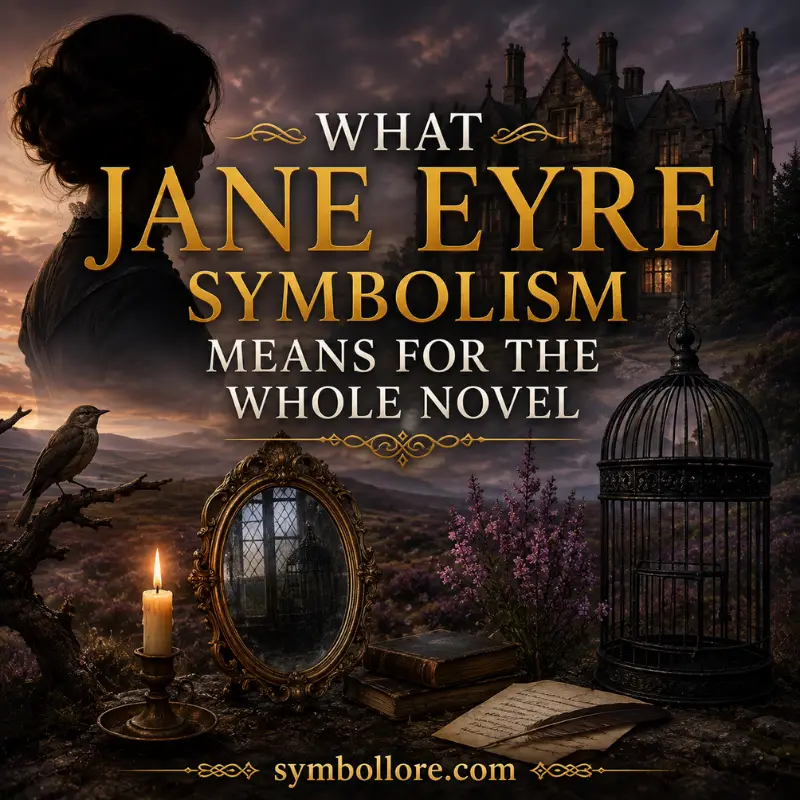
The novel’s symbols trace Jane’s movement from controlled child to self-governing adult. At Gateshead, adults define her as disobedient and ungrateful. At Lowood, institutional discipline tries to make her silent and humble. Thornfield offers love, yet Rochester’s secrecy threatens her moral independence. Finally, Moor House gives her family and money, while Ferndean permits a relationship she can enter freely.
Consequently, the symbols form patterns rather than isolated codes. Enclosed rooms oppose open landscapes. Fire contrasts with ice. Flight answers confinement, while clear sight opposes secrecy. These patterns help Brontë dramatize a central question: How can Jane love another person without surrendering ownership of herself?
The novel’s first-person form matters as well. Jane narrates her childhood from adulthood, selecting images that reveal how she now understands earlier experiences. The University of Oxford’s discussion of
setting and narrative construction in Jane Eyre
notes the novel’s close attention to rooms, houses, and furniture. These physical details often become maps of Jane’s social and emotional position.
The Red-Room Symbolizes Confinement and Exclusion
The red-room at Gateshead is the novel’s first major symbolic space. Jane’s uncle died there, and the Reed family rarely enters it. After Jane defends herself against John Reed, the household locks her inside. The punishment combines physical imprisonment with the message that she does not belong to the family.
Its red furnishings suggest blood, anger, danger, and emotional intensity. However, the room also contains pale and white surfaces, stillness, coldness, and the memory of death. Therefore, it joins passionate fear with lifeless restraint.
A general color symbolism chart
can explain common associations, but Brontë creates meaning through the colors’ relationship with punishment, isolation, and Gothic terror.
Jane sees herself in the room’s mirror and barely recognizes the small, strange figure reflected there. That moment expresses alienation: the Reeds’ treatment has made her feel like an unnatural intruder.
The room also establishes a pattern of enclosed women. Later, Bertha Mason lives behind a locked door at Thornfield. The situations are not identical, yet both involve women whose anger is treated as dangerous. The Victorian Web’s analysis of
the red-room as enclosure and social entrapment
connects the episode with the novel’s larger struggle between restriction and escape.
Fire and Ice Represent Passion and Control
Fire carries several meanings because it can sustain life or consume it. Domestic fires create warmth, companionship, and emotional revival. Jane often sits near a hearth while reading, thinking, or speaking with Rochester. In these scenes, fire suggests intellectual energy, human connection, and a home that feels alive.
Yet flames also reveal the danger of passion without moral limits. Bertha sets fire to Rochester’s bed and later burns Thornfield. These events connect concealed desire, anger, revenge, and destruction. Still, the final fire also exposes Rochester’s secret and ends the household built around that deception. Fire destroys, but it forces change.
This flexibility reflects the broader meanings explained in
fire symbolism across cultures:
a flame may warm, illuminate, purify, transform, or ruin. In Jane Eyre, its effect depends on who controls it and what follows.
Coldness supplies the opposite image. The red-room feels cold, Lowood’s students suffer through frozen mornings, and St. John Rivers often appears emotionally icy. Yet the contrast is not simply passion versus goodness. Brontë instead searches for balance. Jane needs warmth without destructive excess and discipline without emotional death. A Cambridge literary-symbol reference describes
the novel’s fire as a transforming and cleansing force,
especially in relation to Rochester’s past.
Birds and Cages Express Jane’s Independent Will
Bird imagery appears from the opening pages. As a child, Jane studies Thomas Bewick’s History of British Birds. She focuses on distant coasts, cold seas, solitary rocks, and wild landscapes. The pictures give her an imaginative escape from the Reed household, although the scenes also reflect her loneliness.
Later, Rochester compares Jane to a trapped, frantic bird. She rejects the comparison with one of the novel’s clearest declarations: “I am no bird; and no net ensnares me.” In the
complete public-domain text of Jane Eyre,
readers can trace how birds, wings, nests, and cages return during moments of attraction, fear, separation, and reunion.
Birds primarily represent Jane’s desire for movement and self-determination. However, Brontë complicates the image. A bird can fly, but it can also become hungry, injured, exposed, or captured. Rochester’s affectionate bird names may recognize Jane’s energy while also making her seem small enough to possess.
A study of
connects her flight with freedom from the institutions that restrict her. Her final freedom, though, involves more than escape. It requires education, financial security, family ties, and the power to choose where she belongs.
The Split Chestnut Tree Foreshadows Separation
Rochester proposes beneath a large horse-chestnut tree in Thornfield’s orchard. That night, lightning splits the trunk. The event clearly warns that their intended marriage cannot proceed as planned. Rochester already has a living wife, so the apparent romantic union rests on concealed facts.
Nevertheless, the tree does not fall into two completely separate pieces. Its halves remain connected by their roots. This detail allows a second meaning: Jane and Rochester will separate, but their bond may survive in a damaged and altered form.
The tree returns symbolically near the end when Rochester compares his injured body with the lightning-struck chestnut. He has lost a hand and most of his sight. Like the tree, he remains alive but changed.
Nature therefore does more than predict the plot. It provides a physical form for a relationship that must break before it can become more honest. Readers interested in how writers build changing meanings through recurring natural details can compare Brontë’s method with
green symbolism in literature.
Weather and Seasons Reflect Emotional Change
Brontë frequently aligns weather with Jane’s circumstances, but the relationship is not mechanical. Storms often accompany danger or emotional conflict. Frost and bitter wind intensify rejection, poverty, or emotional restraint. In contrast, spring growth can suggest friendship, recovery, and new possibility.
Lowood demonstrates this movement. Winter exposes the school’s cruelty as students face hunger, cold, disease, and inadequate clothing. Spring brings beauty, yet it also accompanies illness and Helen Burns’s death. Therefore, pleasant weather does not erase suffering.
At Thornfield, the storm after the proposal exposes the instability beneath the romantic scene. Later, the isolated landscape around Ferndean creates a quieter mood. Rochester no longer rules a grand estate filled with hidden rooms. Instead, the natural setting supports a simpler and more private relationship.
Weather in the novel works best as emotional reinforcement rather than supernatural prediction. A storm matters because it develops an existing conflict; it does not automatically prove that nature has issued a divine judgment.
Moonlight Suggests Guidance and Inner Knowledge
The moon often appears when Jane faces desire, uncertainty, or a major decision. Its light differs from fire. Fire comes from earthly spaces and human actions, while moonlight feels distant, cool, and difficult to control.
After Jane discovers Rochester’s existing marriage, she struggles between love and conscience. In a dreamlike moment, the moon takes on a maternal form and urges her to flee temptation. This scene can represent conscience, intuition, memory, divine guidance, or Jane’s mind giving a visible form to an internal decision.
The novel never forces readers to choose between psychological and supernatural explanations. The same uncertainty surrounds Jane’s apparent hearing of Rochester’s distant voice. Gothic fiction often places an extraordinary event at the edge of possible reality. Brontë uses that uncertainty to show the emotional strength of their connection without turning every unusual experience into a fixed magical rule.
Windows, Doors, and Houses Mark Freedom or Entrapment
Jane begins the novel inside a curtained window seat. The space protects her from the Reeds, but it also separates her from the outdoor world she studies through the glass. This opening image captures her condition: intellectually awake, physically sheltered, and socially excluded.
Doors repeatedly decide who may enter or leave. The red-room door imprisons Jane. Thornfield’s locked upper story conceals Bertha. At Moor House, Jane arrives starving and initially finds the door closed. Once Diana, Mary, and St. John accept her, the house becomes a place of kinship.
Each major residence also marks a stage of development:
- Gateshead represents dependence, rejection, and childhood rebellion.
- Lowood represents discipline, suffering, education, and friendship.
- Thornfield represents desire, secrecy, inequality, and moral testing.
- Moor House represents work, inheritance, family, and renewed choice.
- Ferndean represents privacy and a relationship formed under changed conditions.
A house is not automatically a symbol of safety. Its meaning depends on who controls it, what it hides, and whether Jane can leave.
Paintings, Mirrors, and the Torn Veil Reveal Hidden Truths
Jane’s paintings give visible form to an imagination that her plain appearance does not reveal. Rochester studies them because they expose her emotional and creative depth. Their strange seas, skies, figures, and lights show that Jane possesses an inner life far larger than her restricted social position suggests.
Mirrors create a darker kind of revelation. In the red-room, Jane sees herself as an uncanny outsider. Before the wedding, she sees Bertha reflected in a mirror after Bertha enters her room. The image connects the hidden wife, the threatened bride, and the possibility of a divided female identity.
Bertha also tears Jane’s wedding veil. A veil normally prepares a bride for marriage, but it also conceals. Its destruction warns that Rochester’s secret has made the ceremony false. The torn fabric represents a broken illusion rather than the destruction of Jane herself.
Together, these objects ask whether appearance matches reality. Paintings express hidden truth, mirrors produce disturbing recognition, and the veil hides a marriage built on incomplete knowledge.
Fairy and Elf Language Makes Jane Both Powerful and Other
Rochester repeatedly describes Jane as an elf, fairy, sprite, or other supernatural being. Such language recognizes her unusual intelligence and her refusal to behave like a decorative, obedient governess. It also fits the Gothic atmosphere surrounding their relationship.
However, these names have a controlling side. By treating Jane as a tiny magical creature, Rochester can avoid recognizing her as a socially vulnerable employee with ordinary human rights. The labels make her fascinating, but they may also make her seem less real.
Jane sometimes answers with imaginative language of her own. Therefore, the motif is not simply imposed on her. Their playful speech creates intimacy while revealing an imbalance in status and power.
Victorian fairy imagery could suggest wonder, wildness, temptation, otherness, or freedom from ordinary rules. These varied associations also appear in the broader history of
fairy symbolism and literary culture.
Within Brontë’s novel, the important question is whether the language supports Jane’s individuality or turns her into Rochester’s fantasy.
Bertha Mason as Jane’s Double—and the Limits of That Reading
Many critics interpret Bertha as Jane’s Gothic double. Both women experience confinement. Both feel intense anger. Jane fears losing control, while the narrative presents Bertha through violent movement, laughter, fire, and attacks. From this perspective, Bertha externalizes emotions that Jane must recognize without allowing them to destroy her moral judgment.
The parallel is especially clear between Jane in the red-room and Bertha in Thornfield’s attic. The British Library’s examination of
women, confinement, and Bertha in Jane Eyre
notes that critics have connected these two imprisoned figures.
Still, reducing Bertha to Jane’s “dark side” creates serious problems. Bertha is a Caribbean Creole woman whose history reaches the reader mainly through Rochester’s self-defending account. The novel uses racialized and animalizing descriptions that modern readers should examine rather than repeat as neutral truth.
Therefore, Bertha can function as a literary double while remaining a character shaped by gender, colonial power, illness, race, and narrative silencing. One symbolic interpretation should not erase those dimensions.
Clothing and Jewelry Represent Possession and Class
After the engagement, Rochester tries to cover Jane with expensive clothes and jewelry. He intends the gifts as signs of love and social elevation. Jane, however, feels that the transformation could turn her into a decorative object.
Her resistance protects more than a preference for simple dresses. She wants Rochester to value the self he already knows, not manufacture a fashionable version that displays his wealth. Clothing therefore becomes part of the novel’s conflict between affection and possession.
Jane’s plain appearance also exposes the class rules surrounding governesses. She lives inside a wealthy household but does not belong to the servant class or the family’s social circle. Her clothes make that uncertain status visible.
Later, inheritance changes her position more effectively than jewelry could. Money gives Jane independence, allows her to share wealth with her cousins, and lets her return to Rochester without economic compulsion. Material objects matter most when Jane controls what they mean and how they are used.
Sight and Blindness Examine Knowledge and Power
Sight in Jane Eyre often means more than physical vision. Characters watch, judge, disguise themselves, misread one another, and conceal facts. Rochester studies Jane’s face but hides his marriage. Jane sees his emotional pain but does not yet know its cause.
Rochester’s blindness after the Thornfield fire has often been interpreted as judgment, humility, or the removal of his former power. When Jane returns, he can no longer control every encounter through wealth, status, and observation. Their relationship becomes more dependent on trust and speech.
However, disability should not be reduced to a convenient moral punishment. Rochester remains intelligent, responsible for earlier choices, and capable of emotional change. His injuries alter the relationship’s practical balance, but they do not automatically make him virtuous.
His partial recovery of sight later supports renewal, especially because he can see his first child. Still, the deeper transformation comes from honesty, vulnerability, and Jane’s freedom to choose the relationship.
Biblical Imagery Tests Different Forms of Faith
Religious language appears throughout the novel, yet Brontë does not present every religious character as morally reliable. Mr. Brocklehurst uses images of hellfire, sin, humility, and punishment to control children while his own family enjoys comfort and fine clothing. His language turns faith into institutional power.
Helen Burns offers another model. Her Christianity emphasizes forgiveness, patience, and hope beyond suffering. Jane admires Helen but cannot fully accept her willingness to endure injustice without resistance.
St. John represents disciplined religious duty without enough emotional warmth. His proposed marriage would turn Jane into an instrument of his missionary work. His cold, marble-like characterization suggests a spiritual life that risks suppressing individual feeling.
Jane ultimately seeks a balance between conscience and emotional truth. She refuses Rochester when staying would violate her moral independence. Later, she refuses St. John because duty without love would destroy her inner self. Religious imagery therefore supports discernment rather than blind obedience.
How to Interpret Jane Eyre Symbolism in an Essay
A strong interpretation begins with a pattern in the text, not a universal symbol dictionary. Choose one image and trace how its meaning changes.
For example, fire moves through several stages: domestic warmth, hidden danger, sexual passion, destruction, exposure, and renewal. Calling fire “passion” is only a starting point. A stronger argument explains why controlled fire comforts Jane while uncontrolled fire destroys the deceptive structure of Thornfield.
Use this method:
- Identify the exact object, color, place, or image.
- Record where it appears and who notices it.
- Examine the emotions and events surrounding each appearance.
- Compare the symbol with its opposite, such as fire with ice.
- Explain how its meaning changes as Jane gains independence.
- Connect that development with a theme such as equality, gender, class, faith, or freedom.
- Acknowledge alternative readings when the evidence supports more than one.
The best thesis makes a claim about change. Instead of writing “birds symbolize freedom,” explain how Brontë moves from lonely birds and cages toward Jane’s rejection of every social or romantic “net.”
FAQs
The red-room is arguably the novel’s foundational symbol because it introduces confinement, exclusion, anger, fear, and unequal power. However, fire becomes the most persistent motif across Jane’s adult life. The two symbols work together: the red-room establishes the problem, while fire traces its destructive and transforming consequences.
Fire symbolizes passion, emotional warmth, rebellion, danger, destruction, and transformation. A controlled hearth can create comfort, while Bertha’s fires reveal the danger surrounding Rochester’s hidden marriage. The destruction of Thornfield ends a deceptive household and prepares the way for a changed relationship.
Birds mainly symbolize freedom, independent will, vulnerability, and the desire to escape confinement. Jane rejects Rochester’s attempt to describe her as a trapped bird because she insists on her full humanity. Yet Brontë also uses birds to suggest loneliness, hunger, exposure, and the need for a secure home.
The chestnut tree symbolizes Jane and Rochester’s interrupted relationship. Lightning splits it after their engagement, foreshadowing the failed wedding and their separation. Because its two halves remain joined at the roots, the tree also suggests that their connection can survive, although it will never return in its original form.
The red-room symbolizes Jane’s social exclusion, physical powerlessness, anger, fear, and struggle against unjust authority. Its connection with death and its cold, rarely used interior add Gothic terror. It also begins the novel’s recurring pattern of women confined because others consider their emotions threatening.
No. Bertha can function as Jane’s Gothic double, especially through confinement, anger, and fire. However, she is also a Caribbean Creole woman filtered through Rochester’s biased narrative. Treating her only as Jane’s repressed passion overlooks the novel’s colonial, racial, gender, and mental-health concerns.
Rochester’s blindness can symbolize limited knowledge, vulnerability, dependence, and a change in the balance of power between him and Jane. It also challenges his former confidence in controlling people and information. Still, readers should avoid treating disability as a simple punishment or proof of moral reform.
Conclusion
Jane Eyre symbolism gives physical form to Jane’s search for freedom, equality, moral integrity, and belonging. The red-room establishes her experience of exclusion, while fire, ice, birds, trees, mirrors, and changing houses trace her growth toward independence. These symbols remain powerful because Brontë lets them change: warmth can become danger, shelter can become imprisonment, and a damaged tree can still remain rooted.
Historical context, narrative perspective, and character power all shape the meaning. The most convincing interpretation therefore asks what a symbol does in a particular scene and how its role develops across Jane’s life.
Five Related Articles from symbollore.com
- Fire Symbolism: What Fire Represents Across Cultures — https://symbollore.com/fire-symbolism/
- Green Symbolism in Literature: 7 Meanings and Classic Examples — https://symbollore.com/green-symbolism-in-literature/
- Color Symbolism Chart: What Different Colors Mean — https://symbollore.com/color-symbolism-chart/
- Fairy Symbolism and Its Meaning in Folklore and Modern Culture — https://symbollore.com/fairy-symbolism/
- Blue Symbolism in The Great Gatsby: Meaning and Key Examples — https://symbollore.com/blue-symbolism-great-gatsby/