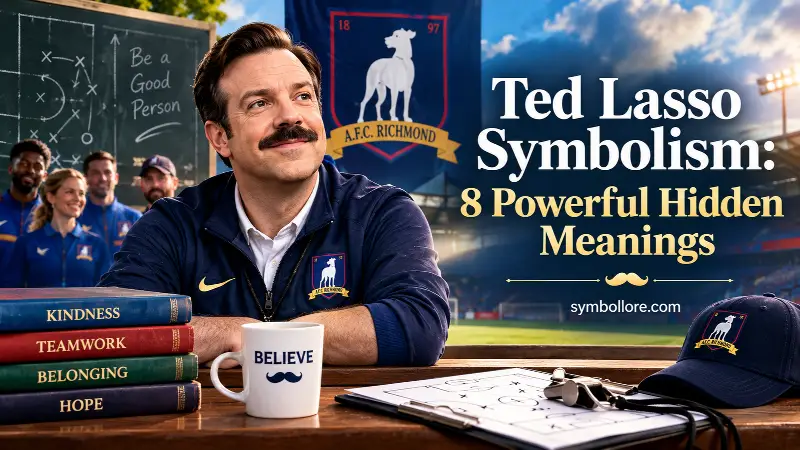
A yellow BELIEVE sign, a pink box of biscuits, and a tiny plastic soldier might seem like simple props. Yet in Ted Lasso, these objects reveal deeper ideas about hope, kindness, trust, and healing.
The comedy-drama follows an American football coach who takes charge of an English soccer team despite having little experience with the sport. His unusual approach gradually influences the people around him.
Ted Lasso symbolism gives ordinary objects and repeated actions emotional meaning. From the team’s famous sign to a broken object repaired with gold, these details help explain the show’s most important messages about human connection and personal growth.
Quick Answer
Ted Lasso symbolism centers on hope, kindness, forgiveness, and emotional resilience. The yellow BELIEVE sign represents faith and teamwork. Ted’s homemade biscuits symbolize care and trust, while the goldfish metaphor encourages players to move beyond mistakes. Other symbols, including green army men, red strings, and the repaired sign, explore protection, connection, and personal healing.
Key Takeaways
- The BELIEVE sign represents the team’s developing confidence and shared values.
- Homemade biscuits show how small acts of kindness can build trust.
- Green army men highlight support but also reveal how symbols vary across cultures.
- The repaired sign and kintsugi imagery suggest that damage does not prevent growth.
- The show’s strongest symbols gain meaning as characters change.
What Is Ted Lasso Symbolism?
Symbolism in Ted Lasso occurs when an object, action, image, or recurring idea represents something larger than its literal purpose.
The series uses ordinary items instead of relying only on dramatic visual effects.
A handmade sign becomes a reminder of hope. A box of biscuits creates a connection between two people. A small toy suggests that someone cares about another person’s safety.
These symbols work because viewers see them during important emotional moments.
At first, the characters often misunderstand Ted’s approach. His cheerful attitude appears strange in a competitive sports environment.
Over time, however, his actions begin to influence relationships within AFC Richmond.
The show’s symbols help communicate these changes.
They also reveal that kindness and optimism are not always simple. Ted struggles with anxiety, grief, and separation from his family despite the confidence he shows others.
As a result, the recurring objects carry both hopeful and complicated meanings.
Meaning and Importance of Symbolism in Ted Lasso
The symbolism in Ted Lasso supports the idea that people can grow through trust, support, and accountability.
Ted rarely teaches only through formal speeches.
Instead, he creates routines, offers encouragement, and gives people small reminders that they matter.
These actions eventually become important parts of the team’s identity.
For example, the BELIEVE sign begins as a simple coaching message. Later, it becomes something the players protect and preserve.
That change matters because the team develops its own understanding of what belief means.
Similarly, Ted’s biscuits begin as an unusual gift to Rebecca. They gradually become part of a relationship built on greater honesty.
Symbolism also helps reveal the show’s emotional complexity.
The characters make mistakes, damage relationships, and sometimes struggle to forgive themselves.
The recurring objects remind viewers that personal growth rarely happens in one perfect moment.
Instead, it develops through repeated choices, difficult conversations, and acts of care.
Eight Important Symbols in Ted Lasso
| Symbol | Main Meaning | Related Theme |
|---|---|---|
| Yellow BELIEVE sign | Hope, faith, shared confidence | Teamwork |
| Homemade biscuits | Care, patience, trust | Friendship |
| Goldfish metaphor | Moving beyond mistakes | Resilience |
| Green army men | Protection and cultural perspective | Empathy |
| Repaired BELIEVE sign | Healing and second chances | Forgiveness |
| Red strings | Connection and shared responsibility | Team unity |
| AFC Richmond | Belonging and community | Collective identity |
| Darts game | Curiosity instead of judgment | Understanding others |
1. The Yellow BELIEVE Sign Symbolizes Hope and Teamwork
The BELIEVE sign is the show’s most recognizable symbol.
Ted hangs the handmade yellow sign above the coaches’ office door in AFC Richmond’s locker room.
Its message seems almost too simple.
How can one word help a struggling soccer team?
At first, some players see Ted’s approach as unrealistic. They are accustomed to judgment, pressure, and the expectation that winning matters above everything else.
Ted challenges that attitude.
For him, belief means trusting the possibility of improvement even when success seems unlikely.
However, the sign represents more than confidence about winning matches.
It encourages players to believe in themselves, their teammates, and their ability to become better people.
As the story progresses, the team begins to treat the sign as something meaningful.
Its value comes from their shared experiences rather than the paper itself.
The sign’s destruction during Nate’s conflict with Ted makes that meaning more complicated.
A symbol that once represented unity becomes connected to anger and damaged trust.
Yet the message survives.
Central meaning: The BELIEVE sign represents hope that grows stronger when people turn encouragement into action.
2. Homemade Biscuits Symbolize Kindness and Trust
Ted regularly brings homemade biscuits to Rebecca Welton, the club’s owner.
He calls the routine Biscuits with the Boss.
At the beginning, Rebecca is suspicious of Ted’s friendly behavior.
She has her own reasons for bringing him to Richmond, and his kindness does not immediately change her plans.
Ted continues bringing biscuits anyway.
The small pink box becomes part of their daily routine.
Symbolically, the biscuits represent care, patience, and the steady development of trust.
Ted does not begin by demanding Rebecca’s friendship.
Instead, he offers a thoughtful gesture without expecting an immediate reward.
Over time, their relationship changes.
Rebecca becomes more open, and Ted learns about her struggles.
However, the biscuits do not suggest that kindness instantly solves every problem.
Their significance comes from consistency.
A simple action repeated with genuine care can help create emotional safety.
Central meaning: The biscuits symbolize the gradual power of kindness and the value of building trust through everyday actions.
3. The Goldfish Metaphor Symbolizes Resilience
Ted encourages his players to behave like goldfish when they make mistakes.
He uses the popular idea that goldfish have extremely short memories.
The statement functions as a motivational metaphor, not an accurate scientific claim about fish memory.
Its message is straightforward.
An athlete who makes one mistake should not allow that failure to control the entire match.
For example, a missed opportunity can make a player nervous.
That anxiety may lead to another mistake.
Ted wants his players to interrupt this pattern.
Instead of replaying the failure endlessly, they should focus on their next decision.
The goldfish therefore represents resilience and the ability to move forward.
However, this lesson has limits.
People still need to recognize mistakes, accept responsibility, and learn from their experiences.
Ted’s message is not that consequences should disappear.
Rather, it suggests that people can acknowledge a mistake without allowing it to define them forever.
Central meaning: The goldfish metaphor represents recovering from setbacks and refusing to let one failure control future choices.
4. Green Army Men Symbolize Protection and Different Perspectives
Ted sometimes gives people small green plastic army figures.
The toys originally connect to his son, Henry, and the idea of keeping someone safe.
For Ted, they represent comfort, protection, and the feeling that someone is looking out for another person.
Giving a toy soldier becomes a personal gesture of care.
However, the series complicates this meaning through Sam Obisanya.
Sam, who is Nigerian, explains that he does not associate the American military with the same positive ideas Ted does.
This moment is important.
It shows that symbols do not carry identical meanings for everyone.
An object that represents safety to one person may represent military power or painful history to another.
Ted accepts Sam’s perspective instead of insisting that his own interpretation must be correct.
That response reflects one of the show’s larger ideas about empathy.
Understanding people requires listening to their experiences rather than assuming everyone sees the world in the same way.
Central meaning: The army men symbolize Ted’s wish to protect others while showing that cultural experience shapes symbolic meaning.
5. The Repaired BELIEVE Sign Symbolizes Healing and Forgiveness
The damaged BELIEVE sign returns as an especially powerful image in the Season 3 finale.
Nate previously tears the sign apart during his conflict with Ted.
His action represents anger, betrayal, and the breakdown of a relationship that once gave him confidence.
Later, the team’s players reveal that they have kept pieces of the sign.
Their decision shows how deeply Ted’s message has affected them.
The pieces belong to different people, yet they can come together again.
This makes the sign a visual expression of collective unity.
Nate eventually repairs it using gold-colored material that recalls kintsugi, a Japanese art associated with repairing broken pottery while emphasizing its cracks.
Instead of pretending the damage never happened, the repaired object displays evidence of what it has experienced.
This connects directly to Nate’s character development.
He cannot erase his earlier behavior, but he can acknowledge his mistakes and work toward repairing damaged relationships.
The sign is no longer perfect in its original form.
Its imperfections become part of its history.
Central meaning: The repaired BELIEVE sign represents forgiveness, accountability, and the possibility of becoming stronger after experiencing damage.
6. Red Strings Symbolize Connection and Teamwork
In Season 3, Ted introduces an unusual training exercise involving red strings.
He explains a Japanese belief about invisible red strings connecting people who are destined to meet.
Roy turns that idea into a deliberately uncomfortable physical exercise for the players.
The scene is primarily comedic, but it also supports the team’s developing approach to soccer.
The strings force players to remain aware of their teammates’ movements.
Nobody can behave as though they are playing alone.
This creates a physical demonstration of shared responsibility.
The exercise also connects to Richmond’s attempt to understand Total Football, a playing approach that depends on movement, awareness, and cooperation.
The scene should not be treated as an accurate representation of a traditional Japanese ritual. It is a comic adaptation of a cultural idea.
Its symbolic purpose within the story is clearer.
Players must recognize how their actions affect everyone around them.
Central meaning: The red strings symbolize the connections that make teamwork possible and the responsibility individuals have toward one another.
7. AFC Richmond Symbolizes Belonging and Community
AFC Richmond is more than the soccer club where the story takes place.
It serves as the central community through which the characters form relationships and change.
At the beginning, several people within the organization are divided.
Some players focus on personal success. Others struggle with insecurity, mistrust, or disappointment.
Ted’s approach gradually helps them develop stronger relationships.
The club becomes a place where people learn to support one another.
This does not mean everyone agrees all the time.
Characters argue, compete, and make harmful decisions.
However, the team increasingly demonstrates that belonging involves more than winning matches.
It also requires honesty, respect, and the willingness to help others improve.
The locker room is especially important.
It is where the BELIEVE sign hangs and where many important conversations occur.
The shared space becomes associated with trust and a developing sense of family.
Central meaning: AFC Richmond symbolizes community built through mutual care, shared effort, and acceptance of different personalities.
8. The Darts Game Symbolizes Curiosity Over Judgment
One of Ted’s most memorable scenes takes place during a darts game against Rupert Mannion.
Rupert assumes he understands Ted.
He sees an inexperienced American soccer coach and expects an easy victory.
However, Ted reveals that he has substantial experience playing darts.
The scene turns Rupert’s assumptions against him.
Ted explains that people have often underestimated him because they judged his appearance or personality without asking meaningful questions.
The darts game becomes a demonstration of curiosity versus judgment.
Rupert believes he already knows Ted’s abilities.
Ted understands that someone who asked about his experience might have reached a different conclusion.
The game represents the danger of making decisions based on incomplete information.
It also reflects Ted’s approach to coaching.
He tries to understand the people around him before deciding what they need.
Central meaning: The darts game symbolizes the value of curiosity, humility, and looking beyond first impressions.
How Symbolism Reveals Character Development in Ted Lasso
The show’s recurring symbols become more meaningful when viewed alongside changes in its characters.
Ted begins as an outsider who introduces unfamiliar methods to AFC Richmond.
His homemade sign and unusual routines initially seem strange.
As the characters develop, however, those same details begin to represent shared experiences.
Rebecca’s relationship with the biscuits changes as her trust in Ted grows.
Nate’s relationship with the BELIEVE sign changes as he struggles with ambition, resentment, guilt, and reconciliation.
The team also develops a deeper connection to Ted’s message.
By the end of Season 3, the sign no longer belongs only to its creator.
It belongs to the people who have chosen to preserve its meaning.
This change suggests an important difference between receiving advice and truly understanding it.
The players no longer need Ted to explain belief every time they face difficulty.
They have begun incorporating its message into their own behavior.
Symbolism vs. Motifs and Themes in Ted Lasso
Symbols, motifs, and themes are connected, but they have different functions.
| Literary Element | Definition | Ted Lasso Example |
|---|---|---|
| Symbol | An object or image representing a larger idea | The BELIEVE sign represents hope |
| Motif | An element that repeats throughout a story | Ted repeatedly brings Rebecca biscuits |
| Metaphor | A comparison used to explain an idea | The goldfish represents moving beyond mistakes |
| Theme | A central message or subject | Trust can help people grow |
| Visual callback | A detail returning to an earlier scene | The repaired BELIEVE sign recalls its destruction |
The BELIEVE sign works as both a symbol and a recurring motif.
It represents hope, but its repeated appearances also connect different parts of the story.
Its meaning develops over time.
This is why recurring objects can become more emotionally powerful than isolated images.
They carry the memory of what characters have experienced.
Common Misconceptions About Ted Lasso Symbolism
The BELIEVE Sign Guarantees Success
The sign does not promise that Richmond will win every match.
Its message concerns confidence, collective effort, and the willingness to continue despite setbacks.
The team’s development includes defeats and disappointment.
Belief matters because it influences how people respond to those experiences.
Ted’s Positivity Means He Never Struggles
Ted frequently appears cheerful, but his optimism does not protect him from emotional pain.
The series explores his anxiety, personal losses, and difficulty expressing certain feelings.
His character demonstrates that someone can encourage others while struggling privately.
Every Object Has One Universal Meaning
Symbols can have different meanings depending on personal and cultural experience.
The green army men provide a clear example.
Ted associates them with protection, while Sam brings a different perspective shaped by his background.
Forgiveness Erases Earlier Mistakes
Nate’s reconciliation does not mean his earlier actions never mattered.
The repaired BELIEVE sign makes that distinction visible.
The damage remains part of the object’s history, just as personal mistakes remain part of a character’s experience.
Forgiveness can create opportunities for change without eliminating accountability.
Important Insights About the Show’s Symbolism
One of the most effective storytelling choices in Ted Lasso is the way simple objects gain emotional value through repetition.
The BELIEVE sign does not begin as an expensive or impressive object.
It is handmade and visually ordinary.
Yet it becomes meaningful because the players associate it with experiences that change their lives.
The show also demonstrates how the meaning of an object can evolve.
Early in the story, the sign reflects Ted’s personal philosophy. Later, it represents something shared by the whole team.
The final repair adds another layer: hope can survive disagreement and damage.
The biscuits follow a similar pattern.
What begins as an unusual gift gradually becomes part of a trusted relationship.
Another important insight is that the show’s symbols are not always universally positive.
The toy soldiers show how one person’s comforting gesture can carry a different meaning for someone else.
This complexity strengthens the series.
It suggests that genuine kindness requires more than good intentions. People must also listen to how others experience their actions.
People Also Ask
What does the BELIEVE sign mean in Ted Lasso?
The BELIEVE sign represents hope, trust, and shared confidence. Its meaning grows as Richmond’s players begin applying Ted’s philosophy to their relationships and performances. The damaged and repaired sign later adds themes of forgiveness and healing.
Why does Ted Lasso give Rebecca biscuits?
Ted brings Rebecca homemade biscuits as a friendly daily gesture. The routine gradually helps build trust between them. Symbolically, the biscuits represent patience, kindness, and the importance of caring actions.
What does the goldfish represent in Ted Lasso?
The goldfish represents the ability to move beyond mistakes. Ted uses it to encourage players not to remain trapped by disappointment. The lesson is about recovering emotionally rather than forgetting responsibility.
What does kintsugi mean in Ted Lasso?
Kintsugi is a Japanese repair tradition that highlights cracks in broken pottery. In Ted Lasso, similar imagery appears when Nate repairs the BELIEVE sign. It suggests that damage, forgiveness, and repair can become part of personal growth.
Frequently Asked Questions
The yellow BELIEVE sign is the series’ most recognizable symbol. It represents hope, trust, and faith in collective improvement. Its importance increases as the team develops stronger relationships. The sign’s later destruction and repair also connect it to forgiveness and resilience.
The green army men represent Ted’s desire to protect and support people he cares about. However, Sam’s response shows that military imagery does not carry the same associations for everyone. The toys therefore highlight both caring intentions and the importance of cultural understanding.
Nate tears the sign during a period of resentment and conflict with Ted. His action reflects damaged trust and his growing anger. The moment becomes especially meaningful when he later takes part in repairing the sign, connecting the object to accountability and reconciliation.
The red strings symbolize connection and shared responsibility. Although the exercise is intentionally absurd, it forces players to pay attention to one another. The scene supports Richmond’s developing understanding of teamwork and coordinated movement.
Color contributes to the show’s visual identity, especially through Richmond’s blue-and-red colors and the yellow BELIEVE sign. Yellow may suggest warmth and optimism in the sign’s context. However, individual colors should not be assigned fixed meanings without evidence from the story.
The darts scene emphasizes the value of curiosity over premature judgment. Rupert underestimates Ted because he assumes he knows his abilities. Ted’s unexpected skill exposes that mistake. The scene encourages viewers to ask questions and understand people before making conclusions about them.
The recurring symbols suggest that meaningful growth comes through trust, compassion, cooperation, and accountability. They also show that mistakes and painful experiences do not have to define a person’s entire future. Relationships become stronger when people remain willing to listen, learn, and repair harm.
Conclusion
Ted Lasso symbolism turns simple objects and memorable moments into meaningful storytelling devices.
The yellow BELIEVE sign represents hope. Homemade biscuits reflect kindness and trust. Green army men highlight protection and cultural perspective, while the repaired sign demonstrates the possibility of healing.
Together, these details reinforce the series’ central message: people become stronger through connection, understanding, and the willingness to keep growing.
The most powerful symbols in Ted Lasso do not suggest that life is always easy. Instead, they show how hope can remain meaningful even when people experience mistakes, loss, and disappointment.